
North Macedonia School Route Passport
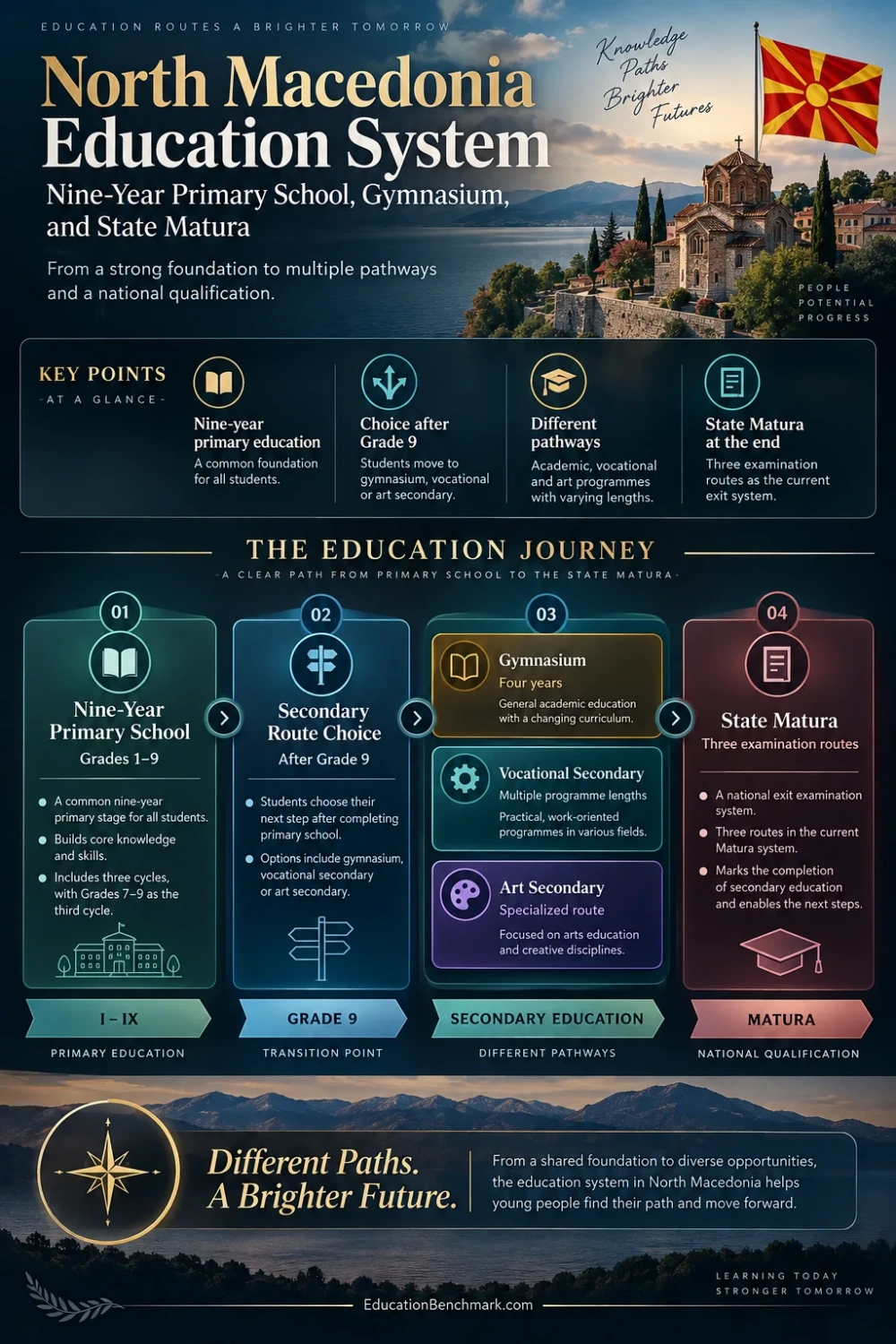
A route map from the nine-year primary stage to Grade 9 branching, the changing gymnasium curriculum, vocational options, and the current Matura routes.
Nine-Year Primary
Selected stamp: Nine-Year Primary. Choose another stamp to update the route card.
North Macedonia keeps Grades 1–9 inside a single primary stage. Primary education lasts nine years, is compulsory and free, and typically covers ages about 6 to 14 or 15. After Grade 9, students move into secondary education, where general gymnasium, vocational and art programmes form the main branches; gymnasium and art programmes are normally four years, while vocational programme length can differ. [a]
The route is easy to misread if national school names are replaced with international labels. North Macedonia calls all nine grades primary education, even though international classification treats the final part of that stage as lower secondary. That distinction matters when comparing school ages, grade labels and transition points across countries.
Nine-Year Primary School Is One Continuous Stage
The nine-year primary stage is divided into three three-grade periods: Grades 1–3, Grades 4–6 and Grades 7–9. UNESCO’s 2024 education-sector analysis also describes Grades 7–9 as the equivalent of lower-secondary education in ISCED terms, while they remain part of primary education in the national system. The same analysis records primary instruction in Macedonian, Albanian, Turkish, Serbian and Bosnian, and describes secondary education as part of compulsory schooling. [b]
Nine-year route
The Three Primary Cycles
The national label remains primary education across all three cycles, including Grades 7–9.
| Primary cycle | Grades | Role in the route |
|---|---|---|
| First cycle | 1–3 | Foundation years within the same nine-year primary school sequence. |
| Second cycle | 4–6 | Middle stage before the more subject-based final primary cycle. |
| Third cycle | 7–9 | Final primary stage; internationally comparable to lower secondary. |
What readers often confuse: seeing “lower secondary” in an international database does not mean a North Macedonian student has necessarily transferred to a separately named lower-secondary school after Grade 6. The national route still runs through Grade 9 as primary education.
Grades 7–9 Are Also in a Curriculum Transition
The final primary cycle is changing in a way that older descriptions may miss. The Ministry of Education and Science revised the primary-education concept so that History, Geography, Biology, Physics and Chemistry return as separate subjects in Grades 7–9. The change began to phase in from the 2025/26 school year and continues across successive grades, with the Bureau for Development of Education involved in preparing the revised programmes. [c]
This means a current Grade 7 or Grade 8 timetable should not be reconstructed from an older description of integrated subject areas. The applicable curriculum depends on the student’s grade and school year during the rollout.
Grade 9 Splits the Route Into Gymnasium, VET, and Art Education
Completion of Grade 9 is the main school-route branching point. Students do not enter one uniform type of secondary school. They apply to programmes with different purposes, curricula and exit examinations.
Grade 9 decision point
The Main Secondary Branches
The branches run in parallel; they should not be read as steps that every student completes in sequence.
A four-year general secondary programme with a broad academic curriculum and a State Matura route.
Programmes vary by profile and length, combining general subjects with occupation- or sector-focused learning.
Secondary arts programmes combine general education with specialized artistic study and their own Matura route.
Some programmes can add their own entry conditions or selection rules to the annual secondary admission process.
The balance of places also shows that vocational education is not a small side route. For the 2026/27 public-secondary admission cycle, the Ministry announced more than 25,000 places across 109 public schools: more than 17,000 in vocational education, almost 6,000 in gymnasium programmes and 570 in art education. These figures describe offered places, not final enrolment shares. [d]
Admission conditions can differ by school and programme. Annual competition notices matter because capacity, available profiles and special entry requirements can change from one cycle to the next.
Gymnasium Is Four Years, but the Curriculum Is Moving by Cohort
Gymnasium remains the four-year general academic secondary route, but not every gymnasium grade is following the same curriculum during the present transition. The first-year curricula under the new model entered classroom use in the 2025/26 school year; the Bureau for Development of Education trained teachers who would implement those new Year I programmes. [e]
For 2026/27, the Bureau published the new Year II gymnasium programmes. The list includes the relevant language-and-literature programmes, English and other foreign languages, Mathematics, Physics, Chemistry, Biology, Geography, History, Sociology, Music, Art and Sport. [f]
Cohort transition
Why Two Students in the Same Gymnasium Can Face Different Rules
The new model is moving through the grades by cohort. A Year I or Year II student in 2026/27 can therefore be on the new curriculum while an older student remains under an earlier arrangement.
This cohort distinction is more useful than treating “the gymnasium curriculum” as one static timetable. It also prevents later-stage elective rules from being presented as if every current Year III or Year IV student were already studying under them.
The New Gymnasium Model Changes Years III and IV
The adopted gymnasium concept keeps a broad common academic base. Language and literature, Mathematics, English, a second foreign language and Sport run through all four years, while subjects such as History, Geography, Biology, Chemistry, Physics, Informatics, Sociology, Philosophy, Music and Art appear for specified parts of the four-year programme.
Two-Year Elective Blocks
Under the new model, students in Years III and IV are designed to choose one subject from each of three two-year elective blocks. These are not three fixed “science,” “humanities” or “social science” tracks. The choices cross traditional track boundaries.
| Elective block | Years III–IV choice | What the pairing does |
|---|---|---|
| Block 1 | Biology or Geography | Pairs a life-science option with a geographic option. |
| Block 2 | Chemistry or Logic and Ethics | Pairs a laboratory science with a reasoning-and-ethics option. |
| Block 3 | Physics or Psychology | Pairs a physical-science option with a behavioural-science option. |
One-Year Choices, Free-Choice Subjects, and Community Service
The same concept adds one-year elective pairs. In Year III, students choose between Programming and Sociology, and between Economics and Latin Language and Classical Culture. In Year IV, the pairs are Advanced Mathematics or Law, and Business and Entrepreneurship or History. It also provides for two free-choice subjects in each school year, one per semester, and 36 hours of community service per year.
State Matura and School Matura Are Not the Same Exit
The gymnasium concept distinguishes two different completion purposes. State Matura is described as the route for students continuing into higher education, while School Matura is the gymnasium-completion route for students who do not continue through that university-entry path. The concept leaves detailed subject selection, assessment and examination rules to the separate Matura examination model. [g]
The distinction matters during the curriculum rollout: the published design for Years III and IV describes where the system is going, but students should use the rules for their own cohort rather than assume every element is already active in every grade.
State Matura, State Vocational Matura, and State Art Matura
The end-of-secondary examination system changed for the 2025/26 cycle. The Ministry had announced that separate state-level Matura routes would apply to gymnasium, vocational and art education rather than treating all four-year secondary students under one undifferentiated state examination route. [h]
Secondary exit exams
Three State-Level Matura Routes
The applicable exam route follows the type of four-year secondary programme completed by the student.
The academic state examination route associated with gymnasium completion and higher-education progression.
The state examination route created for the relevant four-year vocational secondary programmes.
The state examination route assigned to students completing the relevant four-year art secondary programmes.
The State Examination Centre’s 2026 call for external assessors confirms all three examination types in the 2025/26 cycle. Its external-assessment subject pool covered language and literature in Macedonian, Albanian, Turkish and Serbian; English, French, German, Russian and Italian; Mathematics; and History. The exact combination available to a candidate depends on the applicable Matura type and examination rules rather than one universal menu for every student. [i]
A Matura result and university admission are related but not identical. Meeting the relevant secondary-school exit requirement does not guarantee entry to every degree programme. Universities and faculties can publish programme-level conditions, so applicants need the rules for the institution and study programme they are actually applying to.
PISA 2025 Adds a Current Learning-Outcome Reference
PISA does not describe the legal school route or determine a student’s qualification. It provides a separate international reference point for the performance of 15-year-old students in mathematics, reading and science. The latest OECD country note for North Macedonia is PISA 2025.
PISA 2025
Students Reaching at Least Level 2
Percentages show the share of students reaching Level 2 or above in each PISA domain.
North Macedonia; OECD average: 65%.
North Macedonia; OECD average: 69%.
North Macedonia; OECD average: 74%.
The OECD reports that North Macedonia scored below the OECD average in all three domains. Compared with 2022, mathematics performance was lower in 2025, while reading and science were about the same. [j]
These results should be read as an outcome measure, not as a replacement for the route information above. PISA does not tell a family which curriculum a Grade 8 student follows, which Matura applies to a vocational student, or whether a university will admit an applicant.
Where Current Rules Need to Be Checked
North Macedonia is in the middle of curriculum and examination changes, so the student’s school year, grade, secondary programme and examination cycle can affect the answer to a practical question. A published concept can describe a later stage of a phased rollout before that stage has reached every current cohort.
For decisions that affect enrolment or qualifications, the relevant official source should be checked for the applicable year: the annual secondary-school admission competition, the current curriculum programme, the State Examination Centre’s Matura materials, and the target university or faculty’s admission rules. School-level implementation can also differ where a programme or subject is not offered in every institution.
Education Benchmark is an independent informational guide and is not affiliated with any ministry of education, school authority, exam board, university, government agency, or official ranking organization. The purpose here is to explain the education route clearly, not to act as an admissions service or an official decision source.
Sources and Verification
- [a] Archive – State Statistical Office of the Republic of Macedonia — Used for the nine-year primary stage, typical ages, school forms and secondary-route duration context. (Reliable because it is the official national statistical office methodology page.)
- [b] Education Sector Analysis: North Macedonia — Used for the three primary cycles, international level equivalence, languages of instruction and compulsory-schooling context. (Reliable because it is a 2024 UNESCO IIEP education-sector analysis.)
- [c] Ministry: Updated Concept for Primary Education — Used for the Grades 7–9 subject changes and phased primary-curriculum rollout. (Reliable because it is an official Ministry of Education and Science notice.)
- [d] Secondary School Admission Competition Published for 2026/2027 — Used for current public-secondary capacity by vocational, gymnasium and art routes. (Reliable because it is the official ministry notice for the 2026/27 admission cycle.)
- [e] Teacher Training for the New First-Year Gymnasium Curricula, 2025/2026 — Used to verify that the new Year I gymnasium curricula entered implementation in 2025/26. (Reliable because it is published by the Bureau for Development of Education.)
- [f] Second-Year Gymnasium Curricula for 2026/2027 — Used for the current Year II gymnasium rollout and subject list. (Reliable because it is an official Bureau for Development of Education curriculum page.)
- [g] Concept for Gymnasium Education — Used for the common gymnasium subjects, Years III–IV elective blocks, free-choice subjects, community service, and the State Matura versus School Matura distinction. (Reliable because it is the official gymnasium concept published by the Bureau for Development of Education.)
- [h] State Matura Began with the Mother-Tongue Exam — Used for the announced transition to separate state Matura routes for gymnasium, vocational and art education from 2025/26. (Reliable because it is an official Ministry of Education and Science notice.)
- [i] Public Call for Assessors for the 2025/2026 External Matura Exams — Used to confirm the three state Matura types operating in 2025/26 and the external subject pool. (Reliable because it is an official State Examination Centre document.)
- [j] PISA 2025 Results (Volume I): North Macedonia — Used for PISA 2025 Level 2 attainment rates, OECD-average comparisons and change from 2022. (Reliable because it is the OECD country note for the latest PISA cycle.)