
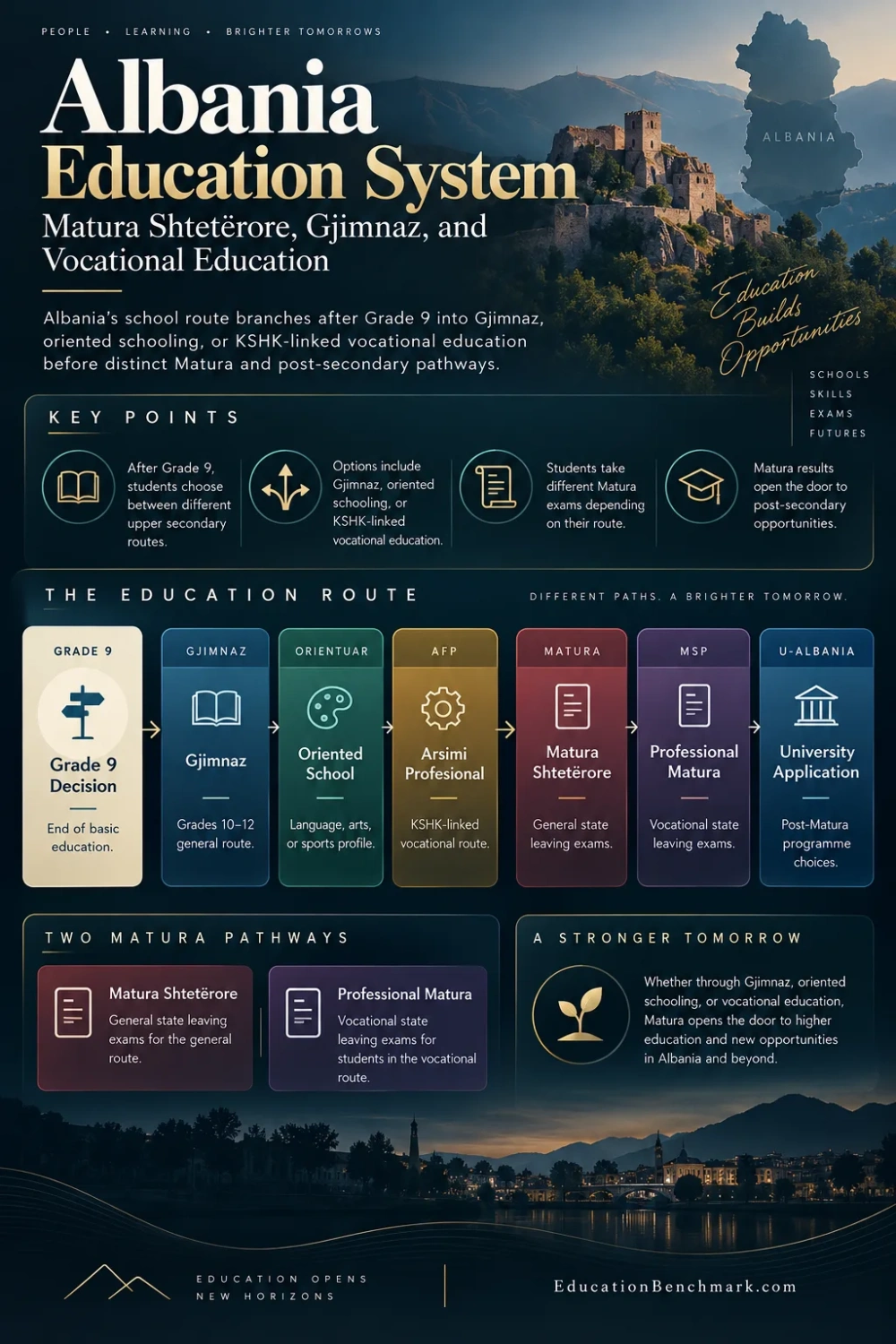
Albania: From Grade 9 to Matura
Albania’s school route branches after Grade 9 into Gjimnaz, oriented schooling, or KSHK-linked vocational education before distinct Matura and post-secondary pathways.
Grade 9 Decision
Selected stamp: Grade 9 Decision. Choose another stamp to update the route card.
Albania’s education system is easiest to understand by looking at what happens after the common basic-school route. Students normally complete nine years of compulsory basic education, divided into five years of primary education and four years of lower secondary education. Upper secondary is then a separate, non-compulsory stage: the standard general route is the three-year Gjimnaz, while vocational and specialised oriented programmes run alongside it. The usual age mapping places Grades 1–9 at about ages 6–14 and Grades 10–12 at about ages 15–17.[a]
That branching point matters more than a simple list of school levels. A Gjimnaz student and a vocational student can both reach a national Matura stage, but their programmes and final examination routes are not identical. Albania also distinguishes specialised upper-secondary provision, including foreign-language, artistic, and sports profiles. Understanding those differences prevents Matura Shtetërore, vocational qualifications, and university admission from being collapsed into one process.
The first major split
The Grade 9 Decision: Gjimnaz, Oriented School, or Arsimi Profesional
Grade 9 closes the common basic-education cycle. The next stage is not one uniform type of secondary school.
A three-year general upper-secondary programme covering Grades 10–12, with core learning and a growing elective component.
Foreign-language, artistic, sports, and related profiles use specialised programmes alongside required general education.
Vocational education combines general studies with occupational theory and practical training linked to formal qualification levels.
The distinction is visible in the examination system itself. Qendra e Shërbimeve Arsimore (QSHA), Albania’s educational services and examination body, publishes separate 2026 Matura orientation programmes for standard Gjimnaz, foreign-language schools, sports schools, artistic schools, and professional education in subjects where the test programme differs.[b]
Terminology note: Albania’s Gjimnaz should not be assumed to be identical to the German Gymnasium simply because the words are related. In the Albanian system, the term identifies the mainstream general upper-secondary route after basic education.
Before the upper-secondary split
Albania’s 5+4 Basic Education Before the Split
The age bands below are the standard grade-age mapping, not a guarantee that every student will be the same age in a given grade.
| Stage | Grades | Typical ages | Status | What follows |
|---|---|---|---|---|
| Primary cycle | 1–5 | About 6–10 | Part of compulsory basic education | Lower secondary |
| Lower secondary cycle | 6–9 | About 11–14 | Part of compulsory basic education | Upper-secondary route choice |
| Gjimnaz | 10–12 | About 15–17 | Non-compulsory upper secondary | Matura Shtetërore and possible higher education |
| Vocational upper secondary | Programme-dependent | After Grade 9 | Non-compulsory vocational route | Qualification progression, employment, or Professional Matura |
One point is easy to misread in English: basic education does not mean primary school alone. In Albania it includes both the five-year primary cycle and the four-year lower-secondary cycle. A separate 2026 cross-country compulsory-education dataset likewise records Albania with an official school-entry age of 6 and nine compulsory years.[c]
Inside the Gjimnaz: Core Learning, Electives, and the 2026–27 Transition
The Gjimnaz is not simply three identical years of broad academic study. Albania’s updated upper-secondary framework divides the curriculum into a core curriculum, an elective curriculum, and a school-based curriculum. The core is common and compulsory within the framework, while students choose from an approved menu of elective subjects or modules. Once selected, an elective carries the same compulsory status for that student as a core subject.
The balance also changes across the three years. In the updated framework, elective curriculum is designed to take a much larger share of learning time in Grade 12 than in Grades 10 or 11. The curriculum document allocates 6% of instructional time to electives in Grade 10, 9% in Grade 11, and 35% in Grade 12, allowing the final year to become considerably more differentiated by student interests and intended progression.
This framework is being introduced by cohort rather than replacing every upper-secondary grade at once. The approval order starts the updated core curriculum with Grade 10 in the 2026–27 school year, Grade 11 in 2027–28, and Grade 12 in 2028–29.[d] That distinction is important when comparing timetables across students in different grades during the transition period.
The curriculum covers the expected academic fields—Albanian language and literature, foreign languages, mathematics, natural sciences, social sciences, physical education, technology and ICT—with arts and other choices appearing through the relevant curriculum components. The final year therefore has a stronger connection between subject choice, Matura preparation, and the student’s next step.
Matura Shtetërore 2026: The General and Professional Exam Routes
Matura Shtetërore is a national upper-secondary examination system rather than one single test. For the 2026 first session, the general route consisted of four examinations: foreign language, Albanian language and literature, mathematics, and one elective subject. The Professional State Matura retained the first three areas but replaced the academic elective with integrated vocational theory linked to the candidate’s vocational qualification.
2026 Session I
The Four Examination Dates
These dates belong to the 2026 examination cycle and should not be treated as a permanent annual calendar.
| Date | State Matura | Professional State Matura |
|---|---|---|
| 2 June 2026 | Foreign language | Foreign language |
| 9 June 2026 | Albanian language and literature | Albanian language and literature |
| 16 June 2026 | Mathematics | Mathematics |
| 23 June 2026 | Elective subject | Integrated vocational theory |
The 2026 instruction set the examinations to begin at 10:00, allowed 150 minutes for each test, and set a maximum of 60 points per examination. It also assigned QSHA responsibility for preparing, administering, and evaluating the tests.[e]
What Can Appear as the Elective Examination?
The general elective pool for 2026 included subjects such as biology, chemistry, physics, history, geography, economics, citizenship and psychology, and philosophy and sociology. Specialised pathways also had relevant arts-oriented programmes, including art history, music history, and ballet history. QSHA’s published materials further show that mathematics, Albanian, and foreign-language test programmes are not necessarily identical across Gjimnaz, vocational, artistic, sports, and language-oriented routes.[f]
Foreign-language testing also needs to be read by programme rather than as a single nationwide level chosen freely by every candidate. QSHA publishes different language and level variants according to the applicable curriculum and school route.
Two leaving-exam routes
State Matura and Professional State Matura Compared
What readers often confuse: passing Matura is not the same as being automatically assigned a university place. The Matura stage and the higher-education application and admission stage are connected, but they are separate processes.
The 2+1+1 and 2+2 Logic in Albania’s Vocational Route
Vocational education is one of the most easily oversimplified parts of the Albanian system. It is not a single fixed-length “vocational high school” programme. Pre-university Arsimi Profesional is organised through the Korniza Shqiptare e Kualifikimeve (KSHK), the Albanian Qualifications Framework, with qualifications at Levels II, III, and IV after the compulsory basic-education stage. The framework is referenced to the European Qualifications Framework.
Qualification ladder
How KSHK Levels Build the Vocational Route
The structure allows staged qualifications rather than requiring every vocational student to follow one identical four-year programme.
Provides an initial vocational qualification associated with semi-skilled occupational preparation.
Builds toward qualified-worker status in the vocational field.
Leads to a higher vocational qualification associated with technician or manager preparation and the Professional State Matura route.
Approved vocational schools may also offer one- or two-year Level V qualifications after secondary education.
The current public vocational-school guidance describes pre-university vocational education as beginning after nine-year compulsory education, lasting no more than four years through Levels II–IV, and allowing progression to a higher level in the same qualification or a related qualification field. A student may also leave toward employment after completing a qualification level. Progression should therefore not be read as unrestricted transfer into any unrelated vocational field.[g]
The abbreviations can also be confusing. AP is commonly used for Arsimi Profesional (vocational education), while AFP refers more broadly to Arsimi dhe Formimi Profesional—vocational education and training.
New Vocational Fields and the Dual VET Model
Albania’s vocational system is also being updated around newer technical and service-sector qualifications. A curriculum package approved for 2026–27 includes new or revised provision in areas such as software programming, website development, multimedia, mechatronics, e-commerce, construction, veterinary services, employment services, and social care. The reform links these qualifications to labour-market priorities and closer alignment with the European Qualifications Framework.[h]
Alongside school-based vocational education, Albania has been developing a dual VET pathway that combines education with structured workplace learning. The first implementation recorded in the national Youth Guarantee progress report was launched in 2024. That report documented the model in 10 VET schools across eight municipalities, covering reception, culinary arts, multimedia, auto-electrical services, hotel facilities management, and electrical installations, with 100 partner businesses involved.[i]
Those figures describe the reported implementation stage rather than a permanent ceiling on dual VET. School participation, partner employers, and occupational fields can expand or change as the model develops. What is structurally important is that workplace learning is becoming a defined vocational route rather than merely an informal addition to classroom study.
From Matura to U-Albania: Admission Is a Separate Step
Completing the relevant Matura route places a student at the end of upper secondary education; it does not collapse all university admissions into the Matura examination itself. Candidates seeking higher education must then follow the applicable application rules, programme criteria, ranking procedures, and registration timetable.
Post-Matura progression
The Admission Sequence After Upper Secondary
- Complete the relevant upper-secondary programme. This may be Gjimnaz, an oriented route, or an eligible vocational qualification.
- Complete the applicable Matura examinations. The precise exam route depends on the student’s programme.
- Check programme-specific admission conditions. Requirements can differ by institution, degree programme, and admission cycle.
- Apply through the announced higher-education process. U-Albania is used for programme selection in the national application process.
- Follow ranking and registration results. A Matura result does not itself guarantee admission to a particular programme.
For the 2026 admission cycle, the Ministry of Education opened U-Albania applications from 27 July to 1 August and allowed candidates to select up to 10 study programmes. That number and timetable belong specifically to the 2026 cycle and should not be treated as an unchanging rule for future applicants.[j]
Where Albania’s Education Rules Can Vary
Several parts of the system are stable enough to describe structurally but still require year-specific checking. The nine-year basic cycle and the distinction between general, oriented, and vocational upper-secondary education form the broad route. By contrast, Matura dates, approved test programmes, elective papers, language levels, vocational qualifications, dual-programme availability, university application windows, and programme admission criteria can change.
Age bands also need context. Ages such as 6–10 for primary school or 15–17 for three-year upper secondary are standard grade-age mappings. Individual students may be older or younger because of enrolment timing, repetition, interruption, transfer, or another permitted circumstance. Similarly, a vocational programme should be identified by its KSHK level and qualification structure rather than by assuming that every student spends exactly four years in vocational upper secondary.
Curriculum transition adds another reason to check the student’s cohort. The revised upper-secondary core curriculum begins with Grade 10 in 2026–27 and then reaches the later grades in subsequent school years, so two students in the same school can temporarily be studying under different curriculum versions.
Education Benchmark is an independent informational guide and is not affiliated with any ministry of education, school authority, exam board, university, government agency, or official ranking organization. For a decision involving a current examination, qualification, school placement, or university application, the relevant Albanian authority, school, vocational provider, or higher-education institution should be checked for the rules applying to that specific year and programme.
Sources and Verification
- [a] Children and Youth in Albania: Census 2023 – Thematic Insights Report — Used for Albania’s school levels, grade structure, standard age mapping, compulsory basic education, and the parallel upper-secondary routes. (Reliable because it is an official INSTAT thematic report prepared with UNICEF technical assistance.)
- [b] Matura Shtetërore 2026 Orientation Programmes — Used to verify separate examination programmes for Gjimnaz, language-oriented, artistic, sports, and professional education. (Reliable because QSHA is Albania’s official educational services and examination authority.)
- [c] Compulsory Education Worldwide (2026): Years, Ages, and Enforcement by Country — Used as a cross-country check for Albania’s official entrance age and nine-year compulsory-education duration. (Useful as a structured comparative education reference that documents its indicator basis.)
- [d] Order No. 552 Approving the Core Curriculum for Upper Secondary Education — Used for the updated Gjimnaz curriculum structure, elective share, and staged introduction in Grades 10–12. (Reliable because it is the official approved upper-secondary curriculum document published by ASCAP.)
- [e] Instruction on the Organization and Conduct of the State Matura and Professional State Matura Exams, 2026 — Used for the four-exam structure, 2026 examination calendar, test duration, maximum points, and the integrated vocational theory examination. (Reliable because it is the official instruction governing the 2026 Matura cycle.)
- [f] Matura Shtetërore 2026 – QSHA — Used for the published elective-subject assessment schemes and route-specific mathematics and language test materials. (Reliable because it is QSHA’s official 2026 Matura information page.)
- [g] Guide for Public Vocational Schools, 2025–2026 — Used for KSHK Levels II–V, the 2+1+1 and 2+2 structures, Professional State Matura progression, and vocational transfer rules. (Reliable because it is official guidance from Albania’s national vocational education, training, and qualifications agency.)
- [h] Revision and Approval of Vocational Education and Training Curricula in Line with the Smart Specialisation Strategy – Measure 2.1.1 — Used for the 2026–27 vocational curriculum package and examples of new or revised qualification fields. (Reliable because it is published by Albania’s State Agency for Strategic Programming and Aid Coordination.)
- [i] Youth Guarantee Implementation Plan 2023–2025 Albania – Progress Report 2024 — Used for the launch and documented early implementation of Albania’s dual VET pathway, including schools, municipalities, fields, and partner businesses. (Reliable because it is an official government implementation progress report.)
- [j] Online Applications Open in U-Albania: Up to 10 University Programme Preferences — Used for the 2026 U-Albania application window and the limit of up to 10 programme preferences in that admission cycle. (Reliable because it is an official Ministry of Education announcement describing the 2026 application process.)