Romania’s Gimnaziu-to-Bac School Route
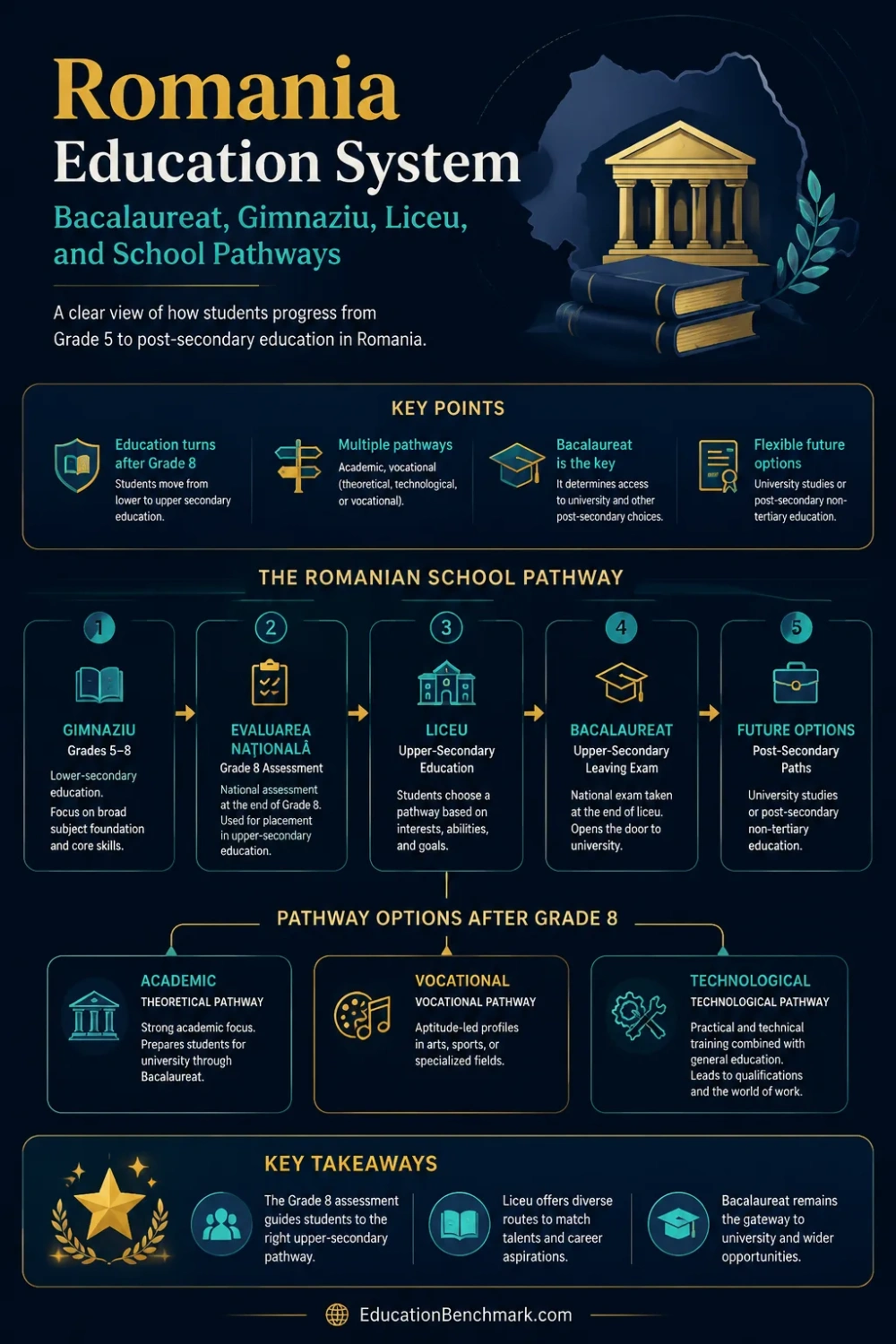
The Romanian route turns sharply after Grade 8, then branches across liceu tracks before the Bacalaureat separates university access from other post-secondary options.
Gimnaziu
Selected stamp: Gimnaziu. Choose another stamp to update the route card.
Romania’s school system is best understood through its transition points rather than as a simple ladder of primary school, secondary school and university. Gimnaziu ends with the Evaluarea Națională, Grade 9 placement opens several kinds of liceu, and the Bacalaureat later determines whether a graduate can enter the higher-education admission process. The routes can branch, but they do not always close off later study.
That distinction matters because several Romanian terms have no perfect one-word English equivalent. Gimnaziu is lower secondary school, not a sports facility. Liceu is upper-secondary education, but it contains different filiere, or broad pathways. The Bac is separate from simply finishing liceu.
From Clasa Pregătitoare to the End of Gimnaziu
Romania’s current general compulsory education spans 14 school grades or years. It includes the middle and senior preschool groups for children aged 4–6, primary education, lower secondary education and high-school education. Primary school lasts five years—Clasa Pregătitoare followed by Grades 1–4—while Gimnaziu covers Grades 5–8. Daytime liceu normally covers Grades 9–12; evening and part-time upper-secondary routes can extend through Grade 13. The national structure also distinguishes theoretical, vocational/aptitudinal and technological high-school pathways.[a]
Primary education is generally organised for children aged about 6–11.[b] Gimnaziu then normally covers students from roughly 11/12 to 14/15, although individual timing can differ.[c]
School progression
The Route Before Grade 9
Typical ages describe the normal progression. Entry timing, repetition, transfers and alternative forms of study can change an individual student’s age at a given grade.
| Romanian stage | Grades or years | Typical age or point | Next transition |
|---|---|---|---|
| Compulsory preschool groups | Middle and senior groups | About 4–6 | Clasa Pregătitoare |
| Învățământ primar | Preparatory Grade + Grades 1–4 | About 6–11 | Gimnaziu |
| Gimnaziu | Grades 5–8 | Generally 11/12–14/15 | Evaluarea Națională and liceu admission |
| Liceu | Usually Grades 9–12 in daytime study | Begins after Grade 8 placement | Completion, qualifications and possible Bacalaureat |
The term Gimnaziu deserves special attention because Grade 8 is where the ordinary school route meets a national selection process. Students are not merely moving into the next numbered grade; they are moving into an upper-secondary system with different profiles and specialisations.
From Gimnaziu to Liceu: How EN VIII Placement Works
During Gimnaziu, school assessment uses marks from 1 to 10, with 10 as the highest mark. At the end of Grade 8, students take the mandatory Evaluarea Națională. The national assessment includes Romanian Language and Literature and Mathematics, plus a mother-tongue paper in the circumstances defined for students educated in, or studying, a national minority language.[d]
For the 2026–27 state liceu admission cycle, the ordinary admission average is the general EN VIII average: the arithmetic mean of the grades obtained in the national assessment papers, calculated to two decimal places without rounding.[e] This makes EN VIII more than a record of Grade 8 achievement. Its result becomes part of the mechanism that assigns students to upper-secondary places.
Worked admission calculation
How a Two-Paper EN VIII Average Can Look
This calculation illustrates a candidate whose admission average is based on Romanian and Mathematics only.
The two grades are added and divided by two.
(8.70 + 9.20) ÷ 2 = 8.95.
The score alone does not name a liceu. Candidates complete ordered choices, and the state placement process matches candidates and available places through computerised allocation. The 2026 round illustrates the scale of this mechanism: on 22 July, 119,484 candidates were computer-allocated after submitting choices, and 62.01% of those candidates received their first option.[f]
Grade 8 transition
The EN VIII-to-Liceu Allocation Sequence
The Grade 8 national papers produce the results used to calculate the ordinary admission average.
The result becomes the numerical basis for the ordinary state liceu placement route.
Candidates rank schools and specialisations rather than receiving a school solely from the exam score.
The central process assigns places according to the admission rules, candidate position and submitted options.
The student then enters the relevant upper-secondary route, profile and specialisation.
Filiera Teoretică, Vocațională, and Tehnologică Are Different Purposes
Liceu is not one uniform academic route. Romania separates upper-secondary education into broad pathways. The theoretical route is academically oriented and includes science and humanities directions. The vocational/aptitudinal route covers specialised areas such as arts, sports, pedagogy, military and theological education. The technological route combines upper-secondary study with technical or occupational preparation.
Liceu route comparison
What the Three Filiere Mean in Practice
What readers often confuse
Vocațională and Tehnologică Are Not Interchangeable
Filiera vocațională is the specialised liceu pathway used for areas such as arts, sport or pedagogy. Filiera tehnologică is the route most directly associated with technical preparation, occupational qualifications and work-linked progression.
Within theoretical liceu, Romanian terminology also uses profile labels such as real for science-oriented study and umanist for humanities-oriented study. These distinctions matter later because Bacalaureat papers are partly related to a student’s profile and specialisation.
The 2026–27 Shift Inside Filiera Tehnologică
Romania is reorganising professional and technological education beginning with the 2026–27 school year. Under the announced model, the older separate professional-school route is folded into a broader technological pathway. A Level 3 qualification can be obtained on the technological route after Grade 11, with or without a dual format. Students can then enter employment or continue their liceu studies and preserve a route toward the Bacalaureat and later university eligibility.[g]
This makes the technological route easier to understand as a fork rather than an educational dead end. A student can reach an occupational qualification before completing the full Bac route, while another student on the same broad pathway can continue studying.
Technological progression
Where Grade 11 Can Lead on the Reorganised Route
Students combine general upper-secondary education with technological and occupational preparation.
The qualification can mark an employment entry point within the reorganised technological route.
Students may use the occupational qualification to move toward the labour market.
Students can remain in education and continue toward upper-secondary completion.
Students who continue and meet the applicable conditions can follow the Bac route toward higher education.
Dual education can sit inside this technological route. Its purpose is to connect formal study with practical training and employer participation rather than create a completely separate school level.
Bacalaureat: Competencies, Written Papers, and the 5-and-6 Rule
The Romanian Bacalaureat contains more than written subject papers. In the first 2026 session, the competency component covered oral communication in Romanian, oral communication in the mother tongue where applicable, competence in a modern foreign language and digital competence. These competency results are expressed as competence levels rather than ordinary numerical pass/fail grades, and participation in the competency assessments is one of the conditions for passing the Bacalaureat.[h]
The written side of the 2026 examination includes Romanian Language and Literature, a compulsory profile paper, an elective paper tied to the profile and specialisation, and a mother-tongue written paper where applicable. To pass, a candidate must have taken the required competency assessments and all written papers, obtain at least 5 in every written paper, and finish with an overall written-exam average of at least 6.[i]
Bac passing logic
Why the Overall Average Alone Is Not Enough
These worked results use three written papers and assume the candidate has completed the required competency assessments.
Every written grade is at least 5 and the overall written average is above 6.
The overall average is above 6, but one written paper is below the required minimum of 5.
The Bacalaureat is therefore both a school-leaving qualification process and a gate to another part of the education system. It should not be treated as synonymous with simply reaching the end of Grade 12.
After Liceu: University and Postliceal Routes Use Different Gates
Finishing high school and holding a diploma de bacalaureat are different outcomes. For higher education, the distinction is decisive: only high-school graduates holding a Bacalaureat diploma or an equivalent qualification can be admitted. Universities and other higher-education institutions establish their own admission methods within national rules. Selection can use the Bac average, marks from relevant high-school subjects, an institution-run entrance examination, or a combination defined by the institution.[j]
A Bac diploma therefore creates eligibility to apply; it does not guarantee a university place. Admission can still differ by university, faculty and programme.
Romania also has învățământ postliceal, or post-secondary non-tertiary education. This route is accessible to students who have completed high school with or without a Bacalaureat diploma.[k] That distinction prevents a common misunderstanding: not passing the Bac does not mean that every form of further education is closed, even though university admission remains Bac-dependent.
Two different post-school gates
Liceu Completion Does Not Create the Same Access as the Bac Diploma
University: requires the Bacalaureat or an accepted equivalent. Postliceal study: can admit high-school completers with or without the Bac, subject to the programme’s own conditions.
Why Gimnaziu, Filieră, Liceu, and Bac Do Not Translate Neatly
Romanian education terminology often carries more information than a literal English translation suggests. Keeping the original term beside a practical English meaning makes the student route easier to follow.
Romanian school terminology
Terms That Define the Student Route
The labels also explain why “academic versus vocational” is too simple a description of Romania. Filiera vocațională and filiera tehnologică are separate categories, while students within theoretical liceu can also follow different subject orientations. The route is better described as a set of branches connected by national assessment, qualifications and later admission gates.
What Changes for Students Starting Grade 9 in 2026–27
The Grade 9 cohort entering liceu in the 2026–27 school year is beginning under new high-school curricula. The Ministry reported that the new programmes take effect from Grade 9 in 2026–27, with textbook preparation, teacher training and national assessment standards following as parts of the curriculum reform process.[l]
That cohort is also tied to a future change in the Bacalaureat. The Ministry’s 2030 examination model is designed for students who begin Grade 9 in 2026 and complete liceu under the new curriculum plans. The planned examination is more differentiated by filieră, profile, specialisation and occupational qualification. It also changes parts of the language and written-paper structure compared with the Bac taken by current candidates.[m]
Current rules and future cohort
The 2026 Bac and the 2030 Bac Should Not Be Mixed
A candidate sitting the Bacalaureat in 2026 follows the current examination structure. The redesigned 2030 structure is intended for the cohort beginning Grade 9 under the new 2026–27 high-school curriculum.
Where Official Details May Vary
Romania has a nationally defined school structure, but an individual route still depends on the admission year, available liceu specialisations, language of instruction, programme-specific requirements and the institution involved. University admission methods are institution-specific, while national examination calendars and secondary admission procedures are issued for particular cycles.
For decisions about enrolment, examination eligibility, school placement, qualifications or university admission, the applicable Ministry documentation and the current rules of the relevant school, admission authority or higher-education institution should be checked directly.
Education Benchmark is an independent informational guide and is not affiliated with any ministry of education, school authority, exam board, university, government agency, or official ranking organization.
Sources and Verification
- [a] Romania — Overview — Used for compulsory education, primary and secondary grade structure, liceu pathways and the overall organisation of Romanian school education. (Reliable because Eurydice is the European Union’s national education systems information network.)
- [b] Organisation — Used for the typical age range associated with Romanian primary education. (Reliable because the page is part of the European Union’s Eurydice education information system.)
- [c] Organisation of general lower secondary education — Used for the Grade 5–8 structure and typical student ages in Gimnaziu. (Reliable because Eurydice documents national education structures for the European Union.)
- [d] Assessment in general lower secondary education — Used for Gimnaziu grading and the subjects included in the Grade 8 national assessment. (Reliable because it is the Romania assessment profile in the EU Eurydice system.)
- [e] Evaluarea Națională pentru absolvenții clasei a VIII-a (EN VIII 2026) începe luni, 22 iunie — Used for the 2026 definition and calculation of the ordinary liceu admission average based on EN VIII results. (Reliable because it is an official Romanian Ministry of Education and Research publication.)
- [f] Repartizarea computerizată în învăţământul liceal de stat a absolvenţilor clasei a VIII-a (an școlar 2026 – 2027): Informare sintetică — Used for the current computerised liceu allocation process and 2026 placement figures. (Reliable because it is an official Romanian Ministry of Education and Research publication.)
- [g] Învățământul profesional/tehnologic se reorganizează în România — Used for the 2026–27 technological education reorganisation, the Grade 11 Level 3 qualification point and continued-study route. (Reliable because it is an official Romanian Ministry of Education and Research publication.)
- [h] Examenul național de bacalaureat 2026 (prima sesiune) începe luni, 8 iunie, cu probele de evaluare a competențelor — Used for the Romanian, mother-tongue, foreign-language and digital competency components of the 2026 Bacalaureat. (Reliable because it is an official Romanian Ministry of Education and Research examination notice.)
- [i] Examenul național de bacalaureat 2026 (a doua sesiune): Informare privind desfășurarea probelor scrise (10 – 13 august) — Used for the current written-paper sequence and the minimum 5-per-paper plus 6-overall passing rule. (Reliable because it is an official Romanian Ministry of Education and Research examination notice.)
- [j] Higher education — Used for the Bacalaureat requirement for higher education and the institution-led university admission model. (Reliable because it is the Romania higher-education profile maintained through the EU Eurydice network.)
- [k] Organisation of the education system and of its structure — Used for access to post-secondary non-tertiary education after high school with or without a Bacalaureat diploma. (Reliable because it is part of the European Union’s Eurydice national education system documentation.)
- [l] Informare privind publicarea în Monitorul Oficial a ordinului de ministru care aprobă programele școlare pentru învățământul liceal — Used for the introduction of new high-school curricula from Grade 9 in the 2026–27 school year. (Reliable because it is an official Romanian Ministry of Education and Research publication.)
- [m] Bacalaureat diferențiat, din 2030, adaptat specializării și alegerii elevilor — Used to distinguish the current Bacalaureat from the differentiated 2030 examination planned for the cohort entering Grade 9 in 2026. (Reliable because it is an official Romanian Ministry of Education and Research publication.)