Italy’s Route From the First Cycle to Liceo, IeFP, and Tertiary Study
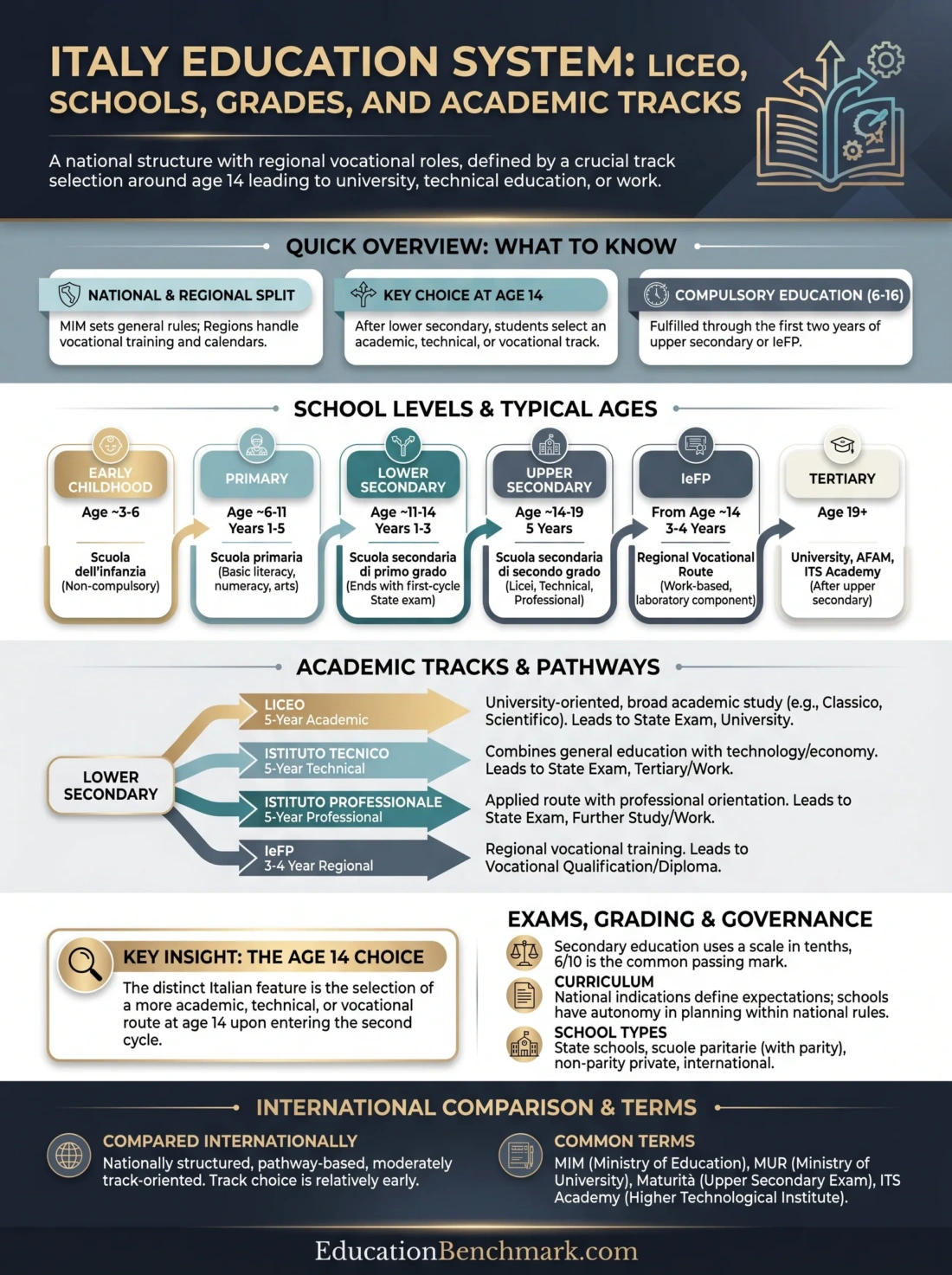
The main branching point comes after lower secondary school, when students choose among academically oriented, technical, professional, and regional training routes.
Primary and Lower Secondary
Selected stamp: Primary and Lower Secondary. Choose another stamp to update the route card.
Italy’s school system has a common first cycle followed by a pronounced choice of direction at about age fourteen. Primary and lower secondary pupils share a broad route, then upper secondary education separates into licei, technical institutes, professional institutes, and regional vocational education and training. The Ministry of Education and Merit sets the national structure, while regions and autonomous schools shape parts of delivery. [a]
Main decision point
The Choice at 14: Liceo, Technical Institute, Professional Institute, or IeFP
The first-cycle curriculum is broadly shared. Specialisation begins when students enter the second cycle.
A five-year general and subject-specialised route, usually chosen by students expecting to continue into tertiary education.
A five-year route combining general subjects with economic or technological fields, laboratories, and applied study.
A five-year State-school route organised around service, craft, production, and profession-linked learning profiles.
Three- and four-year vocational programmes governed by regions and delivered through accredited providers or participating schools.
Compulsory education runs for ten years, from age six to sixteen. This means that the first two years after the lower secondary choice remain within the compulsory span, whether the student attends a liceo, a technical or professional institute, or an eligible IeFP programme. [b] Italian law also uses the broader idea of a right and duty to education and training, normally continuing for at least twelve years or until a three-year vocational qualification is obtained by age eighteen. [c]
The choice at fourteen matters, but it is not an irreversible allocation. Transfers between upper secondary routes can occur. A receiving school may compare curricula, identify missing subjects, and require integration work or an examination. The practical ease of transfer depends on the year of study and the difference between programmes.
School sequence
School Stages From Scuola dell’Infanzia to the First-Cycle Exam
Ages are typical for students progressing on schedule; birth dates, early admission rules, repetition, and individual circumstances can shift them.
| Italian stage | Common English description | Typical age | Length and status | Route outcome |
|---|---|---|---|---|
| Nido d’infanzia | Early childhood service | About 0–3 | Non-compulsory; locally and regionally organised | May be followed by scuola dell’infanzia |
| Scuola dell’infanzia | Pre-primary school | About 3–6 | Three years; non-compulsory | Preparation for primary school |
| Scuola primaria | Primary school | About 6–11 | Five years; compulsory | Direct progression to lower secondary |
| Scuola secondaria di primo grado | Lower secondary school | About 11–14 | Three years; compulsory | Ends with the first-cycle State exam |
| Secondo ciclo | Upper secondary or regional vocational route | From about 14 | Five years in State upper secondary schools; usually three or four in IeFP | State diploma, vocational qualification, or vocational diploma |
Families often call lower secondary school scuola media, although the formal name is scuola secondaria di primo grado. Primary and lower secondary together make up the primo ciclo di istruzione. There is no separate national examination between primary and lower secondary; the formal completion point comes after the third year of lower secondary.
Academic-track map
Inside the Licei: What Each Academic Track Emphasizes
All licei retain general subjects, but the balance of languages, mathematics, sciences, arts, humanities, or social studies changes by track.
The Ministry describes licei, technical institutes, professional institutes, and regional IeFP as distinct upper secondary choices, each with its own study profiles. [d] A newer Liceo del Made in Italy entered the liceo system from the 2024/25 school year, with an economic, legal, and productive-systems orientation. It should be read as a recently introduced route whose local availability is still narrower than the established liceo families. [e]
A Liceo Track Does Not Formally Reserve One University Field
A student with a valid five-year upper secondary diploma can generally apply across university subject areas, subject to the rules of the chosen course. A liceo scientifico graduate is not formally restricted to science, and a liceo classico graduate is not restricted to humanities. Preparation still matters. Degree courses may test knowledge, set prerequisites, or use selective admission, so the subject mix of the school route can make some transitions easier than others.
Istituti Tecnici, Istituti Professionali, and Regional IeFP
Istituti Tecnici
Technical institutes are five-year State upper secondary schools. Their programmes sit in economic and technological sectors and combine general education with specialised subjects, laboratories, project work, and links to production or services. The route is applied, yet it remains a full upper secondary diploma route.
Istituti Professionali
Professional institutes also last five years. Their organisation is closer to service, craft, production, and profession-linked profiles, with more emphasis on practical settings and personalised learning. Students still study general subjects and, after passing maturità, can apply to tertiary education.
Regional IeFP
- Three-year route: the usual first outcome is a qualifica professionale linked to an occupational profile.
- Fourth year: eligible learners may continue toward a diploma professionale.
- Further progression: employment, additional technical training, and transfers into other education routes remain possible under the receiving programme’s conditions.
The word professionale can cause confusion because an istituto professionale and an IeFP programme are not the same route. The former belongs to the five-year State upper secondary school system and ends with the State examination. IeFP falls under regional responsibility and usually leads first to a three-year qualification or four-year vocational diploma.
Technical and professional institutes do not close the university route. Students who complete the five-year programme and pass maturità receive a diploma that supports applications to university, AFAM, ITS Academy, and other post-diploma study. IeFP progression is more dependent on the qualification held and the bridge or additional year required by the destination programme.
Assessment record
Grades, Promotion, INVALSI, and the Two State Exams
Classroom grades, national assessments, and final State examinations serve different purposes.
Primary reporting uses nationally regulated verbal judgments linked to learning levels, rather than copying the later numeric model in every subject.
Lower and upper secondary subject assessment commonly uses a 1–10 scale, with six generally marking a passing level.
Standardised tests measure Italian, mathematics, and English at defined points; they do not replace the full school report.
Formal State examinations mark completion of lower secondary education and five-year upper secondary education.
Assessment rules differ by stage. Current Ministry guidance distinguishes primary-school achievement judgments from the numeric marks used in secondary education and explains the role of conduct assessment and final evaluation. [f] Promotion is decided by the class council under national rules; one low mark does not function as an automatic national selection formula detached from the student’s wider record.
INVALSI administers national standardised assessments at grades 2, 5, 8, 10, and 13. Italian and mathematics are assessed at several of these points, while English is included at selected grades. The results support system monitoring, school analysis, and competence reporting; they should not be confused with a single entrance examination that assigns students to liceo tracks. [g]
Esame di Stato Conclusivo del Primo Ciclo
The first-cycle State examination follows the third year of lower secondary school. It includes written and oral assessment under national regulations, with exact procedures set through the applicable rules and annual instructions. The final result is expressed in tenths; six out of ten is the pass threshold, and a score of ten may receive honours under the stated conditions. [h]
School-leaving qualification
Maturità: The Diploma That Opens Tertiary Study
The formal name is the second-cycle State examination, although maturità remains the familiar public term.
- School record: credits from the final upper secondary years contribute to the result under the rules in force.
- First written paper: a nationally set Italian language examination is shared across the covered upper secondary routes.
- Second written paper: the discipline depends on the student’s liceo, technical, or professional route and the annual Ministry decision.
- Colloquio: the commission conducts an oral stage under the examination rules for that school year.
The examination result is normally expressed out of 100, with 60 as the passing score. A successful candidate receives the upper secondary school-leaving diploma associated with the completed route. The Ministry publishes annual details on admission, papers, commissions, scoring, and examination dates, so the precise procedure should always be checked for the relevant school year. [i]
Maturità is a school-leaving qualification, not a centralised placement rank for every university course. It establishes eligibility for tertiary applications. The next admission step is set by the university, AFAM institution, ITS Academy, or regulated programme.
Responsibility map
Who Sets the Rules: State Standards, Regional Powers, and School Autonomy
The State regulates the main school order, qualifications, staffing rules, national guidance, and State examination requirements.
Regions define school calendars, plan parts of the school network, and hold direct responsibility for regional vocational education and training.
Municipalities, provinces, and metropolitan bodies have duties connected with premises, transport, and services at different school levels.
Schools organise teaching, timetables, projects, and parts of the curriculum through their educational plan and available resources.
Italy is nationally regulated without being identical in every locality. Regions establish the school calendar and control IeFP provision, while schools use organisational and teaching autonomy within national requirements. [j] The autonomous provinces of Trento and Bolzano and multilingual areas can have additional arrangements, especially for language of instruction, administration, and vocational provision.
The school year is formally defined across an administrative year, while classroom teaching normally runs from September into June. Start dates, end dates, and some holiday periods differ by region. A family moving between regions should therefore check the destination school’s calendar and course offer rather than assuming that every timetable and programme label is identical.
Reading Italy’s Compulsory Span Internationally
A dated cross-country compilation places Italy at an official entry age of six, a ten-year compulsory duration, and a theoretical exit age of sixteen. That pattern is common internationally, but the comparison does not describe the quality of schools, the difficulty of individual tracks, or the wider Italian right-and-duty period extending toward age eighteen. [k]
School provision
State, Paritaria, Private, and International School Routes
Paritaria is a legal status, not simply another word for private. Recognised paritarie schools belong to the national education system and can issue qualifications with the same legal value as the corresponding State schools. Non-paritarie schools cannot issue school qualifications with that legal value, so families must check examination and progression arrangements carefully. [l]
International-school families need to examine the exact diploma route. An IB Diploma, foreign school-leaving certificate, or bilingual programme may support university entry, but recognition conditions depend on the qualification, years of prior schooling, subject record, destination institution, and current admission rules.
After the diploma
From Diploma to Università, AFAM, or ITS Academy
Italy’s university system uses CFU, or university learning credits, aligned one-for-one with ECTS. A standard full-time year corresponds to 60 CFU; a three-year laurea requires 180 CFU, a two-year laurea magistrale 120 CFU, and single-cycle degrees commonly require 300 or 360 CFU. Universitaly also identifies AFAM, language-mediation schools, and ITS provision within the wider tertiary landscape. [m]
ITS Academies are non-university tertiary institutions focused on higher technological specialisation. Admission normally requires an upper secondary diploma, while some vocational candidates can qualify through defined additional routes. Course selection is institution-specific and often includes an application assessment or test. [n]
A school diploma gives the right qualification level to seek entry; it does not guarantee a place in every course. Universities can use open admission with an initial knowledge check, locally limited places, or nationally regulated procedures. Arts and performance courses may require auditions or portfolios. Rules for medicine, dentistry, veterinary medicine, architecture, and other controlled fields can change, so the current Universitaly notice and the chosen institution’s call for applications take priority.
Where Italian Education Rules May Differ or Change
Several details require a date and location check: regional IeFP qualifications, regional school calendars, individual liceo options, local course capacity, annual State-exam subjects, transfer requirements, university selection procedures, and newer upper secondary experiments. Eurydice’s reform record notes continuing changes around the technological-professional route and the second-cycle State examination. [o]
Education Benchmark is an independent informational guide and is not affiliated with any ministry of education, school authority, exam board, university, government agency, or official ranking organization. For enrolment, qualification recognition, transfer, examination, or university admission decisions, the relevant school, region, Ministry platform, examination notice, or institution should be checked directly.
Sources and Verification
- [a] Sistema educativo di istruzione e di formazione — Used for the national school structure, first and second cycles, and upper secondary route categories. (Reliable because it is an official Ministry of Education and Merit page.)
- [b] Obbligo di istruzione – Modalità e verifica dell’assolvimento — Used for the compulsory education span from ages six to sixteen and the routes through which it can be completed. (Reliable because it is an official Ministry source on the legal education obligation.)
- [c] Italy – Eurydice network — Used for the first-cycle sequence, second-cycle branches, IeFP position, and the right-and-duty period toward age eighteen. (Reliable because Eurydice is the European Union’s education-system information network.)
- [d] Scegliere il percorso di scuola superiore — Used for the official distinction among licei, technical institutes, professional institutes, and regional IeFP choices. (Reliable because it is the Ministry’s upper secondary orientation page.)
- [e] Liceo del Made in Italy — Used for the creation and start date of the Liceo del Made in Italy route. (Reliable because it is the official Ministry page for that liceo.)
- [f] Valutazione — Used for school assessment, numeric secondary marks, promotion context, and stage-specific reporting. (Reliable because it is an official Ministry assessment page.)
- [g] Prove INVALSI ed esempi di prove — Used for the role and grade points of Italy’s national standardised assessments. (Reliable because INVALSI is Italy’s official national institute for education evaluation.)
- [h] Esame di Stato Primo ciclo — Used for the lower secondary completion examination, final mark, pass threshold, and honours rule. (Reliable because it is the official Ministry page for the first-cycle State exam.)
- [i] Esame di Stato secondo ciclo — Used for maturità admission, examination components, scoring, and annual procedural verification. (Reliable because it is the official Ministry page for the second-cycle State examination.)
- [j] Administration and governance at central and/or regional level — Used for the division of responsibility among the State and regions, including calendars, school networks, and IeFP. (Reliable because it is an EU Eurydice country-system record based on national arrangements.)
- [k] Compulsory Education Worldwide (2026): Years, Ages, and Enforcement by Country — Used only for the dated cross-country comparison of Italy’s entry age, duration, and theoretical compulsory exit age. (Useful as a transparent comparative compilation that identifies its underlying international datasets; Italian rules were checked separately against official sources.)
- [l] Sapere la differenza tra le scuole paritarie e le scuole private — Used for the legal distinction between paritarie and non-paritarie schools and their authority to issue recognised qualifications. (Reliable because it is an official Ministry page on non-State school status.)
- [m] Il sistema italiano: cosa c’è da sapere — Used for CFU, laurea and laurea magistrale cycles, single-cycle degrees, AFAM, and other tertiary institutions. (Reliable because Universitaly is the official Italian higher education portal supported by the Ministry of Universities and Research.)
- [n] Istituti tecnologici superiori (ITS Academy) — Used for the status and purpose of ITS Academies as post-diploma higher technological institutions. (Reliable because it is the official Ministry topic page for ITS Academy provision.)
- [o] National reforms in general school education – Eurydice network — Used for the note on current upper secondary and State-examination reforms that may alter future procedures. (Reliable because Eurydice tracks national reforms through official and institutional sources.)