Bulgaria Route Passport: From Grade 7 NVO to Matura
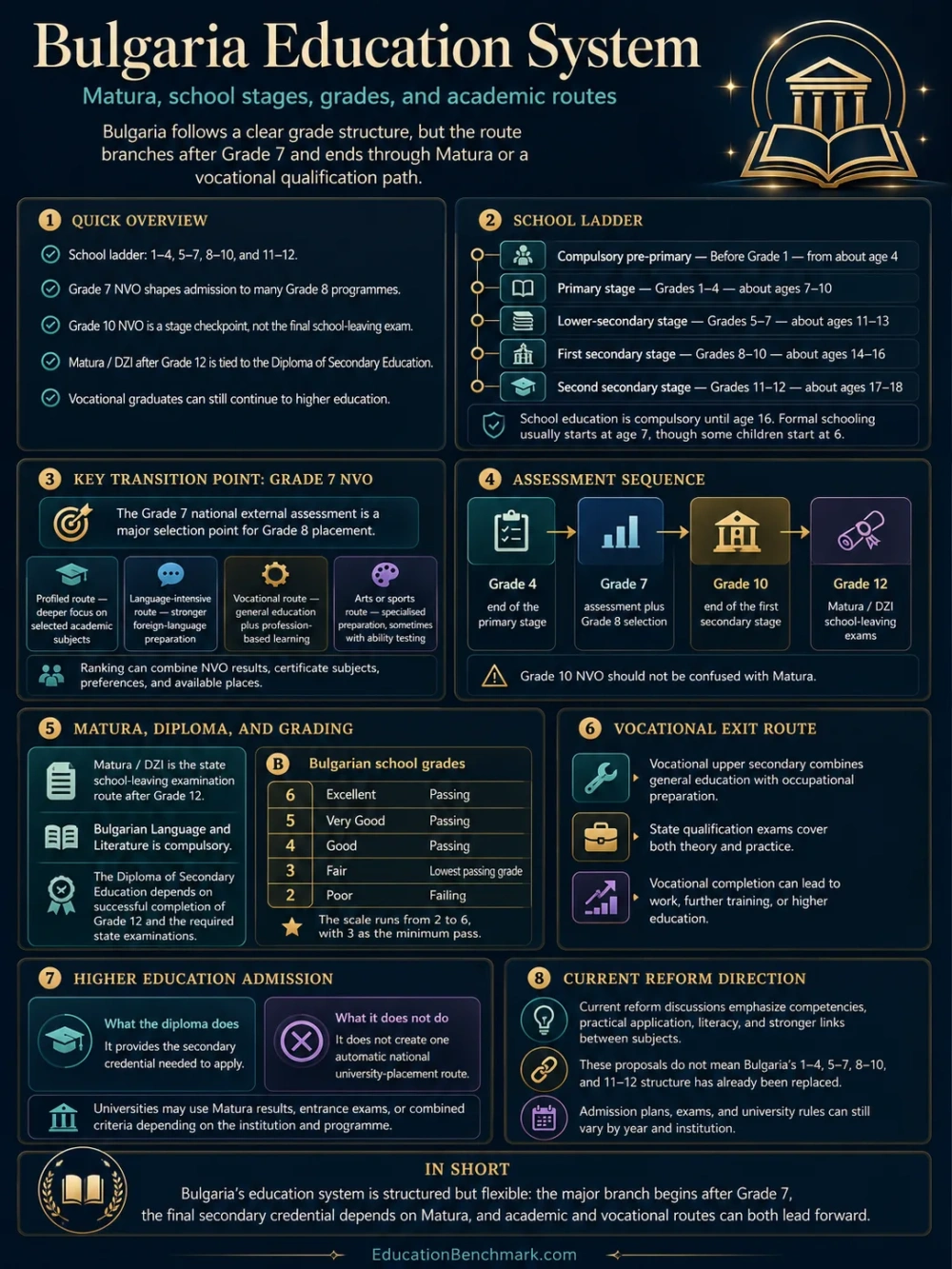
Bulgarian secondary education branches after Grade 7, passes another national assessment in Grade 10, and ends through Matura or a vocational qualification route.
Grade 7 NVO
Selected stamp: Grade 7 NVO. Choose another stamp to update the route card.
Bulgaria’s education system is easiest to understand through its transition points. Students move through a nationally defined grade structure, but the route begins to branch around the end of Grade 7. From there, profiled, foreign-language-intensive, vocational, and specialised programmes can lead toward different forms of upper-secondary preparation before Grade 12 and the state school-leaving examinations.
Bulgaria’s School Ladder: Grades 1–4, 5–7, 8–10, and 11–12
Compulsory pre-primary education begins in the school year in which a child turns four. School education normally starts at age seven, although a six-year-old may start earlier when the family chooses this and the child is considered ready. Bulgaria divides basic education into a primary stage covering Grades 1–4 and a lower-secondary stage covering Grades 5–7. Secondary education then has a first stage in Grades 8–10 and a second stage in Grades 11–12.[a]
School structure
The Normal Route From Preschool to Grade 12
Ages are approximate for a student entering Grade 1 at seven; an earlier start, repetition, transfer, or another individual circumstance can shift the age shown.
| Stage | Grades | Approximate age | Route role |
|---|---|---|---|
| Compulsory pre-primary | Before Grade 1 | From about 4 | Preparation before formal school education |
| Primary stage of basic education | 1–4 | About 7–10 | Foundation stage ending with a national assessment checkpoint |
| Lower-secondary stage of basic education | 5–7 | About 11–13 | Ends with the Grade 7 NVO and the main Grade 8 selection point |
| First secondary stage | 8–10 | About 14–16 | Academic or vocational direction develops; Grade 10 NVO closes the stage |
| Second secondary stage | 11–12 | About 17–18 | Profiled or vocational preparation leads toward final examinations and qualifications |
Schooling itself is compulsory until age 16. This matters because compulsory attendance and the full secondary route are not identical: a typical student continues through Grade 12, but the legal compulsory-schooling boundary is reached earlier. State and municipal provision operates under national education rules, while the Ministry of Education and Science and its regional education structures carry responsibilities for standards, assessment, admission procedures, and oversight.[b]
Why Grade 7 NVO Changes the Secondary-School Route
The Grade 7 national external assessment is not simply another end-of-year test. NVO, from Natsionalno vanshno otsenyavane, is used in the competition for many Grade 8 places. The ranking process incorporates the Grade 7 results in Bulgarian Language and Literature and Mathematics together with grades from two certificate subjects determined for the programme. Students are then ranked against their stated preferences and the available places. Certain fine arts, music, physical education, sports, and arts-related routes can also include an ability test.[c]
Grade 7 decision point
What Can Follow the Grade 7 NVO?
Grade 8 admission is programme-based rather than a single identical route for every student.
Bulgarian Language and Literature and Mathematics results feed into the ranking process alongside other permitted admission components.
Students enter a programme that later places greater weight on selected academic subjects during the second secondary stage.
Some Grade 8 classes devote stronger early attention to a foreign language while continuing the national general-education programme.
General education is combined with preparation for a profession, including theory and practical learning.
This is why Grade 7 can affect a student’s school environment several years before Matura. The Grade 12 examination is the better-known school-leaving event, but the earlier Grade 8 placement decision can determine whether the student develops through a profiled academic programme, intensive language study, vocational preparation, or a specialised arts or sports route.
Profiled and Vocational Routes Do Not Lead to the Same Grade 12 Exit
After Grade 7, the distinction between academic and vocational schooling becomes more visible. A profiled programme continues general education while preparing students more deeply in selected subjects, especially during Grades 11 and 12. A vocational programme also preserves general education but adds profession-related knowledge, practical work, and qualification requirements.
Secondary route comparison
Profiled, Language-Intensive, Vocational, and Specialised Routes
A vocational secondary route should not be read as a route that automatically ends before university. Students who satisfy secondary-completion requirements can still apply to higher education. The distinction is mainly in what they study during secondary school and which final professional qualification requirements accompany school completion.
Grade 10 NVO Is a Stage Checkpoint, Not the Matura
Bulgaria uses national external assessments at the end of Grades 4, 7, and 10. Grade 4 assesses Bulgarian Language and Literature and Mathematics. Grade 7 again assesses those subjects, with an optional foreign-language assessment, and has an additional role in Grade 8 selection. At the end of Grade 10, Bulgarian Language and Literature and Mathematics are assessed again; students may also take designated assessments in a foreign language or information technology. The Grade 10 assessment closes the first secondary stage and should not be confused with the state school-leaving examinations after Grade 12.[d]
National assessment sequence
Four Checkpoints With Different Purposes
National assessment checks learning at the end of the first stage of basic education.
NVO results have a direct role in the ranking process for many upper-secondary programmes.
The assessment measures achievement before students enter the final two years of secondary education.
State school-leaving examinations are tied to secondary certification and the route beyond school.
The distinction matters for transfer students and families comparing systems internationally. A Grade 10 NVO result is not the Bulgarian equivalent of a final high-school diploma, and passing Grade 10 does not replace the examination requirements attached to Grade 12 completion.
Matura / DZI, the Diploma, and Bulgaria’s 2-to-6 Grades
After successful completion of Grade 12, students face the state matriculation examination route known as Matura. The Bulgarian term is Darzhaven zrelosten izpit, commonly abbreviated as DZI. Bulgarian Language and Literature is a compulsory state matriculation examination, while the other required examination follows the student’s applicable upper-secondary preparation and current examination rules. Additional state school-leaving examinations may also be available by choice. A Diploma of Secondary Education is issued when Grade 12 and the required state matriculation examinations have been completed successfully.[e]
Completing Grade 12 and Holding the Diploma Are Not Identical
Grade 12 completion records that the final school year has been completed. The full secondary-education diploma also depends on satisfying the applicable state examination requirements. A student who has not yet met those requirements should therefore not be described as holding the same final credential as a student who has received the diploma.
School assessment uses grades from 2 to 6. 3 is the lowest passing grade, while 6 is the highest. The ordinary awarded scale therefore appears as 2, 3, 4, 5, and 6 rather than a 1-to-6 sequence.
| Bulgarian grade | English meaning | Status |
|---|---|---|
| 6 | Excellent | Passing |
| 5 | Very Good | Passing |
| 4 | Good | Passing |
| 3 | Fair | Lowest passing grade |
| 2 | Poor | Failing |
The scale should not be converted mechanically into an A–F letter grade or a 4.0 GPA. A Bulgarian 6 clearly represents the top end of the national school scale, but an institution evaluating foreign credentials may apply its own recognition or conversion method.
The Professional Qualification Exit in a Profesionalna Gimnaziya
Vocational students have an additional qualification logic that is easy to lose when Matura is presented as though every Grade 12 student follows one identical exit. State examinations for acquiring a degree of vocational qualification cover both the theory and the practice of the profession or speciality. Vocational programmes also use practical assessment, projects, laboratory work, and other programme-specific evidence of occupational competence. Professional qualification documents can sit alongside the student’s secondary-education credentials.[f]
Grade 12 exit routes
Academic and Vocational Completion Side by Side
Students complete the final secondary stage and satisfy the state school-leaving examination requirements attached to the diploma.
Students combine secondary completion with the applicable state examination process for occupational theory and practice.
Either route can support a later university application when the applicant holds the required secondary credential and meets admission conditions.
The practical effect is that academic route and vocational route describe different forms of preparation, not two permanently disconnected education systems. A vocational graduate may enter employment with an occupational qualification, continue training, apply to higher education, or combine these options over time.
From Matura Results to Bulgarian University Admission
There is no single national university-placement formula that assigns every Bulgarian graduate to a degree programme. Applicants to a Bachelor programme must have completed secondary education and the required state matriculation examinations, but higher-education institutions retain their own admission rules within national requirements. A university may hold a competitive entrance examination, recognise another qualifying examination, or decide to admit applicants without a separate entrance examination when acceptable Matura results can be used under its rules.[g]
After secondary school
What the Diploma Does — and What It Does Not Do
The diploma and required school-leaving examinations provide the educational basis for a higher-education application.
Matura results, entrance examinations, programme rules, capacity, and requirements for regulated fields may affect the final selection method.
This makes Matura both a school-leaving mechanism and a result that may matter in university selection, but not an automatic university-placement system. The exact weight given to a DZI subject can differ by institution and programme.
What Bulgaria’s Current Curriculum Reform May Change
Bulgaria is working on new curricula and standards with greater emphasis on competencies, practical application, literacy, social-emotional skills, streamlined content, and connections between subjects. The 2026 reform material describes a general curriculum concept under public discussion and notes that sixteen subject-level curriculum concepts were in consultation. These proposals concern what and how students learn; they should not be read as evidence that the established Grades 1–4, 5–7, 8–10, and 11–12 ladder has already been replaced.[h]
School-leaving rules can also evolve independently of the curriculum itself. Recent changes have expanded opportunities for some graduates to sit a further examination to improve a result for higher-education application purposes. This is another reason to separate the stable structure of the Bulgarian school route from examination procedures that can change by graduating cohort.
Where Official Details May Vary
Annual Grade 8 admission plans, available profiles and professions, minimum admission scores, examination schedules, Matura subject arrangements, university selection rules, and reform measures can change. A school, university, Regional Department of Education, or the Ministry of Education and Science should be checked when a current rule affects an application or qualification decision.
Education Benchmark is an independent informational guide and is not affiliated with any ministry of education, school authority, exam board, university, government agency, or official ranking organization.
Sources and Verification
- [a] Organisation of the education system and of its structure — Used for compulsory pre-primary entry, Grade 1 starting age, and Bulgaria’s 1–4, 5–7, 8–10, and 11–12 structure. (Reliable because Eurydice is the European education information network managed through the European Education and Culture Executive Agency.)
- [b] Organisation of single-structure education — Used for the compulsory-schooling boundary, school-entry rules, and basic-education stage information. (Reliable because the Bulgaria country material is part of the Eurydice national education information system.)
- [c] Organisation of general upper secondary education — Used for Grade 8 ranking, Grade 7 NVO components, student preferences, ability testing, and profiled, language-intensive, and vocational admission routes. (Reliable because Eurydice country pages document national education arrangements with national-unit input.)
- [d] Quality assurance in early childhood and school education — Used for the national external assessment sequence in Grades 4, 7, and 10 and the subjects attached to those assessments. (Reliable because Eurydice is an institutional European source for national education structures and assessment systems.)
- [e] 5.3 Assessment in general upper secondary education — Used for Matura, the Diploma of Secondary Education, Grade 12 assessment, and the Bulgarian 2-to-6 grading scale. (Reliable because the page is part of Eurydice’s country-level documentation of Bulgarian upper-secondary assessment.)
- [f] Assessment in vocational upper secondary education — Used for vocational qualification examinations, professional theory and practice, certification, and progression from vocational secondary education. (Reliable because Eurydice documents the national vocational assessment and qualification system.)
- [g] Bachelor — Used for Bachelor admission eligibility, institutional entrance examinations, use of state matriculation results, and university-level admission autonomy. (Reliable because Eurydice reports national higher-education admission arrangements and institutional responsibilities.)
- [h] National reforms in school education — Used for the current curriculum reform direction, public consultation status, and recent changes affecting school-leaving examination opportunities. (Reliable because the Eurydice reform page records current Bulgarian education policy developments and dates the reported measures.)