
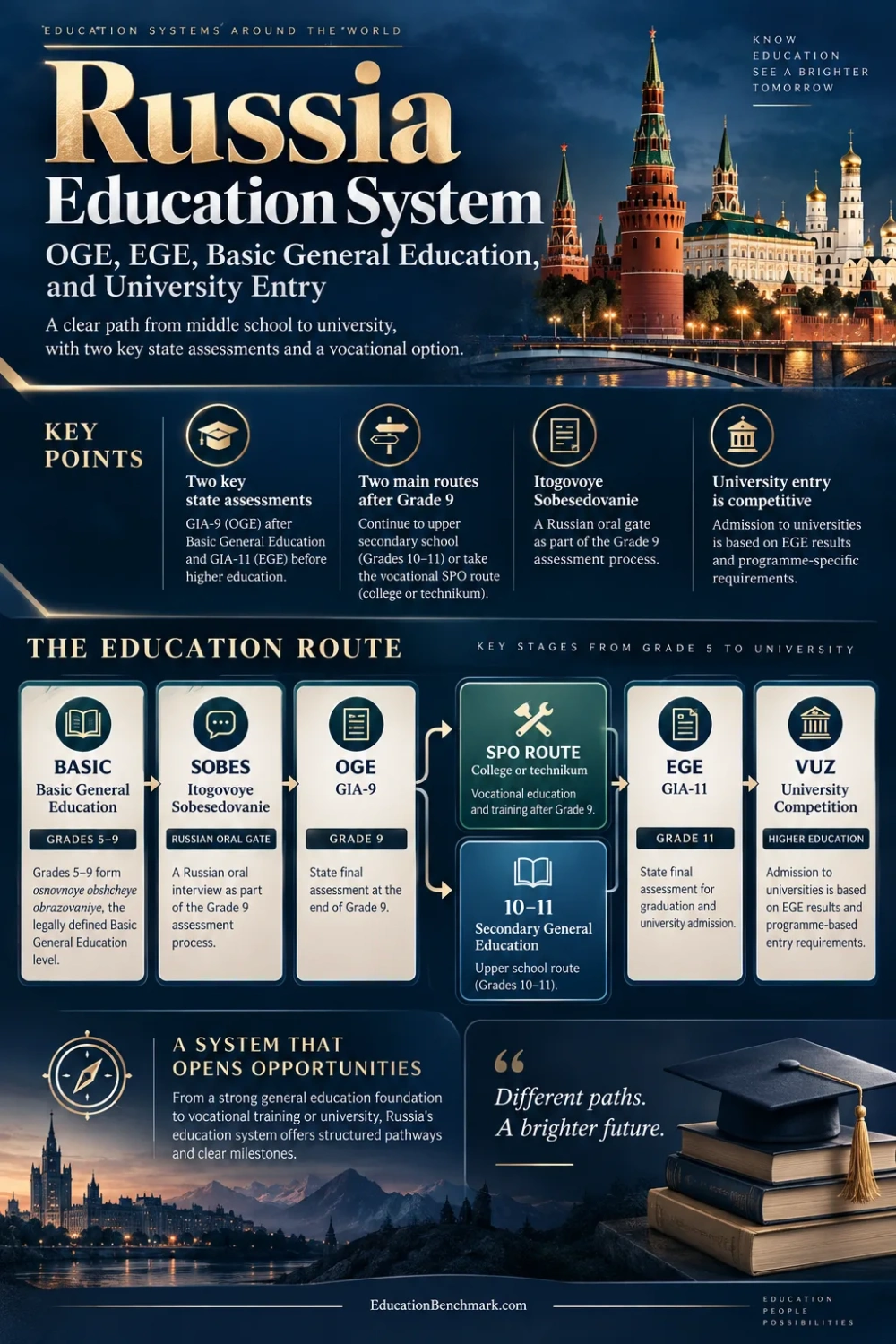
Russia’s Grade 9 and Grade 11 Route Passport
Two state-assessment gates shape the route: GIA-9 after Basic General Education and GIA-11 before higher education, with an SPO branch after Grade 9.
Basic General Education
Selected stamp: Basic General Education. Choose another stamp to update the route card.
Russia’s school route is easier to understand as two connected assessment gates than as one uninterrupted eleven-grade sequence. Federal law distinguishes Primary General Education, Basic General Education, and Secondary General Education as separate levels, and treats all three as compulsory levels of general education. The requirement to obtain Secondary General Education remains in force for an individual student until age 18 if that level has not been obtained earlier. [a]
In the usual school sequence, Primary General Education covers Grades 1–4, Basic General Education covers Grades 5–9, and Secondary General Education covers Grades 10–11. [b] The Grade 9 boundary matters because students can continue in general school or move into secondary vocational education. Grade 11 creates the next gate, where EGE results can serve both the school-leaving process and later university admission.
Why Grade 9 Is the First Major Fork in the Russian School Route
The Russian term osnovnoye obshcheye obrazovaniye is commonly rendered in English as Basic General Education. It is not a loose description of compulsory schooling. It is a specific education level between Primary General Education and Secondary General Education.
That distinction explains why Grade 9 carries more weight than a normal year-to-year promotion point. A student reaches the end of Basic General Education, completes the applicable state final assessment, and then faces two main educational directions: remain in general school for Grades 10–11 or move into an SPO programme.
School sequence
Primary, Basic, and Secondary General Education
The grade bands below describe the standard general-school sequence; individual arrangements can differ in specific forms of education.
| Russian education level | Usual grades | Main transition |
|---|---|---|
| Primary General Education | Grades 1–4 | Progression into Basic General Education |
| Basic General Education | Grades 5–9 | GIA-9, normally OGE, followed by Grades 10–11 or SPO |
| Secondary General Education | Grades 10–11 | GIA-11, normally EGE, followed by higher education or another post-school route |
Schools can also provide deeper or profile-based study in particular subjects. The legal education levels remain the same; profile study changes the content emphasis rather than creating a separate national school level.
OGE and GIA-9: Four Exams and a Russian Oral Admission Gate
GIA-9 means the state final assessment attached to Basic General Education. OGE—Osnovnoy Gosudarstvenny Ekzamen, or Basic State Examination—is its standard examination form for the mainstream Grade 9 route. The two terms are related but not interchangeable: GIA-9 is the broader assessment process, while OGE is an examination form within it.
Under the current GIA-9 procedure, a regular student must have no academic debt, complete the curriculum with Grade 9 annual marks at least satisfactory, and receive a pass in the final Russian-language oral interview (itogovoye sobesedovanie po russkomu yazyku) before admission to GIA-9. The standard OGE/GVE assessment comprises four subject examinations: Russian language and mathematics plus two chosen subjects. The choice list includes biology, geography, foreign languages, informatics, history, literature, social studies, physics, and chemistry. [c]
The Oral Interview Is Not a Fifth OGE Subject
The oral interview comes before the examination session and functions as an admission condition. A student does not simply add it to Russian, mathematics, and two electives and call the result a five-exam OGE package.
This distinction also helps separate the Grade 9 system from university admission. OGE results belong to the completion and transition process at the end of Basic General Education. They are not the normal national scores used to compete directly for bachelor’s or specialist university places.
The 2026 Two-Exam OGE Pilot for SPO Applicants
The standard four-exam model now has an important regional exception. In 2026, an experiment covering 12 regions allows eligible Grade 9 students who plan to move into colleges or technical schools through the pilot route to take only Russian language and mathematics instead of the usual four examinations. The experiment was extended through 2029. [d]
The 12 participating regions are:
- Moscow
- Saint Petersburg
- Republic of Tatarstan
- Kamchatka Krai
- Khanty-Mansi Autonomous Okrug–Yugra
- Lipetsk Oblast
- Moscow Oblast
- Murmansk Oblast
- Rostov Oblast
- Smolensk Oblast
- Tver Oblast
- Tyumen Oblast
The distinction is especially useful when comparing descriptions of OGE from different years. “Russian plus mathematics plus two electives” remains the ordinary national model, while “Russian plus mathematics only” describes the eligible experimental SPO route in participating regions.
After Grade 9: Grades 10–11 or the SPO Route
Russian secondary vocational education is known as SPO, from srednee professionalnoe obrazovanie. Federal education law permits entry to SPO programmes for people with education no lower than Basic General Education or Secondary General Education. When an SPO programme is entered on the basis of Basic General Education, the programme is delivered together with the requirements for Secondary General Education. [e]
Grade 9 decision point
Where the Route Splits After Basic General Education
Both branches can lead to further education, but they organize upper-secondary learning differently.
OGE is the normal standardized route, with the regional two-exam SPO experiment applying only where its conditions are met.
Students complete Secondary General Education and prepare for GIA-11, including EGE subjects relevant to later study plans.
The programme combines vocational preparation with the applicable secondary general education component when entered after Grade 9.
SPO should not be read as an educational dead end. It is a separate post-Grade-9 route with its own qualifications and can be followed by employment or further education. University entry after SPO, however, has its own admission rules and should not be confused with the direct Grade 11–EGE sequence.
From the Final Essay to EGE at the End of Grade 11
Students on the Grades 10–11 general-school route eventually reach GIA-11, the state final assessment for Secondary General Education. Admission to GIA-11 requires completion of the relevant curriculum without academic debt and a pass in the final essay or, for eligible categories, the final exposition. Under the GIA-11 rules, Russian language and mathematics are the compulsory subjects. Other EGE subjects—including biology, geography, foreign languages, informatics, history, literature, social studies, physics, and chemistry—are selected voluntarily when their results are needed for bachelor’s or specialist admission. Mathematics EGE is offered at basic and profile levels. [f]
EGE Has a School-Leaving Role and an Admission Role
EGE, the Unified State Examination, is a form of GIA-11. Its role is broader than OGE because relevant EGE results can also become entrance results for higher education.
That does not mean every EGE subject serves both purposes in exactly the same way. Mathematics provides the clearest example.
Mathematics choice
Basic and Profile Mathematics Have Different Admission Roles
The correct EGE subject set therefore starts with the intended university programme, not with a universal combination for all applicants. Engineering, medicine, humanities, computing, and other fields can require different entrance subjects, and the exact list must be checked for the programme and admission year concerned.
How EGE Scores Become a University Application
Federal law states that admission to bachelor’s and specialist programmes is based on EGE results unless another route is provided by law. EGE results remain valid for admission for the four years following the year in which they were obtained. Universities set their own minimum EGE scores where those minima have not been set by the institution’s founder, and institution-set minima cannot fall below the applicable federal floor. Certain programmes may also use permitted creative or professional entrance examinations, and individual achievements can be considered alongside examination results. [g]
- Select the programme. The applicant first identifies the bachelor’s or specialist programme rather than choosing EGE subjects in isolation.
- Check its entrance subjects. The university states which EGE results or other permitted entrance examinations apply.
- Meet the relevant minimums. A result below an applicable minimum cannot be treated as competitive simply because the student completed school.
- Add other permitted admission elements. These may include additional entrance tests or recognized individual achievements where the rules allow them.
- Enter the competition for places. Meeting a minimum makes an application eligible; it does not guarantee enrolment.
Applicants Coming From SPO
The route from vocational education into a university also needs careful reading. A person whose secondary vocational qualification has a profile corresponding to the intended bachelor’s or specialist programme can be admitted through entrance examinations whose form and list are set by the higher-education institution. The university determines whether the profiles correspond. Applicants should therefore not assume that any SPO diploma automatically replaces EGE requirements for any unrelated university field.
Foreign applicants can also fall under different entrance arrangements. Federal law allows foreign citizens without EGE results to be admitted on the basis of entrance examinations conducted by the higher-education institution, subject to the applicable admission rules.
What Changed for University Entry in 2026
Permanent admission rules and annual campaign arrangements should be kept separate. For the 2026 admission campaign, 20 June was the common opening date for university applications. For EGE-based applications to budget-funded bachelor’s, specialist, and covered basic-higher programmes, the main document-submission deadline was 25 July; other routes can have different deadlines. [h]
2026 admission cycle
Three Current Rules That Change Application Planning
These points belong to the current admission cycle and should be rechecked for later years.
From the 2026 campaign, the federal “Admission to University Online” service became the main way of submitting university admission applications. [i]
For 2026/27 admission, physics became a mandatory entrance examination for 25 engineering specialties covered by the revised rules. [j]
The internal-exam route for SPO graduates is tied to correspondence between the vocational qualification profile and the intended higher-education programme.
These changes make early subject planning more consequential for some applicants. A student considering an engineering programme, for example, cannot assume that a subject combination accepted in a previous admission cycle will remain sufficient. The programme’s published entrance requirements for the intended year remain the controlling reference.
OGE and EGE Serve Different Transition Points
Exam roles
OGE vs EGE in the Russian Student Route
The two examinations belong to different education levels and should not be treated as earlier and later versions of the same admission test.
| Feature | OGE | EGE |
|---|---|---|
| Main school point | End of Grade 9 | End of Grade 11 |
| Assessment level | GIA-9 after Basic General Education | GIA-11 after Secondary General Education |
| Standard compulsory core | Russian language and mathematics, plus two selected subjects under the ordinary four-exam model | Russian language and mathematics for the school-leaving assessment; other EGE subjects are selected for admission needs |
| Direct university role | Not the normal national university entrance score | Main national entrance-result route for bachelor’s and specialist admission |
| Main next decision | Continue to Grades 10–11 or move into SPO | Apply to higher education or follow another post-school route |
| Current regional exception | Two-exam SPO pilot in 12 regions for eligible participants | Admission subject requirements vary by programme and current higher-education rules |
What Readers Often Confuse About the Russian Exam Route
OGE Is Not Russia’s University Entrance Examination
OGE sits at the end of Grade 9 and Basic General Education. The normal university admission role belongs to relevant EGE results or another legally permitted university entrance route.
Not Every Grade 9 Student Takes Only Two Exams
The two-exam arrangement belongs to the regional SPO experiment. The ordinary GIA-9 structure remains Russian, mathematics, and two selected subjects for students to whom the standard rule applies.
Passing EGE Does Not Mean Automatic University Admission
School completion, satisfying a formal admissions minimum, and ranking high enough to receive a university place are separate outcomes. Competitive results vary between programmes and admission cycles.
Basic Mathematics Is Not a Substitute for Profile Mathematics in a Mathematics-Based Application
Basic Mathematics can serve the GIA role defined for it. Profile Mathematics is the level that also functions as a mathematics entrance result for bachelor’s and specialist admission.
SPO Does Not Close the Higher-Education Route
Students can progress from secondary vocational education to higher education, but the admission mechanism depends on current rules, the qualification held, its relationship to the intended programme, and the requirements of the receiving institution.
Where Russian Education Rules Can Vary
Russia combines federal education rules with areas of regional and institutional variation. The federal rules define major education levels and state assessment procedures, while regions administer parts of the system and can participate in authorized experiments such as the current Grade 9 SPO pilot. Schools may differ in subject profiles and deeper-study options. Universities publish programme-level entrance subjects, minimums, additional tests where permitted, and their own admission information within national rules.
This matters most when a decision depends on a particular year. OGE arrangements, EGE subject requirements, admission deadlines, regional experiments, and university programme conditions can change. Applicants and families should verify the current rule with the relevant official education authority, examination source, school, college, or university before making an application decision.
Education Benchmark is an independent informational guide and is not affiliated with any ministry of education, school authority, exam board, university, government agency, or official ranking organization.
Sources and Verification
- [a] Federal Education Law, Article 66: Primary General, Basic General, and Secondary General Education — Used for the legal status of Russia’s three general-education levels, compulsory education, and the age-18 condition. (Reliable because it reproduces the current federal education law.)
- [b] Ministry of Education Open Data: School Programme Grade Groups — Used for the standard grouping of Primary General Education as Grades 1–4, Basic General Education as Grades 5–9, and Secondary General Education as Grades 10–11. (Reliable because it is an official Ministry of Education open-data resource.)
- [c] GIA-9 Procedure: Forms and Participants — Used for the Russian oral-interview admission condition, OGE as a GIA-9 form, and the ordinary four-exam subject structure. (Reliable because it reproduces the official Ministry of Education and Rosobrnadzor GIA-9 procedure.)
- [d] Ministry of Education: 2026 SPO Access Experiment — Used for the two-exam Grade 9 pilot, its 12 participating regions, and its extension through 2029. (Reliable because it is an official Ministry of Education publication describing the active experiment.)
- [e] Federal Education Law, Article 68: Secondary Vocational Education — Used for SPO entry after Basic or Secondary General Education and the integration of Secondary General Education when SPO begins after Grade 9. (Reliable because it reproduces the current federal education law.)
- [f] GIA-11 Procedure: EGE, Subject Choice, and Mathematics Levels — Used for the final-essay admission condition, compulsory GIA-11 subjects, optional EGE subjects for university entry, and basic-versus-profile mathematics. (Reliable because it reproduces the official GIA-11 procedure.)
- [g] Federal Education Law, Article 70: Bachelor’s and Specialist Admission — Used for EGE-based university admission, result validity, minimum scores, additional examinations, individual achievements, foreign applicants, and the profile-aligned SPO route. (Reliable because it reproduces the current federal education law.)
- [h] Ministry of Science and Higher Education: Start of the 2026 University Admission Campaign — Used for the 20 June campaign opening and 25 July EGE-based budget-place application deadline. (Reliable because it is an official Ministry of Science and Higher Education publication for the 2026 campaign.)
- [i] Ministry of Science and Higher Education: University Admission Online in 2026 — Used for the 2026 change making the federal online university-admission service the main application method. (Reliable because it is an official Ministry of Science and Higher Education publication.)
- [j] Ministry of Science and Higher Education: Changes to the 2026/27 Admission Campaign — Used for the expanded mandatory role of physics in admission to 25 engineering specialties. (Reliable because it is an official Ministry of Science and Higher Education publication on the 2026/27 admission rules.)