Turkey’s 4+4+4 School Route
A route map built around compulsory stages, two national selection systems, local secondary placement, and parallel academic and workplace-based options.
Compulsory Route
Selected stamp: Compulsory Route. Choose another stamp to update the route card.
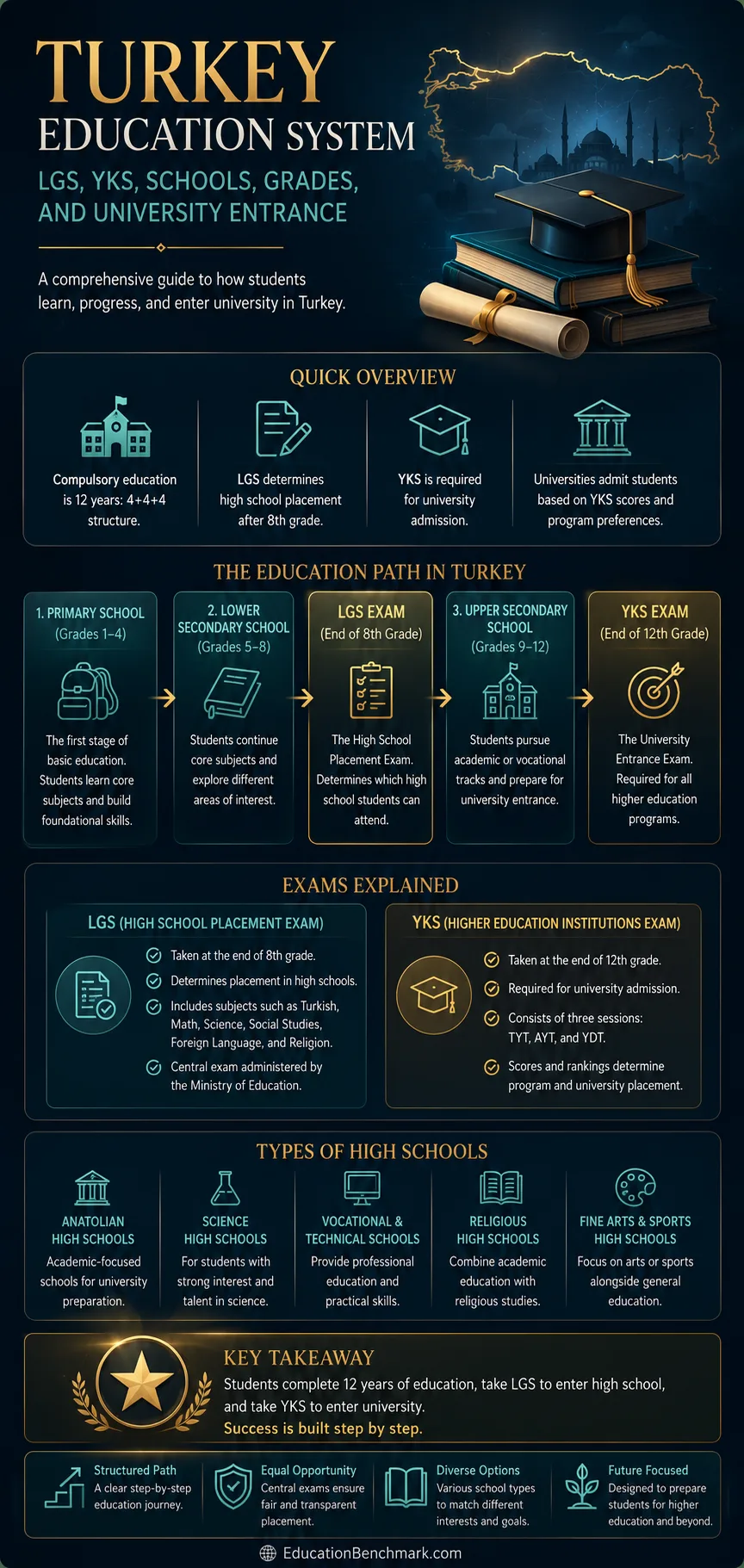
Turkey’s formal school route is organised around 12 years of compulsory education: four years of primary school, four years of middle school, and four years of upper secondary education. Preschool comes before this sequence and is generally outside the compulsory 4+4+4 route. The Ministry of National Education, usually abbreviated as MEB, sets national rules and curricula for school education, while provincial and district directorates carry out much of the local administration.[a]
The structure is nationally recognisable, but a student’s actual route is not fully linear. Birth month can affect first-grade entry. Residence affects local high-school placement. LGS scores open access to selected secondary schools, while YKS scores and preferences shape entry to most domestic higher-education programmes. An independent country profile can also help readers place these stages within the wider system, provided official rules are checked separately.[b]
System logic
The 4+4+4 Route and Its Two National Gates
The school years are compulsory, but access to particular schools and university programmes depends on separate selection processes.
Students enter upper secondary education through local placement, an LGS score-based placement, talent testing, private-school registration, or another authorised route.
A high-school diploma completes compulsory schooling, but most domestic university places are allocated through YKS scores, rankings, preferences, and programme conditions.
The two national gates serve different purposes. LGS does not decide whether a child may continue to high school; upper secondary education remains part of the compulsory route. It helps distribute places in schools and programmes that admit students through a central examination. YKS works later, when candidates compete for higher-education places.
School stages
School Levels, Entry Ages, and Compulsory Attendance
Age ranges are approximate because first-grade entry is calculated in months and individual routes can include deferral, early entry, repetition, or a preparatory year.
| Turkish stage | Grades | Typical age | Place in the route |
|---|---|---|---|
| Okul öncesi | No national grade sequence | Usually before age 6 | Preschool provision before compulsory primary school |
| İlkokul | 1–4 | About 6–9 or 10 | First compulsory four-year stage |
| Ortaokul | 5–8 | About 10–13 or 14 | Second compulsory stage; LGS occurs at the end |
| Ortaöğretim / lise | 9–12 | About 14–17 or 18 | Final compulsory stage; academic and vocational types coexist |
| Yükseköğretim | Programme-based | Usually 18+ | Optional tertiary study after secondary completion and admission |
For first-grade registration, the month count matters more than a simple “starts at six” rule. MEB guidance states that children who reach 69 months by the end of September are registered for Grade 1. Children aged 66–68 months may start on written parental request, while parents of children aged 69–71 months may request deferral or preschool direction under the stated conditions.[c]
This is why two children born in the same calendar year may begin primary school in different school years. Families moving into Turkey should also separate age placement from document recognition: previous transcripts, grade completion, and equivalency procedures may influence the assigned level.
Grade 8 transition
From LGS Scores to Local Placement
The phrase “LGS placement” covers more than one route. A central score is used for listed selective schools, while local placement remains central to the wider transition.
Grade 8 applicants take verbal and quantitative sessions based on specified middle-school subjects and learning outcomes.
Students rank eligible schools, and placement is made through score superiority, preferences, quotas, and published tie-break rules.
Students choose from local options, with residence, school achievement, attendance, school type, and capacity entering the process.
The 2026 central examination guide describes two sessions. The verbal session covers Turkish, the History of the Turkish Revolution and Kemalism, Religious Culture and Ethics, and a foreign language. The quantitative session covers mathematics and science. The guide also identifies the school categories and programmes that use the central score, including science high schools, social sciences high schools, listed Anatolian high schools, Anatolian imam-hatip high schools, project schools, and Anatolian technical programmes within vocational and technical high schools.[d]
Central placement and local placement should not be treated as interchangeable. Under the 2026 placement rules, central placement followed the candidate’s exam score and preferences. Local placement considered the registration area, residence address, school achievement, and unexcused absence, with additional tie-break rules when needed. Students without a central exam score could still choose local and boarding-school routes.[e]
Secondary choices
What Turkish High School Types Are Built to Do
School names indicate curriculum emphasis or institutional purpose, but students from different recognised high-school types may still pursue YKS and higher education.
MEB groups general upper secondary institutions under several named school types, including Anatolian, science, social sciences, fine arts, and sports high schools. The wider secondary sector also includes Anatolian imam-hatip schools, vocational and technical schools, multi-programme schools, vocational education centres, private schools, and open-education routes.[f]
A school label does not describe every campus equally. Some Anatolian high schools are locally placed; others admit by central score. Some schools offer a foreign-language preparatory year. Project-school status, boarding provision, capacity, local demand, and programme availability can change the experience even within the same school category.
Learning and records
Grades, Promotion, and the Maarif Model Rollout
Turkey does not use one national GPA in the same way as a typical United States high school. Schools record course-level results, written and applied assessments where relevant, attendance, year-end achievement, and promotion status through MEB systems. The meaning of a score must be read together with the rules for the student’s school stage.
At middle-school level, promotion decisions include subject thresholds and teacher-board procedures. At upper secondary level, the year-end achievement score, failed-course count, responsibility examinations, attendance, and graduation conditions interact. A student can therefore move to the next grade while carrying responsibility for a course in some circumstances, while a larger number of failed courses can lead to repetition under the applicable rules.[g]
The curriculum is also in a phased transition. The Türkiye Yüzyılı Maarif Model began with selected entry grades and then extended upward by cohort. For the 2025–2026 school year, official planning materials covered Grades 1–2, Grades 5–6, preparatory classes, and Grades 9–10 under the newer programmes. This means students in different grades may be studying under different programme versions during the rollout.[h]
Vocational routes
Mesleki ve Teknik Anadolu Lisesi and MESEM Routes
Both routes are part of upper secondary education, but they organise occupational learning in different ways.
Students take general secondary subjects together with occupational field courses, workshops, workplace practice, or technical programme study.
MESEM students combine one day of theoretical education with four days of practical training in a contracted enterprise under the current model.
MESEM follows an apprenticeship-style sequence. MEB describes three years of apprenticeship training followed by one year of journeyperson training, with workplace insurance and pay provisions tied to the programme. Students can work toward occupational certificates, and diploma access depends on completing the courses required by MEB. Transfers from other high-school types are possible, but timing, field match, class level, workplace contract, and difference courses affect the route.[i]
Vocational education does not close the university route. Graduates who meet diploma and examination conditions may take YKS. Their earlier training may make an associate programme or an applied field a natural continuation, but they may also compete for bachelor’s programmes under the relevant score and ranking rules.
University selection
YKS: TYT, AYT, YDT, and Central Placement
YKS is a multi-session selection system. The relevant session and score type depend on the programme being considered.
- TYT — Temel Yeterlilik Testi: the basic proficiency session used across the system and especially associated with two-year programme selection and the calculation process for other score routes.
- AYT — Alan Yeterlilik Testleri: field-based tests used for four-year programmes associated with numerical, equally weighted, or verbal score types.
- YDT — Yabancı Dil Testi: the foreign-language session used for programmes admitting through language scores.
- Preference stage: candidates use eligible scores and rankings to order programmes during the published preference period.
- Central placement: ÖSYM places candidates by score, ranking, preference order, quota, and any programme-specific conditions.
The 2026 YKS cycle retained the three-session structure: TYT on the first day, followed by AYT and YDT on the second day. The annual guide, programme tables, and preference materials control the operative details, so an old score threshold or quota should not be carried into a later application year without checking.[j]
School grades still matter, but not as a substitute for YKS. Secondary-school achievement contributes through the placement calculation defined for the year, while the examination score and ranking remain decisive for many programmes. Some fields also impose success-ranking conditions or other requirements. Conservatories, fine arts, sports, military, police, and certain international-student routes may use different or additional procedures.
Degree ladder
Associate and Bachelor’s Routes After YKS
Associate programmes are generally two years and are often delivered through vocational schools within higher-education institutions.
Bachelor’s programmes generally last four years, while fields such as medicine and some professional programmes take longer.
Associate graduates may seek vertical transfer under the relevant process, while bachelor’s graduates may apply to master’s study.
The Council of Higher Education describes Turkish universities as offering associate, bachelor’s, graduate, and postgraduate study. Associate programmes normally take two years, bachelor’s programmes generally take four, and medicine commonly takes six. Preparatory language study can add time when a programme or institution requires it.[k]
University admission should not be reduced to “take YKS and enter a university.” The candidate must hold the required secondary status, sit the relevant sessions, receive a valid score, satisfy any minimum ranking or special condition, prepare a preference list, and fall within the programme quota. Placement is central, but enrolment is completed with the university after the result.
School provision
Public, Private, and International School Provision
Public schools form the main national route and operate under MEB rules. Private Turkish schools are also regulated within the national system, although tuition, campus facilities, language intensity, admissions practices, scholarships, and supplementary programmes vary by institution.
The label international school needs careful reading in Turkey. A private school offering intensive English, an International Baccalaureate programme, or a foreign curriculum component is not automatically the same legal category as a özel milletlerarası okul. MEB’s international-school information system tracks enrolment, programmes, promotion, transfers, and records for private international schools; official descriptions state that this category serves foreign-national students.[l]
Families should confirm the school’s licence category, permitted student population, curriculum, diploma pathway, language of instruction, equivalency arrangements, and transfer procedures. A foreign curriculum may be useful for mobility, but recognition and entry into a Turkish grade or university route still depend on the applicable rules.
Verification
Where Turkish Education Rules Can Differ or Change
Turkey has nationally defined structures, yet annual guides carry much of the practical detail. LGS dates, preference limits, quotas, selective-school lists, registration areas, tie-break rules, YKS programme tables, ranking conditions, and curriculum rollout stages can change. School-level matters such as a preparatory class, boarding place, talent test, occupational branch, or language programme also depend on the institution.
Education Benchmark is an independent informational guide and is not affiliated with any ministry of education, school authority, exam board, university, government agency, or official ranking organization. For enrolment, placement, recognition, graduation, or university decisions, the latest MEB, ÖSYM, YÖK, school, and university publications should be checked directly.
References
Sources and Verification
- [a] Türk Millî Eğitim Sistemi / Turkish National Education System — Used for the 4+4+4 structure, compulsory stages, preschool status, governance, and general system organisation. (Reliable because it is an official Ministry of National Education publication.)
- [b] Turkey Education System (2026): Structure, Quality, and Performance — Used as an independent country-level overview alongside official Turkish sources. (Useful because it organises country education information for comparative reading, though it is not an official authority.)
- [c] Sıkça Sorulan Sorular — Used for first-grade registration at 69 months and the parental-request rules affecting children aged 66–71 months. (Reliable because it is published by MEB’s Directorate General for Basic Education.)
- [d] Sınavla Öğrenci Alacak Ortaöğretim Kurumlarına İlişkin Merkezî Sınav Başvuru ve Uygulama Kılavuzu – 2026 — Used for LGS eligibility, sessions, subjects, scoring context, and the listed selective-school categories. (Reliable because it is the official annual MEB examination guide.)
- [e] 2026 Ortaöğretime Geçiş Tercih ve Yerleştirme Kılavuzu Yayımlandı — Used for the distinction between central and local placement, preference groups, criteria, and 2026 placement procedures. (Reliable because it is an official MEB publication explaining the annual placement guide.)
- [f] Ortaöğretim Kurumlarının Amaçları — Used for the names and stated roles of general upper secondary school types. (Reliable because it is an official MEB Directorate General for Secondary Education document.)
- [g] Ortaöğretim Kurumları Yönetmeliği’nde Yapılan Değişiklik Resmî Gazete’de Yayımlandı — Used for the interaction of year-end achievement, failed courses, responsibility, and promotion at upper secondary level. (Reliable because it is an official MEB explanation of a regulatory amendment.)
- [h] Taslak Çerçeve Planları – Türkiye Yüzyılı Maarif Modeli — Used for the grade-by-grade curriculum rollout during the 2025–2026 school year. (Reliable because it is the official MEB curriculum portal.)
- [i] Mesleki Eğitim Merkezleri – Mesleğim Hayatım — Used for MESEM’s school-and-enterprise pattern, training stages, contract route, transfers, certification, and diploma conditions. (Reliable because it is an official MEB vocational education portal.)
- [j] 2026-Yükseköğretim Kurumları Sınavı (YKS) Kılavuzu — Used for the official YKS cycle and its TYT, AYT, and YDT materials. (Reliable because ÖSYM administers the national examination and central placement process.)
- [k] Higher Education System — Used for degree levels and normal programme durations in Turkish higher education. (Reliable because it is published by the Council of Higher Education.)
- [l] Özel Milletlerarası Okullar Bilgi Sistemi (MOBİS) — Used to distinguish the regulated private international-school category and its student-record system. (Reliable because it is published by MEB’s Directorate General for Private Education Institutions.)