France: From Collège Decisions to the Baccalauréat
Follow the French route from lower secondary school through the brevet, three lycée directions, the baccalauréat, and post-bac study choices.
Collège
Selected stamp: Collège. Choose another stamp to update the route card.
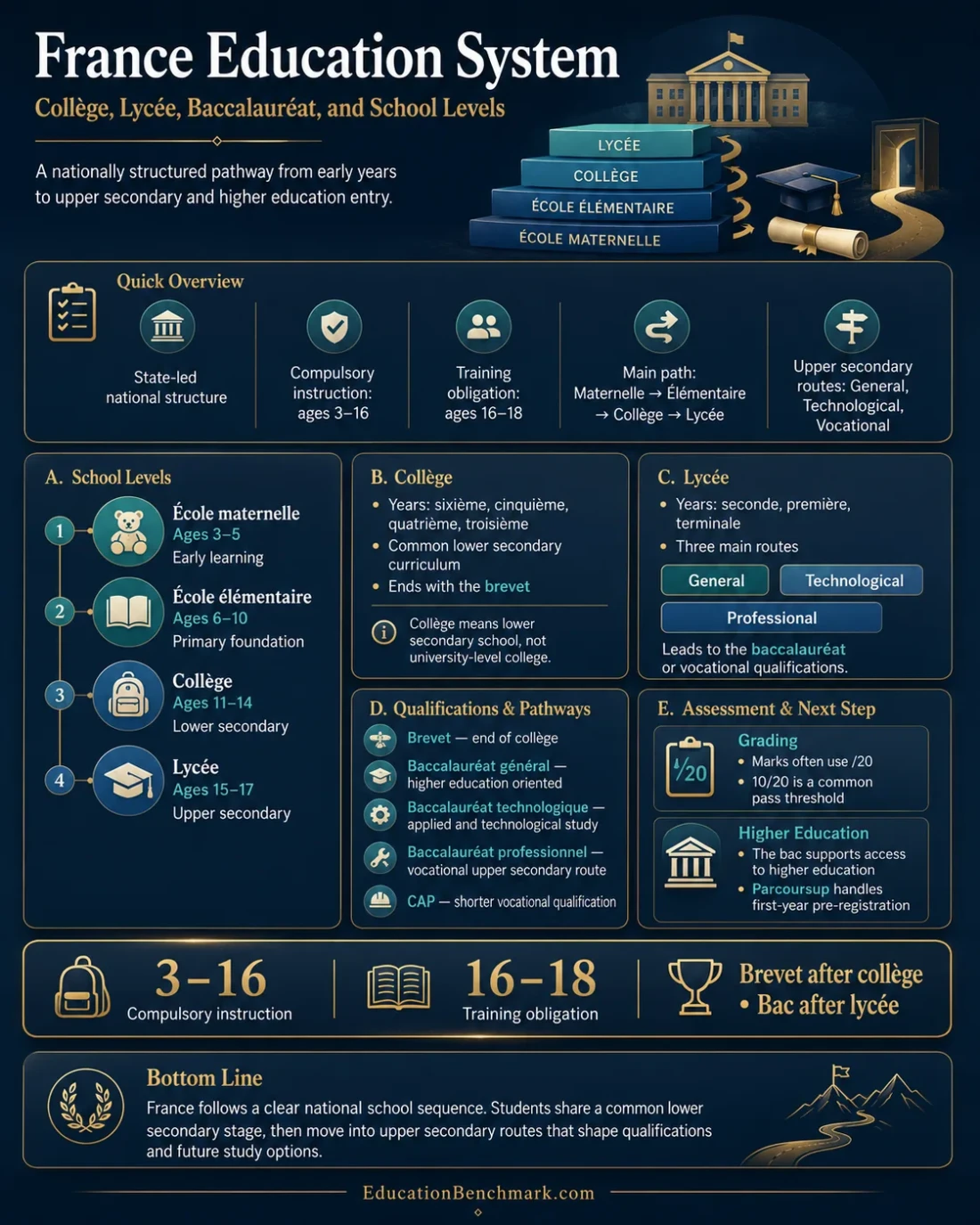
France organizes schooling through named stages that carry their own class labels: école maternelle, école élémentaire, collège, and lycée. The usual age progression runs from nursery education at about age 3 to the final lycée year at about age 18, although repetition, acceleration, vocational course length, and individual placement can shift the pattern. [a]
Instruction is compulsory for children living in France from age 3 until age 16. This is an obligation to receive instruction, not a rule that every child must remain in the same type of school throughout those years. [b] A useful independent overview also places the French system within its broader country context, but official French sources remain the reference for ages, qualifications, examination rules, and admissions. [c]
The shared secondary route
Why Collège Sits at the Center of the French School Route
Collège is not the French equivalent of a university college. It is the common lower-secondary stage between primary school and the first major upper-secondary branch.
Most pupils follow four numbered classes with a broad set of subjects before choosing a lycée direction.
The brevet records achievement at the end of collège, while the orientation process determines the next school route.
The class numbering can confuse readers accustomed to grades that rise each year. French secondary numbers move downward: sixième comes first, followed by cinquième, quatrième, and troisième. Lycée then continues with seconde, première, and terminale.
The national programs are arranged in learning cycles rather than as isolated annual syllabuses. Cycle 3 crosses the institutional boundary between primary school and collège by including CM1, CM2, and sixième; cycle 4 covers cinquième through troisième. [d] This crossing matters because the transition into collège does not mark a complete curriculum reset.
Class sequence
From Petite Section to Terminale: Classes and Typical Ages
Ages are typical starting points, not guaranteed placement rules for every pupil.
| Stage | French classes | Typical ages | Route meaning |
|---|---|---|---|
| École maternelle | Petite section, moyenne section, grande section | About 3–6 | First cycle of schooling; compulsory instruction begins during this stage. |
| École élémentaire | CP, CE1, CE2, CM1, CM2 | About 6–11 | Primary education leading to entry into sixième. |
| Collège | Sixième, cinquième, quatrième, troisième | About 11–15 | Common lower-secondary route ending with the DNB and lycée orientation. |
| Lycée général | Seconde, première, terminale | About 15–18 | General upper-secondary study leading to the bac général. |
| Lycée technologique | Usually seconde, première, terminale | About 15–18 | Series-based upper-secondary study leading to the bac technologique. |
| Baccalauréat professionnel | Seconde professionnelle, première professionnelle, terminale professionnelle | Often about 15–18 | Three-year vocational diploma route with occupational teaching and workplace periods. |
| CAP | Usually first and second CAP years | Often begins after troisième | Occupation-focused qualification, normally shorter than the bac professionnel route. |
CP means cours préparatoire; CE and CM refer to later elementary classes. In secondary education, the everyday terms are usually the class names rather than an international grade number. A pupil in troisième, for instance, is in the final year of collège, not a third-grade primary class.
First major branch
The Troisième Decision: Three Directions, Not One Ranking
The end of collège opens several routes with different teaching styles and later destinations.
A determination year before pupils continue into either the general route or a technological series.
The first year of a bac professionnel route, organized by occupational field or a named specialty.
A focused program preparing for a particular occupation, with later study still possible.
During troisième, the pupil and family express orientation preferences, and the school considers the pupil’s record and proposed route. The main official destinations are seconde générale et technologique, seconde professionnelle, and the first year of CAP. The process includes advice and an assignment stage; it is not simply a pass-fail result from one national test. [e]
The phrase general and technological can also be misleading. Pupils commonly enter the same seconde générale et technologique before choosing between the general route and a technological series for the final two years. The vocational route begins separately and gives occupational study a larger place from the start.
End of collège assessment
DNB 2026: A Diploma at the End of Collège, Not a Lycée Admission Ticket
The diplôme national du brevet and the orientation decision happen near the same point, but they serve different purposes.
The school-based part uses annual results from compulsory subjects studied in troisième.
Written papers and an oral component form the examination part of the DNB result.
For the 2026 session, the DNB is awarded when the final average reaches at least 10 out of 20. The result combines 40% continuous assessment and 60% terminal examinations. The written subjects include French, mathematics, history-geography with moral and civic education, and sciences, alongside an oral assessment. [f]
Passing the brevet is not the legal condition that alone unlocks lycée. Orientation and assignment are handled through the separate school process. This distinction explains why a pupil’s next destination cannot be read from the DNB result alone.
Upper-secondary route comparison
Lycée Général, Technologique, and Professionnel Compared
All three routes can lead to a baccalauréat, but their subjects, learning settings, and usual post-bac directions are not identical.
In the general route, pupils select three specialty subjects for première and retain two in terminale. The route is mainly designed for later study and does not use the old literary, economic, and scientific series. [g]
The technological route keeps named series. These include STMG, STI2D, STL, ST2S, STD2A, STHR, S2TMD, and STAV. Most pupils choose a series after seconde générale et technologique, while STHR normally begins through a specific seconde arrangement. [h]
The vocational route can lead to a CAP or a three-year baccalauréat professionnel. Study combines general education, occupational content, and periods in a workplace; programs may be followed under school status or through apprenticeship, depending on the qualification and available place. [i]
School-leaving qualification
How the Baccalauréat Combines School Results and Final Exams
The word bac names a level of qualification, but the assessment pattern depends on the chosen route.
Marks from specified subjects across première and terminale contribute 40% of the final result.
Anticipated and final examinations, including route-specific subjects and the Grand oral, contribute 60%.
Professional subjects, general subjects, practical requirements, and examination arrangements follow vocational rules.
For the bac général, 40% of the final mark comes from continuous assessment in subjects that do not have terminal examinations, while terminal assessments account for 60%. The terminal component includes anticipated French examinations, the new anticipated mathematics examination first taken in June 2026 for the 2027 bac session, specialty examinations, philosophy, and the Grand oral. [j]
A baccalauréat is both the end qualification of lycée and the normal credential for entering higher education. It does not guarantee admission to every program. Selective formations examine applications, and even non-selective university routes can be affected by capacity and applicant support arrangements.
CAP, Apprenticeship, and Route Changes in the Voie Professionnelle
The CAP, or certificat d’aptitude professionnelle, prepares for a defined occupational field. It is usually completed after troisième and is commonly shorter than a bac professionnel. A learner may enter employment after the qualification, continue toward a bac professionnel, or add another qualification where an appropriate route exists.
- School status: the learner studies in a lycée professionnel and completes required workplace periods.
- Apprenticeship status: the learner signs an employment contract and alternates between a CFA or training provider and the workplace.
- Transfers: movement between qualifications or between school-based and apprenticeship arrangements can be possible, but it depends on timing, preparation, available places, and the receiving institution.
The vocational route should not be read as a closed track. A bac professionnel can support direct employment or further study, especially in a BTS connected to the student’s field. The realistic transfer point depends on the diploma already earned and the entry rules of the next program.
After terminale
From the Bac to Parcoursup, BTS, BUT, CPGE, and University
The French post-bac system is a set of parallel routes rather than one uniform university ladder.
Parcoursup collects applications for many first-year programs. Applicants submit choices and supporting information, formations examine files under their stated procedures, and candidates receive offers, waiting-list positions, or other responses according to the type of program. An accepted offer is followed by administrative enrolment after the required diploma has been obtained. [k]
A BTS, or brevet de technicien supérieur, is normally a two-year program with occupational teaching and one or more workplace placements. Entry generally requires the baccalauréat or another accepted qualification, and admission is selective. [l]
The BUT, or bachelor universitaire de technologie, is prepared in an institut universitaire de technologie and carries 180 ECTS credits as a three-year licence-level qualification. [m] It has a more applied and structured profile than many general university licences, while still allowing later study.
CPGE are selective preparatory classes linked especially to competitive entry into grandes écoles. They are not the same as a university licence, although later recognition and transfer can depend on agreements, credits, examinations, and the student’s next destination. [n]
University study usually follows the licence, master, and doctorat sequence. Alongside it sit engineering schools, business schools, art and design schools, health programs, social-work programs, and other specialist routes. Admission methods differ, so the phrase “having the bac” should be read as basic eligibility for higher study rather than automatic entry everywhere.
National rules, territorial delivery
Who Sets the Rules: Ministry, Académies, and Local Authorities
France has a national curriculum and national qualifications, while administration, buildings, transport, and local delivery are divided across several levels.
National authorities set the main curriculum, examination, diploma, and teaching rules.
Académies apply national policy, organize examinations, and manage many regional education procedures.
Communes are linked to primary schools, departments to collèges, and regions to lycées and related facilities.
The division of responsibilities is one reason France can be nationally standardized without every administrative task being run from one office. The state retains control over teaching policy and national credentials, while communes, departments, and regions hold different responsibilities for school premises and services at the primary, collège, and lycée levels. [o]
Private schools also sit in more than one legal category. A private establishment sous contrat follows public teaching rules and programs under its agreement with the state, while an establishment hors contrat operates with greater curricular freedom but remains subject to state controls. [p] International schools may offer French, foreign, bilingual, or combined programs, so families need to verify the exact diploma and recognition route rather than relying on the school label alone.
Where the French Education Route Can Differ
The national class sequence is stable, but the lived route can differ by academy, school, program, and year. Specialty subjects are not offered in every lycée. Technological series and vocational specialties depend on local provision. Apprenticeship requires a suitable training place and employer. Parcoursup calendars and requested documents are updated for each campaign.
Compulsory instruction ends at 16, but France also applies a training obligation from 16 to 18 for young people who are not in education, training, or employment. The available response may involve returning to school, entering training, apprenticeship, support toward a qualification, or another recognized arrangement. [q]
Verification Before an Education Decision
Rules for examinations, orientation, school assignment, specialties, foreign qualifications, and higher-education admission can change. The relevant school, académie, examination authority, Parcoursup program page, university, or ministry source should be checked before a decision or application.
Education Benchmark is an independent informational guide and is not affiliated with any ministry of education, school authority, exam board, university, government agency, or official ranking organization.
Reference record
Sources and Verification
- [a] Table of School System Structure — Used for the official class sequence and typical ages from nursery school through lycée. (Reliable because it is an official Éduscol school-structure page.)
- [b] Instruction obligatoire — Used for the compulsory instruction ages of 3 through 16. (Reliable because Service-Public.fr is the French public-administration information service.)
- [c] France Education System (2026): Structure, Quality, and Performance — Used as an independent country-level cross-check for the broad system outline. (Useful as a focused secondary reference; official French pages were used for rules and qualifications.)
- [d] Programmes scolaires — Used for the national learning-cycle sequence, including the cross-school Cycle 3 and collège Cycle 4. (Reliable because it is an official Ministry of National Education page.)
- [e] Que faire après la troisième ? — Used for the official post-troisième routes and the distinction between general-technological and vocational destinations. (Reliable because it is an official ministry orientation page.)
- [f] Le collège — Used for the DNB award rule and the 2026 split between continuous and terminal assessment. (Reliable because it is the ministry’s official collège overview.)
- [g] La voie générale au lycée — Used for the organization and purpose of the general lycée route. (Reliable because it is an official Ministry of National Education route page.)
- [h] La voie technologique au lycée — Used for the structure of the technological route and its relationship with seconde and the terminal cycle. (Reliable because it is an official ministry route page.)
- [i] La voie professionnelle au lycée — Used for CAP, baccalauréat professionnel, apprenticeship, and workplace-based elements of vocational study. (Reliable because it is an official ministry vocational-education page.)
- [j] Le baccalauréat général — Used for the current 40% continuous-assessment and 60% terminal-examination structure of the bac général. (Reliable because it is the official ministry page for the qualification.)
- [k] Parcoursup, la plateforme d’accès à l’enseignement supérieur — Used for the national first-year application and admission process. (Reliable because it is the official Parcoursup platform.)
- [l] Brevet de technicien supérieur (BTS) — Used for BTS entry, usual program length, and workplace-placement information. (Reliable because it is an official higher-education ministry page.)
- [m] Licence professionnelle — Used for the BUT’s status as a three-year, 180-ECTS licence-level university technology qualification. (Reliable because it is an official higher-education ministry page.)
- [n] Classes préparatoires aux grandes écoles (CPGE) — Used for the place of CPGE within selective higher-education progression. (Reliable because it is an official higher-education ministry page.)
- [o] Décentralisation dans l’éducation : quelle répartition des compétences — Used for the division of education responsibilities among the state and territorial authorities. (Reliable because Vie-publique.fr is an official French public-information service.)
- [p] Les établissements d’enseignement scolaire privés — Used for the distinction between private schools under contract and outside contract. (Reliable because it is an official ministry page on private-school status and control.)
- [q] L’obligation de formation des 16-18 ans — Used for the training obligation that follows compulsory instruction until age 18. (Reliable because it is an official Ministry of National Education page.)