Serbia: From Mala Matura to Secondary and Higher Education
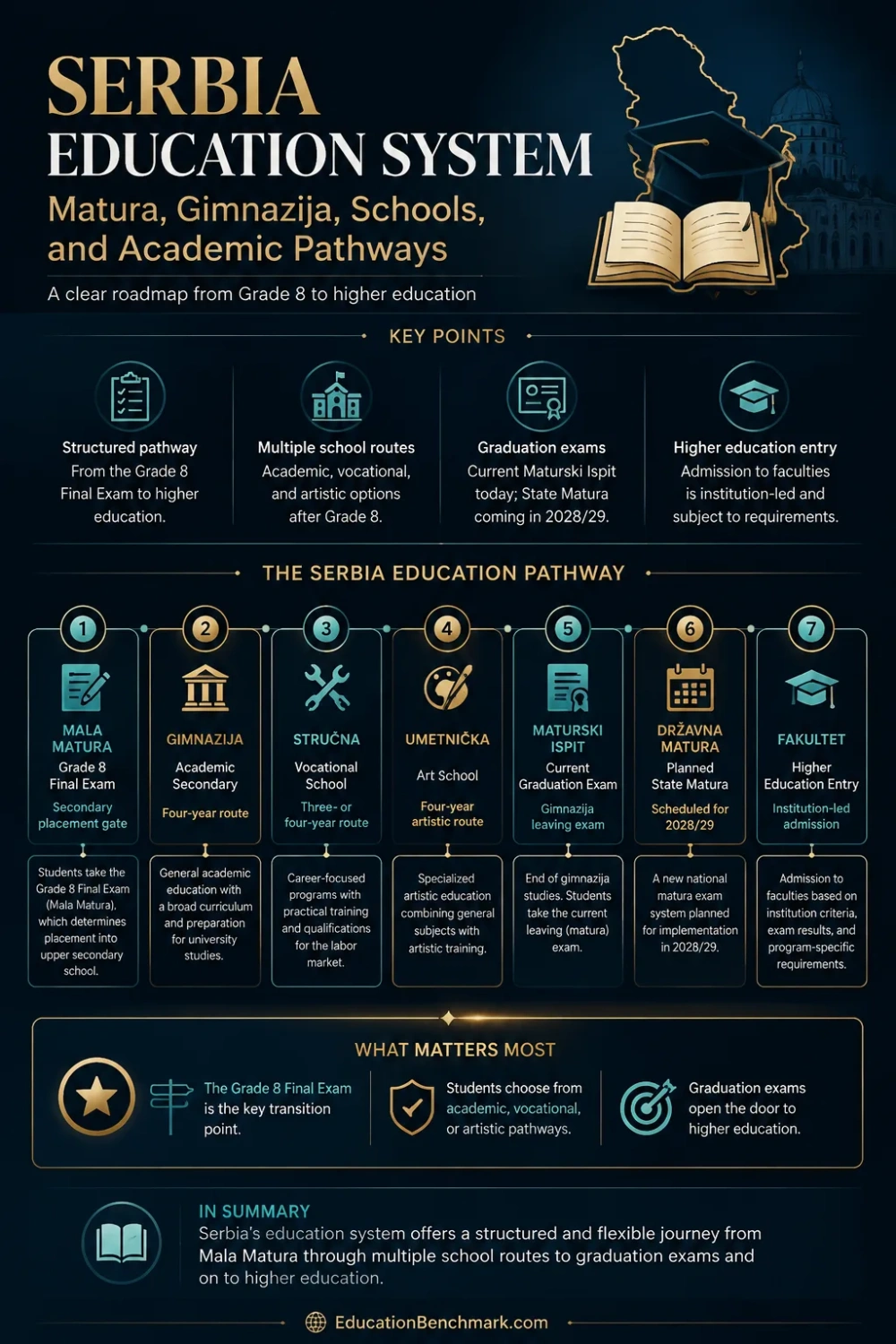
A Serbia-specific route map from the Grade 8 selection point through gimnazija, vocational and artistic schools, current graduation exams, and the planned State Matura.
Grade 8 Final Exam
Selected stamp: Grade 8 Final Exam. Choose another stamp to update the route card.
Serbia’s education system is best understood through its transition points rather than as a simple list of school levels. The first major decision comes when basic school ends and students compete for secondary-school places. The next depends on whether the student enters gimnazija, a vocational programme, or an artistic route, because those choices lead to different qualifications and different paths toward employment or higher education.
The word matura also needs context. Mala matura belongs to the end of basic education. Maturski ispit refers to the current school-leaving examination in general secondary education. Državna matura, the State Matura reform, is a future system whose introduction is scheduled for the 2028/2029 school year. Treating these as the same exam obscures how the Serbian pathway actually works.
From Osnovna Škola to Mala Matura: Serbia’s First Selection Point
Compulsory education begins with the pripremni predškolski program, the preschool preparatory programme, and continues through eight years of osnovna škola. Basic education is a single structure divided into two four-year cycles. In Grades 1–4, most subjects are taught by a class teacher; in Grades 5–8, subject specialists take over.
| Stage | Typical age | Structure | Role in the pathway |
|---|---|---|---|
| Preparatory preschool programme | 5½–6½ | Nine-month programme | First compulsory stage before basic school |
| Osnovna škola — Cycle I | About 6½–10½ | Grades 1–4 | Mostly class-teacher instruction |
| Osnovna škola — Cycle II | About 10½–14½ | Grades 5–8 | Subject teaching and preparation for the final exam |
| Secondary education | Usually begins around 15 | Route varies by programme | Gimnazija, vocational, artistic, and specialised choices |
The preschool preparatory programme and eight-year basic school make up compulsory education; the reported leaving age for full-time compulsory education is about 14½. Secondary education follows but is not part of that full-time compulsory sequence. [a]
How Mala Matura Becomes a Secondary-School Placement Score
At the end of Grade 8, students take the final exam commonly called mala matura. It contains three tests: Serbian language and literature or the student’s mother tongue and literature; mathematics; and one subject selected from Biology, Geography, History, Physics, or Chemistry. The language test can contribute up to 14 points, mathematics up to 14, and the chosen third test up to 12. School achievement contributes up to 60 points, producing a 100-point base for ordinary secondary-school placement. The final exam itself has no minimum pass threshold in the usual sense: completing it marks the completion of basic school and establishes the right to enter the secondary admission process. [b]
Prior school performance supplies the largest part of the ordinary placement total.
Serbian language and literature, or the student’s applicable mother tongue and literature.
The mathematics component has the same maximum contribution as the language test.
The third test is selected from five specified natural- and social-science subjects.
A Worked 100-Point Scenario
Suppose a student enters the regular placement calculation with 55.0 points from school achievement, 12.0 from the language test, 11.0 from mathematics, and 9.0 from the chosen subject. The resulting total is 87.0 out of 100. That number is a placement score, not a guaranteed school place.
- School achievement: 55.0 / 60
- Language: 12.0 / 14
- Mathematics: 11.0 / 14
- Chosen subject: 9.0 / 12
- Total: 87.0 / 100
Students also submit an ordered list of preferred secondary programmes, and allocation follows after the final-exam and preference stages. The official 2026 admission calendar shows separate entrance examinations taking place before the June final exam for programmes that require them, followed by submission of preference lists and then the publication of school and programme allocations. This distinction matters because a specialised programme can involve additional selection beyond the ordinary 100-point base. [c]
Gimnazija Is an Academic Route, Not a Name for Every Secondary School
A Serbian gimnazija is a four-year general secondary school. Its main role is broad academic preparation rather than training for one occupation. The term should therefore not be translated mentally as a label for every high school in Serbia: vocational schools and art schools are separate secondary routes.
The current secondary-school admissions portal lists three familiar general gimnazija profiles—društveno-jezički smer (social-linguistic), opšti tip (general type), and prirodno-matematički smer (natural-mathematical)—alongside specialised programmes for students with particular abilities. The current competition includes specialised profiles in areas such as mathematics, computing and informatics, physics, biology and chemistry, sport, and philological studies. [d]
What Changes Between Gimnazija Tracks
- Opšti tip: a broad general programme without concentrating the curriculum as heavily in one disciplinary direction.
- Društveno-jezički smer: gives greater curricular weight to languages, humanities, and social-science subjects.
- Prirodno-matematički smer: places greater emphasis on mathematics and natural sciences.
- Specialised classes: provide intensified study for students selected for particular abilities or fields.
The national curriculum establishes the overall framework, while the balance of subjects changes with the track and school programme. Some gimnazija schools also operate bilingual classes. Eurydice identifies French, English, Italian, German, and Russian among the languages used in bilingual provision, with at least 30% of lessons taught in the foreign language in those classes. [e]
Track choice influences what students study most intensively, but it should not be read as an absolute wall around every later degree. Faculty admission rules still matter at the higher-education stage.
Three-Year and Four-Year Stručna Škola Routes Lead to Different Outcomes
Vocational secondary education is a central part of the Serbian system. A srednja stručna škola can offer three- or four-year programmes, but the two lengths do not simply represent shorter and longer versions of the same qualification.
Vocational route
How Three-Year and Four-Year Programmes Separate
Students complete a four-year occupational profile and the applicable vocational graduation requirements.
The final exam has a certification role and is designed around competences for the occupational profile.
Four-year completion provides the usual route toward higher-education admission; three-year graduates may need additional qualification steps.
Under the current vocational assessment framework, four-year VET students complete a vocational graduation exam, while three-year students complete a final exam focused on occupational competence. The vocational graduation examination includes general components and a vocational component; the three-year final exam is designed principally as certification for entry into the labour market. Supplementary examinations also exist when a student transfers between programmes or streams. [f]
Where Dual Education Fits
Dual education is not a fourth school level beside gimnazija, vocational school, and art school. It operates within secondary vocational education, combining the school programme with structured work-based learning for educational profiles delivered under the dual model. The qualification route remains vocational; what changes is how the practical part of the programme is organised. [g]
Vocational Programmes Account for Most Serbian Secondary Graduates
The scale of vocational education is important when interpreting the system. At the end of the 2024/2025 school year, Serbia recorded 56,757 graduates from regular secondary schools. Of them, 58.6% completed four-year vocational programmes, 13.7% completed three-year vocational programmes, and 27.7% completed gimnazija. At the beginning of 2025/2026, 225,639 students attended regular secondary schools; almost 98% of secondary students were in public schools and slightly more than 2% in private schools. [h]
Graduate routes
Regular Secondary-School Graduates by Programme Length and Type
Shares refer to students graduating from regular secondary schools at the end of the 2024/2025 school year.
Source scope: Statistical Office of the Republic of Serbia, end of the 2024/2025 school year. Unit: percent of regular secondary-school graduates.
Chart analysis
- Four-year vocational education is the largest single graduate category in the reported data.
- Three- and four-year vocational routes together account for 72.3% of regular secondary-school graduates.
Mala Matura, Maturski Ispit, and Državna Matura Are Different Gates
The repeated use of the word matura is one of the easiest sources of confusion in Serbian education terminology. Mala matura occurs after Grade 8. The current maturski ispit belongs to the end of four-year general secondary education. Under the current gimnazija arrangement, the graduation examination includes Serbian or the applicable mother tongue and literature, either mathematics or a foreign language depending on the student’s stream, and an individual graduation paper known as maturski rad. [i]
Državna matura is different again. Amendments adopted in March 2025 moved the planned introduction of the State Matura to the 2028/2029 school year. It should therefore not be described as the examination system already being taken by Serbian secondary students today. [j]
Exam sequence
Three Matura Terms, Three Different Functions
Why the 2028/2029 Date Matters
The postponement is more than a calendar change. The Ministry of Education’s 2025 strategy implementation report states that the State Matura had not yet been introduced and identifies implementation work still connected with the examination system. Among the outstanding elements described in the report is software intended to support State Matura tasks and higher-education enrollment, which was still under development and being connected to education registers. The report also links quality implementation to having the necessary organisational conditions fully in place. [k]
What readers often confuse: a student taking mala matura now is not taking the future State Matura early. The two exams occur at different educational stages and serve different purposes.
From Gimnazija or Four-Year VET to Faculty Admission
Secondary-school graduation and university admission are connected, but they are not currently one automatic step. Completion of an eligible four-year secondary programme is the standard educational basis for entering bachelor or integrated-study admission, while higher-education institutions retain authority to design entrance examinations and other admission requirements. [l]
That distinction changes how the main secondary routes should be read. Gimnazija is designed around broad academic preparation. A four-year vocational programme combines an occupational qualification with a route that can continue into higher education. A three-year vocational programme is more directly oriented toward occupational certification and employment, and moving from that route toward higher education can require additional qualification steps before the relevant admission process is available.
Faculty requirements can also make two students with the same type of secondary diploma face different admission processes. The relevant institution, programme, entrance examination, ranking formula, and annual competition therefore matter alongside the secondary qualification itself.
Which Serbian Education Rules Need Fresh Verification Before Enrollment
Several parts of the Serbian pathway are stable enough to explain structurally but variable enough that an old admission guide should not be treated as a current rulebook. Programme quotas, previous-year cutoff scores, specialised entrance requirements, available bilingual classes, vocational profiles, and school-level offerings can change between admission cycles. University faculties can also alter their competition rules and entrance requirements.
The State Matura deserves particular attention because it remains a reform in transition. The current legal timetable points to 2028/2029, but students affected by that transition should verify the rules applying to their own graduating cohort rather than assume that an earlier or later cohort follows an identical examination arrangement.
Education Benchmark is an independent informational guide and is not affiliated with any ministry of education, school authority, exam board, university, government agency, or official ranking organization. For an enrollment, examination, transfer, or university application decision, the applicable current rules should be checked with the relevant official portal, school, faculty, examination authority, or education institution.
Sources and Verification
- [a] Serbia Education System Overview — Eurydice — Used for compulsory education, the preparatory preschool programme, the two cycles of eight-year basic education, typical ages, and the principal secondary routes. (Reliable because Eurydice is the European education systems information network managed through the European Education and Culture Executive Agency.)
- [b] Moja Srednja Škola — Final Exam — Used for the three mala matura tests, the 14–14–12 exam-point distribution, the 60 school-achievement points, and the 100-point ordinary placement base. (Reliable because the portal is operated by Serbia’s Ministry of Education for final examinations and secondary-school admission.)
- [c] Moja Srednja Škola — Enrollment Calendar — Used to verify the current sequence of entrance examinations, the Grade 8 final exam, preference-list submission, and secondary-school allocation. (Reliable because it is the official secondary-admission calendar published through the Ministry-operated portal.)
- [d] Moja Srednja Škola — Current Gimnazija Educational Profiles — Used to verify current general, social-linguistic, natural-mathematical, and specialised gimnazija profile terminology. (Reliable because the portal displays educational profiles from the official current secondary-school admission competition.)
- [e] Teaching and Learning in General Upper Secondary Education — Serbia — Used for gimnazija curriculum differentiation and bilingual-class provision. (Reliable because Eurydice provides structured national education-system information through the European Education and Culture Executive Agency.)
- [f] Assessment in Vocational Upper Secondary Education — Serbia — Used for four-year vocational graduation exams, three-year final exams, occupational certification, and supplementary examinations for programme transfers. (Reliable because it is a dedicated Eurydice assessment profile for Serbian vocational secondary education.)
- [g] Organisation of the Education System and Its Structure — Serbia — Used to place the dual model within Serbia’s secondary vocational education structure rather than treating it as a separate education level. (Reliable because Eurydice documents the formal organisation of national education systems.)
- [h] Secondary Education — Statistical Office of the Republic of Serbia — Used for 2024/2025 graduate shares and 2025/2026 secondary-student public/private enrollment context. (Reliable because it is Serbia’s official national statistical authority and its education data draw on the Ministry of Education’s unified information system.)
- [i] Assessment in General Upper Secondary Education — Serbia — Used for the current gimnazija graduation examination and maturski rad structure. (Reliable because it is the dedicated Eurydice assessment profile for Serbian general upper-secondary education.)
- [j] Adopted Amendments to Education Laws — Ministry of Education of Serbia — Used to verify that the State Matura was moved to the 2028/2029 school year by amendments adopted in March 2025. (Reliable because it is an official notice from Serbia’s Ministry of Education reporting the adopted legal changes.)
- [k] Fifth Report on the Implementation of the Action Plan for Achieving SDES 2030 — Used for the State Matura implementation status, the 2028/2029 timetable, and remaining examination-system and enrollment-software readiness work reported for 2025. (Reliable because it is an official Ministry of Education strategy implementation report.)
- [l] Bachelor — Serbia — Eurydice — Used for the four-year secondary-education basis for bachelor and integrated-study admission and the institution-led design of entrance examinations. (Reliable because Eurydice provides structured information on Serbia’s higher-education admission framework.)