Greece: From Gymnasio to Panhellenic Placement
A route map centered on the choices after Gymnasio: GEL or EPAL, national admission exams, Michanografiko selection, and post-secondary vocational options.
Lower Secondary
Selected stamp: Lower Secondary. Choose another stamp to update the route card.
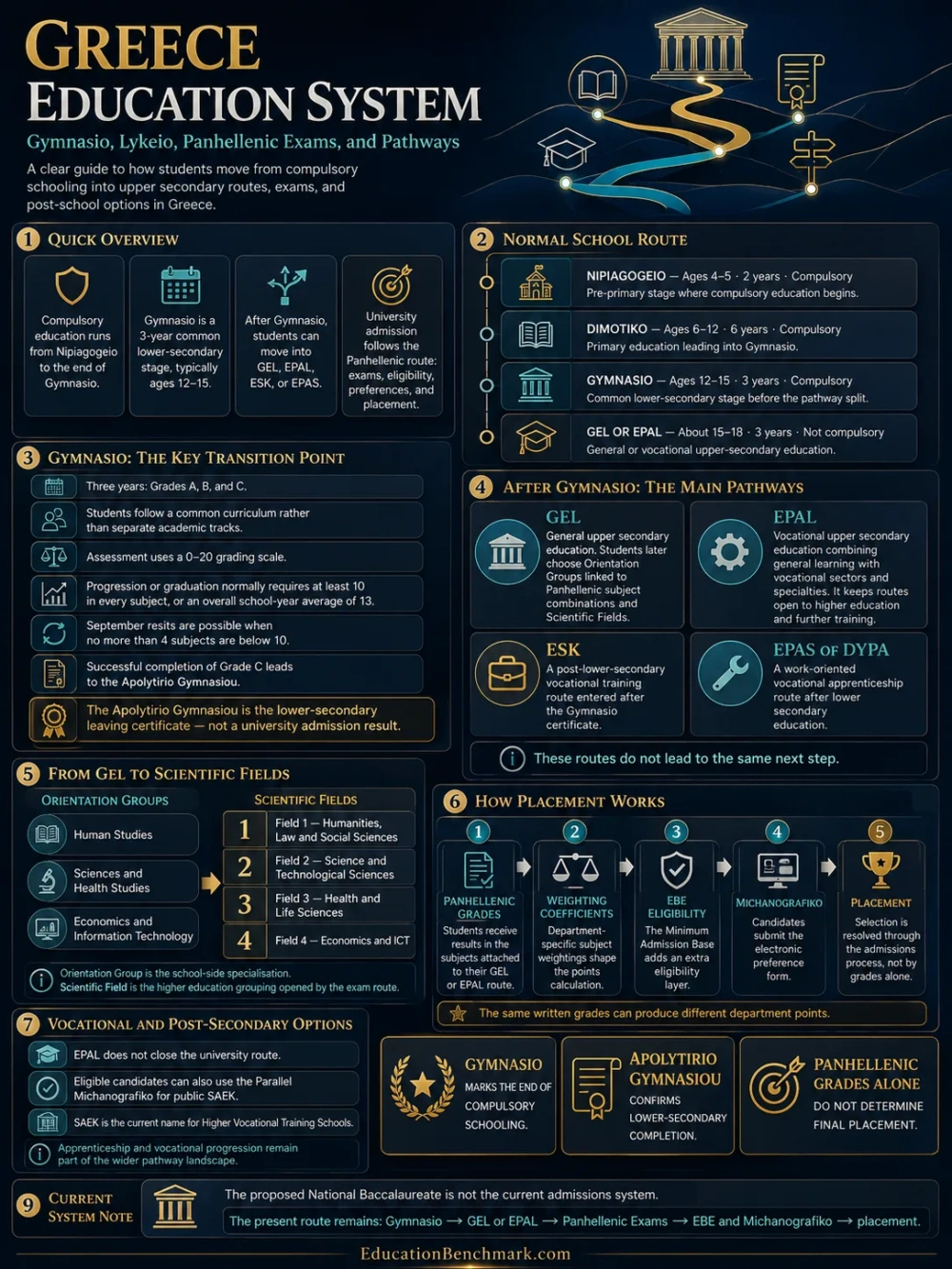
Greece uses a centrally governed school system in which compulsory education begins with two years of Nipiagogeio from age four, continues through six years of Dimotiko, and ends after the three-year Gymnasio. General or vocational Lykeio normally follows from about age 15 but is not compulsory. National rules are set centrally, while regional and local education directorates oversee implementation and schools in their areas.[a]
The most useful way to understand the Greek secondary route is through its decision points. Gymnasio is the common lower-secondary stage. After it, students can move into GEL, EPAL, or post-lower-secondary vocational options. For university-bound candidates, the later sequence runs through orientation or vocational sector choices, Panhellenic Exams, eligibility rules, the Michanografiko preference form, and final selection.
Gymnasio Marks the End of Compulsory Schooling
Gymnasio is Greece’s general lower-secondary school. It lasts three years—Grades A, B, and C—and students follow a common curriculum rather than being divided into academic tracks at this stage. Core subjects include Modern Greek Language and Literature, Ancient Greek Language and Literature, History, Mathematics, Physics, Biology, and English, alongside other sciences, languages, technology, arts, and physical education.[b]
School sequence
Where Gymnasio Sits in the Normal Route
Ages are typical entry and attendance ranges; individual progression can differ.
| Stage | Typical age | Length | Compulsory | Route meaning |
|---|---|---|---|---|
| Nipiagogeio | 4–5 | 2 years | Yes | Pre-primary stage where compulsory education begins. |
| Dimotiko | 6–12 | 6 years | Yes | Primary education leading into Gymnasio. |
| Gymnasio | 12–15 | 3 years | Yes | Common lower-secondary education before the main pathway split. |
| GEL or EPAL | About 15–18 | 3 years | No | General or vocational upper-secondary education. |
Assessment and the Apolytirio Gymnasiou
Gymnasio uses a 0–20 grading scale. Subject to sufficient attendance, a student can progress or graduate when the school-year result is at least 10 in every subject, or when the overall school-year average reaches 13. Students who do not meet the progression condition may take September resits in subjects below 10 when those subjects number no more than four. If the total average is below 10 and more than four subjects are failed, the grade is repeated. Successful completion of Grade C leads to the Apolytirio Gymnasiou, the official lower-secondary school-leaving certificate.[c]
What the certificate means: the Apolytirio Gymnasiou confirms completion of lower secondary education. It opens the next school or vocational routes; it is not a university admission result.
From Gymnasio to GEL, EPAL, ESK, or EPAS
The first major branch comes after Gymnasio. A student can enter the three-year General Lykeio (GEL) or Vocational Lykeio (EPAL). Greece also has post-lower-secondary vocational routes through Vocational Training Schools (ESK) and Vocational Apprenticeship Schools (EPAS) run by the Public Employment Service, DYPA. ESK and EPAS are two-year routes at this level, and holders of the Gymnasio leaving certificate can enter without an entrance examination.[d]
Decision after Gymnasio
Four Routes That Do Not Lead to the Same Next Step
General education with later Orientation Groups tied to Panhellenic subject combinations and Scientific Fields.
General learning plus vocational sectors and specialties, with routes to higher education and further vocational training.
A vocational training option entered after the Gymnasio certificate rather than through General Lykeio.
A work-oriented vocational route available after lower secondary education under DYPA provision.
This split matters because “after Gymnasio” does not automatically mean “prepare for university.” GEL is the clearest general academic route, EPAL combines upper-secondary schooling with vocational specialisation, while ESK and EPAS move earlier toward vocational training.
How GEL Orientation Groups Lead to Four Scientific Fields
GEL remains broad in Grade A, then introduces more specialisation. In Grade C, the three Orientation Groups are Human Studies, Sciences and Health Studies, and Economics and Information Technology. The Sciences and Health group splits for university-entry purposes: Mathematics leads toward Scientific Field 2, while Biology leads toward Scientific Field 3. The resulting four Scientific Fields organise the higher education departments accessible through each Panhellenic subject combination.[e]
GEL subject route
Orientation Group, Exam Subjects, and Scientific Field
The table shows the general GEL combinations described for Grade C and higher education access.
| GEL route | Panhellenic subjects | Scientific Field |
|---|---|---|
| Human Studies | Modern Greek Language and Literature; Ancient Greek; History; Latin | 1 — Humanities, Law and Social Sciences |
| Sciences and Health: Mathematics route | Modern Greek Language and Literature; Physics; Chemistry; Mathematics | 2 — Science and Technological Sciences |
| Sciences and Health: Biology route | Modern Greek Language and Literature; Physics; Chemistry; Biology | 3 — Health and Life Sciences |
| Economics and Information Technology | Modern Greek Language and Literature; Mathematics; Information Technology; Economics | 4 — Economics and ICT |
Orientation Group and Scientific Field are not the same thing. The Orientation Group is the school-side specialisation. The Scientific Field is the higher education grouping opened by the corresponding Panhellenic subject route.
Panhellenic Exams: The National Admission Gate
The Panhellenic Exams (Panelladikes) operate as the national admission gate for candidates following the GEL and EPAL examination routes. They should not be confused with ordinary school assessment inside Lykeio. The current system remained in operation in 2026: the Ministry published separate GEL and EPAL Panhellenic results and an official points calculator for candidates.[f]
Why the Same Written Grades Can Produce Different Department Points
Panhellenic performance is not converted into one universal department score. The Ministry’s 2026 calculation tool combines each candidate’s written grades with the subject weighting coefficients assigned to each department or school. As a result, one set of written grades can generate different point totals across departments within the candidate’s eligible field or sector.
This is one reason a single headline score does not describe the whole admission position. The candidate’s route determines the subjects taken; the intended department determines how those subjects are weighted; other eligibility conditions can then apply before preferences are submitted.
From Exam Grades to EBE, Michanografiko, and Placement
The Elachisti Vasi Eisagogis (EBE), usually translated as the Minimum Admission Base, adds a separate eligibility layer. For the 2026 Panhellenic cycle, the Ministry published EBE coefficients for schools, departments, or admission directions, as well as coefficients for special subjects, music subjects, and practical tests where relevant.[g]
Admission sequence
How Panhellenic Results Become a Placement Decision
The candidate receives grades in the subjects attached to the GEL or EPAL examination route.
Subject grades are weighted according to the department or school used in the point calculation.
The applicable Minimum Admission Base and any relevant special-subject or practical-test conditions must be considered.
The candidate submits the electronic preference form for the tertiary education selection process.
Admission is resolved through the selection process rather than by exam grades alone.
The Michanografiko Deltio (M.D.) is therefore more than an administrative form after the exams. The official 2026 electronic system required GEL and EPAL candidates to submit the M.D. in order to participate in selection for tertiary education. Submission windows and the available choices are annual, so dates from one admissions cycle should not be treated as permanent rules.[h]
Meeting the EBE is not the same as being placed in a department. It establishes an admissions condition, while the Michanografiko carries the candidate’s programme preferences into the selection stage. This distinction also explains why a previous year’s final admitted score should not be treated as a fixed national threshold for a later year.
EPAL Does Not Close the University Route
EPAL is a vocational Lykeio, but its graduates are not restricted to immediate employment. In the 2026 process, eligible GEL and EPAL candidates could obtain credentials to submit the regular Michanografiko for tertiary education and, if relevant, the Parallel Michanografiko for public SAEK. The same official process also allowed final-year GEL and EPAL students who had not taken the 2026 Panhellenic Exams to seek access to public SAEK through the Parallel Michanografiko under the stated conditions.[i]
Upper-secondary contrast
GEL and EPAL Lead to Different Mixes of Options
The Post-Secondary Year–Apprenticeship Class
The Metalykeiako Etos–Taksi Mathiteias is the post-secondary apprenticeship route associated with EPAL graduates. Ministry material for the 2026–27 cycle confirms that apprenticeship places continued to be organised for EPAL and model vocational Lykeio graduates, combining education with learning in a workplace and leading toward recognised Level 5 vocational qualifications.[j]
SAEK and the Former IEK Name
SAEK is the current name used for Higher Vocational Training Schools; older material may still refer to IEK. For public SAEK, the Parallel Michanografiko creates a distinct post-secondary choice alongside the university M.D. This matters especially when comparing older explanations of the Greek system with current application terminology.
National Baccalaureate: A Proposal, Not the Current Admission System
Current position: the proposed Ethniko Apolytirio, or National Baccalaureate, should not be described as the system already governing today’s Lykeio students or replacing the Panhellenic Exams.
In 2026, the Ministry opened a national dialogue on Lykeio and the proposed National Baccalaureate. Its published note stated that the discussion was not a bill announcement, that the Panhellenic Exams were not being abolished or changed at that stage, and that the changes under discussion did not apply to students already in Lykeio or to students then in Grade C of Gymnasio. The first possible implementation horizon named in that process was Grade A of Lykeio in the 2027–28 school year.[k]
For a present-day route map, the existing sequence remains the appropriate reference: Gymnasio completion, a GEL or EPAL pathway where chosen, Panhellenic examination and department-specific admission rules for university-bound candidates, then Michanografiko selection. Any later National Baccalaureate rules should be added only after the final legal and administrative details are published.
Where official details may vary: Panhellenic subjects, EBE coefficients, special-subject requirements, available departments, Michanografiko dates, SAEK specialties, apprenticeship calls, and transition rules can change by admissions year or programme. School-level decisions can also depend on the student’s specific school type and circumstances. For an application, transfer, or qualification decision, the current Ministry, school, university, admissions platform, or vocational authority information should be checked directly.
Education Benchmark is an independent informational guide and is not affiliated with any ministry of education, school authority, exam board, university, government agency, or official ranking organization.
Sources and Verification
- [a] Overview — Used for central governance, compulsory stages, and typical school ages. (Reliable because Eurydice is the European Union’s official network for national education system information.)
- [b] Organisation of General Lower Secondary Education — Used for the three Gymnasio grades and the common lower-secondary curriculum. (Reliable because Eurydice documents national education arrangements with the Greek national unit.)
- [c] Assessment in general lower secondary education — Used for the 0–20 scale, progression rules, September resits, and the Apolytirio Gymnasiou. (Reliable because Eurydice records the official national assessment rules.)
- [d] Organisation of the education system and of its structure — Used for GEL, EPAL, ESK, EPAS, SAEK, and post-lower-secondary route structure. (Reliable because it is the Greece system-structure page in Eurydice.)
- [e] Teaching and learning in general upper secondary education — Used for GEL Orientation Groups, Panhellenic subject combinations, and the four Scientific Fields. (Reliable because Eurydice records current national upper-secondary curriculum arrangements.)
- [f] Greek Ministry of Education — 2026 Panhellenic Exam Results for GEL and EPAL — Used to verify the current GEL and EPAL examination routes and department-specific subject weighting in the official points tool. (Reliable because it is an official Ministry examination notice.)
- [g] Greek Ministry of Education — 2026 Minimum Admission Base Coefficients — Used for the EBE coefficients applying to departments and relevant special, music, or practical examinations. (Reliable because it is the Ministry notice for the 2026 admissions cycle.)
- [h] Electronic Michanografiko 2026 — Used to verify that submission of the electronic M.D. is required to participate in tertiary selection. (Reliable because it is the Ministry’s official candidate application system.)
- [i] Greek Ministry of Education — 2026 Michanografiko and Parallel Michanografiko Access — Used for GEL and EPAL access to the regular M.D. and the Parallel M.D. for public SAEK, including the former IEK terminology. (Reliable because it is an official Ministry admissions notice.)
- [j] Greek Ministry of Education — 2026–27 Post-Secondary Apprenticeship Year — Used to verify the current EPAL apprenticeship route, workplace learning, and its connection to recognised Level 5 vocational qualifications. (Reliable because it is an official Ministry vocational education notice.)
- [k] Greek Ministry of Education — National Dialogue on Lykeio and the National Baccalaureate — Used to separate the proposed National Baccalaureate discussion from the current Panhellenic admissions system. (Reliable because it is the Ministry’s official 2026 information note on the proposal.)