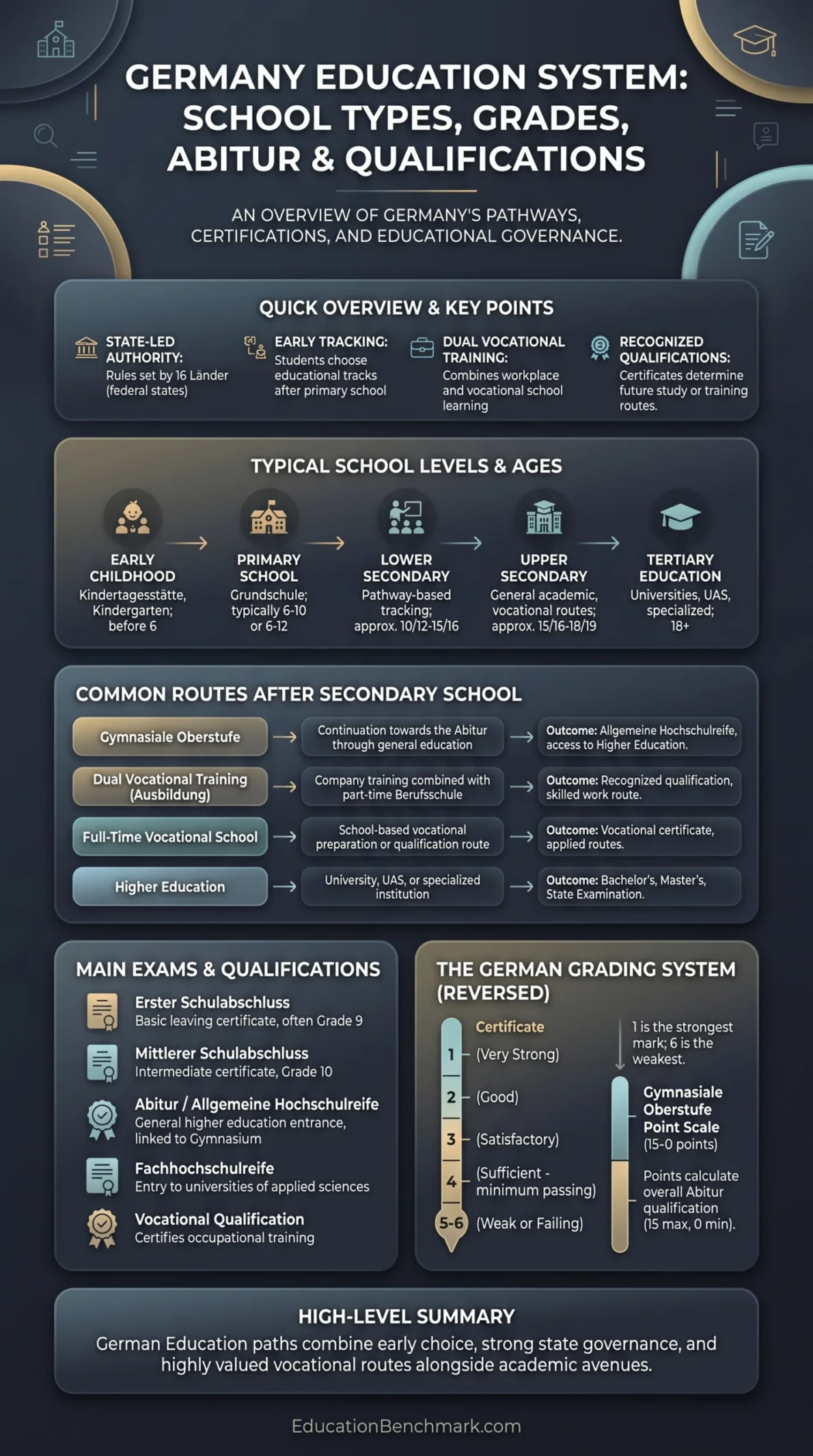
Germany’s Branching School and Qualification Passport
Follow the post-Grundschule decision, parallel secondary tracks, dual training, and the qualifications that reopen routes to higher study.
Grundschule
Selected stamp: Grundschule. Choose another stamp to update the route card.
Germany does not operate one identical national school ladder. The 16 Länder shape school law, curricula, transition rules, school names, and many assessment details, while cross-state agreements keep qualifications recognisable across the country. The route becomes easier to read when three ideas are kept separate: the school a student attends, the course or track followed inside that school, and the qualification earned at the end.
Educational federalism
How the Länder Control School Rules
Germany coordinates qualifications nationally without turning the school system into a single national administration.
Each Land organises its school system, sets curriculum rules, regulates transitions, and determines many examination and teacher-employment details.
The Länder work through the Kultusministerkonferenz to coordinate standards, school stages, mobility, and mutual recognition of qualifications.
Municipal and local bodies commonly handle buildings and local provision, while educational authority remains tied mainly to Land rules.
Under Germany’s Basic Law, education policy is primarily a responsibility of the Länder. The KMK provides coordination so that school programmes and qualifications remain comparable and mutually recognised across state borders.[a]
A statement that is correct for Bavaria may need adjustment for Berlin, Hamburg, Saxony, or North Rhine-Westphalia. School names, the length of a route, and the force of a primary-school recommendation can differ even when the final qualification is comparable.
First branching point
The Track Decision After Grundschule
The move into lower secondary education is not one national placement event. It combines school guidance, family choice, available schools, and Land rules.
Teachers assess attainment and readiness. The recommendation may guide the family or carry greater formal weight, depending on the Land.
This course leads through the gymnasiale Oberstufe toward the Abitur, whether offered in a separate Gymnasium or another school form.
This course normally leads to the Mittlerer Schulabschluss and can continue into training or upper secondary study.
This course commonly leads to a first school-leaving qualification and often connects closely with vocational preparation.
Integrated or cooperative schools can house several courses and qualifications within one school organisation.
The KMK describes three lower-secondary courses—Hauptschule, Realschule, and Gymnasium—but Länder arrange them in many school forms. A school may offer one course, two courses, or all three, and transfer between routes remains possible rather than being legally closed after one decision.[b]
For that reason, the label on the school gate does not always reveal the qualification route inside. An Oberschule, Sekundarschule, Gemeinschaftsschule, Stadtteilschule, or Gesamtschule may provide courses that resemble those offered by separate Hauptschulen or Realschulen. A broad independent profile of Germany reaches the same practical reading: state control, several secondary pathways, and linked academic and vocational qualifications define the route more accurately than a single national sequence.[c]
School stages
Grades, Typical Ages, and Compulsory Attendance
Age ranges are typical rather than universal. Entry dates, grade repetition, early admission, and Land rules can shift an individual student’s position.
| Stage | Typical grades | Typical age range | Route note |
|---|---|---|---|
| Early childhood education and care | Before Grade 1 | Below about 6 | Usually voluntary provision before compulsory primary schooling. |
| Grundschule | Grades 1–4 | About 6–10 | Berlin and Brandenburg normally continue Grundschule through Grade 6, roughly to age 12. |
| Sekundarstufe I | Grades 5/7–9/10 | About 10/12–15/16 | Students follow a first-certificate, intermediate, Gymnasium, or combined course. |
| Sekundarstufe II | Upper secondary | About 15/16–18/19 | Includes the gymnasiale Oberstufe, full-time vocational schools, and dual vocational education. |
General compulsory schooling usually begins in the year a child turns six. Full-time compulsory schooling normally lasts nine years, but it lasts ten years in Berlin, Brandenburg, Bremen, and Thuringia; North Rhine-Westphalia uses nine or ten years depending on the route. Young people who leave full-time general schooling and are not in another full-time upper-secondary school remain subject to Berufsschulpflicht, usually for the duration of a recognised apprenticeship, commonly three years.[d]
Germany combines full-time school attendance with later vocational-school duties. A student may therefore complete the general full-time requirement yet still have a legal obligation to attend Berufsschule while training.
Credential ladder
From Erster Schulabschluss to Abitur
Germany’s school types matter, but the qualification earned often matters more for the next step.
Erster Schulabschluss
Often associated with completion after Grade 9. The familiar term Hauptschulabschluss is still widely encountered in Land rules and everyday usage.
Common next routes:Dual training, transition provision, continued schooling, or work-linked preparation.
Mittlerer Schulabschluss
Usually reached after Grade 10. Readers may also see Realschulabschluss or Mittlere Reife, depending on place and context.
Common next routes:Many apprenticeships, Berufsfachschule, Fachoberschule, or entry to the gymnasiale Oberstufe when the required entitlement is included.
Fachhochschulreife
This qualification generally opens study routes at universities of applied sciences, subject to the qualification’s scope and Land or institutional rules.
Common next routes:HAW/FH study, employment, advanced vocational study, or further qualification.
Fachgebundene Hochschulreife
This route gives higher-education access in defined subject areas rather than the broad subject access associated with the Abitur.
Common next routes:Degree programmes matching the recognised subject area and the institution’s admission rules.
Allgemeine Hochschulreife
Usually identified with the Abitur. It supports applications across subject areas, though restricted programmes can still select applicants.
Common next routes:University, university of applied sciences, arts study, dual study, vocational training, or employment.
For recognition purposes, the KMK describes the Hauptschulabschluss level after at least nine years of schooling and the intermediate level after at least ten years. This matches the usual Grade 9 and Grade 10 positions while leaving room for Land-specific certificate names.[e]
The Higher Education Compass distinguishes three entrance qualifications: the Allgemeine Hochschulreife allows broad programme access, the fachgebundene Hochschulreife limits access by subject, and the Fachhochschulreife normally points to universities of applied sciences, with exceptions under Land rules. The everyday label Fachabitur is ambiguous, so the exact certificate name matters.[f]
How the Abitur Is Built
The gymnasiale Oberstufe normally contains a one-year introductory phase and a two-year qualification phase. The final result combines performance from the qualification phase with four or five examination subjects. The Abitur certificate confirms the Allgemeine Hochschulreife, and the full route to that qualification lasts twelve or thirteen school years. Detailed subject choices and examination arrangements remain the responsibility of the Länder, although common standards and shared task pools support comparability.[g]
Abitur is therefore not simply the name of one final test. It is the school-leaving qualification produced by accumulated upper-secondary work and final examinations. A strong Abitur grade can matter for selective degree programmes, but holding the qualification and winning a place in a restricted programme are separate questions.
Work-linked qualification
How Ausbildung Connects Company and Berufsschule
The dual route is a regulated education pathway, not a school-only programme and not ordinary employment without formal training.
The applicant secures a place with a training company and signs a fixed-term contract for a recognised occupation.
Practical occupational skills are taught in the workplace under regulated training requirements.
School instruction covers occupational theory and general subjects on weekly days or in teaching blocks.
A responsible chamber conducts the final assessment and awards a chamber or journeyman certificate when the trainee passes.
BIBB describes dual Ausbildung as learning at two venues: the company and the vocational school. Trainees are employees and students at the same time, receive a training allowance, and usually train for two to three and a half years. The route ends with a chamber examination in a state-recognised occupation.[h]
School-Based Vocational Options
Not every vocational qualification follows the dual model. Berufsfachschulen and other full-time vocational schools prepare students for occupations in fields such as health, social care, technical assistance, and commercial work. Their admission rules, duration, practical placements, and award titles vary by programme and Land.
Vocational schooling can also produce higher-study access. Depending on the route, students may gain the Fachhochschulreife, a subject-linked higher education entrance qualification, or the Abitur at a berufliches Gymnasium. Under defined Land conditions, experienced vocationally qualified applicants may also enter higher education without a conventional Abitur certificate.[i]
Assessment language
Grades, Zeugnisse, and Promotion
A lower number usually represents a stronger result in German school grading.
Lower-secondary schools generally use the six-mark scale from 1 to 6, while Länder may permit other assessment forms outside school-leaving certificates. A Zeugnis records performance, and promotion decisions can depend on the pattern of marks, compensation rules, the subjects involved, and Land regulations.[j]
Higher-study transition
From Abitur to University Admission
A higher education entrance qualification establishes eligibility. The degree programme then determines whether selection or direct enrolment follows.
Does the qualification permit this type of study?
The Allgemeine Hochschulreife usually permits broad subject access. Fachgebundene Hochschulreife limits access by subject, while Fachhochschulreife normally points toward HAW/FH study.
Does the programme restrict places?
Some programmes have national or local admission restrictions. Institutions may use the Abitur average and, where permitted, other selection measures.
- Identify the entrance qualification. Confirm whether it is general, subject-linked, applied, foreign, or based on an approved vocational route.
- Check the programme’s admission status. The course may be open admission, locally restricted, or nationally restricted.
- Find the correct application channel. Applications may go directly to the institution, through Stiftung für Hochschulzulassung, or through uni-assist for many international cases.
- Meet programme-specific conditions. Language certificates, aptitude tests, portfolios, subject prerequisites, or other documents may apply.
DAAD explains that the application route depends on the applicant’s qualification, country background, and chosen subject. Admission-restricted programmes may use an overall grade and additional criteria, and international applicants may apply through a university, Stiftung für Hochschulzulassung, or uni-assist according to the case.[k]
University, HAW/FH, and Arts Institutions
Germany’s higher education sector includes research universities, Hochschulen für angewandte Wissenschaften or Fachhochschulen, and colleges of art and music. Universities usually cover a broader academic range and hold the standard right to award doctorates. HAW/FH institutions place more emphasis on applied study and practice-linked programmes. Arts institutions use subject-specific admissions and may require auditions or portfolios.[l]
Provision and mobility
Public Schools, Private Schools, and Route Changes
Public schools and privately maintained schools operate side by side under Land supervision. Private provision includes denominational, alternative-pedagogy, bilingual, and international-profile schools; approval and state recognition determine whether a school can fulfil compulsory attendance and award public-equivalent certificates.[m]
Schools using an international or bilingual profile may follow different curricula and qualification routes. Families should check the exact leaving certificate rather than relying on the word “international” in a school name. Higher-education recognition depends on the certificate, subjects, grades, and applicable recognition rules.
Transfers Between Secondary Routes
The system allows movement, but a transfer is not automatic. A student may move between school types, enter a gymnasiale Oberstufe after an intermediate qualification with the required entitlement, or gain a higher qualification through vocational schooling. The receiving school checks attainment, available places, subject sequence, language study, and Land regulations.
A student who does not begin in Gymnasium can still reach an Abitur-level qualification later. A student with Abitur may choose Ausbildung rather than university. German routes branch, reconnect, and sometimes require an extra stage.
Verification
Where German Education Rules May Differ
School-entry cutoff dates, the force of a Grundschule recommendation, school names, G8 or G9 timing, examination subjects, promotion rules, vocational-school arrangements, and university admissions can change by Land, year, institution, and programme. Current reform pages also show that school, vocational, and higher education measures continue to be revised over time.[n]
For a decision involving enrolment, recognition, examinations, or admission, the relevant Land education ministry, school authority, school, chamber, university, or admissions body should be checked directly. Education Benchmark is an independent informational guide and is not affiliated with any ministry of education, school authority, exam board, university, government agency, or official ranking organization.
The German system is best compared with other countries through its structure rather than a single rank. It is state-led, qualification-based, divided into several secondary routes, and strongly connected to formal vocational education. Those traits explain the system; they do not establish that one route or country is universally better than another.
Sources and Verification
- [a] General Education Schools — Used for the Länder’s primary responsibility for school policy and the KMK’s role in comparability and recognition. (Reliable because it is an official KMK page.)
- [b] Educational paths and qualifications — Used for lower-secondary courses, qualification routes, transfer possibilities, and the connection to the gymnasiale Oberstufe. (Reliable because it is an official KMK education pathway page.)
- [c] Germany Education System (2026): Structure, Quality, and Performance — Used for an independent country-level reading of German governance, school pathways, and qualification culture. (Reliable as a topic-specific education reference used here for secondary context rather than binding rules.)
- [d] Organisation of the education system and of its structure — Used for compulsory schooling, Grundschule length, secondary stages, typical ages, and Berufsschulpflicht. (Reliable because Eurydice is the European Union’s education information network and the Germany material is maintained with national authorities.)
- [e] Equivalence with German School-Leaving Certificates — Used to clarify the usual nine-year first-certificate level and ten-year intermediate-certificate level in qualification recognition. (Reliable because it is an official KMK Central Office for Foreign Education page.)
- [f] German entrance qualifications — Used to distinguish Allgemeine Hochschulreife, fachgebundene Hochschulreife, Fachhochschulreife, and the ambiguous informal term Fachabitur. (Reliable because Hochschulkompass is operated by the German Rectors’ Conference with information supplied by higher education institutions.)
- [g] Upper Secondary Level (Gymnasiale Oberstufe) and Abitur — Used for the upper-secondary phases, Abitur examination structure, general higher education entrance qualification, and twelve- or thirteen-year routes. (Reliable because it is the official KMK Abitur page.)
- [h] The dual system — Used for company and Berufsschule learning, training contracts, recognised occupations, duration, allowances, and chamber examinations. (Reliable because BIBB is Germany’s federal institute for vocational education and training.)
- [i] Vocational Education — Used for school-based vocational qualifications and routes from vocational schools into higher education. (Reliable because it is an official KMK vocational education page.)
- [j] Assessment in general lower secondary education — Used for the six-mark school grading scale, reports, and Land variation in assessment practice. (Reliable because it is a Germany-specific Eurydice assessment page.)
- [k] Application process — Used for admission restrictions, selection criteria, and application channels for international applicants. (Reliable because DAAD is Germany’s national academic exchange organisation.)
- [l] Types of higher education institutions — Used for universities, universities of applied sciences, colleges of art and music, and their main institutional roles. (Reliable because Hochschulkompass is operated by the German Rectors’ Conference with institution-supplied information.)
- [m] Organisation of private education — Used for privately maintained schools, Land supervision, approval, state recognition, and certificate-awarding authority. (Reliable because it is a Germany-specific Eurydice governance page.)
- [n] Ongoing reforms and policy developments — Used to support the need to verify current rules because German education measures continue to change across sectors. (Reliable because it is the current Germany reform record in the Eurydice network.)