
Bosnia and Herzegovina School Route Passport
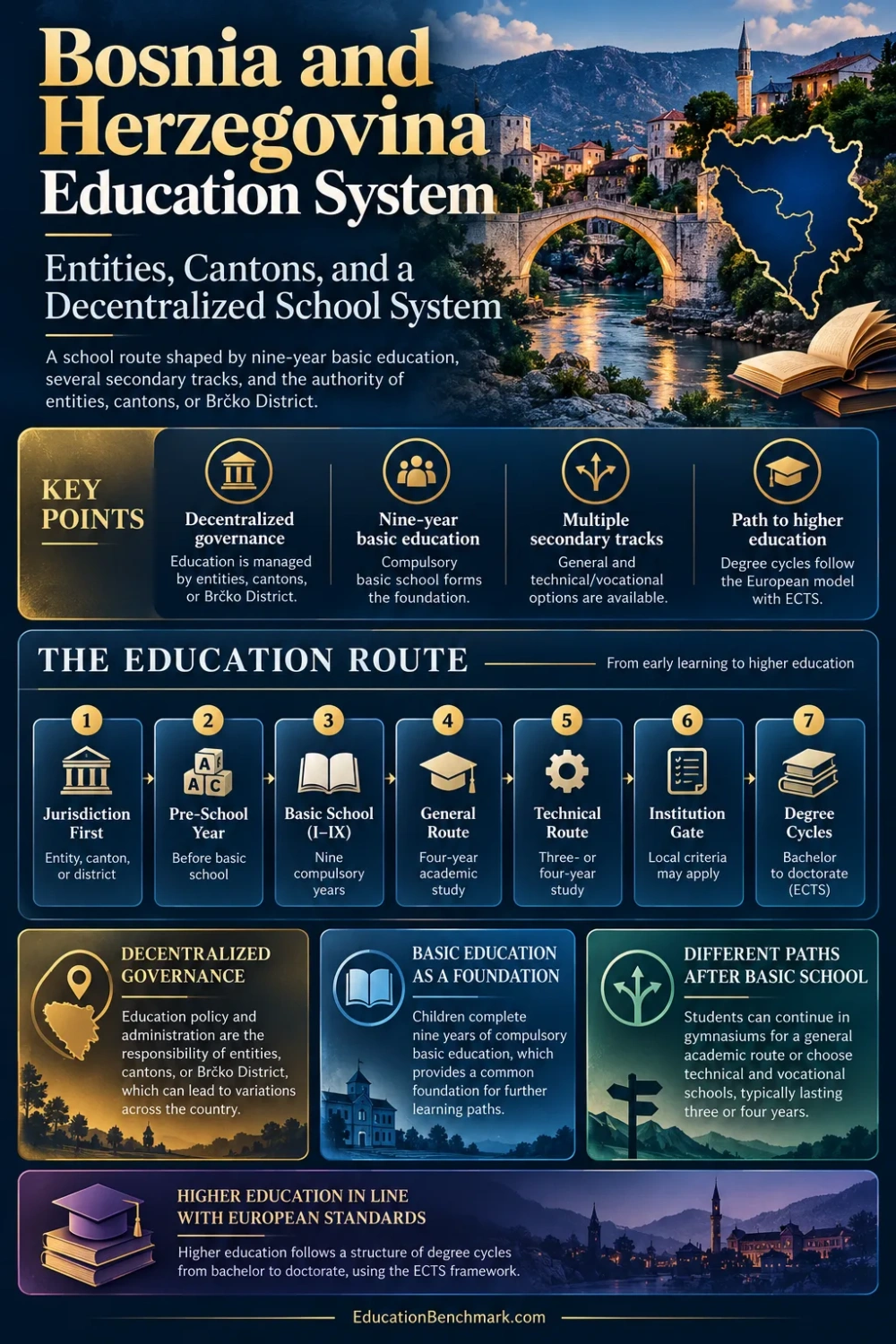
A school route shaped by nine-year basic education, several secondary tracks, and the authority of entities, cantons, or Brčko District.
Jurisdiction First
Selected stamp: Jurisdiction First. Choose another stamp to update the route card.
Bosnia and Herzegovina has a shared sequence of pre-school, basic, secondary, and higher education, while the rules behind that sequence are decentralized. The decisive question is often where the student is enrolled. A student's jurisdiction determines which education authority controls many school rules, so the system does not operate through one ministry-to-school chain.
Entities, Cantons, and Brčko: Who Controls Schools
Education authority is divided among 12 competent education authorities: Republika Srpska, ten cantons inside the Federation of Bosnia and Herzegovina, and Brčko District. The official Ministry of Civil Affairs directory states that these jurisdictions have full and undivided competence in education and lists the ministries or department responsible for that work. [b]
The Ministry of Civil Affairs coordinates activities, aligns plans, and represents Bosnia and Herzegovina in international education work.
School policy is administered at entity level rather than being divided among cantons.
Each canton has authority for education in its own territory, so the Federation does not operate as one unified school administration.
The Department for Education performs the local authority role for schools in Brčko District.
The funding map is also decentralized. The Ministry of Civil Affairs describes 13 separate education budgets by location: two entity budgets, ten cantonal budgets, and one Brčko District budget, with municipal funding also relevant depending on jurisdiction. This is why the number of education budgets is not the same as the number of competent education authorities. [c]
Why the Federation's Ten Cantons Matter
The Federation of Bosnia and Herzegovina is the part of the country where decentralization is most visible to families and schools. Its ten cantons are the practical education jurisdictions for pre-university schooling. Republika Srpska uses a more centralized entity-level arrangement, while Brčko District uses its own district administration. OECD describes school-education decision-making as delegated to twelve competent authorities at entity, canton, and district level. In the Federation, that means the ten cantons; Republika Srpska and Brčko District exercise authority through their own systems. [d]
Federation education map
The Ten Cantonal Jurisdictions
A student's canton determines the ministry that administers many school rules inside the Federation.
Two schools in different Federation cantons can therefore share the same broad national school stages while operating under different cantonal regulations. Curriculum approval, textbooks, school administration, teacher policies, external assessment practices, and detailed admission rules can differ. The student's jurisdiction is part of the education route, not a minor administrative detail.
Nine-Year Basic School and the Shared Student Route
Across Bosnia and Herzegovina, the recognizable route is pre-school, nine-year basic school, secondary school, and higher education. Basic school begins around age six and covers Grades I–IX. Students usually enter secondary education at about age 15. General secondary programmes normally last four years; technical programmes normally last four years; vocational programmes commonly last three years. [e]
School sequence
Typical Route From Pre-School to Higher Education
Ages are typical rather than universal cutoffs; local authority rules can alter timing and admission details.
| Stage | Typical age or grade | Usual role | Compulsory status |
|---|---|---|---|
| Pre-school programme before school | Year before Grade I | Preparation for entry to basic school | Compulsory programme before primary entry |
| Basic school | About 6–14/15; Grades I–IX | Primary and lower-secondary learning in one nine-grade route | Compulsory |
| Gymnasium | About 15–18/19 | Four-year general academic secondary education | Generally non-compulsory |
| Technical secondary school | Usually four years after Grade IX | Technical qualification with general and occupational study | Generally non-compulsory |
| Vocational secondary school | Usually three years after Grade IX | Occupation-oriented secondary education | Generally non-compulsory |
| Higher education | After an eligible secondary qualification | Bachelor, master, integrated, and doctoral study routes | Optional |
Current enrollment data show the scale of the basic-school stage. In the 2025/26 school year, Bosnia and Herzegovina recorded 248,585 basic-school pupils, 3,171 fewer than a year earlier, a decline of 1.3%. Grades I–V accounted for 55% of pupils and Grades VI–IX for 45%. [f]
Gymnasium, Technical, and Vocational Routes After Grade IX
Secondary education branches rather than continuing as one uniform programme. Students may enter gymnasium, technical, vocational, art, religious, or other recognized secondary provision. Academic performance from basic school is commonly part of placement, while local authorities can add their own criteria. The technical route is the largest by enrollment.
After Grade IX
The Main Secondary Branches
Usually four years, with broad general education and a common route toward higher education applications.
Usually four years, combining general subjects with technical or occupational preparation.
Commonly three years, with stronger orientation toward a specific occupation or trade.
Secondary enrollment
Students by Secondary School Type, 2025/26
Bosnia and Herzegovina recorded 108,413 secondary students. Technical schools enrolled 62,061 students, followed by vocational schools and gymnasiums. [g]
Source year: 2025/26 school year; final secondary-education data from the Agency for Statistics of Bosnia and Herzegovina.
Chart analysis
- Technical schools account for 57.2% of secondary enrollment.
- Vocational schools account for 19.7%, while gymnasiums account for 19.6%.
- Art and religious schools form much smaller parts of the secondary system.
Common Learning Outcomes, Different Curricula
Decentralization does not mean that every authority develops education in isolation. The Agency for Pre-Primary, Primary and Secondary Education (APOSO) developed a Common Core Curriculum based on learning outcomes through work carried out from 2012 to 2018, producing 18 documents intended to support curriculum development from pre-school through the end of secondary education. [h]
Curriculum control
What Is Shared and What Can Differ
APOSO's common core documents provide countrywide reference points for curriculum development and student achievement expectations.
Entity, cantonal, and district authorities approve and implement curricula, regulations, learning resources, and many school-level procedures.
This division matters when students move between jurisdictions. Grade labels may look familiar, yet subject sequencing, approved textbooks, assessment practice, or the timing of curriculum reform can differ. Records and placement should therefore be checked with the receiving school and the competent authority rather than assumed to transfer under one identical national rulebook.
Why There Is No Single National Matura
Bosnia and Herzegovina does not operate one standardized state-level examination at the end of basic or secondary school. OECD reporting notes that external assessment exists in some jurisdictions: Sarajevo Canton and Republika Srpska have used standardized examinations at the end of basic schooling, while practices at the end of secondary education are much less uniform. Universities set their own entry requirements, often using a combination of secondary-school grades and an institution-led entrance test. [i]
Assessment map
Where Selection Decisions Are Made
The word matura can therefore refer to a local or institutionally defined examination rather than one exam taken by every student in the country. Applicants comparing schools or universities need the jurisdiction and institution name before interpreting a matura result, entrance test, or admission score.
Higher Education: ECTS Cycles and Institution-Led Admission
Bosnia and Herzegovina has participated in the European Higher Education Area since 2003. The national listing identifies the Ministry of Civil Affairs as the ministry responsible for higher education at country level and the Agency for Development of Higher Education and Quality Assurance as the national quality-assurance agency. [j]
Degree progression
From Secondary Qualification to ECTS-Based Study
Eligible applicants are assessed under the rules of the institution and programme, which may include entrance testing.
First-cycle programmes commonly use 180 or 240 ECTS, while some fields use integrated study structures.
Students can progress to second- and third-cycle study under programme-specific entry and credit rules.
Bosnia and Herzegovina organizes higher education in three cycles: first-cycle study normally carries 180 or 240 ECTS, the second cycle 60 or 120 ECTS, and the third cycle 180 ECTS. [k]
The Agency for Statistics recorded 71,282 students in the winter semester of 2025/26 across first-cycle, short-cycle, and integrated study categories, including candidates for graduation. The same release recorded 10,025 graduates or completed studies during 2025. [l]
Higher education follows recognizable ECTS cycles, but admission remains institution-led. A student with a four-year secondary qualification should check the receiving university's current call for applications, programme prerequisites, entrance-testing rules, recognition requirements, and deadlines.
Why National Benchmarking Can Be Incomplete
The decentralized structure also affects countrywide education data. The European Commission's 2025 country report records no participation in PISA 2022 or PISA 2025, withdrawal from PIRLS 2021, and only partial participation in TIMSS 2023 and ICILS 2023 because Republika Srpska and West Herzegovina Canton did not conduct those assessments. Bosnia and Herzegovina has enrolled for TIMSS 2027, while preparation for PISA 2029 remains a future task. [m]
International assessment record
Recent Countrywide and Partial Participation
| Assessment | Cycle | Bosnia and Herzegovina status |
|---|---|---|
| PISA | 2018 | Participated |
| TIMSS | 2019 | Participated |
| PIRLS | 2021 | Withdrew |
| PISA | 2022 | Did not participate |
| TIMSS and ICILS | 2023 | Partial participation |
| TALIS | 2024 | Did not participate |
| PISA | 2025 | Did not participate |
| TIMSS | 2027 | Enrolled to participate |
For international comparison, the scope of each result matters as much as the score. A result from one canton, one entity, or a partial national sample should not be treated as if every education authority participated under identical conditions.
Sources and Verification
Education rules in Bosnia and Herzegovina can change by entity, canton, district, school type, university, programme, and academic year. Enrollment rules, local assessments, curricula, admission criteria, and recognition procedures should be checked with the competent education authority or institution before a decision is made.
Education Benchmark is an independent informational guide and is not affiliated with any ministry of education, school authority, exam board, university, government agency, or official ranking organization.
- [a] Levels of Education — Ministry of Civil Affairs of Bosnia and Herzegovina — Used for the official sequence of education levels, compulsory pre-school provision before school, nine-year basic education, secondary school types, and degree-cycle descriptions. (Reliable because it is an official state-level ministry source.)
- [b] Competent Education Institutions — Ministry of Civil Affairs of Bosnia and Herzegovina — Used for the distribution of full education competence among Republika Srpska, the ten Federation cantons, and Brčko District. (Reliable because it is the official state-level directory of education authorities.)
- [c] About Education Sector — Ministry of Civil Affairs of Bosnia and Herzegovina — Used for the Ministry's coordination role and the description of thirteen geographically separate education budgets. (Reliable because it is an official state-level education-sector page.)
- [d] Education Authorities and System Evaluation — OECD — Used for the twelve-authority governance structure and the entity, canton, and district levels at which school decisions are made. (Reliable because OECD publishes comparative education policy research using documented national evidence.)
- [e] OECD School-Level and Secondary Route Profile — Used for typical entry age to secondary education and the usual duration of gymnasium, technical, and vocational programmes. (Reliable because OECD documents the country's school structure and programme routes.)
- [f] Primary Education in the School Year 2025/2026 — Agency for Statistics of Bosnia and Herzegovina — Used for 2025/26 basic-school enrollment, year-on-year change, and the Grade I–V versus Grade VI–IX distribution. (Reliable because it is the country's official statistics agency.)
- [g] Secondary Education in the School Year 2025/2026 — Agency for Statistics of Bosnia and Herzegovina — Used for 2025/26 secondary enrollment and student counts by gymnasium, technical, vocational, art, religious, and specialized school type. (Reliable because it is the country's official statistics agency.)
- [h] The Common Core Defined on Learning Outcomes in Bosnia and Herzegovina — APOSO — Used for the common learning-outcome documents developed from 2012 to 2018 and their role in curriculum development. (Reliable because APOSO is the state-level agency for pre-primary, primary, and secondary education.)
- [i] Supporting Student Learning Through Assessment — OECD — Used for the absence of one state-level standardized examination, jurisdiction-level external assessments, and institution-led university admission criteria. (Reliable because OECD's review documents assessment and selection practices across Bosnia and Herzegovina.)
- [j] Bosnia and Herzegovina — European Higher Education Area — Used for Bosnia and Herzegovina's EHEA participation and the listed national higher-education and quality-assurance bodies. (Reliable because it is the official European Higher Education Area country profile.)
- [k] Higher Education in Bosnia and Herzegovina — CIP — Used for the three degree cycles and the ECTS values attached to bachelor, master, and doctoral study. (Reliable because CIP is the official information and recognition center for higher-education documents.)
- [l] Higher Education in the School Year 2025/2026 — Agency for Statistics of Bosnia and Herzegovina — Used for 2025/26 higher-education enrollment and 2025 graduate counts. (Reliable because it is the country's official statistics agency.)
- [m] Bosnia and Herzegovina Report 2025 — European Commission — Used for recent PISA, PIRLS, TIMSS, ICILS, TALIS, and planned TIMSS 2027 participation status. (Reliable because it is an official European Commission country report.)