
Montenegro School Route Passport
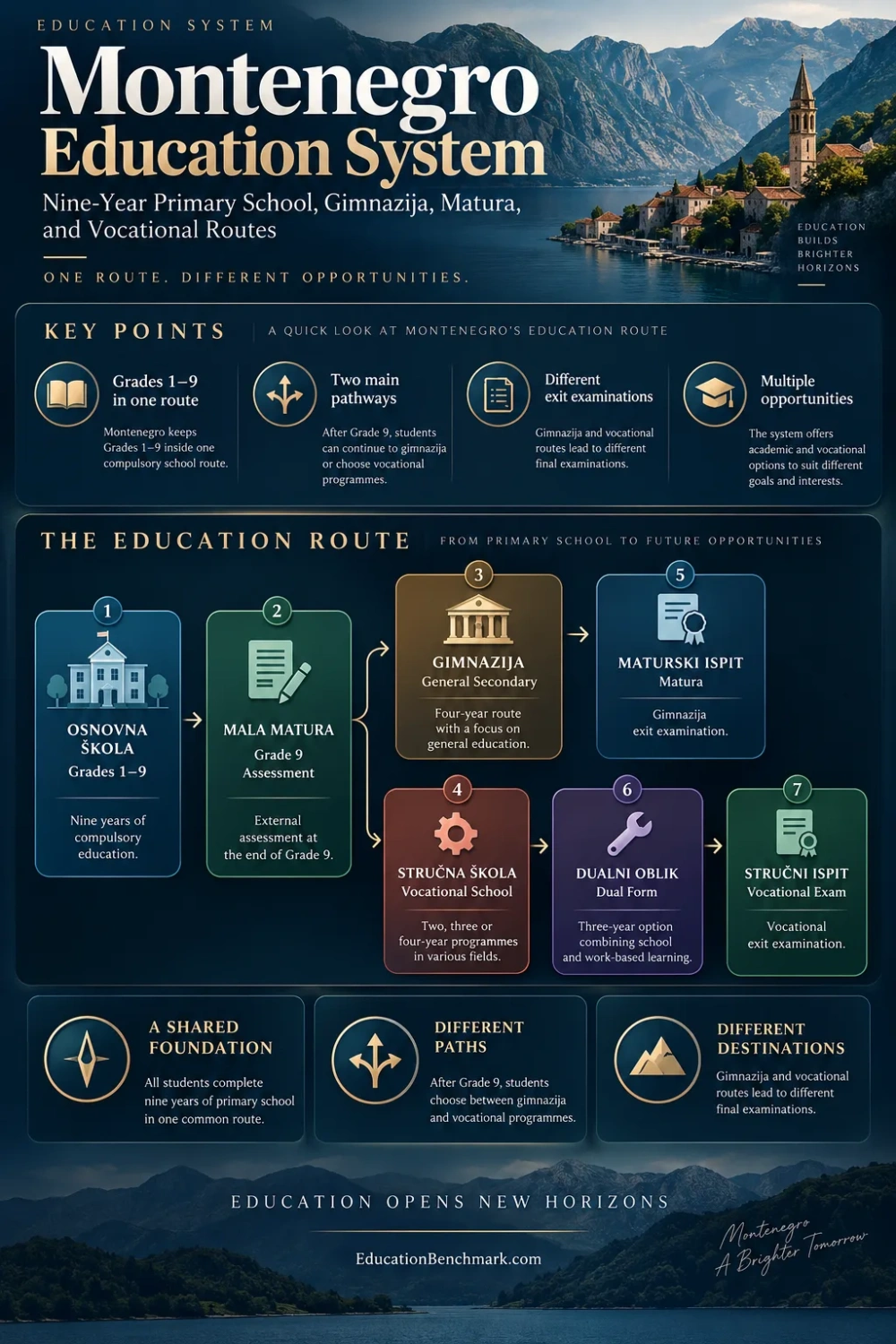
Montenegro keeps Grades 1–9 inside one compulsory school route, then branches into gimnazija and vocational programmes with different exit examinations.
Osnovna Škola
Selected stamp: Osnovna Škola. Choose another stamp to update the route card.
Montenegro’s school route is built around osnovna škola, a nine-year compulsory stage that runs through Grade 9. The law defines compulsory primary schooling for children from age six to 15 and treats completion of nine years as fulfillment of that obligation. [a] The structural break comes after Grade 9, when students move into general or vocational secondary education rather than changing to a separate middle-school institution earlier in the route.
That post-Grade-9 choice matters because the two branches use different qualifications. Gimnazija leads toward the Maturski Ispit, while vocational education uses programme-specific completion routes.
One Osnovna Škola, Three Cycles
The nine-year primary stage is divided into three cycles, but those cycles do not function as three separate schools. The first cycle covers Grades 1–3, the second Grades 4–6, and the third Grades 7–9. Teaching becomes more subject-based as students move through the route; the third cycle is organised as subject teaching under the primary-education law.
| Cycle | Grades | Place in the route |
|---|---|---|
| First cycle | 1–3 | Opening stage of compulsory osnovna škola |
| Second cycle | 4–6 | Middle three years within the same nine-year school structure |
| Third cycle | 7–9 | Subject-based final cycle leading to the Grade 9 external assessment |
First-grade entry is tied to the calendar year in which a child turns six. For the 2026 intake, the Ministry stated that children who would reach age six during that calendar year were to be enrolled; a one-school-year postponement could be approved when readiness procedures supported it. [b] This calendar-year rule explains why a simple fixed-age label can be misleading for the first months of Grade 1.
Grade 9 external assessment
The Grade 9 Gate: Mala Matura
In 2026, more than 7,000 Grade 9 students took the end-of-third-cycle assessment in language, mathematics and one elective subject. Ispitni Centar also moved marking to a central digital process, with double marking and a third marker when scores disagreed. [c]
Montenegrin–Serbian, Bosnian, Croatian language and literature, or Albanian language and literature, depending on the student’s instruction route.
Mathematics is assessed alongside the language paper at the end of the third cycle.
In 2026 the choice covered several foreign languages plus geography, history, chemistry, biology and physics.
Mala matura is not the same examination as Matura at the end of gimnazija. The former closes the nine-year primary route. The latter is a secondary-school leaving qualification. Keeping those two transition points separate prevents one of the most common misunderstandings in short descriptions of Montenegro’s system.
Secondary-school decision
The Split After Grade 9: Gimnazija or Stručna Škola
Montenegro’s general secondary route lasts four years, while vocational secondary programmes may last two, three or four years. A srednja mješovita škola can offer different secondary programmes within the same institution; the name does not mean every student follows one blended course. General and vocational secondary education are not compulsory. [d]
Admission is competitive rather than a simple automatic assignment to either branch. For the 2026/27 intake, the published minimum point threshold was 60 points for gimnazija and 48 points for four-year vocational programmes. The same competition allowed students in three-year vocational programmes to use a dual form with an individual education contract with an employer. Minimum remuneration in that dual form was set at 10% of the previous year’s average net wage in the first year, 15% in the second and 20% in the third. [e]
Those figures belong to the 2026/27 admission cycle. They should not be treated as permanent thresholds or as a guarantee of a place, because annual competition rules, programme supply and applicant ranking can change.
Gimnazija Leads to a Three-Subject Maturski Ispit
The current general Matura catalogue used by Ispitni Centar describes a three-subject Maturski Ispit: two compulsory subjects and one subject chosen by the student for its relevance to further education. For general gimnazija, the compulsory structure is Montenegrin or the student’s mother tongue and literature, plus either mathematics or the first foreign language. Mathematics and the first foreign language can be taken at basic or higher level. The three-subject model dates from the 2020/21 school year. [f]
| Gimnazija programme | First compulsory subject | Second compulsory subject | Third component |
|---|---|---|---|
| General gimnazija | Montenegrin or mother tongue and literature | Mathematics or first foreign language | One eligible elective subject |
| Philological gimnazija | Montenegrin or mother tongue and literature | First foreign language | One eligible elective subject |
| Mathematical gimnazija | Montenegrin or mother tongue and literature | Analysis with Algebra | One eligible elective subject |
This structure also explains why a published examination calendar can show mathematics and foreign-language dates without making both subjects compulsory for every general-gimnazija student. The student’s programme and subject selection determine which paper applies.
Two-, Three-, and Four-Year Stručna Škola Routes
Vocational secondary education is not one single track with one single exit. Programme duration changes the route. Two-year programmes are the shortest option. Three-year programmes place stronger emphasis on occupational preparation and may use the dual form described in the annual admission competition. Four-year programmes combine vocational content with a longer secondary course and connect most directly to the external Stručni Ispit route used by students who want to continue their education.
Vocational progression
Where the Dual Form Fits
The dual form belongs inside eligible three-year vocational programmes. It is an option within vocational education, not a description of Montenegro’s entire VET system.
The student remains in the education programme while practical learning is linked to an employer arrangement.
The 2026/27 admission rules describe an individual contract with an employer for students using the dual form.
These were the minimum first-, second- and third-year shares of the previous year’s national average net wage for the 2026/27 dual route.
The distinction between three- and four-year vocational study is especially important when reading higher-education pathways. A four-year vocational graduate can move directly toward the Stručni Ispit route described below. A three-year graduate does not simply receive the same examination pathway automatically.
Secondary exit qualifications
Stručni Ispit Is Not the Same as Matura
The vocational examination has a general-education part and a professional part. Its general component includes Montenegrin or mother tongue and literature plus mathematics or the first foreign language, as defined by the education programme; the professional component is vocational theory. [g]
The vocational catalogue also defines a bridge for some three-year graduates: a student who has completed a three-year vocational school, passed the final examination and then completed two years of additional education can gain the right to take the Stručni Ispit. For four-year vocational students who intend to continue education, the examination is external. The catalogue states that schools organise the vocational examination for students who do not intend to continue education after secondary school.
From Maturski or Stručni Ispit to University Study
The presence of Stručni Ispit means a vocational secondary route does not automatically close the door to higher education. Admission still depends on the institution and programme. In the University of Montenegro’s 2026/27 first undergraduate admission cycle, candidates who had not taken an external Maturski or Stručni Ispit had to sit supplementary tests, while programmes with separate entrance examinations retained those additional requirements. [h]
That university cycle is best read as a current institutional case, not a permanent rule for every higher-education provider. Applicants need to check the admission notice for the specific university, faculty and study programme because required documents, subject weighting and entrance examinations can change.
Language of Instruction Changes the Labels Students See
Montenegrin is the official language of instruction in educational institutions. The government also states that classes are held in Serbian, Bosnian, Albanian and Croatian, which are languages in official use. [i] This is why examination and school materials may use combined language labels rather than a single-language shorthand.
Several local terms are worth keeping in their original form because they describe specific parts of the route: osnovna škola for the nine-year primary stage, gimnazija for general secondary education, stručna škola for vocational secondary school, maturski ispit for the gimnazija school-leaving examination and stručni ispit for the vocational examination. Translating all of them simply as “school” or “final exam” hides the distinctions that determine progression.
International assessment
PISA 2025 Shows a Rise From 2022, With OECD Gaps Remaining
Montenegro’s 2025 average scores were higher than in 2022 in science, reading and mathematics. OECD still reported performance below the OECD average in all three domains. [j]
PISA score points for 15-year-old students. Changes from 2022 to 2025 were +32 in science, +13 in reading and +5 in mathematics.
| Domain | 2022 | 2025 | Change |
|---|---|---|---|
| Science | 403 | 435 | +32 |
| Reading | 405 | 418 | +13 |
| Mathematics | 406 | 411 | +5 |
PISA is not a graduation test and does not determine an individual student’s route into gimnazija, vocational education or university. It is a sample-based international assessment of 15-year-olds. In 2025, about 60% of students in Montenegro reached at least Level 2 in science, 45% in mathematics and 55% in reading. Those shares remained below the corresponding OECD averages.
The 2025–2035 Reform Strategy May Change Curriculum Details
Montenegro is implementing an Education Reform Strategy for 2025–2035. A government reform schedule published in 2026 placed curriculum revision in phases, including a national curriculum reference document in 2026, new subject programmes in 2027 and new textbooks in 2028. [k] These planned changes should not be read as evidence that the current nine-year primary route, secondary-school lengths or examination pathways have already been replaced.
For the routes described here, governance is national rather than federal or provincial. The Ministry publishes school-admission and reform rules, while Ispitni Centar maintains the secondary examination catalogues and current Matura and vocational-exam information used across the national route. [l]
Education Benchmark is an independent informational guide and is not affiliated with any ministry of education, school authority, exam board, university, government agency, or official ranking organization. School-entry rules, annual admission thresholds, examination catalogues and university requirements can change, so decisions affecting an individual student should be checked against the current notice from the relevant ministry, school, Ispitni Centar or higher-education institution.
Sources and Verification
- [a] Primary Education and Upbringing Law — Used for the nine-year compulsory primary route, ages six to 15 and the three-cycle Grade 1–9 structure. (Reliable because it is the current Government of Montenegro legal text, including amendments through 2025.)
- [b] First-Grade Primary School Enrolment Begins on 1 April 2026 — Used for the 2026 first-grade age rule and the possible one-year postponement. (Reliable because it is a Ministry of Education, Science and Innovation notice.)
- [c] Successful Rollout of Montenegro’s New Mala Matura Model — Used for the 2026 Grade 9 subject pattern and the central digital marking process. (Reliable because it is an official Ispitni Centar publication.)
- [d] Educational Levels — Used for general-secondary and vocational-secondary duration, compulsory status and mixed-school provision. (Reliable because it is an official Government of Montenegro education page.)
- [e] Secondary School First-Year Enrolment Competition for 2026/27 — Used for the 60- and 48-point thresholds and the three-year dual-education contract and remuneration rules. (Reliable because it is the official annual secondary-school admission notice.)
- [f] General Matura Catalogue — Used for the three-subject Matura structure and the compulsory subject pairs in general, philological and mathematical gimnazija. (Reliable because it is the official Ispitni Centar examination catalogue.)
- [g] General Vocational Examination Catalogue — Used for Stručni Ispit components, external examination for further study and the bridge from three-year vocational education. (Reliable because it is the official Ispitni Centar vocational-examination catalogue.)
- [h] University of Montenegro Undergraduate Enrolment Competition Published — Used as a 2026/27 institutional case for supplementary tests and programme-specific entrance examinations. (Reliable because it is an official University of Montenegro admission publication.)
- [i] Language of Instruction — Used for the official language of instruction and the other languages used in classes. (Reliable because it is an official Government of Montenegro education page.)
- [j] PISA 2025 Results (Volume I): Montenegro — Used for 2025 performance, changes from 2022, proficiency shares and OECD comparison context. (Reliable because it is Montenegro’s country note from the OECD PISA programme.)
- [k] Education Reform Steps — Used for the phased curriculum changes scheduled for 2026–2028 under the 2025–2035 reform strategy. (Reliable because it is a Ministry of Education, Science and Innovation reform notice.)
- [l] Secondary Schools — Matura and Vocational Exams — Used to verify the current Ispitni Centar secondary-exam catalogue and results hub. (Reliable because it is the official national examination-centre page.)