Croatia School Route Passport
Croatia’s route turns after eight-year osnovna škola: students enter academic, vocational, or art programmes before matura-based higher-education selection.
Osnovna Škola
Selected stamp: Osnovna Škola. Choose another stamp to update the route card.
Croatia’s school route centres on eight-year osnovna škola. Primary education is compulsory and free for children from ages 6 to 15, after which students move into secondary programmes that can lead toward general academic study, an occupation, artistic education, or a combination of employment and later study. [a] The distinction between these secondary routes matters because državna matura does not play exactly the same role for every student.
The Grade 8 Turn: Osnovna Škola Ends Before Secondary Tracking
Osnovna škola covers Grades 1 through 8 as one compulsory school sequence. That structure can be unfamiliar to readers used to separate elementary and middle schools. Croatia does not require a student to change into a distinct lower-secondary institution simply because the child moves from the earlier to the later primary grades.
The more consequential transition comes after Grade 8. Students then apply for secondary programmes, where the route divides among gimnazija, vocational education and art education. Secondary-school choice therefore affects the programme followed, the form of school completion and the path available toward higher education.
Croatia also uses national examinations during osnovna škola. NCVVO publishes separate national-exam materials for fourth- and eighth-grade pupils. These assessments are not the državna matura, which belongs to the later upper-secondary route. [b]
This distinction matters when interpreting Croatian school records. A Grade 8 national examination, a secondary-school admission result and a later matura result belong to different stages of the student route.
NISpuSŠ and the 2026/27 Secondary-School Choice
Entry into first-year secondary education is organised electronically through NISpuSŠ, the National Information System for Applications and Enrolment in Secondary Schools. The system supports applications and ranking for individual programmes; it is not one universal national entrance examination that gives every Croatian pupil a single secondary-school placement score.
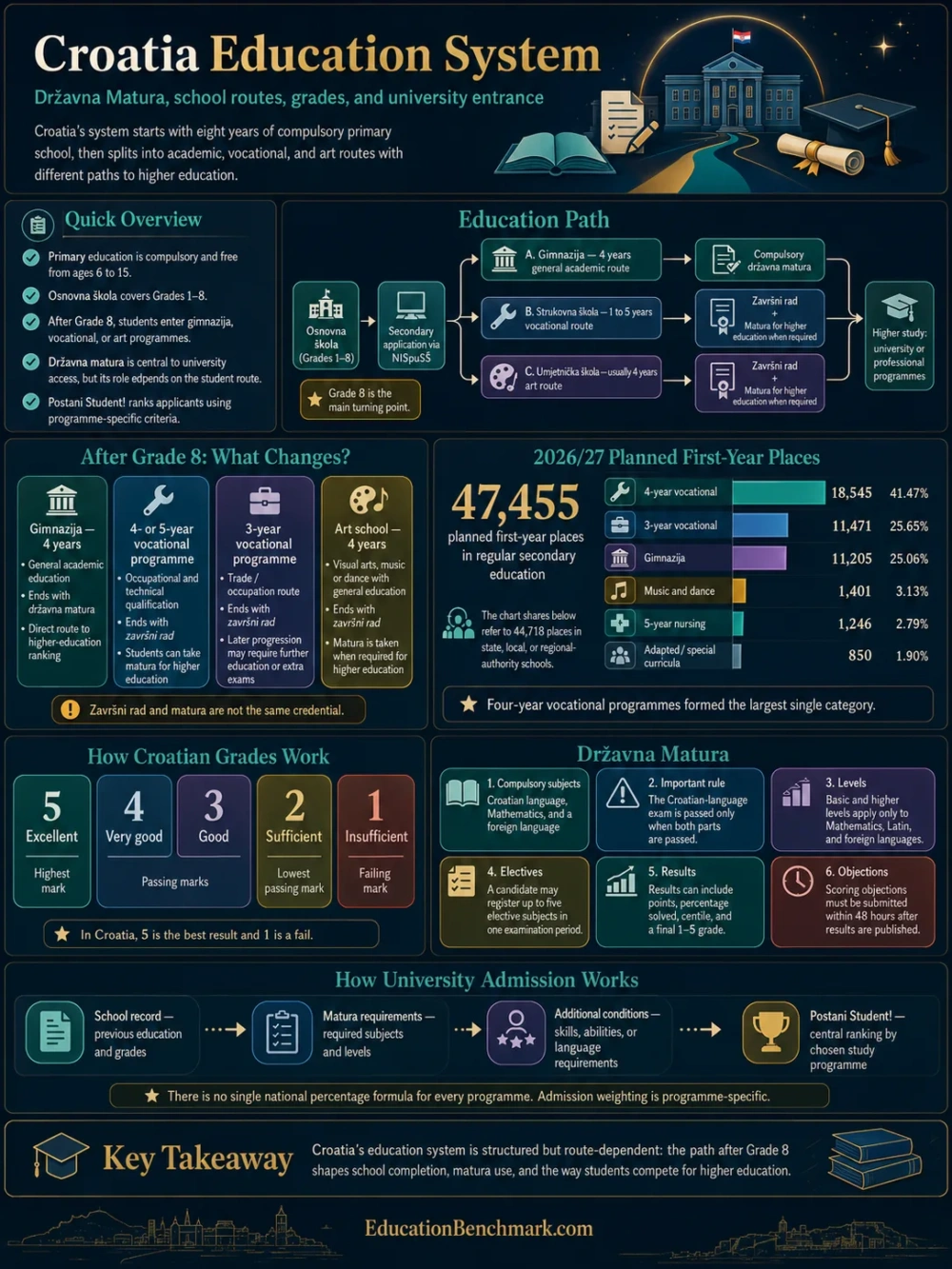
The official 2026/27 enrolment decision planned 47,455 first-year places in regular secondary education across Croatia. Of these, 44,718 places were in schools founded by the Republic, local authorities or regional authorities. Within that 44,718-place group, four-year vocational programmes formed the largest single category, while three-year vocational programmes also represented a large share. [c]
2026/27 Secondary Intake
Planned First-Year Places by Programme Type
Shares refer to 44,718 planned places in schools founded by the state, local authorities, or regional authorities.
Official 2026/27 planned capacity: gimnazija 11,205 places; four-year vocational 18,545; three-year vocational 11,471; five-year general nursing 1,246; adapted or special curricula 850; music and dance 1,401.
- 41.47% of the scoped places were assigned to four-year vocational programmes.
- 25.65% were assigned to three-year vocational programmes.
- 25.06% were assigned to gimnazija programmes.
- The figures show why treating Croatian secondary education as mainly a gimnazija system gives an incomplete picture of the actual intake structure.
The national plan also includes places in private schools and schools founded by religious communities. Those places are outside the 44,718-place denominator used in the chart, which is why the percentages should not be read as the distribution of every secondary-school place in the country.
Gimnazija, Strukovna Škola, and Umjetnička Škola Lead to Different Exits
Croatian secondary education has three main school families: gimnazije, vocational schools (strukovne škole) and art schools (umjetničke škole). Gimnazija programmes last four years and end with compulsory state matura. Vocational programmes can last from one to five years, while secondary art programmes generally combine general and specialised artistic education over four years. [d]
Secondary Route Comparison
What Changes After Grade 8
The exit document and higher-education route depend on the programme completed, not simply on attending a Croatian secondary school.
| Secondary route | Typical duration | Main orientation | How the route ends | Route toward higher education |
|---|---|---|---|---|
| Gimnazija | 4 years | General academic education | Državna matura | Matura results and programme-specific admission requirements are used for university applications. |
| Four- or five-year vocational programme | 4 or 5 years | Occupational and technical qualification | Završni rad and programme completion | Students can take state matura exams when continuing to higher education. |
| Three-year vocational programme | 3 years | Occupation, industry, trades or crafts | Završni rad and vocational qualification | Progression can require further education, additional or supplemental examinations, and fulfilment of later admission conditions. |
| Art school | 4 years | Visual arts, music or dance with general education | Završni rad | Students take state matura exams when the next route requires higher-education admission. |
Završni Rad and Matura Are Not the Same Credential
This is one of the easiest parts of the Croatian system to misread. A four-year vocational student can finish the vocational programme through završni rad and still need matura exams for the intended higher-education route. A gimnazija student, by contrast, completes secondary education through the compulsory state matura.
Three-year vocational programmes need an additional distinction. They are not simply shorter versions of four-year academic programmes. They lead toward occupational qualifications, and students who later want to move to higher educational levels may need supplementary study or examinations before meeting the requirements of a higher-education institution.
Croatia’s vocational sector is undergoing curricular change. During 2025, the Agency for Vocational Education and Training and Adult Education described the changes in vocational schools through modular instruction and the introduction of new curricular documents. [e] This means older descriptions of Croatian vocational education based only on fixed traditional subject programmes can miss the direction of current delivery.
Croatian Grades: 5 Is Excellent and 1 Is a Fail
The Croatian secondary-school grading scale runs from 1 to 5, with the direction opposite to systems where 1 is the strongest result. The marks are 5 excellent, 4 very good, 3 good, 2 sufficient and 1 insufficient. Grades 2 through 5 are passing marks; 1 is failing. [f]
Croatian School Marks
Reading the 1–5 Scale Correctly
Odličan is the highest numerical school mark.
Vrlo dobar and dobar are passing marks below the top grade.
Dovoljan is the lowest passing numerical mark.
Nedovoljan indicates failure.
A Croatian 5 should therefore be read first within its own national scale. Treating the numbers as if they were already a U.S.-style 4.0 GPA can reverse or distort their meaning. For university admission inside Croatia, the original school record can form one part of the candidate’s ranking alongside matura results and any other elements required by the study programme.
Državna Matura Under the 2026 Rules
A new Pravilnik o polaganju državne mature was published on 29 May 2026. It sets the current rules for the content, organisation, levels, examination periods, results and objection process for the state matura. The exams are standardised nationally and are administered by the National Centre for External Evaluation of Education (NCVVO) in cooperation with schools and other participating public institutions. [g]
The Compulsory Part
The compulsory part normally contains:
- Croatian language
- Mathematics
- A foreign language
Students in classical gimnazija programmes can choose Latin or Greek instead of the foreign-language examination under the conditions set by the regulation. Separate provisions apply to students educated in the language and script of a national minority.
Croatian Language Must Be Passed in Both Parts
The Croatian-language examination contains two parts. The 2026 regulation states that the examination is passed only when both parts are passed. This prevents the final Croatian result from being interpreted as one undivided paper with a single threshold.
Basic and Higher Levels Do Not Apply to Every Subject
The current rule starts from a one-level model. The exceptions are Mathematics and Latin in the compulsory part, together with foreign-language examinations in the compulsory or elective part. These can be taken at viša razina (higher level) or osnovna razina (basic level).
That distinction matters for university applicants because a study programme can require or reward a particular subject and level. Choosing a level is therefore not merely a question of whether the student can pass the matura.
Matura Sequence
From Subject Registration to Final Results
Special alternatives or minority-language provisions apply to eligible candidates.
Mathematics, Latin and foreign languages are the subjects covered by the two-level exceptions in the 2026 rule.
A candidate may register no more than five elective subjects in one examination period.
NCVVO publishes the calendar, registration dates, examination dates and final-result schedule for the relevant school year.
Matura Results Contain More Than a 1–5 Grade
The 2026 regulation allows exam results to be expressed through achieved points, the percentage of tasks solved and a centile result, with a final examination grade on the 1–5 scale. A grade of 1 is failing. This is why a school report mark and a matura result should not be treated as interchangeable numbers even though both can ultimately display a 1–5 grade.
Under the 2026 regulation, an objection to examination scoring is submitted within 48 hours after the publication of results. Examination calendars, catalogues and procedural dates should be checked for the specific matura cycle rather than copied from an earlier year.
Postani Student!: Matura Is Only One Part of Admission
Passing državna matura and gaining admission to a university programme are two different outcomes. Croatian-language undergraduate admissions are generally handled through the central online Postani student! system, where applicants can select up to ten study programmes. Higher-education institutions determine the conditions used to classify and select candidates. These can include the type of previous education, grades from secondary school, state matura results, special knowledge or abilities and language requirements. [h]
There is therefore no single national percentage formula that can be applied to every Croatian undergraduate programme. A Mathematics result that carries substantial weight for one programme may matter differently for another. The required matura level can also change by programme.
Higher-Education Selection
How a Croatian Undergraduate Application Becomes a Ranking
The exact weighting is programme-specific, so these stages describe the admission logic rather than a universal point formula.
The completed secondary route and academic achievement can contribute to candidate classification.
The programme determines which state matura results are required or included in the ranking.
Some institutions or programmes require further evidence, testing or demonstrated abilities.
The candidate’s eligible programme choices are ranked according to the requirements attached to each selected study programme.
This is also why a universal “Croatia university admission calculator” would be misleading without programme-specific data. The useful calculation is the one defined for the exact study programme and admission cycle, using its current weighting rules.
University and Professional Study After Admission
Croatian higher education has two broad study orientations. University study programmes are academic programmes offered by universities and can run through undergraduate, graduate and postgraduate cycles, with some integrated programmes combining undergraduate and graduate study. Professional study programmes have a more directly applied orientation and can be provided by polytechnics and universities. [i]
The system uses ECTS to express student workload. This means the move from secondary school into higher education is not simply “matura to university”: the destination can be a university programme or a professional programme, and later progression depends on the qualification earned and the conditions of the next programme.
For a gimnazija graduate, the common route is relatively direct: complete the matura, meet the admission conditions and compete in the programme ranking. For a four- or five-year vocational graduate, the route can also reach higher education, but the student first completes the vocational programme and then uses the required matura examinations for admission. Three-year vocational graduates have a different progression route and may need additional education or examinations before reaching the level required for higher study.
Where Croatian Education Rules Need Current Verification
Croatia combines nationally defined school and examination rules with programme-level choices. The state matura is standardised nationally, but secondary-school capacities, specialised entry requirements and higher-education admission weightings can change by school year, programme and institution. Matura catalogues, examination calendars and elective-subject lists are also issued for particular cycles.
The safest interpretation is therefore to separate stable system structure from cycle-specific requirements. The eight-year osnovna škola route, the distinction among gimnazija, vocational and art schools, and the role of državna matura describe the system. The exact examination dates, programme quotas, subject requirements and admission weights belong to a particular application year.
Education Benchmark is an independent informational guide and is not affiliated with any ministry of education, school authority, exam board, university, government agency, or official ranking organization.
Students and families making an enrolment or study decision should verify the current requirements with the relevant school, higher-education institution, NCVVO, admission system or Croatian education authority.
Sources and Verification
- [a] Primary education — Used for the eight-year primary route and compulsory education from ages 6 to 15. (Reliable because it is an official Government of Croatia information page.)
- [b] Vodič kroz sadržaj i strukturu nacionalnih ispita u četvrtome i osmome razredu u školskoj godini 2025./2026. — Used to distinguish fourth- and eighth-grade national examinations from the later državna matura. (Reliable because NCVVO is Croatia’s national external assessment institution.)
- [c] Odluka o upisu učenika u I. razred srednje škole u školskoj godini 2026./2027. — Used for NISpuSŠ, the 2026/27 national secondary-school enrolment plan and planned first-year places by programme type. (Reliable because Narodne novine is the official gazette of the Republic of Croatia.)
- [d] Types of secondary schools — Used for gimnazija, vocational and art school routes, programme duration, završni rad and progression toward higher education. (Reliable because it is an official Government of Croatia education page.)
- [e] The 9th Vocational Teachers’ Days Held — Used for the current shift toward modular instruction and new curricular documents in Croatian vocational education. (Reliable because it is published by Croatia’s Agency for Vocational Education and Training and Adult Education.)
- [f] Assessment in general upper secondary education — Used for the Croatian 1–5 secondary-school grading scale and the distinction between passing and failing marks. (Reliable because Eurydice is the European Union’s education information network.)
- [g] Pravilnik o polaganju državne mature — Used for the 2026 state matura rules covering compulsory subjects, exam levels, electives, examination periods, scoring and objections. (Reliable because Narodne novine publishes Croatia’s official regulations.)
- [h] How to apply — Used for Postani student!, programme selection and the institution-specific elements used in higher-education admissions. (Reliable because it is an institutional higher-education information portal for Croatia.)
- [i] Higher education system — Used for university and professional study routes, study cycles and ECTS within Croatian higher education. (Reliable because it is an institutional higher-education information portal for Croatia.)