Slovenia School Route Passport
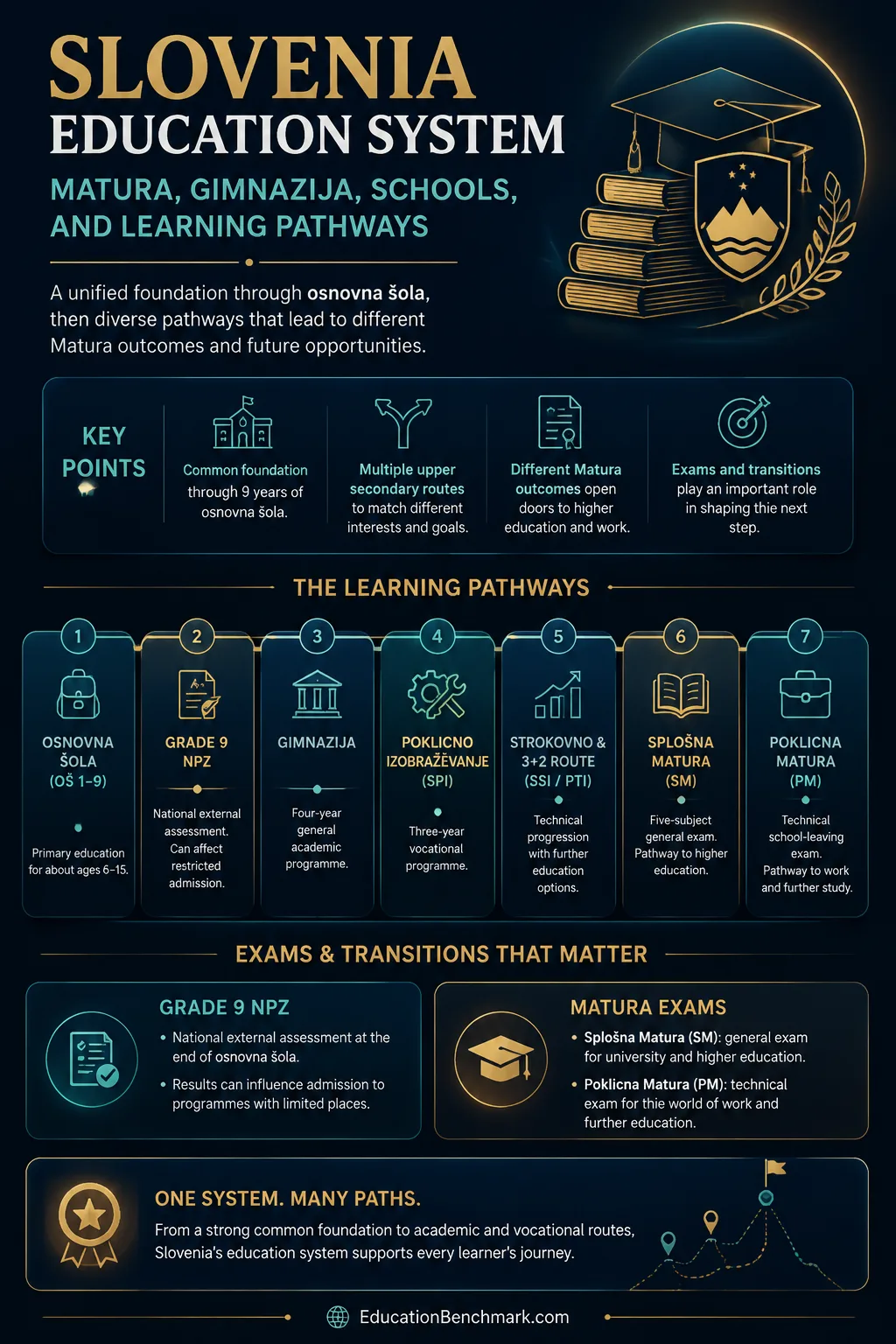
The Slovenian route stays unified through nine-year osnovna šola, then branches into gimnazija, technical and vocational programmes with different Matura outcomes.
Osnovna Šola
Selected stamp: Osnovna Šola. Choose another stamp to update the route card.
Slovenia keeps pupils in a common nine-year osnovna šola until roughly age 15, then opens several distinct upper-secondary routes. The decisive difference is not simply which secondary school a student attends. It is which qualification the programme leads to: a final examination, Splošna Matura, or Poklicna Matura, and what that qualification allows the student to do next. Basic education is compulsory, begins at about age six and is followed by general or vocationally oriented upper-secondary programmes of different lengths.[a]
At national level, Slovenia distinguishes primary education, upper-secondary education and tertiary education, with tertiary provision including both short-cycle higher vocational education and higher education. The Slovenian Qualifications Framework (SQF) adds another layer by mapping qualifications according to learning outcomes and showing their relationship to European qualification levels.[b]
The first major branch
The Choice After Osnovna Šola: Where the Route Branches
Most pupils share the same compulsory school structure through Grade 9. The upper-secondary decision then separates academic, technical, and occupation-focused routes.
Broad general education leads to Splošna Matura and is designed mainly around progression to tertiary study.
Srednje strokovno izobraževanje combines general and technical learning and normally ends with Poklicna Matura.
Srednje poklicno izobraževanje prepares for an occupation, ends with a final examination, and can continue into the two-year PTI route.
Nižje poklicno izobraževanje provides a shorter occupation-oriented pathway with possibilities for further vocational progression.
| Stage or programme | Typical timing | Usual length | Main transition or qualification |
|---|---|---|---|
| Vrtec | Before compulsory school | Varies | Optional preschool education before entry to osnovna šola |
| Osnovna šola | About ages 6–15 | 9 grades | Completion of compulsory basic education and upper-secondary choice |
| Gimnazija | Usually starts around age 15 | 4 years | Splošna Matura |
| NPI | After basic education | 2 years | Final examination and possible further vocational study |
| SPI | Usually starts around age 15 | 3 years | Final examination, employment, or PTI progression |
| SSI | Usually starts around age 15 | 4 years | Poklicna Matura |
| PTI | After an appropriate 3-year vocational programme | 2 years | Poklicna Matura |
A cross-country 2026 dataset codes Slovenia with an official compulsory-school entrance age of 6, a compulsory duration of 9 years and a theoretical exit age of 15. That coding is useful for comparison, but the national pathway is better understood through the nine grades of osnovna šola and the choices that follow them.[c]
Selection at the end of basic school
Why Grade 9 NPZ Matters at the Secondary-School Gate
NPZ should not be read as a universal entrance examination for every Slovenian secondary-school applicant.
Nacionalno preverjanje znanja (NPZ) is Slovenia’s national assessment. Pupils undertake compulsory national assessment at the end of Grades 3, 6 and 9, with the assessment serving system and learning-feedback functions.[d] The Grade 9 result has an additional consequence at the point of transition to upper-secondary education.
When an upper-secondary programme receives more eligible applicants than available places and enrolment is formally restricted, the current selection formula assigns up to 60% of the total to final grades in compulsory subjects from Grades 7, 8 and 9, 20% to the NPZ result in the language of instruction, and 20% to the NPZ result in mathematics. The Ministry expresses the formula as Sk/S × 60% + U/100 × 20% + M/100 × 20%. If a programme has no enrolment restriction and the applicant satisfies its entry conditions, this ranking mechanism does not operate as a nationwide entrance test for everyone.[e]
Final grades in compulsory subjects from Grades 7, 8 and 9 form the largest component.
The Grade 9 national assessment result in the language of instruction contributes separately.
The Grade 9 mathematics NPZ result supplies the remaining standard component of the ranking formula.
This makes the end of osnovna šola more consequential than a simple “finish Grade 9 and choose a school” description suggests. School achievement across three years remains the largest element, but NPZ can materially affect access to an oversubscribed gimnazija, technical, or vocational programme.
Gimnazija Is a Route, Not a Generic Name for Every Secondary School
A gimnazija is a form of general upper-secondary education, normally lasting four years and oriented primarily toward further study. Slovenia recognises general and classical gimnazija programmes as well as specialised forms that include technical, economic and artistic gimnazija programmes. Official classification also includes the one-year Matura course within general secondary provision.[f]
Technical Gimnazija and Technical Education Are Not the Same Route
The terminology can create confusion in English. A technical gimnazija remains within the gimnazija family and follows the general-education route toward Splošna Matura. By contrast, srednje strokovno izobraževanje (SSI) is four-year technical or professional upper-secondary education that normally culminates in Poklicna Matura.
The distinction matters because the two programmes may both contain specialised subjects, but they are built around different leaving qualifications. The name of the school alone is therefore less informative than the actual programme in which the student is enrolled.
What Gimnazija Is Designed to Do
Gimnazija provides a broad academic curriculum rather than training for one defined occupation. Students study languages, mathematics, sciences, humanities, social subjects, arts and other programme-specific components before completing the national General Matura. Specialisation changes the emphasis of the programme without turning the qualification into the vocational Matura route.
General school-leaving qualification
Splošna Matura: Five Subjects and a 34-Point Ceiling
The General Matura is not one final paper. It is a nationally regulated five-subject examination with compulsory and optional components.
General Matura candidates take five subjects. The compulsory core consists of the mother tongue, mathematics and one foreign language; two additional subjects are selected from the approved optional group. The mother tongue is normally Slovenian, with Hungarian or Italian used in the relevant ethnically mixed areas. Certain subjects, including mathematics and several languages, can be taken at foundation or higher tier, and a candidate may take no more than two subjects at the higher tier.[g]
Mother tongue, mathematics and one foreign language form the compulsory core.
Only specified subjects offer foundation and higher tiers, and no candidate may select more than two at higher tier.
Additional points available in mother-tongue and higher-tier assessment make the total higher than a simple five-times-five calculation.
Why the Matura Score Can Exceed 25
The ordinary Slovenian grading scale runs from 1 to 5, with 1 insufficient and 2 the minimum pass grade. General Matura assessment adds extra points at the upper end for mother-tongue examinations and subjects taken at higher tier. These examinations can therefore contribute as many as 8 points each, producing a maximum overall General Matura result of 34 points.
This scoring structure is important when interpreting university admission information. A Matura “point” is not simply a percentage mark, and higher-education programmes can apply their own published selection rules when applicant numbers exceed available places.
Two different school-leaving qualifications
Poklicna Matura Has Different Subjects and Different Access Rules
Under the current four-subject Poklicna Matura model, the first subject is the mother tongue; the second is the theoretical part of a qualification-specific examination; the third is mathematics, a foreign language or an eligible second language; and the fourth is the practical part of the qualification-specific assessment, such as a product or service with defence or performance. The maximum overall score is 23 points because the first subject can contribute up to 8 points while the other three contribute up to 5 each.[h]
Splošna Matura and Poklicna Matura are separate examinations. Even where subject names overlap, the National Examinations Centre states that General and Vocational Matura examination materials are produced by different examination committees and are not the same papers.
Poklicna Matura also functions as more than a school-completion certificate. It combines an upper-secondary vocational or technical qualification with a route into further study. It supports direct progression to short-cycle higher vocational education and relevant professional higher-education routes. For university academic programmes, many—but not all—allow a combination of Poklicna Matura plus one additional General Matura subject; the required subject and whether the combination is accepted are defined in the relevant annual enrolment conditions.[i]
The 3+2 Route, Maturitetni Tečaj, and Other Bridges
Slovenian upper-secondary education branches at about age 15, but it is not designed as a set of completely sealed tracks. Several formal bridges allow a student to gain a higher qualification or redirect the route later. Official guidance describes three-year vocational education, two-year vocational-technical continuation, one-year Matura and vocational courses, and apprenticeship as connected parts of the wider system.[j]
Transfer and progression routes
How Students Can Change Direction After the First Secondary Choice
A relevant three-year vocational programme can be followed by two years of vocational-technical education, raising the route to Poklicna Matura level.
The one-year Matura course provides an important route toward Splošna Matura for eligible learners coming from another secondary pathway.
A one-year vocational course can add a vocationally oriented qualification route for students who meet the prior secondary-education conditions.
Apprenticeship combines school learning with substantial practical training at an employer within eligible vocational programmes.
Why “3+2” Is More Than Five Years of Vocational School
The first three years lead to a vocational qualification and final examination. The additional two-year poklicno-tehniško izobraževanje (PTI) is a progression programme, not simply two more identical years. Its significance is that the student can move onward to Poklicna Matura, expanding the range of further-study possibilities.
Apprenticeship Changes Where Learning Takes Place
In the apprenticeship form described by Slovenian Euroguidance, the apprentice spends at least 40% of the education time in school and at least 50% in practical training with an employer. Schools and companies share the educational role, with support from the relevant chambers. Apprenticeship is therefore a form within vocational education rather than a separate educational level.
School Calendar and Italian–Hungarian Language Provision
The national route operates through a mixture of national rules and local delivery. Public basic schools form the mainstream compulsory network, while private provision also exists. Municipalities establish basic schools and the public network is designed to guarantee a place in the local catchment-area school. Preschool provision precedes this compulsory stage, while upper-secondary education is chosen after completion of osnovna šola.
The Formal School Year Is Longer Than the Teaching Period
For basic education, the formal school year runs from 1 September to 31 August of the following calendar year, while lessons are concentrated within the September-to-June period. Grade 9 finishes instruction earlier than the other basic-school grades because final assessment and transition procedures occur near the end of the school year.[l]
Slovenian Is the Default Language, but Not the Only Model
Schooling is normally conducted in Slovenian. In ethnically mixed areas where the Italian national community lives, schools and kindergartens can provide education in Italian. In areas associated with the Hungarian national community, bilingual Slovenian–Hungarian kindergartens and schools operate under the relevant legal framework.[k]
This language structure also appears in national assessment and Matura rules. References to “mother tongue” or “language of instruction” therefore cannot always be read as meaning Slovenian only; Italian and Hungarian have defined roles in the relevant areas.
Curriculum Renewal and the Next Poklicna Matura Reform
Slovenia’s school framework is currently moving through a substantial curriculum renewal. Revised curricula are being introduced gradually in basic education between the 2026/27 and 2028/29 school years, while revised general upper-secondary curricula begin implementation from 2026/27. The reform covers both revised existing curricula and continued work on new or updated subject frameworks.[m]
The Five-Subject Poklicna Matura Is Legislated, but It Is Not the Current Four-Subject Exam
A 2025 amendment to Slovenia’s Matura Examination Act creates a future five-subject form of Poklicna Matura. Under that model, the common component includes the language of instruction, mathematics and a foreign language at General Matura level, alongside a fundamental vocational-theoretical subject and an additional elective component. Crucially, the law schedules the provisions establishing this five-subject model to begin applying in the 2030/31 school year. It should therefore not be presented as the examination structure already taken by current Poklicna Matura candidates. The same amendment schedules changes to vocational Matura examination periods from the 2026/27 school year.[n]
The four-subject Poklicna Matura described by the National Examinations Centre remains the relevant structure before the five-subject provisions take effect. Future university-entry possibilities under the new model should be checked against the rules applicable to the student’s actual graduation and application year.
The central logic of Slovenian secondary education is therefore one of qualifications and bridges. Gimnazija points toward Splošna Matura; technical and vocational-technical routes point toward Poklicna Matura; three-year vocational education can lead directly to work or onward through PTI; and Matura or vocational courses provide additional ways to redirect a pathway. The first upper-secondary choice matters, but it does not necessarily determine every later option.
Education Benchmark is an independent informational guide and is not affiliated with any ministry of education, school authority, exam board, university, government agency, or official ranking organization.
Enrolment limits, NPZ selection criteria, Matura regulations, subject combinations, curricula and higher-education admission conditions can change. Decisions involving a specific student should be checked against the current Ministry, National Examinations Centre, school, university and programme-specific rules that apply in the relevant academic year.
Sources and Verification
- [a] Organisation of the education system and of its structure — Used for the nine-year basic-school structure, typical school-entry and transition ages, compulsory status and upper-secondary pathway organisation. (Reliable because Eurydice is the European education information network and the Slovenia material is maintained through its national education unit.)
- [b] Slovenian education system and Slovenian Qualifications Framework — Used for the national education-level structure, tertiary categories and the role of the Slovenian Qualifications Framework. (Reliable because it is an official Government of Slovenia education-system page.)
- [c] Compulsory Education Worldwide (2026): Years, Ages, and Enforcement by Country — Used only for the comparative coding of Slovenia’s compulsory-school entrance age, duration and theoretical exit age. (Useful as an independent cross-country education reference that documents standardized legal and indicator-based comparisons; national rules are verified separately with official sources.)
- [d] Slovenia – Eurydice network – European Union — Used for the current national-assessment points in Grades 3, 6 and 9. (Reliable because Eurydice provides regularly maintained European education-system information with a national Slovenian unit.)
- [e] Vpis v srednjo šolo — Used for current upper-secondary restricted-enrolment rules and the 60% school grades, 20% language NPZ and 20% mathematics NPZ formula. (Reliable because it is the official Slovenian government page for upper-secondary enrolment procedures.)
- [f] General secondary education (85.310) — Used for the recognised forms of gimnazija and the position of the Matura course within general secondary education. (Reliable because SPOT is an official Slovenian state portal and identifies the legal and statistical basis for the programme classification.)
- [g] Assessment – General matura exam – eng — Used for General Matura subjects, tier rules, grading and the maximum 34-point overall result. (Reliable because RIC is Slovenia’s National Examinations Centre.)
- [h] Assessment – Vocational matura exam – eng — Used for the current four-subject Vocational Matura structure, grading and maximum 23-point result. (Reliable because RIC is the national body responsible for technical and professional support for Slovenia’s Matura examinations.)
- [i] General information – Vocational matura exam – eng — Used for the relationship between Poklicna Matura, higher vocational study and university routes that may require an additional General Matura subject. (Reliable because it is official guidance from Slovenia’s National Examinations Centre.)
- [j] Lifelong Guidance in Slovenia — Used for the vocational-programme ladder, 3+2 progression, Matura and vocational courses, apprenticeship proportions and short-cycle tertiary pathway. (Reliable because the publication is issued through Euroguidance Slovenia and the Employment Service of Slovenia, drawing its education-system description from Eurydice Slovenia and the Ministry.)
- [k] Private primary education with state-approved programmes — Used for the legal language-of-instruction framework covering Slovenian, Italian-language provision and Slovenian–Hungarian bilingual schooling in nationally mixed areas. (Reliable because SPOT is an official Slovenian state portal and cites the Organisation and Financing of Education Act as its legal basis.)
- [l] Organisation of single-structure education — Used for the basic-school calendar, formal school-year boundaries and the timing of Grade 9 instruction. (Reliable because Eurydice publishes nationally maintained education-organisation information for European systems.)
- [m] National reforms in school education — Used for the phased introduction of revised basic-school and general upper-secondary curricula from the 2026/27 school year. (Reliable because it is the current Slovenia reform record within the Eurydice network.)
- [n] 1905. Zakon o spremembah in dopolnitvah Zakona o maturi (ZMat-C) — Used for the enacted five-subject Vocational Matura model, its subject structure, the 2030/31 implementation date and the earlier change to examination-period provisions. (Reliable because it is the published text of Slovenia’s Matura Examination Act amendment in the Official Gazette.)