
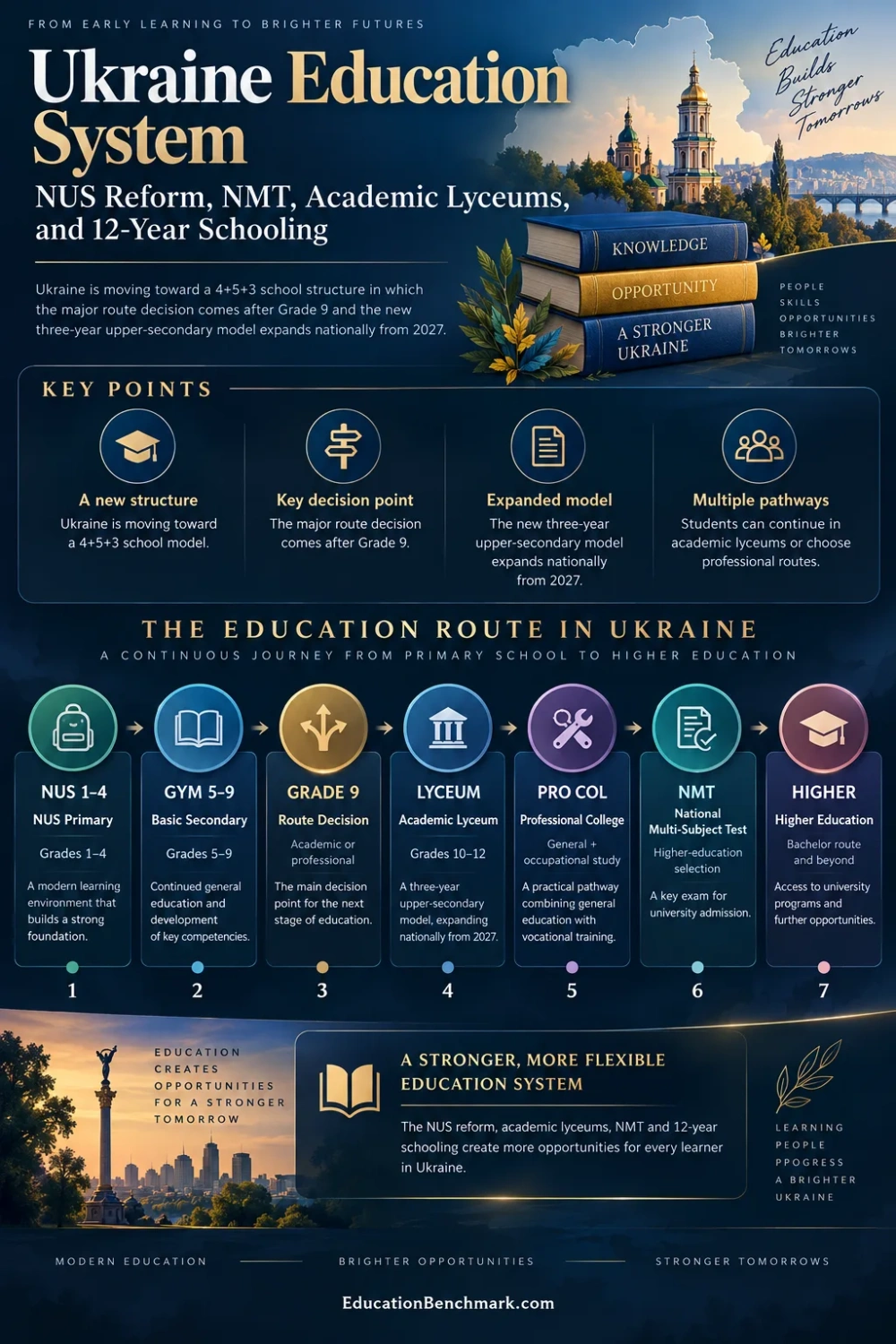
Ukraine’s NUS Route From Primary School to Lyceum, NMT, and Higher Education
Ukraine is moving toward a 4+5+3 school structure in which the major route decision comes after Grade 9 and the new three-year upper-secondary model expands nationally from 2027.
NUS Primary
Selected stamp: NUS Primary. Choose another stamp to update the route card.
Ukraine’s education system is best understood as a reform in motion rather than a twelve-year model that every school cohort already follows in exactly the same way. Under the Law on Education, complete general secondary education is compulsory and is structured as four years of primary education, five years of basic secondary education, and three years of profile or specialised secondary education. Primary education normally begins at age six. The same framework places strong emphasis on competences including language, mathematics, science and technology, digital skills, lifelong learning, civic and social competences, culture, entrepreneurship, critical thinking, problem solving, and cooperation. [a]
The timing matters. The twelve-year programmes were phased in from 2018 at primary level and from 2022 at basic secondary level, while the three-year profile secondary stage is scheduled for nationwide implementation from September 2027. During the 2026–27 school year, 150 academic lyceums are already operating the new upper-secondary model as a pilot, giving Ukraine both a legacy senior-school structure and the emerging Grades 10–12 structure at the same time. [b]
Transition year
Why 2026–27 Has Two Upper-Secondary Structures at Once
References to both Grades 10–11 and Grades 10–12 can be correct because Ukraine is moving between two school structures by cohort.
| Stage | Grades | Approximate age | Position in 2026–27 |
|---|---|---|---|
| Primary education | 1–4 | About 6–10 | Established NUS stage |
| Basic secondary education | 5–9 | About 10–15 | NUS reform reaches the end of the basic-secondary route |
| Legacy senior-school route | 10–11 | About 15–17 | Still relevant to cohorts completing the pre-reform structure |
| Profile secondary route | 10–12 | About 15–18 | Piloted in academic lyceums before nationwide rollout |
The reform therefore does not add a twelfth grade to every existing Grade 11 cohort overnight. The current senior-school model is described by the Ministry as Grades 10–11, while the reformed model is Grades 10–12. In the new model, Grade 10 becomes an adaptation year and Grades 11–12 provide more time for profile study and preparation for further education. The first nationwide Grade 10 cohort enters the profile model in September 2027, with the first Grade 12 completion expected in 2030. [c]
The Grade 9 Fork
Grade 9 becomes more important under the reform because it sits at the point where a common basic-secondary route branches. The two routes below are alternatives, not sequential steps.
Students finish basic secondary education and choose the type of upper-secondary route that matches their plans.
Grades 10–12 emphasize profiles, elective choice, deeper academic study, and preparation for higher education.
Students combine complete general secondary education with preparation for a profession or specialty.
The professional branch is not a dead end for further study. Ukraine’s reform model allows students in professional education to obtain general secondary education alongside occupational preparation and, where admission conditions are met, continue into higher education later.
NUS reform sequence
NUS: From Competency Reform to the 4+5+3 School Route
New Ukrainian School, usually shortened to NUS, changes both what students are expected to learn and how the school route is organized.
NUS is broader than the move from eleven to twelve school years. Its logic is competency-based: students are expected to apply knowledge, communicate, solve problems, work with information, make choices, and connect learning across subjects rather than treat curriculum coverage as the only objective. The structural reform and the curriculum reform are therefore closely linked.
- 2018: the twelve-year programme began at primary level.
- 2022: implementation moved into basic secondary education.
- 2026–27: NUS reaches the end of the basic-secondary phase while 150 academic lyceums pilot the new senior-school model.
- 2027: model programmes and materials for the reformed Grade 10 are introduced nationally.
- 2028: the rollout extends to the new Grade 11.
- 2029: the sequence reaches the new Grade 12.
The government’s updated NUS roadmap through 2029 also links upper-secondary reform with teacher preparation, a redesigned network of profile-secondary institutions, textbook development, and stronger career guidance. This matters because the Grade 9 decision is intended to become an informed choice between educational trajectories rather than merely another automatic year-to-year promotion. [d]
Profile secondary education
Academic Lyceums: Profiles, Clusters, and Grade 10 Adaptation
The academic lyceum is designed to offer substantially more choice than the legacy Grades 10–11 model.
Under the updated lyceum rules, an academic lyceum is primarily an institution for academic upper-secondary education. Primary and basic-secondary stages may be retained only in specified circumstances rather than being the default structure. A lyceum must offer at least three profiles, and those profiles are organized within one or more of three broad clusters.
Natural-science and mathematics-oriented profiles can support deeper study in mathematics, science, technology, and related fields.
Profiles can concentrate on languages, literature, communication, and related humanities-oriented study.
Profiles can emphasize social, historical, civic, cultural, and other humanities-related fields.
Students can choose a profile and build an individual educational trajectory through elective components. The regulations also provide a procedure for changing profile with consultation and allow variable or cross-class groups, so students choosing the same course do not always need to belong to the same fixed class. Competitive admission to Grade 10 is required only when applications exceed available places. [e]
Why Grade 10 Is Different From Grades 11–12
Grade 10 is deliberately less specialized. The common compulsory component is largest in the first year, giving students time to adapt to the lyceum, recover learning gaps where necessary, test whether their chosen profile is suitable, and change direction without having already missed a large amount of specialized study. In Grades 11 and 12, profile study and elective choice occupy a much larger share of curriculum time.
Curriculum shift
How Study Time Changes Across Grades 10–12
Annual hours in the state standard’s basic academic plan show the common core shrinking as profile and outside-profile choice expands.
Grade 10: 840 common compulsory hours, 280 profile hours, and 140 outside-profile choice hours. Grade 11: 630, 315, and 315. Grade 12: 420, 420, and 420 respectively. [f]
Chart analysis
- The common compulsory allocation falls from 840 hours in Grade 10 to 420 in Grade 12.
- Profile study plus outside-profile choice rises from 420 hours in Grade 10 to 840 in Grade 12.
- The total shown in the three categories remains 1,260 annual hours in each grade; what changes is the balance between common and student-directed study.
University admission
NMT 2026: Four Subjects in One Testing Day
The National Multi-Subject Test is primarily an entrance assessment for higher education, not simply another name for the school-leaving examination.
Ukrainian Language, Mathematics, and History of Ukraine are compulsory for 2026 NMT participants.
The fourth subject is selected from Ukrainian Literature, a listed foreign language, Biology, Chemistry, Physics, or Geography.
Each subject receives 60 minutes, with a 20-minute break after Ukrainian Language and Mathematics.
Each subject result is converted to the 100–200 scale used in the competitive admission process.
The 2026 NMT is computer-based. Applicants complete Ukrainian Language and Mathematics first, take the scheduled break, and then complete History of Ukraine plus the selected fourth subject. The optional foreign-language choices are English, German, French, or Spanish. Temporary examination centres were also organized outside Ukraine; the 2026 system included centres in 54 cities across 32 countries. [g]
From NMT Results to the Competitive Score
An applicant’s four NMT results should not be read as a simple arithmetic average that produces the same admission score for every university programme. In the 2026 admission system, individual subjects receive weighting coefficients that depend on the specialty. Creative specialties can also include a creative competition result. The final competitive score for each application is calculated through Ukraine’s Unified State Electronic Database on Education, taking the applicable components and coefficients into account. [h]
This means that a strong result in one NMT subject can matter more for one field of study than for another. NMT therefore creates a common national testing base, while the competitive-score formula connects that base to the programme being applied to.
Assessment distinctions
NMT, DPA, and School Assessment Are Not the Same Thing
Ukraine’s current terminology is easier to understand when each assessment is separated by purpose.
Legislation extended the exemption from state final attestation to students completing each level of full general secondary education in the 2025–26 academic year. In practical terms, this covered the cohorts completing Grades 4, 9, and 11 under the structure applying to them. The exemption is one reason it is inaccurate to describe the NMT simply as the 2026 DPA under another name. [i]
DPA-9 Is Being Rebuilt Rather Than Abandoned
The temporary exemption does not mean Ukraine has stopped developing state assessment. In autumn 2026, the Ukrainian Center for Educational Quality Assessment is testing elements of a redesigned Grade 9 DPA with 2,000 Grade 10 students who previously studied in schools piloting NUS materials at basic-secondary level. The initial work covers the language-and-literature field in the state language and mathematics, with further piloting planned for 2027. A complete DPA-9 system across the planned areas is not expected before 2029. [j]
This creates an important distinction for readers following Ukrainian reform: DPA policy concerns certification and system-level assessment, while NMT policy concerns competitive admission to higher education. The two may coexist but serve different purposes.
School operation
Schooling During Wartime: National Structure, Local Delivery Decisions
The formal grade route remains national, but the way schooling is organized can differ because of local security conditions.
The 2026–27 academic year for general secondary schools is set to run from 1 September 2026 to 30 June 2027. Regional and Kyiv city military administrations, together with school founders, determine how the year begins in individual communities with regard to the security situation. Schools can also determine the actual end of lessons and vacation arrangements within the national framework, taking security conditions and student needs into account. [k]
For understanding the education system, this distinction is important. A student can still be formally in Grade 7, Grade 9, or a Grade 10 lyceum programme even when the local mode of instruction differs from that used in another community. Delivery mode and formal school stage are not the same variable.
Security conditions also help explain why a national examination such as the NMT uses specially equipped centres and procedures for interruptions such as air alerts, and why examination access outside Ukraine remains relevant to displaced students.
International benchmark
PISA 2025: A Learning-Outcome Snapshot, Not a Verdict on NUS
The newest OECD results provide useful context, but their geographic coverage and the timing of the reform require careful interpretation.
| Domain | Ukrainian regions, 17 of 27 | OECD average |
|---|---|---|
| Science | 65% | 74% |
| Mathematics | 54% | 65% |
| Reading | 55% | 69% |
OECD reports that the average 2025 results for the participating Ukrainian regions were about the same as in 2022 in mathematics, reading, and science. The scope is crucial: the country note covers 17 of Ukraine’s 27 regions, not an unrestricted national sample. These results therefore provide evidence about learning conditions and outcomes in the participating regions, but they should not be used to claim that NUS itself caused a particular rise, decline, or lack of change. [l]
The next transition
What Changes in 2027 — and What Still Needs Checking
The most important question is often not simply “What is Ukraine’s school structure?” but “Which structure applies to this student’s cohort?”
For the first NUS generation, September 2027 is the decisive structural change. The student route becomes a full 4+5+3 sequence: four years of primary education, five years of basic secondary education, and three years of profile secondary education. After Grade 9, academic lyceums and professionally oriented institutions become distinct routes rather than the senior years simply continuing in the same form for everyone.
For an academically oriented student, the route can be summarized as Grade 9 completion → academic lyceum → Grade 10 adaptation → deeper profile study in Grades 11–12 → NMT and the applicable university admission process. For a career-oriented student, Grade 9 can instead lead to professional education that combines general secondary study with preparation for a profession or specialty, followed by employment, further professional study, or eligible higher-education admission.
The school year, available lyceums, profiles, elective subjects, local admission capacity, professional programmes, NMT rules, subject coefficients, and higher-education admission procedures can change by cohort, year, locality, institution, and specialty. A student making an actual school or university decision should verify the rules applying to that specific year with the relevant school, education authority, examination body, university, or Ministry source.
Education Benchmark is an independent informational guide and is not affiliated with any ministry of education, school authority, exam board, university, government agency, or official ranking organization.
Research base
Sources and Verification
- [a] Law on Education — Used for compulsory complete general secondary education, the four-year primary, five-year basic-secondary and three-year profile-secondary structure, normal primary-school starting age, competence orientation, and the statutory 2018–2022–2027 implementation sequence. (Reliable because it is the official education law published by the Ministry of Education and Science of Ukraine.)
- [b] Scaling Transformation: Ukraine Advances to the Next Stage of Upper Secondary Education Reform — Used for the September 2026 pilot involving 150 academic lyceums and the move toward nationwide upper-secondary implementation in 2027. (Reliable because it is an official English-language Ministry of Education and Science of Ukraine reform update.)
- [c] Upper Secondary School Reform: Profilna — Used to distinguish the current Grades 10–11 model from the reformed Grades 10–12 structure, explain Grade 10 adaptation, the Grade 9 route split, and the expected first Grade 12 completion in 2030. (Reliable because it is the official Ministry upper-secondary reform portal.)
- [d] Government Updates the NUS Reform Roadmap Through 2029 — Used for the current NUS roadmap and the sequential introduction of new upper-secondary programmes and materials for Grades 10, 11, and 12 in 2027, 2028, and 2029. (Reliable because it is an official Ministry of Education and Science of Ukraine reform announcement.)
- [e] What the Updated Lyceum Regulation Changes — Used for academic-lyceum status, the minimum profile requirement, the STEM, language-and-literature and social-humanities clusters, profile changes, cross-class groups, and admission when demand exceeds places. (Reliable because it is the Ministry’s explanation of the updated government regulation for lyceums.)
- [f] More Choice for Students: State Standard for Profile Secondary Education — Used for the Grade 10 adaptation logic and the annual-hour allocations for common compulsory, profile, and outside-profile study in Grades 10–12. (Reliable because it is the official Ministry explanation of the approved State Standard for profile secondary education.)
- [g] University Entrance Exams in 2026 (University Admission Campaign 2026) — Used for the 2026 NMT subject structure, testing time, one-day format, 100–200 conversion, computer-based delivery, and overseas examination-centre provision. (Reliable because it is published by the Ukrainian Center for Educational Quality Assessment, the state body responsible for national external assessment.)
- [h] 2026 Admission Campaign: Frequently Asked Questions — Used to explain that the competitive admission score is not a simple NMT average and that subject weights and other applicable components depend on the application and specialty. (Reliable because it is an official Ministry of Education and Science of Ukraine admission guidance page.)
- [i] Law No. 4702-IX on State Final Attestation and the 2026 Admission Campaign — Used for the extension of the state final attestation exemption to students completing levels of general secondary education in the 2025–26 academic year. (Reliable because it is an in-force law published through the official legislation portal of the Verkhovna Rada of Ukraine.)
- [j] DPA-9: General Information — Used for the autumn 2026 DPA-9 trial involving 2,000 students, the planned 2027 continuation, and the statement that a complete redesigned DPA-9 system is possible no earlier than 2029. (Reliable because it is official information from the Ukrainian Center for Educational Quality Assessment.)
- [k] Duration and Organization of the 2026/2027 Academic Year — Used for the official 1 September 2026 to 30 June 2027 school-year framework and the role of regional authorities, founders, and schools in making operational decisions based on security conditions. (Reliable because it is an official Ministry of Education and Science of Ukraine school-year notice.)
- [l] PISA 2025 Results (Volume I): Ukrainian regions (17 of 27) — Used for the latest PISA proficiency figures, the 17-of-27-region coverage limitation, OECD comparison values, and the comparison with 2022 results. (Reliable because OECD administers PISA and publishes the official international results and country notes.)