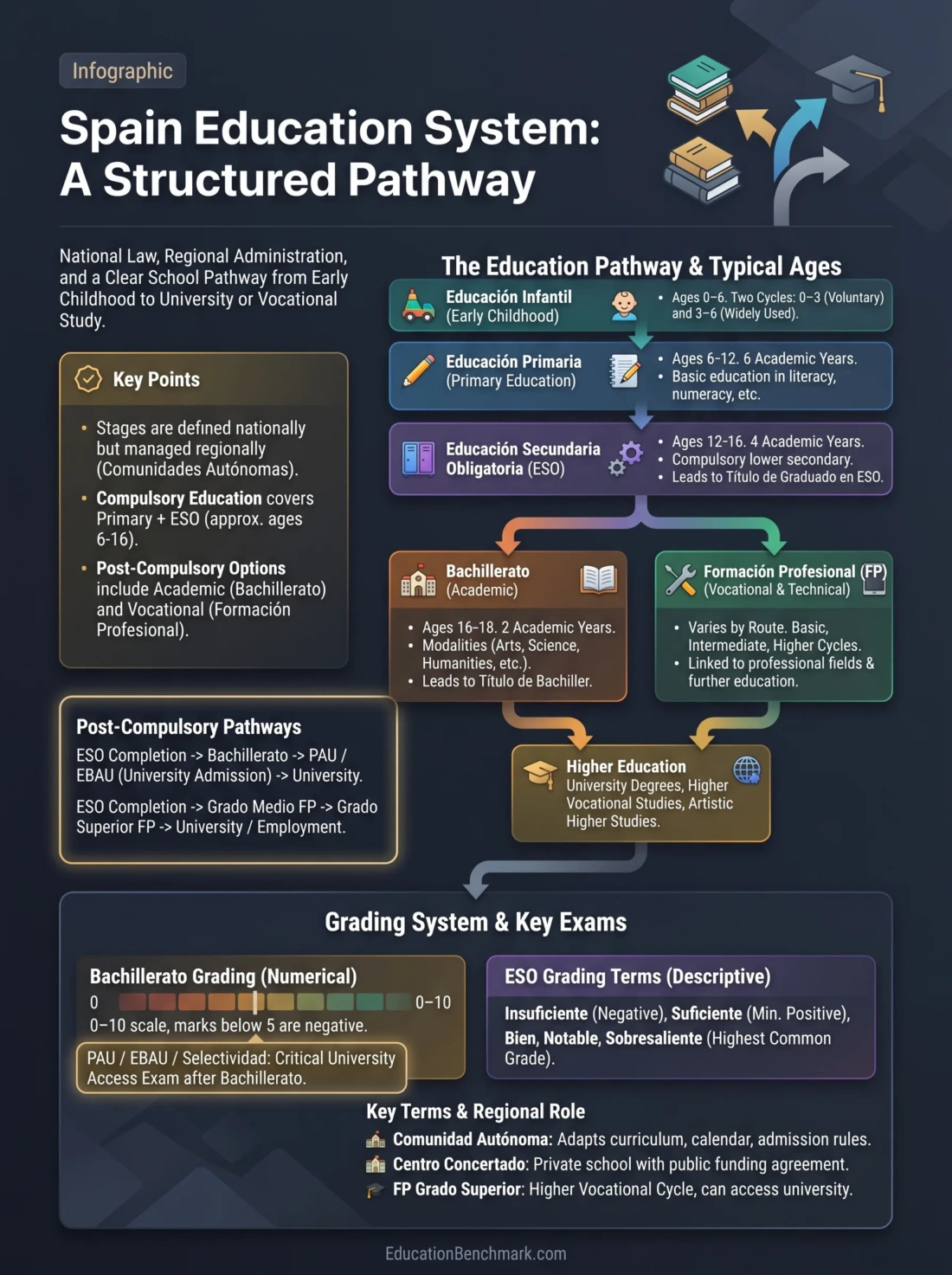
Spain Education Passport: From ESO to PAU and FP
A route map of the compulsory secondary stage, the Bachillerato and vocational branches, and the main paths into higher education.
Compulsory Secondary
Selected stamp: Compulsory Secondary. Choose another stamp to update the route card.
Spain’s school route becomes easiest to understand at the end of compulsory secondary education. ESO is the shared stage, but the routes after it branch: Bachillerato serves the main academic path, Formación Profesional offers several vocational levels, and university admission depends on the qualification a student brings.
The national government sets common rules and valid qualifications, while the 17 autonomous communities manage much of the day-to-day system. That division explains why the same national stage can have different calendars, language arrangements, subject offers, admission procedures, and administrative names from one region to another.
The ESO Decision Point: One Qualification, Several Routes
Educación Secundaria Obligatoria, usually shortened to ESO, lasts four school years and normally covers ages 12 to 16. It forms the second half of Spain’s free compulsory basic education, following six years of primary school. The standard national route therefore contains ten compulsory school years from about age 6 to 16.[a]
Cross-country references often describe Spain as having a ten-year compulsory span. That is useful for comparison, but it does not show the full Spanish route: Educación Infantil begins earlier, post-16 study is common, and regional authorities shape how national rules appear in schools.[b]
The fourth year of ESO is not a single-track preparation year. Students continue common learning while choosing subjects that can support later study. The official structure includes Mathematics A or Mathematics B and a set of option subjects. Eligible students may also be proposed for a Ciclo Formativo de Grado Básico, normally from age 15, under stated academic and guidance conditions. Completing a basic vocational cycle can lead to both the title of Técnico Básico and the Graduado en ESO.[c]
Decision map
What Can Follow 4º ESO
The route depends on the qualification earned, the student’s interests, available places, and any access conditions attached to the next programme.
The school-based qualification normally gives direct access to Bachillerato and Grado Medio.
A two-year programme organised by modality, usually followed by PAU for university applicants.
An occupational cycle leading to the title of Técnico and possible progression to higher vocational study.
A route for eligible students that combines basic learning with vocational preparation and can lead to two qualifications.
The 6–4–2 Pattern and Typical Ages
The phrase 6–4–2 is a useful memory aid, not an official label. It refers to six years of Educación Primaria, four years of ESO, and two years of Bachillerato for students who choose that branch. Educación Infantil comes before primary school, while vocational routes do not fit neatly into the final “two.”
School route
Spanish Education Levels in Sequence
Ages are typical for uninterrupted progression. Repetition, early or late entry, adult provision, and individual programmes can change the timing.
| Stage | Typical age | Usual length | Compulsory status and outcome |
|---|---|---|---|
| Educación Infantil, first cycle | 0–3 | Up to three years | Non-compulsory early childhood education. |
| Educación Infantil, second cycle | 3–6 | Three years | Non-compulsory; publicly funded provision is free. |
| Educación Primaria | 6–12 | Six years | First part of compulsory basic education. |
| Educación Secundaria Obligatoria | 12–16 | Four years | Leads toward the Graduado en ESO. |
| Bachillerato | 16–18 | Two years | Optional academic upper secondary; leads to the Título de Bachiller. |
| Ciclo Formativo de Grado Básico | Usually 15+ | Programme-based | Supported vocational route; may lead to Técnico Básico and Graduado en ESO. |
| Ciclo Formativo de Grado Medio | Usually 16+ | Cycle-based | Optional vocational study leading to Técnico. |
| Ciclo Formativo de Grado Superior | Usually 18+ | Cycle-based | Advanced vocational study leading to Técnico Superior. |
| University Grado | Usually 18+ | Degree-dependent | Undergraduate higher education entered through an eligible access route. |
The legal end of compulsory schooling should not be confused with the end of education participation. Many students remain in Bachillerato or vocational education, and people without the usual qualification can later use adult education, access tests, or other recognised routes. The exact option set is not identical in every community.
State Rules, Autonomous Communities, and School Autonomy
Spain is decentralised in educational administration. The state defines the common legal base, minimum teaching content, nationally valid qualifications, and broad conditions for progression and access. Autonomous communities develop the curriculum for their territory and organise the public system. Schools then adapt and complete parts of that curriculum through their educational plans.[d]
Governance stack
Who Decides What in Spanish Education
The national ministry establishes basic rules, minimum curriculum requirements, qualification conditions, and the shared structure of the system.
Regional education authorities set territorial curricula, calendars, staffing arrangements, language policies, admissions procedures, and many implementation details.
Schools organise teaching, select permitted options, support students, and apply assessment rules within national and regional requirements.
This division produces real differences. A family moving from Andalusia to Catalonia, Galicia, the Basque Country, Madrid, or another community may encounter a different school calendar, additional language study, different application portals, and a different supply of Bachillerato modalities or vocational cycles. The qualification remains nationally recognised, but the route is administered locally.[e]
Where Co-Official Languages Matter
In communities with a co-official language, that language can be part of the curriculum and may also be used as a language of instruction. The balance between Castilian Spanish and the co-official language is set through regional rules and can differ by school model.
Bachillerato Modalities and Subject Choices
Bachillerato is optional upper-secondary education, usually completed over two academic years between ages 16 and 18. It is divided into common subjects, modality subjects, and optional subjects. The current national structure recognises four modalities: Arts, Science and Technology, General, and Humanities and Social Sciences. Arts is divided into its own routes, while schools offer subjects according to staffing, demand, and regional planning.[f]
Modality comparison
What the Four Bachillerato Modalities Emphasise
A modality guides subject selection, but it does not guarantee admission to a particular university degree. PAU subjects and university weightings still matter.
A student should not read a modality as a permanent occupational label. It is better understood as a subject package that affects preparation and may affect which PAU subjects can be used advantageously for admission. University weighting tables can make one subject more useful than another for a competitive degree.
FP Grades A–E and the Route Through Grado Básico, Medio, and Superior
Formación Profesional, or FP, is not one single school type. Spain’s current vocational system is arranged in five grades, A to E, ranging from small units of recognised competence to full training cycles and specialisation courses. The familiar school-age routes sit mainly within Grade D: Grado Básico, Grado Medio, and Grado Superior.[g]
Vocational ladder
How FP Qualifications Can Accumulate
The grades describe the size and level of recognised vocational learning. Entry conditions and progression are not identical for every programme.
A small unit of vocational learning linked to a defined professional competence.
A larger recognised unit formed from related competence standards.
A vocational qualification that can be built from connected competence certificates.
Grado Básico, Medio, and Superior lead to Técnico Básico, Técnico, and Técnico Superior titles.
Post-qualification study designed to extend skills in a defined occupational field.
FP routes can lead both to employment and to further education. A Técnico qualification may support progression toward Grado Superior through the applicable access rules. A Técnico Superior qualification can provide access to university study, although competitive admission can still depend on the applicant’s score and any optional subject examinations used to improve it.
The available choice is strongly local. One province may offer several cycles in health, computing, tourism, manufacturing, or social services, while another has a smaller list. Applicants therefore need the current regional catalogue, not only a national description of the qualification.
PAU, Access Scores, and the Meaning of Nota de Corte
The regulated university access test is the Prueba de Acceso a la Universidad, or PAU. Regional websites and everyday speech may also use older or local labels such as EBAU or EvAU. For a Bachillerato applicant, the national access score combines 60% of the Bachillerato average with 40% of the PAU result. The PAU result used in that calculation must reach at least 4, and the combined access score must reach at least 5.[h]
Worked admission example
A Bachillerato and PAU Score Before Weighting
The school record supplies most of the basic university access score.
The access-test result supplies the remaining part of the basic score.
For admission to a degree with more applicants than places, selected subject results may then be weighted and added under the published university rules.
This creates an important distinction:
- Access score determines whether the Bachillerato–PAU route meets the general university access condition.
- Admission score can include weighted subject marks used to rank applicants for a particular degree.
- Nota de corte is normally the score of the last applicant admitted in a previous allocation. It is not a permanent pass mark and can move each year.
Técnico Superior graduates use a different starting route. Their vocational qualification can provide university access without taking the general PAU route, while optional examinations may be used where permitted to improve their admission position. Universities publish the subjects they weight for each degree, so the same applicant can have different effective admission scores for different programmes.
Public, Concertado, Private, and International Schools
Spanish school provision is often misunderstood because concertado does not mean the same thing as fully private. A centro concertado is privately owned but operates publicly funded teaching under an agreement with the education authority. The funded teaching is provided without tuition, while optional services, meals, transport, materials, or activities may still create family costs.[i]
Provision comparison
How the Main School Categories Differ
School category alone does not reveal teaching language, religious character, academic support, or the range of post-16 options. A public instituto may offer ESO, Bachillerato, and FP under one administration, while another school may stop at ESO. Families comparing schools need the authorised stages and programmes, not only the ownership label.
Assessment Without a National ESO Leaving Exam
Spain does not award the Graduado en ESO through one external national examination. Assessment is carried out through the school programme, and the teaching team makes promotion and graduation decisions under the applicable national and regional criteria. The decision considers achievement of stage objectives and competences; a simple count of failed subjects does not always explain the final outcome.[j]
That distinction matters when records are read outside Spain. A report card, a promotion decision, and a final title are different documents. The Graduado en Educación Secundaria Obligatoria certifies completion of the compulsory secondary stage. The Título de Bachiller, Técnico, and Técnico Superior identify later routes and levels.
What Readers Often Confuse
- Finishing the compulsory school age does not automatically mean that every student has earned the Graduado en ESO.
- Passing PAU is not the same as securing a place in a high-demand degree.
- A nota de corte is an admission outcome from a particular allocation, not a national examination threshold.
- FP is a progression system with several recognised levels, not a single alternative course.
Spanish School Terms That Change the Reading of a Route
Public secondary schools are commonly called institutos de educación secundaria, or IES. Depending on their authorised offer, an instituto can provide ESO, Bachillerato, vocational cycles, or more than one of these stages. The word colegio is used widely for schools but does not by itself identify a school’s funding model or complete age range.[k]
Local terminology
Terms Commonly Seen on School and Admission Pages
Regional pages may use additional abbreviations and the co-official language of the community. The same national stage can therefore appear under more than one linguistic form. When records are being transferred, the full qualification name and issuing authority are more dependable than a short school label.
Where Rules and Admissions Must Be Verified
School calendars, application windows, catchment or priority rules, language models, vocational places, PAU dates, subject weightings, and university cut-offs can change by autonomous community and academic year. Programme names can remain stable while the operational details change.
For a current university choice, the degree catalogue and admission information should be checked with the university, the relevant regional admissions service, and the official national university search tools. The government’s QEDU service can be used to identify recognised undergraduate degrees and where they are offered, but the institution’s current page remains necessary for programme-specific conditions.[l]
Education Benchmark is an independent informational guide and is not affiliated with any ministry of education, school authority, exam board, university, government agency, or official ranking organization. Important decisions about placement, recognition, examinations, or admission should be confirmed with the responsible authority or institution.
Sources and Verification
- [a] Eurydice: Spain Education System Overview — Used for the national stage sequence, typical ages, compulsory basic education, and post-16 routes. (Reliable because Eurydice is the European education information network and the page documents Spain’s system.)
- [b] Education by Country: Compulsory Education Worldwide — Used only for the cross-country description of Spain’s compulsory-school span. (Useful as an independent country-comparison reference; legal details are checked against official and Eurydice sources.)
- [c] Spanish Ministry: Organisation of ESO — Used for the four-year ESO structure, fourth-year subject choices, and Grado Básico entry and qualification details. (Reliable because it is the Spanish ministry’s official education portal.)
- [d] Spanish Ministry: LOMLOE Curriculum — Used for the division of curriculum responsibility among the state, autonomous communities, and schools. (Reliable because it is an official national curriculum source.)
- [e] Eurydice: Administration and Governance in Spain — Used for the central and regional allocation of education powers and the resulting territorial variation. (Reliable because Eurydice compiles verified national education governance information.)
- [f] Spanish Ministry: Organisation of Bachillerato — Used for duration, age range, subject organisation, and the four Bachillerato modalities. (Reliable because it is the ministry’s official Bachillerato information page.)
- [g] TodoFP: Grades of the Vocational Training System — Used for the A–E structure and the position of vocational training cycles within Grade D. (Reliable because TodoFP is the Spanish government’s official vocational education portal.)
- [h] Spanish Official Gazette: Royal Decree 534/2024 on University Access — Used for the PAU threshold, the 60%–40% access-score formula, university admission weighting, and the Técnico Superior route. (Reliable because the BOE publishes Spain’s binding national legislation.)
- [i] Eurydice Spain Glossary — Used for the meaning of centros concertados and their publicly funded, privately owned status. (Reliable because the glossary belongs to the European education information network.)
- [j] Spanish Ministry: ESO Assessment, Promotion, and Graduation — Used for school-based assessment and teaching-team decisions on promotion and the ESO qualification. (Reliable because it is the ministry’s official page for ESO assessment rules.)
- [k] Eurydice: Organisation of General Lower Secondary Education — Used for public secondary-school organisation and the role of institutos de educación secundaria. (Reliable because Eurydice provides system-level descriptions reviewed through national education channels.)
- [l] QEDU: What and Where to Study at University — Used as the official national search point for recognised university degrees and institutions. (Reliable because QEDU is operated through Spain’s public university information system.)