Hungary Route Passport: From Gimnázium Choice to Felvi
Hungary can branch into longer Gimnázium routes before Grade 8, then divide again between academic and vocational schools before Érettségi and higher-education admission.
Early Gimnázium Entry
Selected stamp: Early Gimnázium Entry. Choose another stamp to update the route card.
Hungary’s education system becomes much clearer when it is viewed through its branching points. The common school route runs through óvoda and the eight-grade általános iskola, but some pupils move into a long-form Gimnázium before Grade 8. Later, general academic and vocational routes lead to different combinations of the Érettségi, professional qualifications, employment, and university study. The same school-leaving examination also feeds into higher-education admission, so secondary-school choice and later Érettségi subject choices are closely connected.
From Óvoda to Grade 8: Ages, Attendance, and National Rules
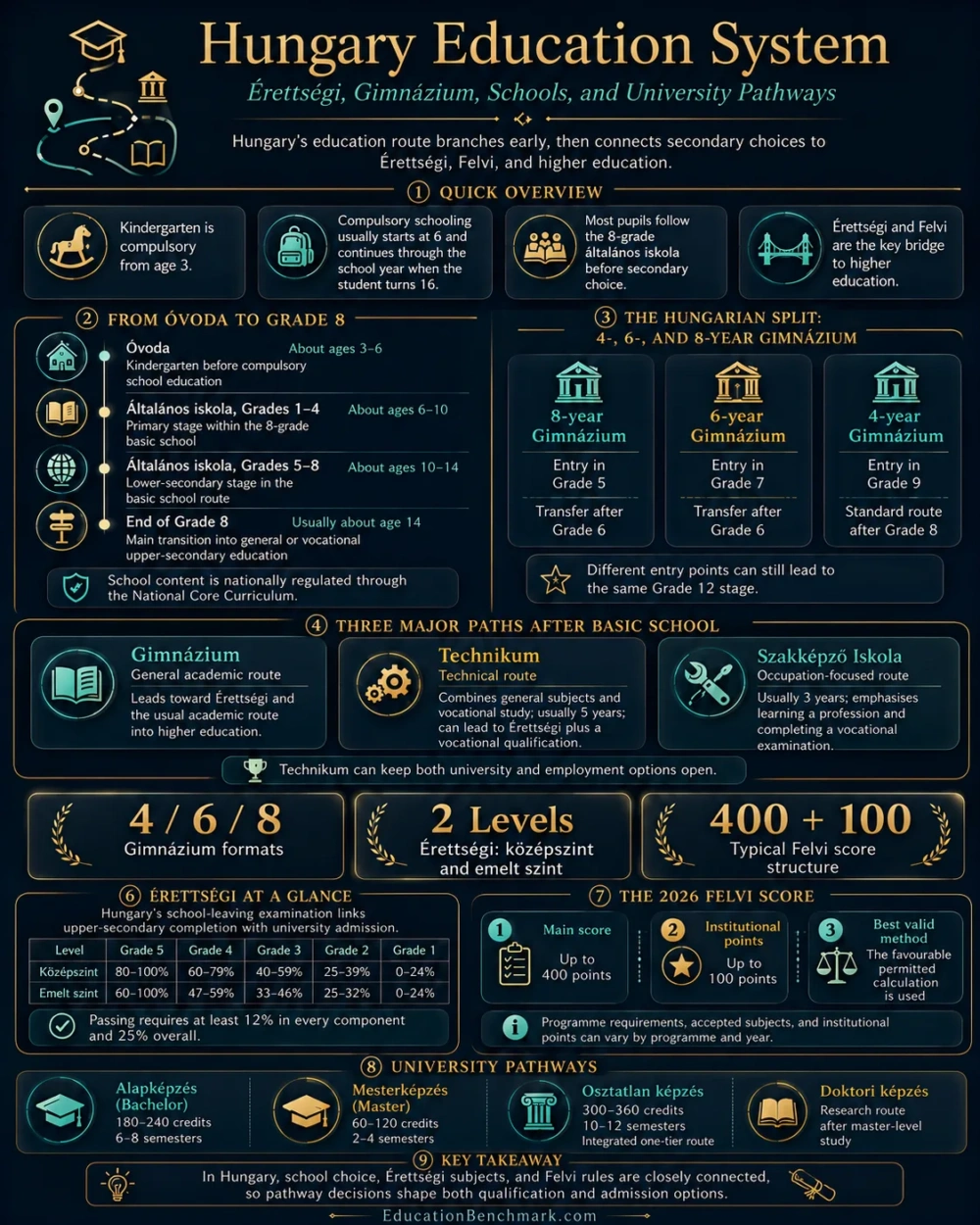
Kindergarten (óvoda) serves children roughly from ages 3 to 6 and is compulsory from age 3. Compulsory school education normally starts at 6 once the child has reached the required level of development, and compulsory schooling continues through the end of the school year in which the student turns 16. Most pupils receive basic education in an eight-grade általános iskola, broadly covering ages 6 to 14. Current institutional categories then include Gimnázium, the more specialised Szakgimnázium, Technikum, and Szakképző Iskola. Public education is mainly overseen at national level through the Ministry of Interior, while higher education and VET fall under the Ministry of Culture and Innovation; municipalities retain responsibility for maintaining kindergartens. [a]
Common school route
The Eight-Grade Basic-School Sequence
Ages are typical rather than fixed. School-readiness decisions can affect the exact age at which Grade 1 begins.
| Stage | Typical age or grade | Place in the route |
|---|---|---|
| Óvoda | About ages 3–6 | Kindergarten before compulsory school education. |
| Általános iskola, Grades 1–4 | About ages 6–10 | Primary stage within the eight-grade basic school. |
| Általános iskola, Grades 5–8 | About ages 10–14 | Lower-secondary stage for pupils who remain in the basic-school route. |
| End of Grade 8 | Usually about age 14 | Main transition into general or vocational upper-secondary education. |
School content is nationally regulated rather than independently designed from scratch by each school. The National Core Curriculum establishes obligatory national content requirements, while schools develop local curricula within those rules. This gives Hungary a more nationally directed curriculum model than systems in which individual regions or school districts set most curriculum requirements. [b]
The Hungarian Split: 4-, 6-, and 8-Year Gimnázium
Gimnázium is the general academic secondary route associated most directly with Érettségi preparation and later higher education. The familiar four-year version starts in Grade 9 after completion of Grade 8 and runs through Grade 12. Hungary also has six-year programmes beginning in Grade 7 and eight-year programmes beginning in Grade 5. This means the academic branch can occur several years before the main secondary-school transition. Admission conditions are set within the regulated secondary-admission process and can include previous school results and, where required, centrally organised written tests. [c]
Gimnázium entry points
Three Routes Can Reach the Same Grade 12 Stage
The programme name refers to its total Gimnázium length, not to additional schooling after Grade 8.
Pupils transfer after Grade 4 and remain in the Gimnázium route through Grade 12.
Pupils transfer after Grade 6 and complete lower- and upper-secondary stages within the same Gimnázium route.
Students finish the full eight-grade általános iskola before beginning the standard Grade 9–12 academic programme.
The longer forms therefore should not be read as six or eight extra years of high school. They bring part of lower-secondary education into the Gimnázium institution. A pupil in an eight-year programme, for instance, has already changed school route after Grade 4.
After Grade 8: Gimnázium, Technikum, and Szakképző Iskola
For students who complete Grade 8 in általános iskola, the next choice is not simply “academic school or work.” Hungary has routes that combine general education, Érettségi preparation, technical study, and occupation-specific training in different proportions.
Secondary route decision
Three Major Paths After the Eight-Grade Basic School
These routes are parallel options rather than consecutive stages.
General secondary education leads toward Érettségi and the usual academic route into higher education.
General subjects and vocational study are combined so students can leave with Érettségi and a professional qualification.
Training places greater emphasis on learning a profession and completing the relevant vocational examination.
Why Technikum Is Different From a Short Vocational Route
IKK describes Technikum programmes as normally five years, with six-year versions in some sectors. Students study the compulsory Érettségi subjects with the same content and teaching time used in Gimnázium, while also completing vocational education. At the end, they can obtain both the Érettségi qualification and a vocational qualification. The professional examination serves as the fifth Érettségi subject and is treated as an emelt szint examination. Szakképző Iskola programmes are normally three years, with four-year cases in some areas. Their initial sectoral basic training is aligned with the corresponding Technikum sector, which can make a transfer into Technikum easier during the early part of training. [d]
Szakgimnázium also remains a separate term in the current Hungarian public-education structure. Its present use is narrower than the broad vocational-secondary meaning found in some older English descriptions, so it should not be used as a generic substitute for Technikum or Szakképző Iskola.
Érettségi: One School-Leaving Examination, Two Levels
The Érettségi is the qualification point that connects upper-secondary completion with higher-education admission. For the standard route, the official subject list includes Hungarian language and literature, history, mathematics, and a foreign-language examination among the compulsory subjects, with national-minority and other permitted variants also listed. A much wider set of elective subjects is available, including biology, chemistry, physics, geography, digital culture, visual culture, physical education, and others. [e]
Középszint and Emelt Szint
Érettségi subjects can be taken at középszint (intermediate level) or emelt szint (advanced level). The distinction affects both the examination standard and the way results may later be treated in university admissions. The two levels also use different percentage bands for grades.
Érettségi assessment
Passing Bands at Középszint and Emelt Szint
The percentages refer to Érettségi performance and should not be treated as a universal conversion for ordinary school marks.
Where an examination has several components, a candidate must reach at least 12% in every component and at least 25% overall to receive a passing grade. The school-leaving certificate requires successful completion of the compulsory examinations and at least one further examination subject, with special rules applying to vocational secondary routes such as Technikum. [f]
The 2026 Felvi Score: The 400 + 100 Structure
Érettségi results do not produce one universal university score that works identically for every degree. For the September 2026 admission cycle, higher-education institutions specify which Érettségi subjects can be used for each programme and whether középszint or emelt szint results are accepted or required. Érettségi points are normally calculated from two eligible subjects. For an emelt szint result, the examination percentage is taken at face value as Érettségi points: 82% gives 82 points. A középszint percentage is instead converted through the official admissions table. [g]
2026 admission scoring
How the Main Felvi Calculation Is Built
Programme rules determine which calculation routes are available to an applicant.
Eligible school, Érettségi, vocational, previous higher-education, or specified practical results can feed into the permitted calculation method.
The higher-education institution defines the published grounds and conditions for its institutional points.
When more than one permitted calculation applies, the admissions system uses the method that produces the better total for the applicant.
Felvi states that, as a general rule, the main result calculation can provide up to 400 points, with up to 100 institutional points added. It also provides alternative calculations for applicants with relevant vocational qualifications, previous higher-education credentials, and certain programmes using practical examinations. Where several legally permitted calculations apply, the most favourable one is selected automatically. The familiar 400 + 100 structure is therefore useful for understanding ordinary admissions, but it should not be treated as the only possible calculation in every case. [h]
Why Two Similar Érettségi Profiles Can Produce Different Results
Institutional points are not identical across all universities and programmes. Institutions individually set the grounds, values, and proof requirements published for their programmes. Common categories listed by Felvi include emelt szint Érettségi performance, academic or artistic competitions, language knowledge, work experience or volunteering, entrance examinations, competence tests, sporting results, vocational qualifications, and qualifications from higher-education vocational study. A result that earns institutional points for one programme does not automatically carry the same value elsewhere. [i]
From Érettségi to Alapképzés and Osztatlan Képzés
Once an applicant satisfies the relevant admission conditions, Hungarian higher education offers several degree routes. The Hungarian terms are useful because they show whether a programme follows separate Bachelor and Master cycles or an integrated route.
- Alapképzés (Bachelor): normally 180–240 credits over 6–8 semesters. It is the first degree cycle and can lead either to employment or later Master study.
- Mesterképzés (Master): normally 60–120 credits over 2–4 semesters and builds on a Bachelor degree.
- Osztatlan képzés (integrated one-tier study): 300–360 credits over 10–12 semesters and leads directly to a Master-level degree without a separate Bachelor stage. Fields using this route include medicine, dentistry, pharmacy, veterinary medicine, architecture, law, and certain teacher, religious, and arts programmes.
- Doktori képzés (doctoral study): follows Master-level study and forms the research degree route toward a PhD or, in arts, DLA.
The practical result is that “university after Érettségi” does not always mean entering a three-year Bachelor programme. An applicant may enter a Bachelor course, an integrated programme leading directly to a Master-level degree, or another eligible tertiary route depending on the chosen field and admission conditions. [j]
Where Rules Change by School, Programme, or Admission Year
Several parts of the Hungarian route are national, but individual decisions still require programme-level checking. Gimnázium admission conditions can differ between schools. Vocational programme length depends on the sector or profession. Érettségi subject requirements depend on the examination chosen, while higher-education programmes determine which examination subjects and levels they accept. Institutional points can also differ from one programme to another.
Education Benchmark is an independent informational guide and is not affiliated with any ministry of education, school authority, exam board, university, government agency, or official ranking organization.
Sources and Verification
- [a] Eurydice — Overview — Used for compulsory ages, basic-school structure, current school types, and national governance responsibilities. (Reliable because Eurydice is the European education-systems platform and the Hungary entry is maintained by the Hungarian Eurydice Unit.)
- [b] Eurydice — Teaching and Learning — Used for the National Core Curriculum and school-level curriculum context. (Reliable because Eurydice documents national education rules through its country education network.)
- [c] Eurydice — Organisation of General Secondary Education — Used for four-, six-, and eight-year Gimnázium entry points and secondary admission context. (Reliable because it is the Hungary-specific secondary-education entry in the European Eurydice system.)
- [d] IKK — Technikum és Szakképző Iskola — Used for vocational programme lengths, sectoral basic training, the Technikum qualification route, and the professional examination’s Érettségi status. (Reliable because IKK is a national vocational education information body working with Hungary’s VET system.)
- [e] Oktatási Hivatal — Érettségi Exam Subjects — Used for compulsory and elective Érettségi subject information. (Reliable because Oktatási Hivatal is Hungary’s Educational Authority and publishes the official examination requirements.)
- [f] Oktatási Hivatal — Érettségi FAQ — Used for the középszint and emelt szint grade bands, component minimums, and passing rules. (Reliable because the Educational Authority publishes the official operational information for the Érettségi.)
- [g] Felvi.hu — Érettségi Pontok — Used for 2026 programme-specific exam requirements and the different admission-point treatment of középszint and emelt szint results. (Reliable because Felvi publishes Hungary’s official higher-education admissions information.)
- [h] Felvi.hu — Pontszámítás — Used for the 2026 main score calculation, the 400-point and 100-point components, and alternative permitted calculation methods. (Reliable because it is the official admissions scoring information for the 2026 intake.)
- [i] Felvi.hu — Intézményi Pontok — Used for institution-defined admission points and the categories that universities may recognise. (Reliable because it is the official 2026 admissions information for institutional points.)
- [j] Information on the Hungarian Higher Education System — Embassy of Hungary — Used for Bachelor, Master, integrated one-tier, credit, and degree-route information. (Reliable because it is an official Hungarian government diplomatic source describing the national higher-education system.)