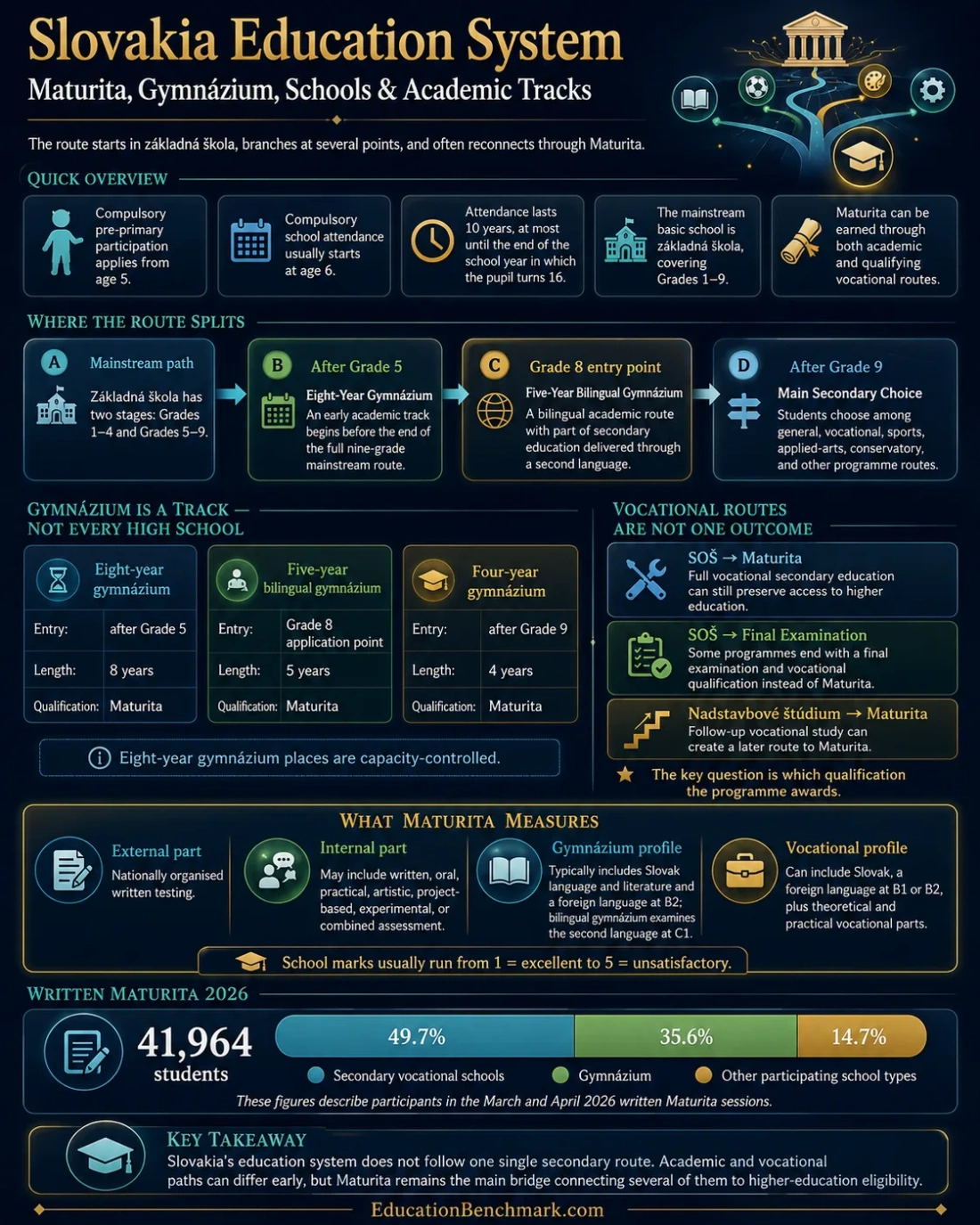
Slovakia Route Passport: From Early Tracking to Maturita
Slovakia’s school route can branch before the end of základná škola, then reconnect through several academic and vocational paths that lead to Maturita.
Eight-Year Gymnázium
Selected stamp: Eight-Year Gymnázium. Choose another stamp to update the route card.
Slovakia does not have a single secondary-school route that every pupil enters at the same age. The mainstream path runs through nine grades of základná škola, but academic differentiation can begin earlier through an eight-year gymnázium, while later choices divide pupils among general, vocational and specialist secondary programmes. The routes are different, yet several of them eventually converge on the same nationally important qualification: Maturita.
Early tracking
Slovakia’s School Route Starts Linear, Then Branches Early
The distinction between compulsory attendance and the school a pupil physically attends is essential to understanding the Slovak system.
Pre-primary education is normally provided in kindergarten, with compulsory pre-primary participation applying to children who reach age 5 by 31 August. Compulsory school attendance normally starts at age 6 and lasts 10 years, at most until the end of the school year in which the pupil turns 16. The mainstream základná škola has a first stage covering Grades 1–4 and a second stage covering Grades 5–9. Pupils can nevertheless complete part of lower secondary education elsewhere if they enter an eight-year gymnázium or another recognised early secondary route. State, private and church schools can all operate within the compulsory-attendance system; state primary and secondary education is free of charge. [a]
| Stage | Typical age or grade | What the stage means | Possible route change |
|---|---|---|---|
| Kindergarten | Usually ages 3–6 | Pre-primary education; participation is compulsory from age 5 under the statutory rule. | Progression into compulsory school attendance. |
| Základná škola — first stage | Grades 1–4; roughly ages 6–9 | Primary education within the nine-grade basic-school structure. | The major early academic branch appears after Grade 5, not during this first stage. |
| Základná škola — second stage | Grades 5–9; roughly ages 10–15 | Lower secondary education for pupils who remain on the mainstream basic-school route. | Selected pupils can move to an eight-year gymnázium after Grade 5. |
| Upper secondary education | Usually begins around age 15 | General, vocational, sports or arts-oriented secondary education. | Grade 9 is the main choice point for four-year gymnázium and most vocational or specialist routes. |
A cross-country legal-data view codes the Slovak Republic with an official entrance age of 6, a compulsory duration of 10 years and a theoretical exit age of 16. That is useful as a benchmark, but it should not be read as meaning that every pupil remains in the same type of school for those 10 years. [b]
An early academic track begins while other pupils remain in the second stage of základná škola.
Most pupils continue toward Grade 9 before choosing their main upper-secondary route.
A separate bilingual academic route is available through the secondary-school admissions process.
Pupils move into general, vocational, sports, applied-arts, conservatory or other programme-specific routes.
Academic tracks
Gymnázium Is a Track, Not a Synonym for High School
The Slovak term identifies a general academic route. It should not be used as an English-language label for every secondary school.
A Slovak gymnázium provides full general secondary education and is oriented mainly toward preparation for higher education. The important structural detail is that gymnázium is not limited to one four-year programme. Slovakia also has eight-year programmes entered earlier in the school route and five-year bilingual programmes with their own admissions point.
The 2026 secondary-school application process makes those entry points especially clear: the Ministry reported that Grade 5 pupils could apply to eight-year gymnázia and Grade 8 pupils could apply to bilingual gymnázia. [c]
| Gymnázium route | Entry point | Programme length | Distinctive role | Leaving qualification |
|---|---|---|---|---|
| Eight-year gymnázium | After Grade 5 | 8 years | Moves academic tracking into the lower-secondary years rather than waiting until Grade 9. | Maturita |
| Five-year bilingual gymnázium | Grade 8 application point in the current admissions route | 5 years | Combines general secondary education with substantial study through a second language. | Maturita |
| Four-year gymnázium | After Grade 9 | 4 years | The standard upper-secondary academic route after completion of základná škola. | Maturita |
The Ministry determines the relevant regional multiple from five percent of pupils in the population cohort and sets maximum first-year numbers for eight-year gymnázia. The Ministry’s published material includes the limits for the 2026/2027 school year, so availability cannot be treated as an unrestricted national entitlement. [d]
The result is an academic system with more than one entry point. Two students can both finish with Maturita from a gymnázium even though one entered the academic track after Grade 5 and another entered after Grade 9.
Qualifications after the split
The Grade 9 Split Does Not Produce One Vocational Outcome
The most important distinction is not simply academic versus vocational. It is which qualification the chosen programme is designed to award.
After the mainstream nine-grade basic-school route, the four-year gymnázium is the principal general-education option. Alongside it are stredná odborná škola (SOŠ) programmes and specialist schools in areas such as sport and the arts. SOŠ itself covers a wide range of profiles, including industrial and technical schools, business academies, hotel academies, healthcare schools and other occupation-linked programmes.
The vocational side therefore cannot be represented as a single dead-end route. Slovak secondary qualifications distinguish between programmes completed by a final examination and programmes providing full secondary vocational education completed by Maturita. A secondary vocational programme at ISCED 353 can end with a Certificate of Final Examination and a Certificate of Apprenticeship, while full secondary vocational programmes at ISCED 354 or 454 can end with Maturita. In qualifying programmes with vocational training, a Maturita graduate may also receive an apprenticeship certificate. Full general or full vocational secondary education completed with Maturita provides the secondary qualification required for admission to higher education. [e]
Full general secondary education with the school-leaving qualification required for higher-education admission.
Full vocational secondary education can preserve both an employment-oriented qualification and access to higher education.
Some fields end with a final examination and apprenticeship qualification rather than Maturita.
Related follow-up vocational study can provide a later route from an earlier vocational qualification to Maturita.
This is why the statement “vocational school means no university” is inaccurate. The decisive question is which vocational programme and which leaving qualification the student completes. Maturita is the bridge that can connect both the general and full vocational routes to higher-education eligibility.
School-leaving examination
What the Maturita Actually Measures
Maturita is not one identical test taken in exactly the same way by every graduating student.
The examination has an external part and an internal part. The external component uses centrally organised written testing administered nationally by the National Institute for Education and Youth (NIVAM). The internal component applies across Maturita subjects and can include written work, oral examination, practical assessment, artistic performance, project or specialist-thesis defence, an experiment, or an approved combination of formats.
External tests are conducted nationwide in specified subjects including Slovak language and literature, foreign languages, recognised minority languages of instruction, and mathematics.
Depending on the subject and programme, assessment can be written, oral, practical, artistic, project-based, experimental, or a combination of these forms.
Gymnázium and Vocational Students Do Not Take the Same Maturita Profile
At a Slovak-language gymnázium, Slovak language and literature and a foreign language at CEFR B2 are compulsory components. A bilingual gymnázium has a different profile: the second language of instruction is examined at C1 and the programme includes additional optional Maturita subjects. Minority-language gymnázia also have requirements reflecting both the language of instruction and Slovak.
At secondary vocational schools and several other vocationally oriented secondary-school types, Maturita can include Slovak language and literature, a foreign language at B1 or B2, and both the theoretical and practical parts of the vocational component. The same qualification name can therefore sit at the end of substantially different educational programmes.
Standard subject marks run from 1 — excellent to 5 — unsatisfactory. The external Maturita component is assessed as a percentage and, when the required participation threshold is met, also by percentile; the oral internal component is marked using the school classification scale. [f]
Maturita 2026
The 2026 Cohort Shows How Central Vocational Schools Are
The figures describe pupils participating in the written Maturita examination in the 2025/2026 school year, not the overall enrollment share of each school type.
In the March and April 2026 written Maturita sessions, 41,964 students participated. Students from secondary vocational schools represented 49.7% of the cohort, while gymnázium students represented 35.6%. The remaining 14.7%, calculated from the two reported shares, came from participating conservatories, sports schools, schools of applied arts and industrial secondary schools. Mathematics in this cohort was taken by students who had chosen it as an optional or voluntary subject. [g]
Scope: written Maturita participants in Slovakia, school year 2025/2026. The 14.7% remainder is derived from NIVAM’s reported 49.7% vocational-school and 35.6% gymnázium shares.
Chart analysis
- Secondary vocational schools accounted for the largest reported school-group share of written Maturita participants.
- Gymnázium students made up slightly more than one third of the written-exam cohort.
- The distribution reinforces that Maturita is a cross-route qualification rather than a gymnázium-only examination.
eMaturita Changed the Delivery Method, Not the Qualification
The 2026 cycle also introduced eMaturita as an electronic form of the external examination. NIVAM states that the electronic and traditional paper forms are equivalent in content. The electronic examination was held on 10 March 2026 for Slovak language and literature in Slovak-language schools and Hungarian language and literature in Hungarian-language schools. The electronic route therefore did not create a separate diploma or a different level of Maturita; it changed how the external test was delivered. [h]
Rules in transition
Why “Compulsory Mathematics From 2027” Needs Qualification
The reform is cohort-based, so the year a pupil begins secondary study matters.
The 2026 examination should not be described as though the new mathematics framework already applied to every graduating student. Mathematics remained an optional or voluntary Maturita subject for the 2026 written-exam cohort.
Current Ministry guidance says that the revised scope of Maturita subjects under rules effective from 2026 does not apply to pupils who begin their secondary studies before 1 September 2027. For pupils entering under the later framework, mathematics will apply to gymnázium students and to students in secondary vocational or industrial fields included on a Ministry list, while the precise mathematics level for different school types and study fields is to be specified through the relevant secondary-school regulation. [i]
The same Ministry guidance states that a unified secondary-school entrance examination under the newer rules is expected no earlier than admissions for the 2028/2029 school year. Admissions for 2026/2027 and 2027/2028 continue under the earlier examination rules, while applicants already use preference ordering on secondary-school applications for 2026/2027.
These overlapping timelines matter. ePrihlášky, the future unified entrance examination and the revised Maturita mathematics framework are related parts of education reform, but they do not all take effect for the same pupils at the same moment.
Governance and verification
National Rules, Local Founders, and What Must Be Verified
Slovakia has a national legal framework, but school operation, available programmes and admissions still have important local and institution-level dimensions.
School governance is not handled by one institution alone. Under the current school-administration framework, qualifying municipalities can perform school-authority functions for kindergartens and basic schools they establish, while higher territorial units also perform school-authority functions as founders of secondary schools. Ministry rules, national legislation, regional administration and individual school responsibilities therefore meet at different points in a student’s route. [j]
This distinction is especially important when comparing provider and track. State, private or church describes who operates a school; gymnázium, SOŠ, sports school, school of applied arts or conservatory describes the educational route or institutional type. A private gymnázium and a state gymnázium can therefore belong to the same broad academic track without having the same provider.
For an actual application or transfer, the details that deserve direct verification include the school’s available study fields, admissions criteria, capacity, language of instruction, Maturita subject requirements, vocational-practice arrangements and any rules applying to the relevant cohort. Higher-education applicants should likewise check the conditions published by the university or programme concerned rather than treating possession of Maturita as a guarantee of admission.
Education Benchmark is an independent informational guide and is not affiliated with any ministry of education, school authority, exam board, university, government agency, or official ranking organization. Education legislation, examination rules and admissions procedures can change, so decisions affecting a specific student should be checked against the relevant Ministry, school, examination authority or higher-education institution.
Sources and Verification
- [a] Organisation of the Education System and of its Structure — Used for compulsory attendance, základná škola stages, gymnázium programme lengths, school providers and the overall Slovak school structure. (Reliable because Eurydice is the European Education and Culture Executive Agency’s national education-policy information network.)
- [b] Compulsory Education Worldwide (2026): Years, Ages, and Enforcement by Country — Used only for the cross-country coding of Slovakia’s entrance age, compulsory duration and theoretical exit age. (Used as a comparative data reference rather than the primary authority for Slovak education law.)
- [c] Slovak Ministry of Education — Secondary-School eApplications — Used for the 2026 application route showing Grade 5 applicants to eight-year gymnázia and Grade 8 applicants to bilingual gymnázia. (Reliable because it is an official Ministry of Education publication.)
- [d] Slovak Ministry of Education — Eight-Year Gymnázium Capacity — Used for the five-percent regional cohort mechanism and maximum first-year capacity of eight-year gymnázia. (Reliable because it is the Ministry page publishing the official capacity determinations.)
- [e] Secondary Education and Post-Secondary Non-Tertiary Education — Used for secondary-school types, vocational qualifications, Maturita pathways, apprenticeship certificates, follow-up study and the qualification required for higher-education admission. (Reliable because Eurydice documents national education structures through its official European policy network.)
- [f] Eurydice — Assessment in Slovak Secondary Education — Used for the Maturita external and internal components, programme-specific subjects, CEFR language levels, assessment formats and the 1-to-5 marking scale. (Reliable because it is the Slovak assessment profile within the Eurydice national-policy platform.)
- [g] NIVAM — Maturita 2026 Written-Test Results — Used for the 41,964 written-exam participants, school-type shares, 2026 mathematics status and eMaturita participation figures. (Reliable because NIVAM is the national institute responsible for organising and evaluating the external Maturita tests.)
- [h] NIVAM — eMaturita 2026 — Used for the electronic examination date, subjects and confirmation that electronic and paper external tests are equivalent in content. (Reliable because it is NIVAM’s official operational page for eMaturita 2026.)
- [i] Slovak Ministry of Education — Secondary Schools — Used for the post-2027 Maturita cohort rule, planned mathematics requirements, preference ordering and the timetable for a future unified secondary-school entrance examination. (Reliable because it is current official Ministry guidance on secondary-school reform.)
- [j] Slovak Ministry of Education — School Authorities — Used for the current roles of municipalities and higher territorial units in school-authority and founder responsibilities. (Reliable because it is an official Ministry page describing the school-administration framework.)