
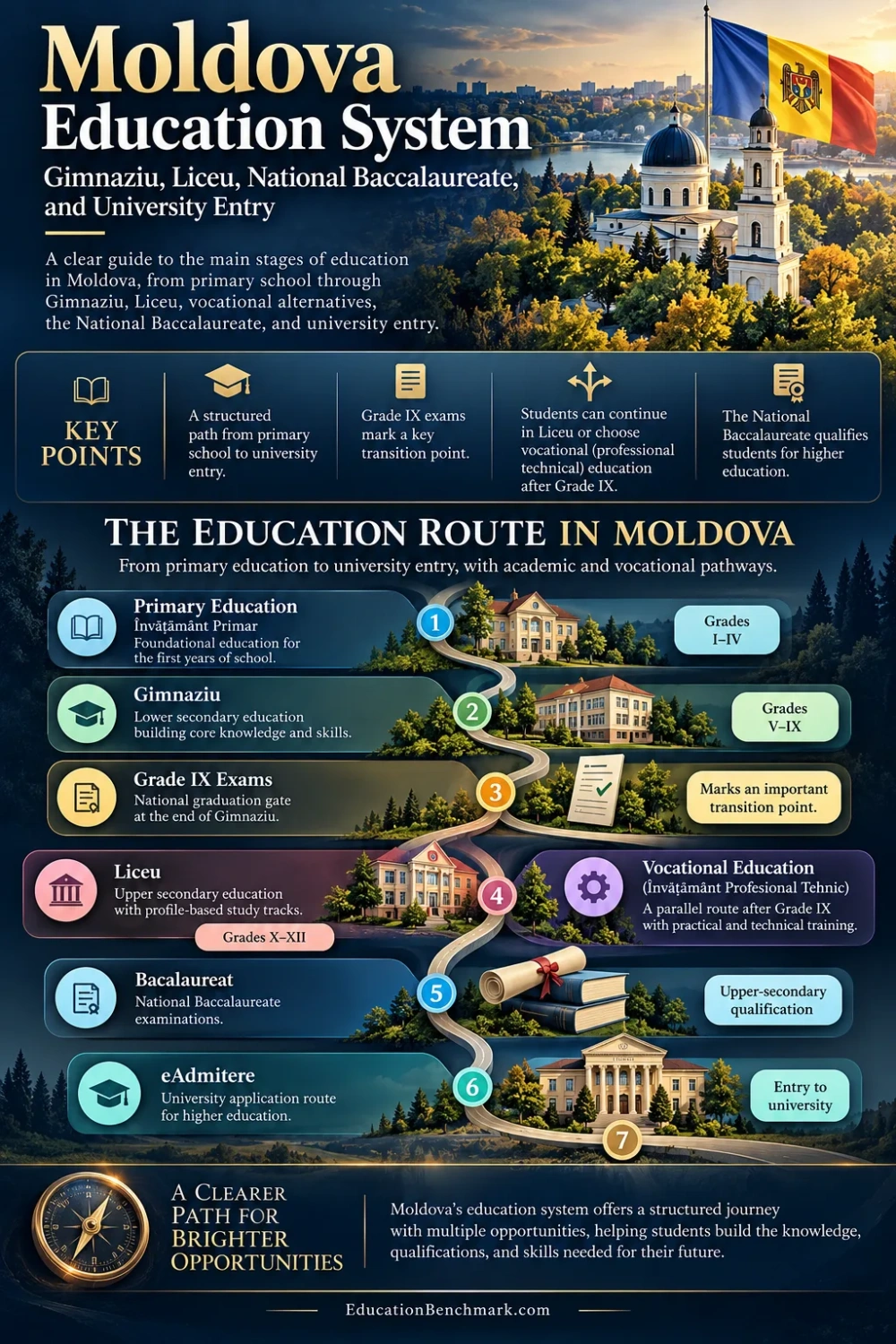
Moldova School Route: From Gimnaziu to University Entry
A route through Grade IX examinations, profile-based liceu admission, vocational alternatives, Bacalaureat, and eAdmitere.
Învățământ Primar
Selected stamp: Învățământ Primar. Choose another stamp to update the route card.
Moldova’s general school route is built around a four-year primary cycle, a five-year gimnaziu cycle, and an academic liceu cycle normally running through Grades X–XII. The legal structure also places professional and technical education beside the academic route rather than treating it as a minor side path. Compulsory education begins with the preparatory preschool group and compulsory attendance ends at age 18. [a]
The Route to Grade IX and the First Major Split
For most children, Grade I begins around age seven. The 2026 enrollment rules required children who reached age seven by the start of the school year to enroll in their local school district, while some younger children could enter later in the process if places and the applicable conditions allowed it. [b]
School route
Grades, Typical Ages, and the Main Transition Point
Age bands are approximate because enrollment timing can shift an individual student by a year.
| Stage | Grades | Typical age | What ends the stage |
|---|---|---|---|
| Preparatory preschool group | Before Grade I | About 6–7 | Entry to primary school |
| Învățământ primar | I–IV | About 7–10 | Progression to gimnaziu |
| Gimnaziu | V–IX | About 11–15 | National Grade IX graduation examinations |
| Liceu | X–XII | About 16–18 | Completion of liceu; Bacalaureat is a separate qualification gate |
The important structural point is that Grade IX is not simply another promotion year. It is where lower secondary school ends and the student chooses the next route. Liceu is one option. Professional and technical study is another.
Grade IX Is Moldova’s First National Examination Gate
The examenele naționale de absolvire a gimnaziului close the gimnaziu stage. In the 2026 session, the examination system included Mathematics, History of Romanians and Universal History, the language of instruction (Romanian or Russian), and Romanian Language and Literature for relevant non-native Romanian candidates. The paper combination therefore depends partly on the student’s language route.
One operational change in 2026 was especially notable: Grade IX papers were held in 385 district or municipal examination centres rather than in the schools where students had studied, with external monitors present. [c] That change affects how the examination is administered, but not its basic role: these are lower-secondary graduation examinations, not university entrance tests.
Grade IX decision
What the Grade IX Result Leads To
Results complete the lower-secondary stage and feed into the next admission decision.
Applicants compete for Grade X places using the admission method linked to the selected profile.
Students may enter vocational or technical programmes instead of continuing through the liceu route.
How the Liceu Competition Average Is Built
Liceu admission is a separate competition after gimnaziu. It should not be described as automatic promotion based only on the Grade IX examination result. The admission methodology combines the average annual grades in profile subjects with the average from the gimnaziu graduation examinations for the real and umanist profiles. Candidates may apply to more than one liceu, and applications can be handled online or on paper under the national methodology. [d]
Admission formulas
Real, Umanist, Arts, and Sport Use Different Inputs
MC is the competition average; MNE is the average from the gimnaziu graduation examinations.
The profil general deserves separate attention because it does not fit neatly into the traditional real-versus-umanist split. Moldova has used it especially in licee where opening separate profile classes is difficult. In the 2025 intake, 1,842 students entered the general profile, and 76 licee that opened only one Grade X class chose it. For the 2026 admission session, the Ministry also stated that supplementary competition tests would be organized only in arts and sport licee. [e]
What Readers Often Confuse
The Grade IX national examination, the liceu admission competition, and the Bacalaureat are three different stages. The first closes gimnaziu, the second allocates Grade X places, and the third is an upper-secondary leaving qualification.
What a Liceu Profile Changes Before the Bac
Liceu normally covers Grades X–XII. The profile affects subject emphasis during upper secondary school and the Bac route later on. In the current national Bac timetable published by the National Agency for Curriculum and Evaluation, the exam profiles are listed as Real, Umanist, Arts, and Sport. Real candidates have Mathematics as the profile paper, while Umanist candidates have History of Romanians and Universal History; Arts and Sport candidates have their corresponding profile paper. The timetable also provides an elective paper chosen from subjects such as Geography, Physics, Chemistry, Biology, Mathematics, History, and Informatics, with profile-based restrictions. [f]
The general liceu profile should therefore not be treated as if it automatically created a fifth Bac exam profile. Because profile offerings and school arrangements can change, students in a general-profile class need to check the Bac route applied by their institution and the current national exam rules.
The Grade IX Fork Does Not End With Liceu
Învățământul profesional tehnic is the parallel route after gimnaziu. Moldova’s professional-technical sector includes vocational schools, colleges, and centres of excellence, with secondary and post-secondary programmes as well as dual education.
The route is not limited to students who passed every Grade IX paper. In the 2026 admission cycle, three-year secondary vocational programmes were open to gimnaziu graduates who had passed the graduation examination, while two-year programmes also admitted students who had not passed it. [g] This makes the Grade IX decision a branching point rather than a single ladder in which every student must first enter liceu.
Two routes after gimnaziu
Academic and Professional Routes Can Lead to Different Qualifications
The standard academic route aims toward the Diploma de bacalaureat and later higher-education competition.
The student works toward a vocational or technical qualification, with later study options depending on the diploma and field.
Some professional diplomas can support later entry to related bachelor’s or integrated programmes under current admission rules.
Bacalaureat Is a Set of Papers, Not One Test
The examenul național de bacalaureat is an external leaving examination. Its structure depends on profile and language route, so a single statement such as “every Moldovan student takes four Bac exams” can be misleading. The common structure includes the language of instruction, a first foreign language, a profile paper, and an elective paper; some candidates also have Romanian for non-native speakers or a mother-tongue paper where applicable.
Passing is defined paper by paper. The national regulation states that the Bac is passed only when every examination grade is at least 5. Successful candidates receive the Diploma de bacalaureat, which gives access to higher-education admission competition. A student who completes the liceu course but does not pass the Bac receives a liceu studies certificate instead, so finishing liceu and passing the Bac are not the same outcome. [h]
2026 Bac results
The Latest Completed Bac Cycle in Numbers
These figures describe the completed 2026 examination cycle, not an admission threshold for future years. [i]
15,100 of 18,437 admitted candidates had passed after the 2026 sessions reported by the Ministry.
11,425 of 11,887 liceu candidates obtained the Bac diploma.
The Ministry reported this as the average Bac result among liceu graduates after the completed 2026 cycle.
The Ministry’s 2026 reporting also shows why Bac statistics should not be read as a liceu-only measure: candidates can come from licee, colleges and centres of excellence, universities, external-study arrangements, and earlier cohorts.
From the Bac Diploma to eAdmitere
The Bac diploma makes a typical liceu graduate eligible to compete for a university place; it does not create an automatic placement. Moldova does not use one national university score that assigns every applicant to a programme. Universities run admission competitions for their programmes under national rules, and programme-level formulas or tests can differ. [j]
- Apply online. The 2026 university admission cycle used the national eAdmitere platform.
- Rank choices. A candidate could enter competitions at up to three universities and select up to three programmes at each institution, in preference order.
- Compete under programme rules. The chosen university or programme applies its published admission method and any permitted additional requirements.
- Confirm one place. Admission becomes final only after the required confirmation and document steps.
The three-university, three-programme structure was used for the 2026–27 admission cycle. [k] It is better understood as a centralized application channel feeding institution-run competitions than as a single centralized placement examination.
Bac is also not the only educational credential that can lead into bachelor’s or integrated studies. In 2026, Moldova adopted a field-correlation route for holders of post-secondary and post-secondary non-tertiary professional diplomas, allowing admission to related higher-education fields under the applicable rules. [l] That is why the most accurate route map shows both liceu/Bac and professional-technical progression rather than presenting university entry as one straight line.
Romanian, Russian, and Minority-Language Routes Affect the Exam Set
Language of instruction matters most visibly at the national examination points. Grade IX has separate Romanian and Russian language-of-instruction papers, with Romanian Language and Literature for relevant allolingual candidates. At Bac level, the national timetable also includes Romanian for non-native Romanian candidates and, where applicable, Bulgarian, Gagauz, or Ukrainian mother-tongue papers.
This does not create a separate national school system for each language. It means that the same national route can produce different examination combinations depending on the student’s language setting. For families moving between schools, the exact language stream is therefore more useful than a generic label such as “Moldovan secondary school.”
Why a Local Liceu May Stop Taking Grade X Students
Moldova’s school network is being adjusted as enrollment changes across localities. Under the rules applied for the 2026–27 reorganization, a liceu with fewer than 30 students across Grades X–XII stops Grade X admission in the following school year. Students already enrolled may finish their studies, after which the institution can be reorganized as a gimnaziu. [m]
Where Official Details May Vary
A liceu’s available profiles, number of Grade X places, local admission threshold, and university programme formula can change from one admission cycle to the next. Current decisions should be checked against the Ministry of Education and Research, the National Agency for Curriculum and Evaluation, the chosen liceu, or the chosen university.
Education Benchmark is an independent informational guide and is not affiliated with any ministry of education, school authority, exam board, university, government agency, or official ranking organization.
Sources and Verification
- [a] Education Code of the Republic of Moldova — Used for the legal structure of primary, gimnaziu, liceu, professional-technical, and higher education, as well as the compulsory-education rule. (Reliable because it is an official government education document.)
- [b] Grade I Enrollment Begins on April 1 — Used for Grade I enrollment age and the 2026 enrollment sequence. (Reliable because it is published by Moldova’s Ministry of Education and Research.)
- [c] Preliminary Results of the Gimnaziu Graduation Examinations — Used for the 2026 Grade IX exam subjects, exam-centre model, and external monitoring. (Reliable because it is an official Ministry examination update.)
- [d] Methodology for Student Admission to Liceu Education — Used for the real, umanist, arts, and sport competition-average formulas and application rules. (Reliable because it is the official liceu admission methodology.)
- [e] 2026 Liceu Admission: More Than 13,700 Places Across 308 Institutions — Used for current liceu admission practice, the role of the general profile, and the 2026 rule on supplementary tests in arts and sport licee. (Reliable because it is an official Ministry admission notice.)
- [f] Information for National Baccalaureate Candidates — Used for the current Bac profile papers, language papers, and elective-subject structure. (Reliable because it is published by the National Agency for Curriculum and Evaluation.)
- [g] Second Round of Professional-Technical Admission: About 2,400 State-Funded Places — Used for 2026 entry conditions to three-year and two-year secondary vocational programmes. (Reliable because it is an official Ministry professional-education admission notice.)
- [h] National Baccalaureate Examination Regulation — Used for the minimum passing grade on each Bac paper, the Diploma de bacalaureat, and the distinction between completing liceu and passing the Bac. (Reliable because it is the national Bac examination regulation.)
- [i] 2026 National Baccalaureate Pass Rate Results — Used for the completed 2026 Bac pass rates, candidate counts, and average result among liceu graduates. (Reliable because it is the Ministry’s official results release.)
- [j] Order No. 965 of May 18, 2026: Higher-Education Admission Rules for 2026–27 — Used for the current national rules governing university admission competitions. (Reliable because it is the official Ministry order for the 2026–27 admission cycle.)
- [k] 2026 University Admission for Bachelor’s, Master’s, and Integrated Studies — Used for eAdmitere and the 2026 limit of three universities with up to three programme choices per institution. (Reliable because it is an official Ministry higher-education admission notice.)
- [l] Order No. 769 of April 8, 2026 — Used for the 2026 route from eligible professional diplomas into related bachelor’s and integrated-study fields. (Reliable because it is an official Ministry order.)
- [m] School Network Reorganization for 2026–27: Results and Support Measures — Used for the rule affecting Grade X admissions in licee with fewer than 30 students across Grades X–XII. (Reliable because it is a current Ministry school-network update.)