Philippines School Route Passport
A compact route map of DepEd basic education, K–12 stages, Senior High choices, TVET options, and college entry points.
Kindergarten
Selected stamp: Kindergarten. Choose another stamp to update the route card.
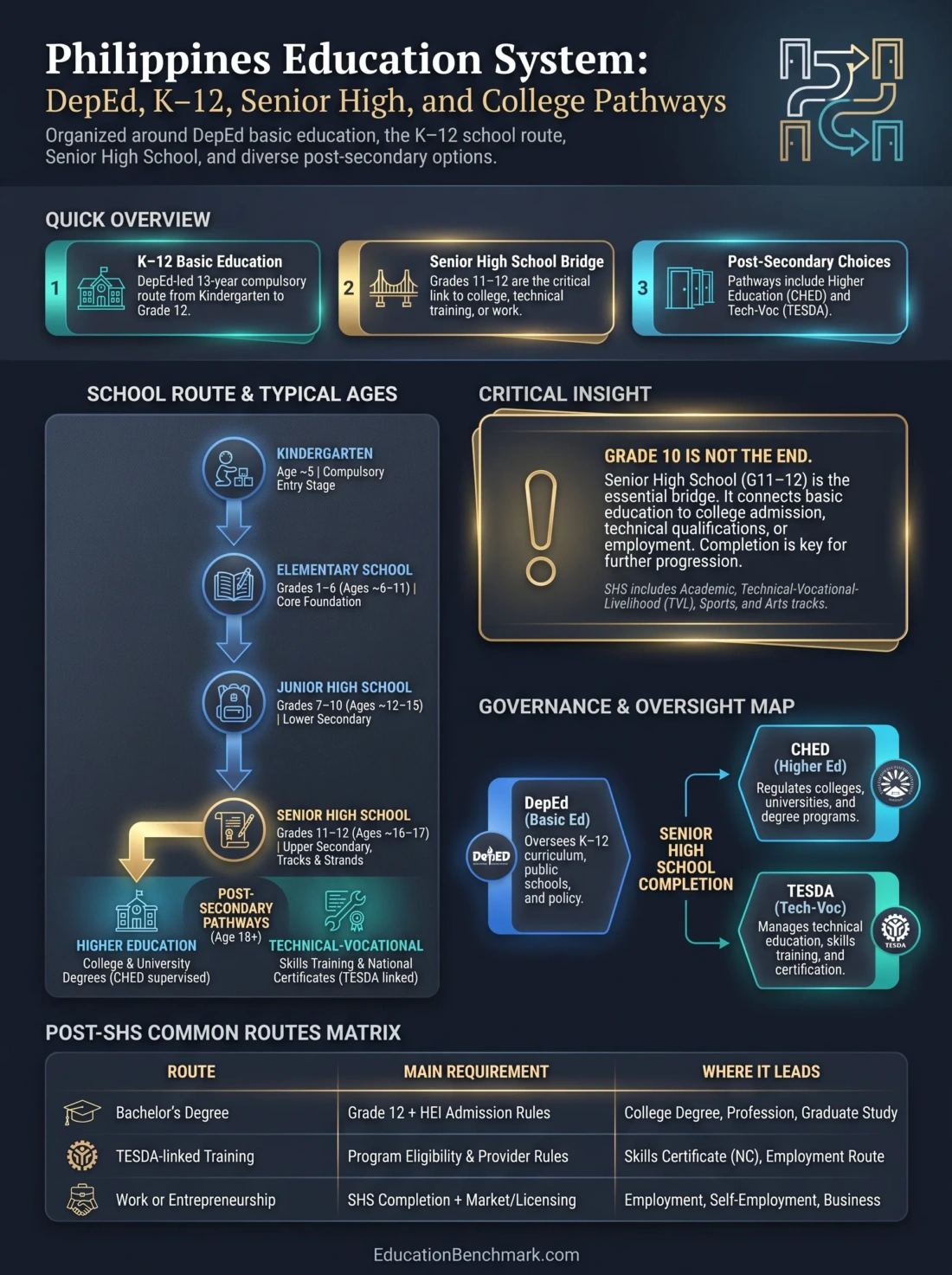
The Philippines education system is organized around DepEd basic education, the K–12 school route, Senior High School, and several college or technical pathways after Grade 12. For most learners, the route moves from Kindergarten to Elementary School, Junior High School, Senior High School, and then higher education, TESDA-linked technical training, work, or entrepreneurship. The system is national in design, but families still need to check current school-year rules because curriculum, assessment, and Senior High implementation details can change.
System structure
How the Philippines Education System Works
The main public route is a national K–12 structure, with DepEd responsible for basic education, CHED supervising higher education, and TESDA overseeing technical-vocational education and training.
The Enhanced Basic Education Act established the modern K–12 route, built around Kindergarten, six years of elementary education, four years of junior high school, and two years of senior high school.[b]
Junior High School ends at Grade 10, but students normally proceed to Senior High School in Grades 11 and 12 before college or other postsecondary choices.
College is handled through higher education institutions, while technical-vocational training may be offered through TESDA-registered programs and training institutions.
Public schools, private schools, international schools, colleges, and training providers may differ in admissions, language, calendar details, electives, fees, and program availability.
The Philippine system separates basic education from postsecondary education. Basic education covers the K–12 school route. Postsecondary education begins after Senior High School and may lead to college degrees, TESDA qualifications, licensure-linked programs, or work-based skills training.
School route
School Levels and Typical Ages
Ages are typical, not a promise for every learner. Entry age, transfer history, school readiness, repetition, acceleration, and special placement routes can change a student’s actual age by grade.
| School level | Typical age | Typical grade or year | What it means |
|---|---|---|---|
| Kindergarten | About 5 | Kindergarten | Compulsory entry stage before Grade 1; DepEd describes Kindergarten as the mandatory entry stage for basic education.[a] |
| Elementary School | About 6–11 | Grades 1–6 | Primary years for core literacy, numeracy, early science, social studies, arts, physical education, and values-related learning. |
| Junior High School | About 12–15 | Grades 7–10 | Lower secondary stage that continues general education and prepares learners for Senior High choices. |
| Senior High School | About 16–17 | Grades 11–12 | Upper secondary stage with core subjects and pathway choices linked to college, technical training, work, or entrepreneurship. |
| Higher Education | Usually 18+ | Post-Grade 12 | College, university, professional, or other higher education programs supervised by higher education rules and institutional admissions. |
| Technical-Vocational Education and Training | Varies | SHS-linked or postsecondary | Skills training through school-based or TESDA-linked routes, depending on program registration, facilities, and qualification level. |
Table analysis
- The K–12 route means college entry normally comes after Grade 12, not after Grade 10.
- Senior High School is the main transition stage where academic and technical choices become more visible.
- Typical ages help with orientation, but official enrollment decisions depend on current rules and school records.
Required schooling
Compulsory Education in the Philippines
Compulsory education is best read as a legal school route, not simply as a list of ages.
DepEd identifies Kindergarten as compulsory and as the entry stage to basic education, with the usual entry age around five.
International law-coded education data list the Philippines with a compulsory starting age of 5, a 12-year compulsory duration, and a theoretical exit age of 17.[c]
Learners who transfer, repeat, return to school, or use special placement routes may be older or younger than the typical age shown in route tables.
The compulsory route matters because it changes how families interpret “high school” in the Philippines. Junior High School is not the final school stage in the K–12 design. Senior High School is part of the basic education route and is the usual bridge to college admission, technical training, employment-linked skills, or entrepreneurship.
Academic Year and Grade Structure
The Philippine school year is set through official school calendar issuances, so exact start dates, end dates, breaks, and assessment schedules should be checked for the current school year. Public schools follow DepEd calendar rules, while private and international schools may have approved calendars that do not always match the public school pattern exactly.
Grade route
From Grade 1 to Grade 12
Grades 1–12 are organized across elementary, junior high, and senior high school.
Elementary School develops the base for reading, writing, numeracy, science foundations, local and national identity, arts, physical education, and values-related learning.
Junior High School broadens subject learning and moves students toward the Senior High decision point.
Senior High School combines core learning with pathway choices that connect to college and work-linked routes. In SY 2026–2027, the exact track, strand, or elective structure depends on the learner’s cohort and curriculum version.
Curriculum and School Governance
DepEd is the central authority for basic education policy, public school rules, and national curriculum guidance in the K–12 route. For School Year 2026–2027, the Revised K to 10 Curriculum is in its third and final rollout phase, covering Grades 6, 9, and 10 after earlier grade-level phases. Official curriculum guides and implementation details remain tied to the learner’s grade and school year.[d]
The Strengthened Senior High School Curriculum moved beyond the Grade 11 pilot for School Year 2026–2027. DepEd piloted the curriculum with Grade 11 learners in 891 schools in SY 2025–2026. Starting SY 2026–2027, all public and private Senior High Schools implement it for incoming Grade 11 learners. Grade 12 remains cohort-specific during the transition: learners in non-pilot schools continue under the existing SHS curriculum, while the 891 pilot schools continue Strengthened SHS for the Grade 12 cohort that began the pilot in the previous school year. The strengthened model uses Academic and Technical Professional directions with elective choices connected to college preparation, employment, national certification, or entrepreneurship.[e][f]
Governance map
Who Oversees Each Education Route?
DepEd covers Kindergarten, Elementary School, Junior High School, Senior High School, national curriculum policy, public school operations, and many basic education assessments.
CHED handles higher education policy for colleges and universities, while individual higher education institutions set many admission and program rules.
TESDA covers technical-vocational education and training, including registered training programs and skills qualification routes.
Schools apply national rules through actual class schedules, subject offerings, assessment practice, language support, and student services.
Main Exams, Qualifications, and Assessments
The Philippines does not use one single national exam as the only gate from secondary school to college. Instead, the route combines school completion, classroom assessment, placement tools for special cases, Senior High credentials, TESDA qualifications where relevant, and institution-level college admissions.
Assessment route
Main Exams and Qualifications
Exact schedules, eligibility rules, and documentary requirements should be checked with DepEd, TESDA, CHED, the school, or the admitting institution.
| Exam or qualification | Level | Purpose | What varies |
|---|---|---|---|
| Classroom assessment and report grades | K–12 | Tracks learner progress, subject performance, and promotion requirements. | Current grading rules depend on the DepEd order used for that school year. |
| Philippine Educational Placement Test | Basic education | Provides a route for learners in special circumstances to access, resume, or certify grade-level completion in the formal system.[j] | It is not the regular route for every learner. |
| Senior High School completion | Grades 11–12 | Shows completion of the upper secondary stage before college or postsecondary routes. | The learner’s track, strand, or elective history depends on the SHS curriculum used by that cohort and may matter for preparation, but it is not the only factor in admission. |
| TESDA National Certificate route | SHS-linked or postsecondary TVET | Confirms competency in a technical-vocational field where the learner completes assessment requirements. | Availability depends on registered programs, training facilities, and qualification rules. |
| College or university entrance requirements | Post-Grade 12 | Allows HEIs to select students for degree programs through grades, tests, interviews, portfolios, or program rules. | Admission is institution-specific, especially for selective or licensure-linked programs. |
Table analysis
- Senior High completion is central to college applications, but colleges may still apply their own selection rules.
- PEPT is a special placement and certification tool, not a standard annual exam for all students.
- Technical qualifications depend on TESDA-linked training and assessment, not only on school attendance.
Grading System
Grading in Philippine basic education is policy-based and can change when DepEd updates classroom assessment rules. Schools commonly report learner progress through numerical grades, descriptors, and official learner progress records, but the exact computation method, term structure, and recognition rules should be checked against the DepEd order for the current school year. DepEd Order No. 015, s. 2026 sets the revised guidelines on classroom assessment, the grading system, awards, and recognition for the K to 12 Basic Education Program.[l]
Grade reporting
Grade Reporting, Promotion, and Admissions
Grades show how a learner performed in specific learning areas during a reporting period, not a full measure of ability or future college success.
Grades may affect promotion, remediation, completion, and support decisions, depending on current DepEd policy and school implementation.
Colleges may review Senior High grades, but many programs also use entrance exams, interviews, portfolios, prerequisite subjects, or capacity limits.
Public, Private, and International Schools
Public schools form the main national route for basic education. Private schools operate under recognition, permit, or regulatory requirements, especially where they offer Senior High School. DepEd’s 2026 issuance on government recognition for private basic education institutions offering SHS shows that private SHS provision is not simply a local business decision; it is tied to formal recognition rules.[k]
School type comparison
Public, Private, and International School Differences
The public-private distinction should not be reduced to quality labels. A school’s fit depends on curriculum, language support, location, cost, recognition status, student needs, and the family’s plan after Grade 12. International schools may serve a different purpose because they often connect students to foreign university calendars or non-Philippine diploma systems.
Vocational and Technical Education
Vocational and technical learning appears in two linked places: within Senior High School options and through TESDA-supervised technical-vocational education and training. TESDA describes TVET as education and training that combines general education, technologies and sciences, practical skills, and attitudes related to occupations across economic and social life.[g]
After or alongside school-based preparation, learners may move toward TESDA-registered training programs. TESDA’s program registration system, UTPRAS, is the process used to register TVET programs and check that they meet training regulation requirements such as curriculum, trainers, facilities, and equipment.[h]
Applied route
How the Technical Route Fits the K–12 System
Students may choose technical or applied subjects where the school offers the facilities, teachers, and approved program route.
Learners may continue through registered technical-vocational institutions, community-based training, enterprise-based training, or other approved delivery modes.
Where required, competency assessment can lead to a National Certificate or other recognized TVET qualification.
Higher Education and University Entrance
College entry in the Philippines is not handled by one single national admission exam. CHED policy on Senior High graduates states that Grade 12 graduates are eligible to enter college regardless of SHS track or strand, while admission to a specific higher education institution or program remains subject to the institution’s admission requirements.[i]
This distinction matters. A student from an Academic, technical-professional, or other Senior High route may be eligible to apply to higher education, but a nursing, engineering, education, architecture, fine arts, or other selective program may still ask for specific preparation, grades, entrance tests, interviews, portfolios, bridging subjects, or other institutional requirements.
College pathway
Common Routes After Senior High School
How This System Compares Internationally
Compared with highly decentralized systems such as the United States or Canada, the Philippine K–12 route is more nationally defined. DepEd sets the basic education direction, while schools deliver it locally. Compared with systems where upper secondary is divided into many early tracks, the Philippine route places much of the academic or technical choice in Senior High School.
The system is also college-access oriented: Grade 12 completion is the normal route into higher education applications. At the same time, TESDA and technical-vocational routes give students options outside the bachelor’s degree path. This makes the system both standardized in school structure and pathway-based near the end of secondary education.
Common Education Terms
Local terms
Philippines Education Terms
These terms appear often in school documents, policy pages, and admission materials.
What Can Change Over Time
The most change-sensitive parts of the Philippine education system are curriculum rollout schedules, Senior High School elective rules, grading policy, school calendar dates, private school recognition, college admission requirements, and TESDA qualification rules. For SY 2026–2027, SHS curriculum status depends on cohort: all incoming Grade 11 learners use Strengthened SHS, Grade 12 learners in the former pilot schools continue Strengthened SHS, and Grade 12 learners in non-pilot schools remain under the existing SHS curriculum. Later school years should be checked against the current DepEd issuance.[f]
Education Benchmark is an independent informational guide and is not affiliated with any ministry of education, school authority, exam board, university, government agency, or official ranking organization. For enrollment, transfer, college admission, scholarship, visa, licensing, or placement decisions, readers should check the current official source, school, university, training provider, or examination authority.
Sources and Verification
- [a] Kindergarten | Department of Education — Used for Kindergarten as a compulsory entry stage and for the usual age 5 starting point.
- [b] Philippines: Republic Act No. 10533 of 2013, Enhanced Basic Education Act | Refworld — Used for the legal basis of the K–12 basic education route.
- [c] Compulsory Education Worldwide (2026): Years, Ages, and Enforcement by Country — Used for cross-country compulsory-education definitions and comparable age/duration indicators.
- [d] Revised K to 10 Curriculum | Department of Education — Used for the current Revised K to 10 curriculum and rollout context.
- [e] Strengthened SHS Program | Department of Education — Used for current Strengthened SHS pathway language, Academic and Technical Professional directions, electives, and the Grade 12 transition FAQ.
- [f] DepEd Memorandum No. 012, s. 2026 — Full Implementation of the Strengthened Senior High School Curriculum in School Year 2026–2027 — Used for the 891-school Grade 11 pilot in SY 2025–2026, full Grade 11 implementation in SY 2026–2027, and the different Grade 12 treatment for pilot and non-pilot schools.
- [g] TVET Information — Used for TESDA’s definition of technical-vocational education and training.
- [h] Program Registration and Accreditation — Used for UTPRAS and TESDA program registration requirements.
- [i] CHED Memorandum Order No. 105, Series of 2017: Policy on the Admission of Senior High School Graduates to the Higher Education Institutions — Used for Grade 12 graduate eligibility to apply for higher education, subject to HEI admission rules.
- [j] Philippine Educational Placement Test | Department of Education — Used for PEPT purpose and placement/certification context.
- [k] May 6, 2026 DO 012, s. 2026 – Government Recognition of Private Basic Education Institutions Offering the Senior High School (SHS) Program | Department of Education — Used for private basic education institutions offering SHS and government recognition context.
- [l] June 4, 2026 DO 015, s. 2026 — Revised Guidelines on Classroom Assessment, Grading System, and Awards and Recognition for the K to 12 Basic Education Program — Used for the current classroom assessment, grading, awards, and recognition rules for K–12 basic education.