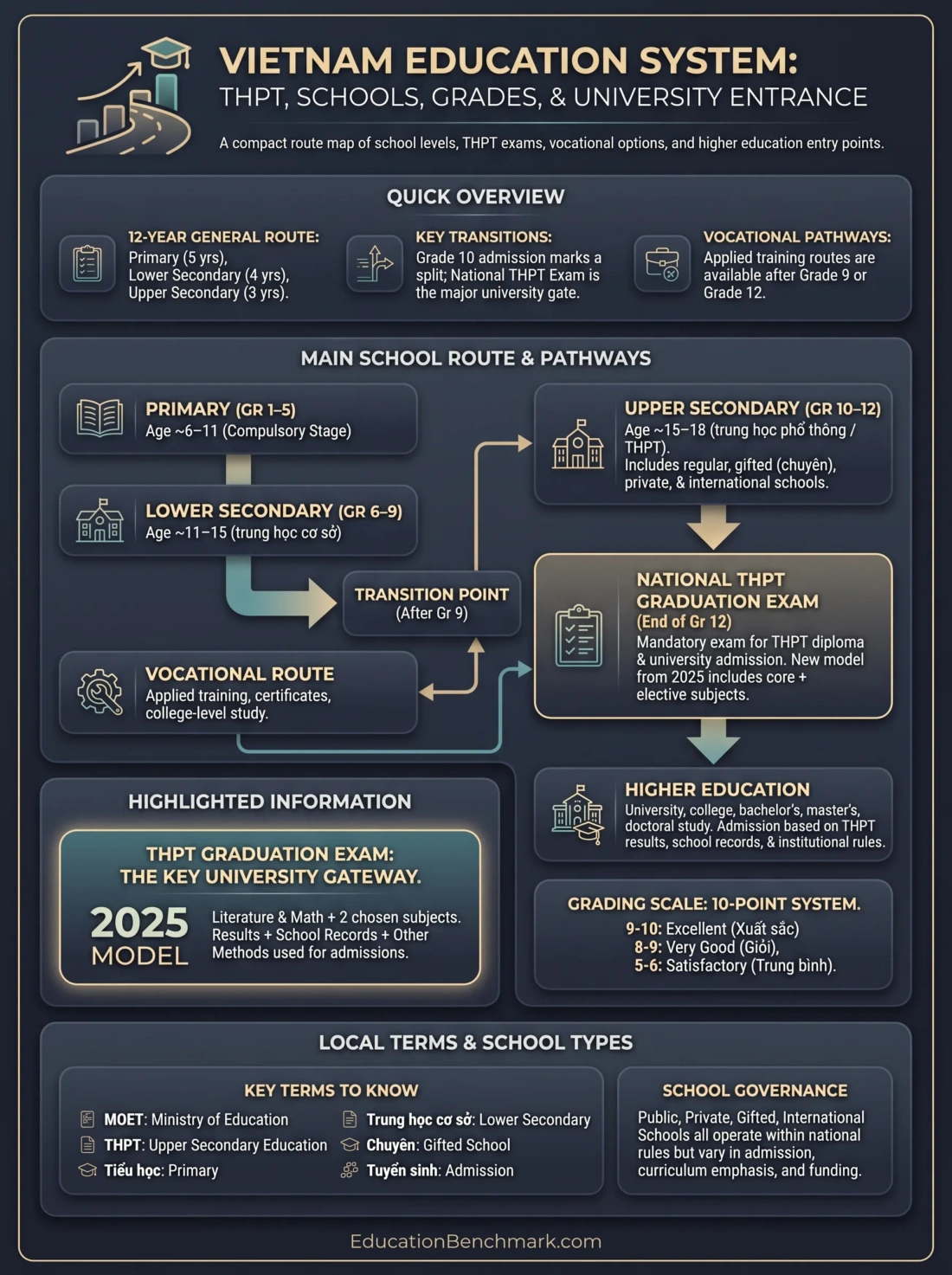
Vietnam’s Route From Primary School to THPT and University Admission
Vietnam’s route turns on a 5–4–3 school structure, the Grade 10 selection point, THPT graduation, and ranked university preferences.
Primary School
Selected stamp: Primary School. Choose another stamp to update the route card.
Vietnam’s school system is easy to describe as five years of primary school, four years of lower secondary, and three years of upper secondary, but the important decisions sit between those stages. Grade 9 does not simply flow into any desired THPT school, the Grade 12 examination no longer uses the older subject pattern, and passing through upper secondary is not the same process as gaining a university place. The clearest way to understand the system is to separate school progression, THPT graduation, and university admission.
School structure
Vietnam’s 5–4–3 Structure and Nine Years of Compulsory Schooling
The general-school route runs through primary, lower secondary, and upper secondary education, with a parallel vocational-secondary route after THCS.
| Stage | Vietnamese term | Grades | Typical entry age | Standard duration |
|---|---|---|---|---|
| Primary education | Tiểu học | 1–5 | 6 | 5 years |
| Lower secondary | Trung học cơ sở (THCS) | 6–9 | 11 | 4 years |
| Upper secondary | Trung học phổ thông (THPT) | 10–12 | 15 | 3 years |
| Vocational secondary | Trung học nghề | Post-THCS route | Usually after Grade 9 | 3 years |
Decision No. 38/2026/QD-TTg established the current national education-system framework, with five standard years for primary education, four for THCS, and three for either THPT or vocational secondary. It took effect on September 7, 2026. Programmes and programme standards issued earlier may continue for cohorts admitted before January 1, 2027, which matters during the transition to the new framework. [a]
The compulsory boundary also changed. Under the Education Law amendments effective January 1, 2026, both primary and lower-secondary education are compulsory. In the normal grade sequence, that means compulsory general education extends from Grade 1 through Grade 9 rather than ending after primary school. [b]
The standard age reference remains Grade 1 at age 6, Grade 6 at age 11, and Grade 10 at age 15. These are normal entry ages, not rigid age limits; acceleration, delayed schooling, interrupted study, and other permitted circumstances can produce different age-grade combinations. [c]
First major selection point
The Grade 10 Selection Point in Vietnam
Finishing Grade 9 confirms completion of THCS, but entry to a particular public upper-secondary school is a separate local admission process.
The student completes lower secondary and receives completion confirmation in the school record under the current credential system.
Provincial education authorities apply the permitted admission method for local public THPT schools.
The student enters Grades 10–12 and follows the national upper-secondary curriculum offered by the school.
Specialized upper-secondary schools can use additional competitive requirements for specialist subjects and places.
A vocational-secondary programme provides a different post-THCS route instead of the standard academic THPT pathway.
Vietnam does not operate one identical nationwide Grade 10 entrance examination for every student. Under the rules applied for the 2026–2027 admission cycle, localities using an entrance examination use Literature, Mathematics, and a third subject or test selected by the provincial Department of Education and Training. A proposal released in August 2026 would reduce the public-THPT examination to Mathematics and Literature, but that proposal was still a draft rather than the rule already in force. [d]
This distinction is important in large or highly competitive local systems. Completing THCS establishes the student’s educational stage; it does not guarantee a place in any particular THPT school. Admission pressure, school capacity, specialist programmes, and the chosen local method can all affect the Grade 10 outcome.
THPT Is More Than “High School”: Grades 10–12 Under the 2018 Curriculum
THPT stands for trung học phổ thông, the three-year upper-secondary stage covering Grades 10, 11, and 12. The 2018 General Education Curriculum treats these years as a more career-oriented stage following the basic-education phase completed at the end of Grade 9.
At THPT level, the compulsory learning components include Literature, Mathematics, Foreign Language 1, History, Physical Education, National Defense and Security Education, Experiential and Career Guidance Activities, and local educational content. Students also choose four subjects from a group that includes Geography, Economic and Legal Education, Physics, Chemistry, Biology, Technology, Informatics, Music, and Fine Arts. History was moved into the compulsory group through a later curriculum adjustment. [e]
The distinction between curriculum requirements and graduation-exam subjects matters. Foreign Language 1 is part of the compulsory THPT curriculum, for example, but Foreign Language is no longer a compulsory subject in the national graduation examination. Likewise, a student does not automatically sit every elective subject studied during upper secondary.
Regular public THPT schools, private schools following the national general-education programme, and selective trường chuyên can therefore share the same national curriculum framework while differing in admissions, specialist provision, available subject combinations, and school-level organization.
Marks and records
What a 10-Point Mark and Học Bạ Actually Mean
A classroom mark, an annual result, a graduation score, and a university cut-off are different measurements even when all are expressed numerically.
| Record or score | What it represents | Where it matters |
|---|---|---|
| Subject mark | Assessment in a particular subject where numerical grading applies | Ongoing and periodic school assessment |
| Annual subject or school result | Performance recorded for a school year under the assessment regulation | Promotion, academic record, and later calculations |
| Học bạ | The student’s official school academic record | School history, graduation calculation, and some university methods |
| THPT graduation score | A regulated calculation combining examination and school-record components | Recognition of THPT graduation |
| Điểm chuẩn | The admission cut-off for a university programme under its applicable method | University admission, not school graduation |
Vietnam’s secondary-school assessment rules combine regular and periodic assessment and distinguish subjects assessed with numerical marks from those assessed through comments or achievement categories. The formal framework is set by Circular No. 22/2021/TT-BGDDT for THCS and THPT students. [f]
A number such as 8.0 therefore needs context. An 8.0 subject result is not automatically equivalent to an 8.0 graduation result, a foreign GPA, or a university admission score. There is no single conversion that should be applied to every purpose.
National graduation examination
The Kỳ Thi Tốt Nghiệp THPT: Vietnam’s Current 2+2 Exam
The examination introduced for the 2018 curriculum uses two compulsory subjects and two student-selected subjects.
The Ministry of Education and Training retained this structure for the 2026 examination. Literature is administered in written form, while the other subjects use objective-test formats, and the examination is organized across three sessions. [g]
One distinction prevents a common misunderstanding: Foreign Language remains a compulsory curriculum subject in THPT, but it is not a compulsory graduation-exam subject under the 2+2 model. A candidate can select Foreign Language as one of the two chosen examination subjects, but Mathematics and Literature are the two compulsory examinations.
Graduation calculation
Why Four Exam Scores Do Not Decide THPT Graduation
The four national examination scores are important, but the school record carries equal weight in the core graduation calculation.
The current graduation regulation gives 50% of the core result to examination performance and 50% to the upper-secondary academic record. Within the school-record calculation, Grades 10, 11, and 12 have weights of 1, 2, and 3 respectively. For ordinary candidates, all examination subjects must be above 1.0 on the 10-point scale and the final graduation score must reach at least 5.0, alongside the other eligibility requirements in the regulation. [h]
This creates three separate milestones that should not be collapsed into one: a student can complete the Grade 12 programme, then undergo the national graduation-recognition process, and only after that compete for or confirm a place in higher education. A THPT diploma is evidence of graduation; it is not a university admission decision.
What Changed for THCS and THPT Credentials in 2026
Vietnam changed an important piece of the school-leaving documentation system in 2026. The previous separate THCS graduation diploma was replaced by confirmation that the student completed the THCS programme in the học bạ. The same credential reform decentralized the issuing of THPT diplomas to school principals, introduced a vocational-secondary diploma, and formally provided for digital diplomas and certificates. Circular No. 10/2026/TT-BGDDT took effect on April 15, 2026. [i]
After Grade 9: completion of THCS is now confirmed in the school record rather than through the old separate THCS graduation diploma. After THPT: a student who satisfies the graduation requirements receives the THPT graduation diploma.
This change also affects how older English-language descriptions of Vietnam’s education system should be read. References saying that every Grade 9 graduate receives a separate THCS diploma describe the previous credential model, not the current 2026 regime.
Higher education admission
From THPT Scores to Nguyện Vọng: How University Admission Works
Vietnam does not reduce university entry to one universal entrance examination. Institutions use permitted admission methods, while preferences are processed through a common national system.
Depending on the institution, evidence can include THPT examination results, học bạ results, separate assessment results, direct admission, or combined methods.
Candidates place programmes in genuine priority order on the common admissions system.
If more than one preference is academically eligible, the system recognizes the highest-ranked eligible one.
The candidate is admitted to the qualifying programme that survives the centralized preference-processing rules.
For the 2026 admissions cycle, candidates can register up to 15 programme preferences, ordered from highest to lowest priority. The regulation also introduced a general source threshold of at least 15 points out of 30 from three relevant THPT graduation-exam subjects, or Mathematics, Literature, and another examination subject as specified by the rule, for candidates graduating under the 2026 system. This 15-point figure is an eligibility floor in the national regulation; it is not the same as a university programme’s final điểm chuẩn, which may be much higher. [j]
A Four-Preference Admission Scenario
In this scenario, Preference 2 becomes the admission result. Preferences 3 and 4 do not replace it simply because the candidate also qualifies for them. This is why nguyện vọng should be understood as an ordered preference system, not merely a list of applications.
Học Bạ Admission in 2026 Is Not Just a Grade 12 Average
Universities may use the student’s học bạ as an admission method, but the 2026 regulation prevents this from being reduced to an arbitrary single Grade 12 number. Where admission is based on THPT school results, the subject combination must use the full-year academic results across Grades 10, 11, and 12 for at least three subjects. Mathematics or Literature must be included, and the required Mathematics or Literature component must carry at least one-third of the weighting on the 30-point admission scale. [k]
The regulation also permits a route using at least two school subjects plus an eligible foreign-language certificate, subject to the prescribed conversion rules. If a student changed an elective and therefore did not study one admission subject for all six semesters, a closely related replacement subject may be used where the regulation and institution’s method allow it.
This makes the word học bạ context-dependent. The same official school record can feed the THPT graduation calculation and a university’s transcript-based admission method, but the two calculations are not the same formula.
The Parallel Route After Grade 9: Trung Học Nghề
The 2026 national framework places trung học nghề, or vocational secondary education, at the same programme level as THPT, with a standard duration of three years. It should be understood as a parallel post-THCS route rather than as an academic THPT school with a few vocational subjects added.
The broader progression system is also becoming more explicit. Circular No. 52/2026/TT-BGDDT regulates articulation among vocational secondary, intermediate, college, and university education. Its principles allow recognized prior learning to support progression without automatically requiring learners to repeat content that has already been formally recognized. [l]
That does not mean every vocational-secondary qualification leads directly to every university programme. Entry conditions, recognized learning outcomes, bridging requirements, programme compatibility, and institution-level admission rules still matter. The route is designed to make progression possible, not to erase qualification requirements between levels.
Where official details may vary: Grade 10 admission procedures can differ by locality; THPT examination regulations can change by cohort; university methods and điểm chuẩn vary by programme; and vocational progression depends on the qualification and receiving institution. For decisions that affect an actual application, the current Ministry of Education and Training rules, the relevant provincial education authority, and the target institution should be checked directly.
Education Benchmark is an independent informational guide and is not affiliated with any ministry of education, school authority, exam board, university, government agency, or official ranking organization.
Sources and Verification
- [a] Decision No. 38/2026/QD-TTg on the National Education System Framework — Used for the current 5–4–3 structure, vocational-secondary level, standard programme durations, effective date, and transition provision. (Reliable because it is the official Government legal-document record.)
- [b] Law No. 123/2025/QH15 Amending the Education Law — Used for the expansion of compulsory education to both primary and lower-secondary education from 2026. (Reliable because it is the official Government record of legislation adopted by the National Assembly.)
- [c] Levels of Vietnam’s National Education System — Used for the normal entry ages for Grades 1, 6, and 10. (Reliable because it is published by the Ministry of Education and Training’s higher-education portal; current credential changes are verified separately.)
- [d] Consultation on a Two-Subject Grade 10 Entrance Examination Proposal — Used to distinguish the Grade 10 rules applied for 2026–2027 from the later two-subject proposal that had not yet replaced them. (Reliable because it is an official Government Portal publication describing the Ministry proposal and existing rule.)
- [e] Consolidated General Education Curriculum — Used for the compulsory and elective learning components in upper-secondary education. (Reliable because it is the Ministry of Education and Training’s consolidated curriculum document.)
- [f] Circular No. 22/2021/TT-BGDDT on Lower- and Upper-Secondary Student Assessment — Used for the assessment framework governing THCS and THPT student results. (Reliable because it is the official Government legal-document record of a Ministry of Education and Training circular.)
- [g] 2026 THPT Graduation Examination: Stable Structure With Limited Adjustments — Used for the current 2026 THPT graduation-exam structure and its continuation of the 2+2 model. (Reliable because it is published by the Ministry of Education and Training’s Quality Management Agency.)
- [h] Regulations on the THPT Graduation Examination From 2025 — Used for the graduation-score formula, the 1:2:3 weighting of Grades 10–12, the 50:50 structure, and graduation-recognition conditions. (Reliable because it is the official examination regulation hosted by the Ministry’s Quality Management Agency.)
- [i] Changes Introduced by Circular No. 10/2026/TT-BGDDT on Diplomas and Certificates — Used for the 2026 THCS completion-record change, THPT diploma authority, vocational-secondary diploma, and digital credentials. (Reliable because it is an official explanation from the Ministry’s Quality Management Agency.)
- [j] New University Admission Regulations for 2026 — Used for the 15-preference limit, preference ordering, the 15-out-of-30 general source threshold, and the 2026 admission framework. (Reliable because it is an official Government Portal account of the Ministry’s final university-admission regulation.)
- [k] University Admission in 2026: Changes to School-Record Admission — Used for the Grade 10–12 học bạ requirements, minimum subject count, Mathematics or Literature requirement, and weighting rule. (Reliable because it publishes the Ministry of Education and Training’s explanation of the final 2026 regulation.)
- [l] Rules on Articulation Between Vocational Secondary, Intermediate, College, and University Education — Used for the 2026 articulation principles connecting vocational-secondary and higher education levels. (Reliable because it is an official Government Portal explanation of Circular No. 52/2026/TT-BGDDT.)