Singapore’s Exams, Subject Levels, and Post-Secondary Routes
A route map built around PSLE placement, Full Subject-Based Banding, the 2027 SEC transition, and Singapore’s parallel academic and applied pathways.
Primary Leaving Exam
Selected stamp: Primary Leaving Exam. Choose another stamp to update the route card.
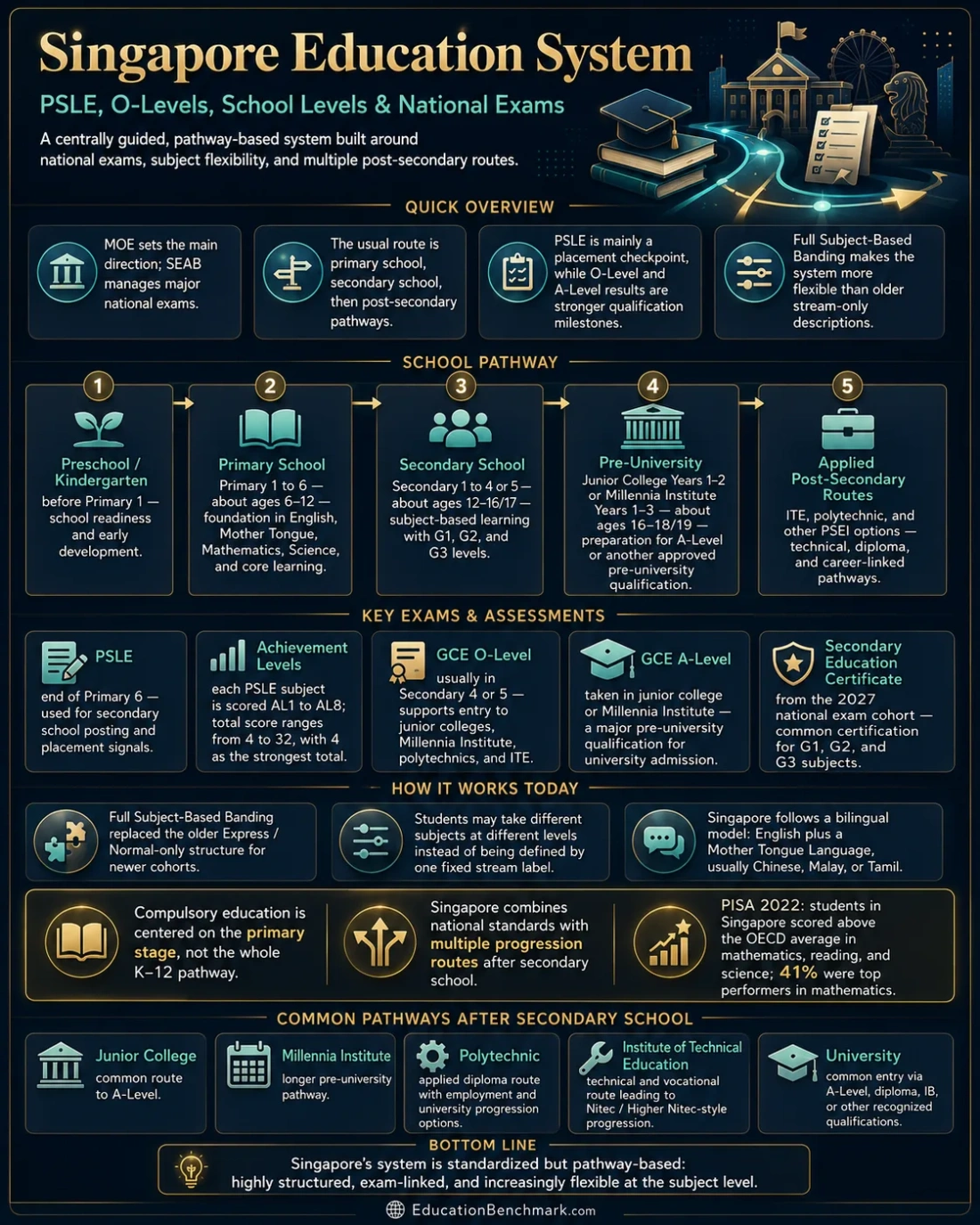
Singapore’s education system is nationally coordinated, examination-aware, and increasingly organised around flexible subject combinations rather than fixed secondary streams. Primary school provides a common six-year foundation, the PSLE helps determine the starting point for secondary education, and students later branch toward the Integrated Programme, national secondary qualifications, junior colleges, Millennia Institute, polytechnics, the Institute of Technical Education, or other approved routes.
The structure can look highly linear when reduced to a diagram. In practice, it contains several decision points. A PSLE result does not describe every subject a student will take, the same secondary school may serve students entering through different Posting Groups, and an applied diploma can still lead to university study. The system is therefore better understood as a set of connected routes rather than a single academic ladder.
PSLE Is a Placement Signal, Not a Permanent Track
The Primary School Leaving Examination is taken at the end of Primary 6. English Language, Mother Tongue Language, Mathematics, and Science are each reported through an Achievement Level from AL1 to AL8. The four Achievement Levels are added together, producing a total PSLE Score from 4 to 32; a lower total represents stronger overall examination performance.[a]
This scoring model is standards-referenced. Students within the same Achievement Level band receive the same subject score instead of being separated by very small differences in raw marks. Foundation-level subjects are mapped to equivalent Achievement Levels for Secondary 1 posting, while approved Mother Tongue Language exemptions are handled through separate score-assignment rules.
Placement sequence
How a PSLE Result Becomes a Secondary Starting Point
English, Mother Tongue, Mathematics, and Science contribute to the overall PSLE Score.
The total supports secondary school choice and determines the Posting Groups available to the student.
The Posting Group guides admission and the likely starting level of most Secondary 1 subjects.
For mainstream Secondary 1 posting, MOE currently links PSLE Scores of 4–20 with Posting Group 3, scores of 23–24 with Posting Group 2, and qualifying scores of 26–30 with Posting Group 1. Scores of 21–22 and 25 sit in option bands where more than one Posting Group may be available. These groups establish an initial position; they are not intended to function like the former Express, Normal (Academic), and Normal (Technical) identities.
From Secondary Streams to Full Subject-Based Banding
Starting with the 2024 Secondary 1 cohort, the former Express, Normal (Academic), and Normal (Technical) streams were removed for new entrants. Under Full Subject-Based Banding, students enter through Posting Groups 1, 2, or 3 and can study subjects at G1, G2, or G3 levels as they progress.[b]
Secondary structure
Posting Groups and Subject Levels Do Different Jobs
The distinction matters because an entry category is not the same as the level of every subject studied.
Posting Groups support Secondary 1 admission and guide the initial level at which most subjects are offered.
A student may take different subjects at different levels according to readiness, interests, and school guidance.
Post-secondary options depend on the subjects, levels, grades, and programme-specific requirements actually completed.
This arrangement reduces the need to describe a student through one course label. A learner could, for instance, begin with most subjects at G2 while taking a stronger subject at G3. Schools can later adjust subject levels at suitable points when performance and learning needs indicate that a change is appropriate.
Full SBB does not remove selection or assessment. It changes where differentiation occurs. Instead of placing every subject within one stream, the system distinguishes the level of individual subjects and records those levels in later qualifications.
Singapore’s School Route by Stage and Typical Age
The ages below describe the normal progression rather than an absolute placement rule. MOE’s admission guidance, for example, lists age six to six-plus for Primary 1, age twelve to twelve-plus for Secondary 1, and age sixteen to sixteen-plus for the first pre-university year.[c]
School route
Levels, Years, and Main Transition Points
Ages are approximate. Entry decisions may be affected by a student’s previous schooling, admission route, and programme.
| Stage | Usual years | Typical age | Main transition |
|---|---|---|---|
| Preschool | Before Primary 1 | Usually before age 6 | Preparation for formal primary education; not the national compulsory stage |
| Primary school | Primary 1–6 | About 6–11 | PSLE at the end of Primary 6 |
| Secondary school | Secondary 1–4 or 5 | About 12–15 or 16 | O-Level or N-Level for transitional cohorts; SEC from 2027 |
| Integrated Programme | Six-year combined route | About 12–17 | A-Level, IB Diploma, or NUS High School Diploma without the Secondary 4 O-Level |
| Junior college | Usually 2 years | Usually from about 16 | A-Level or an approved alternative at selected institutions |
| Millennia Institute | Usually 3 years | Usually from about 16 | A-Level examination |
| Polytechnic | Commonly a 3-year diploma | Usually after secondary school | Employment, further qualifications, or university application |
| Institute of Technical Education | Varies by Higher Nitec route | Usually after secondary school | Employment, further ITE study, polytechnic, or another diploma route |
Singapore’s legal definition of compulsory education is narrower than a general statement such as “school is compulsory until age fifteen.” It applies to qualifying Singapore Citizens residing in Singapore and requires regular attendance at a national primary school unless an exemption is granted. Compulsory school age is defined as above six and under fifteen, but the required programme itself is primary education.[d]
O-Levels in 2026, One SEC From 2027
References to Singapore’s secondary examinations can appear contradictory because the system is in a transition period. O-Level and N-Level examinations remain relevant to the cohorts completing the older qualification structure in 2026. The first graduating cohort under the replacement framework will sit the Singapore-Cambridge Secondary Education Certificate in 2027.
Qualification transition
From Separate N- and O-Level Certificates to the SEC
Students in the remaining course-based cohorts complete the national examinations associated with their existing routes.
Different subjects can be studied at different levels instead of being tied to one secondary stream.
One certificate records the subjects and the G1, G2, or G3 levels at which they were examined.
SEAB states that the SEC will combine and rename the former N(T), N(A), and Ordinary Level qualification structure. Students will sit each subject at its relevant G1, G2, or G3 level, and the resulting certificate will show the subject-level combination rather than assigning one overall stream label.[e]
The examination standards do not become identical across all subjects merely because one certificate is issued. G1, G2, and G3 retain different assessment demands and grading structures. The central change is how those levels are combined and presented for an individual student.
The Integrated Programme Route Without Secondary 4 O-Levels
The Integrated Programme, usually shortened to IP, is a distinct six-year academic route offered by selected schools. Students normally do not sit the GCE O-Level examination in Secondary 4. They continue toward a later qualification such as the Singapore-Cambridge GCE A-Level, International Baccalaureate Diploma, or NUS High School Diploma.[f]
What the O-Level Bypass Means
Skipping the Secondary 4 O-Level does not mean that IP students follow a qualification-free route. The programme replaces that examination checkpoint with a longer school-designed curriculum leading to a later, recognised pre-university credential.
IP admission is therefore more than a decision about avoiding an examination. The student is entering a continuous programme whose curriculum, subject offerings, school culture, and final qualification may differ from those of another IP school. Transfers between IP schools are generally restricted, so the particular institution matters.
JC, Millennia Institute, Polytechnics, and ITE Compared
Singapore’s post-secondary structure is not divided simply into “university preparation” and “non-university education.” It includes academic, applied, technical, and transfer-oriented routes with different credentials and progression possibilities. A Singapore-specific independent overview also identifies junior colleges, Millennia Institute, polytechnics, and ITE as the central branches following secondary education.[g]
Route comparison
What Each Post-Secondary Route Is Designed to Do
The routes differ in emphasis, not in whether further progression is possible. Polytechnic diploma holders can compete for university places, while ITE graduates may progress to polytechnic or other diploma programmes when they meet the applicable requirements. Course relevance, grades, aptitude-based selection, interviews, and portfolios may matter alongside the name of the qualification.
How O-Level Results Feed the JAE—and What Replaces It
For the current O-Level structure, eligible certificate holders use the Joint Admissions Exercise to apply to junior colleges, Millennia Institute, polytechnics, and ITE. In the 2026 JAE, applicants received course eligibility information after the release of the 2025 O-Level results and submitted their choices through the online JAE system.[h]
- Results are released: the student receives subject grades and, when eligible, information showing the courses available through the admissions exercise.
- Aggregate scores are calculated: different routes use different combinations of language and relevant subject grades.
- Courses are ranked: applicants submit choices rather than receiving an automatic destination solely from one examination total.
- Posting is completed: eligibility, choice order, available places, and the results of other applicants influence the outcome.
The 2027 SEC cohort will move into a new Post-Secondary Admissions Exercise for the 2028 intake. MOE’s published pathway list includes junior colleges, Millennia Institute, polytechnic diploma programmes, the Polytechnic Foundation Programme, and two- or three-year Higher Nitec routes. The new process is intended to align admissions with the mixed G1, G2, and G3 subject combinations shown on the SEC.[i]
This transition makes the year of graduation important. A student completing an O-Level route before the SEC transition should consult the JAE rules for that admission cycle. A student receiving the SEC should instead check the PSE requirements, subject-counting rules, and programme prerequisites that apply to the relevant intake.
A-Levels and Institution-Led University Admission
The GCE A-Level remains a major pre-university qualification, but it does not create one automatic national university placement. Applicants apply to individual autonomous universities, which publish their own programme prerequisites, application windows, selection methods, and additional requirements.
University route
Qualification Results and Programme Selection Are Separate Stages
Academic results create an application profile, but do not by themselves guarantee entry to a particular degree.
Universities assess applicants against programme capacity, subject prerequisites, competition, and applicable aptitude-based criteria.
The cohort receiving its A-Level results in February 2026 was the first assessed under the revised University Admission Score computation. Under that method, a fourth content-based subject is counted only when it improves the final score, while Project Work is treated as Pass/Fail and excluded from the score calculation.[j]
A-Levels are not the only locally recognised application route. NUS, for example, separates applicants into qualification groups that include the Singapore-Cambridge GCE A-Level, local polytechnic diplomas, the NUS High School Diploma, the IB Diploma, international qualifications, and transfer applicants.[k] Other universities publish their own categories and programme rules, so admission should always be checked at institution and course level.
English-Medium Learning, Mother Tongue, and School Provision
English is the principal language of instruction in mainstream national schools, while Mother Tongue Language is a central part of Singapore’s bilingual education model. The three official school Mother Tongue Languages are Chinese, Malay, and Tamil. Exemptions or alternative language arrangements may be approved in specific circumstances, but they should not be assumed.[l]
Local terminology
Terms That Change How the Route Is Read
The publicly funded school sector also contains more variation than the word “national” may suggest. MOE distinguishes government, government-aided, autonomous, independent, specialised independent, and specialised schools, among other provisions. These categories can differ in governance, fees, admissions, programmes, and the degree of curricular flexibility available.[m]
International and foreign-system schools operate outside the ordinary national-school route. Their curricula, admissions, fees, grade structures, and qualifications may follow systems such as the IB, British, American, French, German, or other national frameworks. Families comparing them with MOE schools should not assume that grade names or transfer points correspond directly.
Reading Singapore’s Rules During a Reform Cycle
Several education terms will coexist until older cohorts finish their programmes. A current secondary student may still encounter Express, Normal (Academic), Normal (Technical), O-Level, or N-Level references, while a younger student is more likely to be described through Posting Groups, G1–G3 subjects, Full SBB, and the SEC.
Details That Should Be Checked for the Relevant Year
- PSLE posting ranges, option bands, tie-break rules, and school-specific score ranges.
- Which subjects are available at G1, G2, or G3 in a particular school.
- O-Level, N-Level, or SEC examination arrangements for the student’s graduating cohort.
- JAE or PSE aggregate calculations and programme eligibility.
- JC, MI, polytechnic, ITE, and university subject prerequisites.
- Mother Tongue Language requirements, exemptions, and approved alternatives.
- International-student admissions, fees, passes, and age-placement conditions.
Education Benchmark is an independent informational guide and is not affiliated with any ministry of education, school authority, exam board, university, government agency, or official ranking organization. Examination structures, course names, admission exercises, and institutional requirements can change. Decisions about school placement or further study should therefore be checked with MOE, SEAB, the relevant school, and the receiving post-secondary institution or university.
Sources and Verification
- [a] How will the current PSLE scoring system benefit your child? — Used for PSLE subjects, Achievement Levels, the total score range, and the relationship between PSLE results and secondary placement. (Reliable because it is an official Singapore Ministry of Education resource.)
- [b] Secondary school experience under Full SBB — Used for the removal of the former secondary streams and the operation of Posting Groups under Full Subject-Based Banding. (Reliable because it is an official MOE policy explanation.)
- [c] Studying in Singapore — Used for MOE’s published age guidance at primary, secondary, and pre-university entry points. (Reliable because it is official admission guidance from Singapore’s Ministry of Education.)
- [d] Overview of compulsory education — Used to distinguish compulsory primary education from the wider school-age range and to identify the citizens covered by the requirement. (Reliable because it is the official MOE explanation of the Compulsory Education Act framework.)
- [e] Secondary Education Certificate (SEC) — Used for the 2027 introduction of the SEC and the recording of G1, G2, and G3 subjects on one certificate. (Reliable because SEAB is Singapore’s official examinations and assessment authority.)
- [f] Integrated Programme — Used for the six-year IP structure, the O-Level bypass, and the possible final qualifications. (Reliable because it is an official MOE programme page.)
- [g] Singapore Education System (2026): Structure, Quality, and Performance — Used as a supplementary independent overview of Singapore’s centrally governed stages and major post-secondary branches. (Relevant because it is a Singapore-specific education reference that cites public sources; official rules were separately verified through MOE and SEAB.)
- [h] Joint Admissions Exercise (JAE) — Used for the current O-Level admissions exercise, participating institution types, and the sequence from results to course choices. (Reliable because it is the official MOE admissions page.)
- [i] Post-Secondary Admissions Exercise (PSE) — Used for the post-SEC admissions process beginning with the 2028 intake and its listed pathways. (Reliable because it is the official MOE page for the new admissions exercise.)
- [j] Release of the 2025 Singapore-Cambridge GCE A-Level Examination Results — Used for the revised University Admission Score computation applied to the first affected A-Level cohort. (Reliable because it is an official MOE examination-results release dated February 2026.)
- [k] NUS Undergraduate Admissions — Used to demonstrate that universities accept applications through several qualification categories, including A-Levels and local polytechnic diplomas. (Reliable because it is the official admissions site of the National University of Singapore.)
- [l] Learning a Mother Tongue Language in school — Used for the compulsory Mother Tongue Language framework and the official Chinese, Malay, and Tamil options. (Reliable because it is an official MOE curriculum page.)
- [m] Types of schools — Used for the distinctions among government, government-aided, autonomous, independent, and specialised school categories. (Reliable because it is the official MOE school-type reference.)