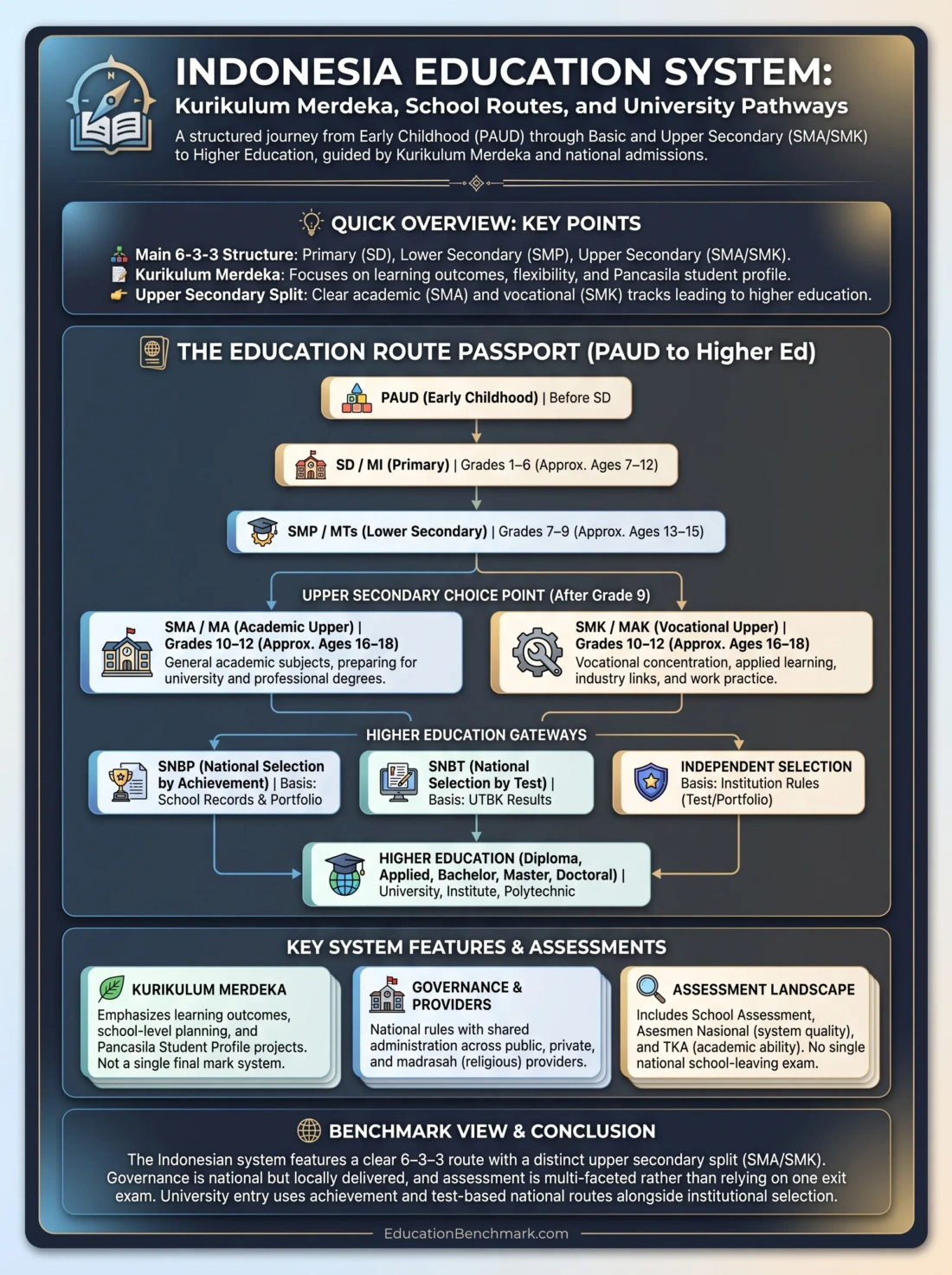
Indonesia’s SD–MI to PTN Route Passport
Follow the parallel school and madrasah route, the SMA–SMK split, TKA, and the paths into academic or applied higher education.
Primary Route
Selected stamp: Primary Route. Choose another stamp to update the route card.
Indonesia’s education system is easiest to understand as a branching route rather than a single straight ladder. The familiar school sequence is six years of primary education, three years of lower secondary, and three years of upper secondary, while the government’s current Wajib Belajar 13 Tahun policy adds one year of preschool before the 6–3–3 route. The official policy description is one year of PAUD, six years of SD, three years of SMP, and three years of SMA/SMK or an equivalent route. [a]
The route also runs through parallel school and madrasah institutions. At upper secondary, the system divides more clearly between general education in SMA or MA and vocational education in SMK or MAK. Kurikulum Merdeka then changes what happens inside those routes: Grade 10 provides a broad base, later subject choice becomes more individualized, vocational students move deeper into a named field of expertise, and higher-education admission can involve TKA, SNBP, UTBK-SNBT, or institution-run selection.
Parallel school routes
How SD–MI, SMP–MTs, and SMA–MA Routes Correspond
General schools and madrasahs use different institutional names while occupying corresponding stages of the national education route.
Ministry of Religious Affairs definitions place MI in the six-level primary stage, MTs in the three-level lower-secondary stage, and MA in upper-secondary education. This is why MI should not be treated as an alternative below SD or MTs as a separate level above SMP; they are parallel institutional forms within the route. [b]
For an on-time student, a useful age guide is roughly 5–6 for the preschool year, 7–12 through SD/MI, 13–15 through SMP/MTs, and about 16–18 through a three-year upper-secondary program. These are route estimates, not universal admission cutoffs. A 2026 cross-country legal dataset still codes Indonesia with an official compulsory-school entrance age of 7 and a nine-year compulsory duration. That measurement should not be confused with the government’s newer Wajar 13 policy program: the two describe different layers of the system. [c]
Kurikulum Merdeka in 2026: Transition Rules, Deep Learning, and Coding
Kurikulum Merdeka is now the central curriculum model for PAUD, primary, and secondary education, but the transition was deliberately staggered. The original transition rule allowed schools outside disadvantaged, frontier, and outermost areas to continue Kurikulum 2013 through 2025/26 and required them to begin Kurikulum Merdeka by 2026/27. Schools in designated 3T areas were given one additional year: they may continue Kurikulum 2013 through 2026/27 and must begin Kurikulum Merdeka by 2027/28. [d]
Curriculum transition
What the 2026/27 School Year Means
The deadline depends on whether a school falls under the special 3T transition provision.
A school that had remained on Kurikulum 2013 is scheduled to begin Kurikulum Merdeka no later than this school year.
Eligible schools may still use Kurikulum 2013 in 2026/27, with Kurikulum Merdeka beginning no later than 2027/28.
The 2025 curriculum amendment did not announce another replacement curriculum. It retained the existing curriculum direction while adding or adjusting several elements. Pembelajaran Mendalam, often translated as deep learning, is an educational approach here rather than a machine-learning term. The ministry describes learning that is mindful, meaningful, and enjoyable, with greater emphasis on understanding, reasoning, application, and reflection. Coding and Artificial Intelligence also became an elective subject that schools may provide according to available resources and that students may choose according to interest. [e]
Grade 10 to Fase F: How SMA Subject Choice Now Works
The most useful way to read the SMA route under Kurikulum Merdeka is to separate Grade 10 from Grades 11–12. Grade 10 is the broad-base stage commonly associated with Fase E. In the current curriculum structure, science and social-science content in Grade 10 is not automatically split into the narrower subject packages that older descriptions of Indonesian high school often emphasize.
SMA subject structure
From a Broad Grade 10 Base to Fase F Choice
Students study a broad program before the more differentiated elective structure used in the final two school years.
Students continue required subjects and choose from electives that the school is able to offer.
For Fase F in Grades 11 and 12, the current national curriculum structure divides subjects into required and elective groups. An SMA, MA, or equivalent school must provide at least seven elective subjects. The available list can include Biology, Physics, Chemistry, Economics, Geography, Sociology, Informatics, Advanced Mathematics, advanced language subjects, foreign languages, and other permitted options. The exact menu at one school can be narrower than the national list because staffing and resources still matter. [f]
This is why reducing every current SMA student to a fixed IPA or IPS label can be misleading. Under the Merdeka structure, the more useful question is which Fase F subjects the student actually takes. A student aiming toward engineering may build a combination around advanced mathematics and physical sciences where offered; a student considering medicine or life sciences may prioritize biology and chemistry; a student interested in economics may combine economics with mathematics or social-science subjects. Those are illustrations, not nationally prescribed packages.
Subject choice also connects school study to later selection. TKA asks upper-secondary participants to choose two subjects in addition to the required tested subjects, while SNBP can consider supporting subjects related to the intended program. The practical result is that Grade 10 planning and Fase F choices can matter well before a university application is submitted.
Upper-secondary decision
SMA–MA or SMK–MAK: What Changes After the Split
The routes differ mainly in academic breadth, vocational specialization, and the role of workplace learning; none should be read as a single mandatory destination after graduation.
General upper-secondary study with Fase F subject choice and a common route toward academic or vocational higher education.
Upper-secondary general education in the madrasah system, combining general study with the religious character of the provider.
Vocational upper secondary organized around a field and concentration of expertise, with direct links to workplace learning.
The vocational madrasah route, combining vocational study with the institutional character of madrasah education.
Konsentrasi Keahlian Is the Organizing Unit Inside SMK
SMK is not one uniform technical program. The national Spektrum Keahlian organizes vocational study into programs and concentrations of expertise. Current fields include accounting, banking services, animation, broadcasting and film, visual communication design, culinary arts, hospitality, software and game development, computer networks and telecommunications, automotive engineering, electronics, health services, medical laboratory technology, agriculture, fisheries, maritime fields, logistics, energy, construction, and many other specializations. A student’s SMK experience therefore depends heavily on the concentration offered by the school. [g]
PKL Is Curriculum, Not Just an Optional Internship
Praktik Kerja Lapangan (PKL) is treated as a subject and a workplace-learning vehicle in the vocational curriculum. Its purpose is to let students strengthen technical skills in the context of their concentration while also experiencing workplace practices and expectations. Current national guidance was revised after the 2024 curriculum regulation, so schools should not be assumed to follow an older Prakerin or PKL model simply because an older article describes it that way. [h]
The vocational route is also not synonymous with “school, then work.” Employment is one destination, but an SMK or MAK graduate may also apply to diploma, applied-bachelor, or academic bachelor programs when the relevant admission conditions are met. That distinction becomes clearer in the national higher-education selection rules.
TKA Is Not a Graduation Exam
Tes Kemampuan Akademik (TKA) was introduced to provide an individual standardized measure of academic achievement that can be used when results from different schools need to be compared. At SMA/MA/SMK/MAK level, the current TKA design covers Bahasa Indonesia, Mathematics, English, and two elective subjects chosen by the participant. TKA is generally voluntary, and a student can still graduate without taking it. Graduation remains a school decision based on school assessment. TKA is therefore not a return to the old Ujian Nasional as a graduation gate. [i]
Assessment roles
School Assessment, TKA, and Asesmen Nasional Are Not the Same Thing
| Assessment | Main purpose | Individual result | Graduation role |
|---|---|---|---|
| School assessment | Measure learning within the school program | Yes | Used by the school when determining graduation |
| TKA | Provide standardized information on academic achievement | Yes | Does not determine graduation |
| Asesmen Nasional | Evaluate education quality at school and regional level | Not designed as an individual student score report | Not a student graduation exam |
The distinction matters because the same student can encounter all three forms of assessment for different reasons. TKA may become practically necessary when a selection route asks for it even though TKA itself is not universally compulsory. That is exactly what happens in SNBP 2026.
Public university admission
SNBP, SNBT, and Mandiri: The 2026 PTN Decision Map
Indonesia does not use one single public-university entrance mechanism. Achievement, UTBK testing, and institution-run selection operate as separate routes.
Uses school achievement records and related selection components, with a TKA result required for 2026 applicants.
Uses the 2026 UTBK result, with portfolios added for specified arts and sports programs.
Is organized by individual PTNs or groups of PTNs under their own published mechanisms.
National routes can lead to academic bachelor programs or vocational programs such as D3 and D4/Sarjana Terapan.
SNBP: School Achievement Plus TKA in 2026
SNBP is the national achievement-based route for eligible final-year SMA, SMK, and MA students. For 2026, the school must enter the eligible student’s report data into PDSS, and the student must have a TKA result. The selection model gives report grades across all subjects at least 50 percent of the assessment component. The remaining share, up to 50 percent, can be built from report grades in up to two subjects supporting the intended program, portfolio, and/or achievements, with the composition set by the PTN. Students may choose programs in PTN Akademik and/or PTN Vokasi. A student admitted through SNBP 2026 cannot register for UTBK-SNBT 2026 or a 2026 PTN Mandiri selection. [j]
SNBT: UTBK Measures a Different Set of Skills
SNBT is the test-based national route and uses UTBK. In 2026, UTBK contains a Tes Potensi Skolastik component covering general reasoning, general knowledge and comprehension, reading and writing, and quantitative knowledge. It also includes literacy in Indonesian, literacy in English, and mathematical reasoning. The 2026 result is valid for that year’s SNBT and PTN admission process, and a participant may take UTBK only once in the cycle. Current rules allow a maximum of four program choices under a defined combination of bachelor and vocational options. [k]
Mandiri Is Not a Fourth National Exam
Seleksi Mandiri is the third PTN admission route, but it is organized by a PTN or a group of PTNs rather than through one national selection method. A university may use a mechanism that includes UTBK results or other institution-defined evidence, so the exact rule must be checked with the target PTN. The official SNPMB FAQ for 2026 lists the three routes as SNBP, SNBT, and Mandiri and confirms that the national SNBP/SNBT scope includes Sarjana, Diploma Empat/Sarjana Terapan, and Diploma Tiga programs. [l]
After SMA or SMK: S1, D3, D4/Sarjana Terapan, and Polytechnic Routes
Indonesia’s higher-education route is not simply “university or no university.” Academic and vocational higher education sit beside each other, and the qualification name matters.
- S1 / Sarjana is the usual academic bachelor route.
- D3 / Diploma Tiga is a vocational diploma route with an applied orientation.
- D4 / Sarjana Terapan is an applied bachelor route within vocational higher education. It should not be treated as merely a shorter or lesser version of S1; its orientation is different.
- Politeknik institutions can offer vocational programs including D1, D2, D3, D4/Sarjana Terapan, and, where authorized, higher applied and professional programs.
The higher-education institutional rules for vocational providers explicitly recognize Diploma Empat or Sarjana Terapan alongside Diploma Tiga and other vocational qualifications. This matters for SMK graduates because the natural next step is not limited to employment: a graduate can pursue a vocational degree and may also compete for academic higher education when the admission route and chosen program permit it. [m]
Where National Rules End and School or PTN Rules Begin
Several parts of the Indonesian route are national: the curriculum regulations, TKA design, the national SNBP and SNBT systems, and the broad definitions of school and higher-education routes. The student experience is still not identical everywhere. A school may offer a different Fase F elective menu, one SMK may have concentrations that another does not, PKL partners can differ, 3T schools have a different curriculum transition deadline, and each PTN can publish program-specific requirements or its own Mandiri mechanism.
This is also why older descriptions of Indonesia’s education system can become misleading without being completely false. A page written during the Kurikulum 2013 period may still describe IPA/IPS streams as if they define every current SMA route. A pre-TKA admissions page may say SNBP depends only on report cards and achievements. A vocational guide may describe an older PKL duration or organization. For current applications, the school year and the exact institution matter.
Independent Information and Official Verification
Education Benchmark is an independent informational guide and is not affiliated with any ministry of education, school authority, exam board, university, government agency, or official ranking organization.
Curriculum transition rules, TKA procedures, SNBP and SNBT conditions, program requirements, school admissions, and university-specific selection rules can change by school year. Students and families making an application decision should verify the current rule with the relevant ministry, school, SNPMB source, PTN, or other responsible institution.
Sources and Verification
- [a] Wajib Belajar 1 Tahun Pra Sekolah | Direktorat PAUD Kemendikdasmen — Used for the current Wajib Belajar 13 Tahun description and its 1 + 6 + 3 + 3 route. (Reliable because it is an official Ministry of Primary and Secondary Education early-childhood source.)
- [b] Keputusan Direktur Jenderal Pendidikan Islam — Used for the formal definitions and grade structure of MI, MTs, and MA in the madrasah route. (Reliable because it is an official Ministry of Religious Affairs document.)
- [c] Compulsory Education Worldwide (2026): Years, Ages, and Enforcement by Country — Used to distinguish current Wajar 13 policy language from cross-country law-coded compulsory-schooling indicators. (Reliable as a structured independent education reference that identifies its international indicator basis.)
- [d] Permendikbudristek Nomor 12 Tahun 2024 tentang Kurikulum — Used for the 2026/27 and 2027/28 Kurikulum Merdeka transition deadlines, including the special 3T provision. (Reliable because it is the official curriculum regulation.)
- [e] Ringkasan Permendikdasmen Nomor 13 Tahun 2025 — Used for the 2025 curriculum adjustments, Pembelajaran Mendalam, and Coding and Artificial Intelligence as an elective. (Reliable because it is the official national curriculum information service.)
- [f] Peraturan Menteri Pendidikan Dasar dan Menengah Nomor 13 Tahun 2025 — Used for the current SMA/MA Grade 10 and Fase F subject structure, including the requirement to provide at least seven elective subjects. (Reliable because it is an official ministry regulation document.)
- [g] Spektrum Keahlian | Direktorat SMK — Used for current SMK programs and concentrations of expertise under Kurikulum Merdeka. (Reliable because it is the official Directorate of Vocational High Schools source.)
- [h] Panduan Praktek Kerja Lapangan Edisi Revisi Tahun 2024 | Direktorat SMK — Used for PKL’s current status as a vocational curriculum subject and workplace-learning component. (Reliable because it is official guidance from the Directorate of Vocational High Schools.)
- [i] TKA – Pusat Assesment Pendidikan :: Kementerian Pendidikan Dasar dan Menengah — Used for TKA purpose, tested subjects, voluntary status, and the rule that TKA does not determine graduation. (Reliable because it is the official national assessment center’s TKA page.)
- [j] SNBP 2026: Informasi Umum — Used for SNBP eligibility, the TKA-result requirement, PDSS, selection components, program choices, and restrictions after admission. (Reliable because it is the official SNPMB information page.)
- [k] UTBK-SNBT 2026: Informasi Umum — Used for UTBK test content, attempt limits, result validity, portfolios, and current program-choice rules. (Reliable because it is the official SNPMB test-route information page.)
- [l] FAQ | Seleksi Nasional Penerimaan Mahasiswa Baru — Used for the three 2026 PTN admission routes and the degree types covered by national selection. (Reliable because it is the official SNPMB FAQ.)
- [m] Sistem Informasi Pengembangan Kelembagaan Perguruan Tinggi — Used for the structure of vocational higher education, including D3, D4/Sarjana Terapan, and polytechnic provision. (Reliable because it is an official higher-education institutional information system.)