Malaysia School and Post-SPM Route Passport
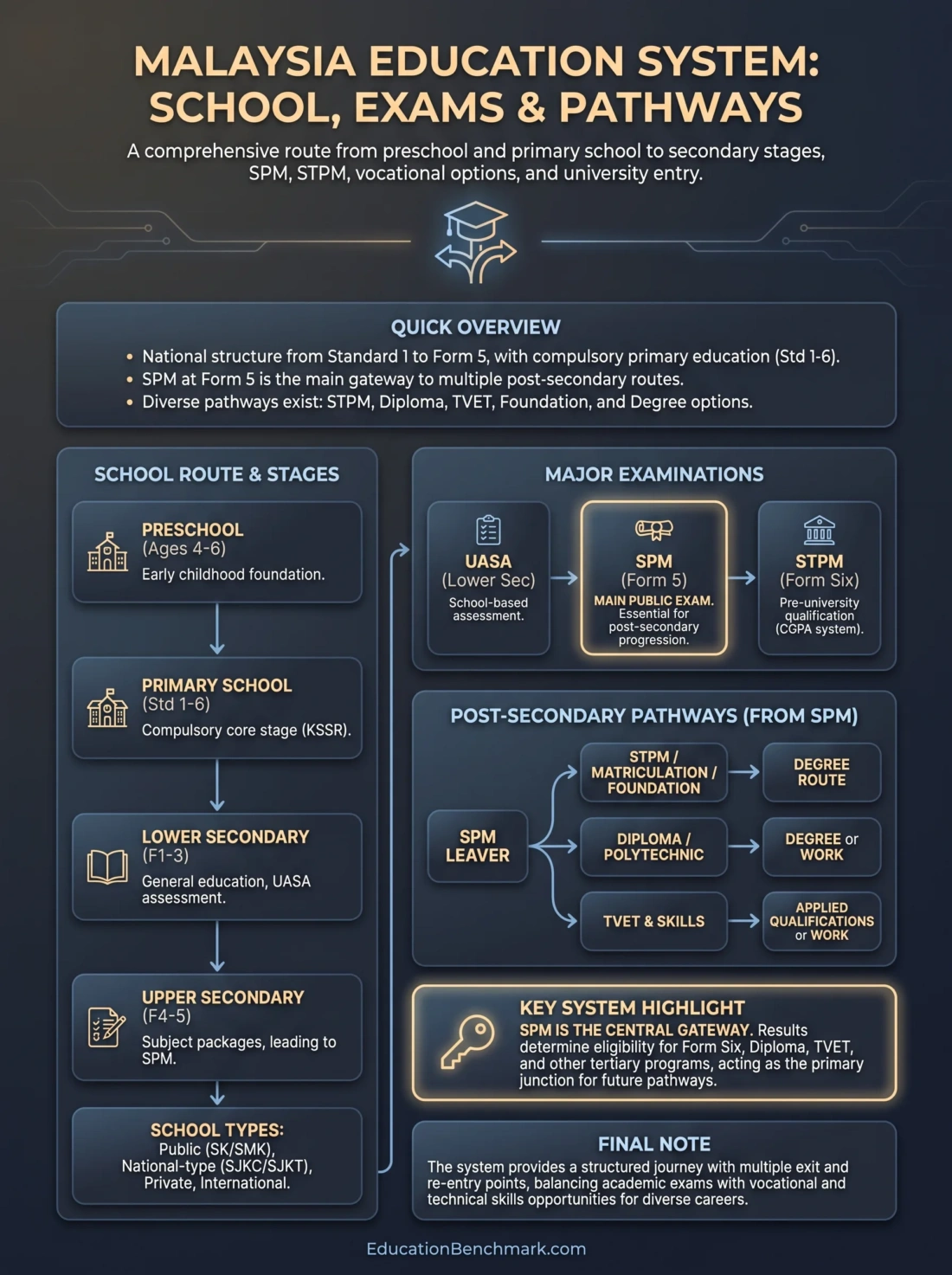
Follow the route from Standard 1 and secondary Forms to SPM, then compare the different paths through STPM, Matriculation, Asasi, diploma, TVET, and public higher-education applications.
Primary School
Selected stamp: Primary School. Choose another stamp to update the route card.
Malaysia’s education system becomes easier to understand when SPM is treated as a branching point rather than the end of a single straight route. Before SPM, most students in the national system move through Standards and Forms. After SPM, the route divides: Form Six and STPM, Matriculation, Asasi, diploma programmes, polytechnics, community colleges, and TVET can lead students in different directions. University admission is therefore pathway-based rather than controlled by one national entrance examination for every applicant.
Those routes should not be treated as interchangeable. STPM is a post-secondary qualification reached through Form Six. Matriculation is a Ministry of Education pre-university programme. Asasi is a foundation route connected to selected universities. A diploma is a qualification in its own right, while TVET routes place greater emphasis on technical or occupational preparation. UPUOnline sits above many public-sector applications as an application system, not as another exam.
From Standard 1 to Form 5: The Route to SPM
Malaysia uses Standard for primary-school years and Form for secondary-school years. The government education portal describes primary education as a six-year route from Standard 1 to Standard 6, with Standard 1 typically beginning at age 7. It identifies the six-year primary stage as compulsory for Malaysian citizens. [a]
Secondary education then divides into lower secondary, Form 1 to Form 3, normally around ages 13 to 15, and upper secondary, Form 4 to Form 5, normally around ages 16 to 17. SPM appears at the end of the upper-secondary route. [b]
School sequence
Standards, Forms, and the Main School Stages
Ages are typical for the mainstream national route; individual placement and school circumstances can differ.
| Stage | Local label | Typical age | Next point |
|---|---|---|---|
| Primary school | Standard 1–6 | About 7–12 | Form 1 |
| Lower secondary | Form 1–3 | About 13–15 | Form 4 |
| Upper secondary | Form 4–5 | About 16–17 | SPM and post-SPM routes |
SK, SJKC, and SJKT Are Different National-School Routes
The primary-school system has an important language distinction. Sekolah Kebangsaan (SK) uses Malay as the main medium of instruction. Sekolah Jenis Kebangsaan Cina (SJKC) uses Mandarin, while Sekolah Jenis Kebangsaan Tamil (SJKT) uses Tamil. SJKC and SJKT are national-type schools within the national education system; they should not be confused with international schools. Current government information also identifies KSSR as the primary curriculum used in these national-school settings. [c]
Not Every Student in Malaysia Follows the SPM Route
The SPM route is central to the national system, but Malaysia also has private and international provision. Government information on private secondary schools distinguishes national-curriculum private schools, religious schools, international schools using foreign curricula, expatriate schools, and Chinese private secondary schools where the Unified Examination Certificate (UEC) is the main assessment. [d] A student following an international or other non-mainstream curriculum can therefore have a different examination and university-entry sequence from a student progressing through Form 5 and SPM.
Post-SPM decision
SPM Is the Main Branching Point
SPM sits at the end of the mainstream Form 5 route, but one SPM result can lead into several different types of post-secondary education.
The Malaysian Examinations Syndicate maintains SPM as an upper-secondary examination and publishes the examination’s current notices, schedules, and related assessment information. [e]
Subject results help determine which post-SPM routes and programmes a student can enter.
A three-semester pre-university route leading to STPM and later degree applications.
A Ministry of Education programme for eligible SPM leavers preparing for bachelor’s-level study.
A foundation route offered by selected universities for progression into eligible degree programmes.
A qualification route that can support employment, further study, or later degree progression.
Technical and occupational programmes lead toward skills qualifications, employment, or further education.
SPM is therefore not Malaysia’s single university entrance examination. An SPM result can open access to the next educational stage, but the qualification used for a later bachelor’s application may be STPM, Matriculation, Asasi, a diploma, or another accepted equivalent. Programme-specific subject requirements also matter, so two students with superficially similar SPM results can face different eligibility rules if they choose different fields.
Why Individual SPM Subjects Matter
Post-SPM selection is not simply a matter of converting every subject into one universal national score. A programme can require particular grades or credits in named subjects. Science, engineering, accounting, language, or other routes may therefore examine different parts of the same SPM record. The exact requirement belongs to the programme and admission cycle rather than to a single rule covering all post-secondary study.
UPSR and PT3 Are Gone: What PBD and UASA Do Now
Malaysia’s school assessment sequence changed when UPSR was abolished from 2021 and PT3 was abolished in 2022. Ministry of Education guidance states that school-based assessment was strengthened after those changes and that UASA is implemented as a component of PBD. The same guidance explicitly says that UASA does not replace UPSR or PT3. It covers Year 4 to Year 6 at primary level and Form 1 to Form 3 at lower secondary under the stated guidance. [f]
Assessment sequence
The Difference Between the Old Exams and the Current School Assessments
The former primary leaving examination is no longer the end point of Standard 6.
The former Form 3 assessment no longer acts as a national lower-secondary exit point.
PBD uses ongoing classroom assessment, while UASA provides an end-of-session assessment where applicable.
PBD is broader than a single written paper. Classroom evidence can be collected across the learning period, while UASA adds a summative assessment at the end of the academic session. This distinction matters because describing UASA simply as “the new PT3” gives the wrong impression of how the present system is designed.
Form Six and STPM: Three Semesters, Coursework, and Retakes
Form Six is a post-SPM pre-university route. It should not be read as an ordinary “Form 6” immediately continuing the Form 1–5 naming sequence. Government information describes Form Six as a 1.5-year course running over three semesters and leading to STPM. General entry information lists an SPM pass with at least a credit in Bahasa Melayu and an age range of 17 to 20 on 1 January, alongside additional route-specific conditions. [g]
STPM Is Built Across Semesters, Not One Examination Day
The Form Six assessment system combines central examinations with coursework. Ministry of Education information states that central examinations carry 60% to 80% of assessment and coursework 20% to 40%, with the weighting depending on the subject. Students receive results for each semester. Results from Semester 1 and Semester 2 can be improved through the U1 and U2 repeat examinations, while the overall STPM result is cumulative across the three semesters and applicable coursework. [h]
This makes STPM structurally different from SPM. SPM closes the mainstream upper-secondary stage; STPM is a later pre-university qualification. The distinction also explains why an SPM leaver does not have to choose STPM. Form Six is one branch among several.
STPM vs Matriculation, Asasi, Diploma, and TVET
The main post-SPM options differ in purpose. Some are designed primarily as preparation for bachelor’s study. Others award a qualification that can have value for employment as well as further education. The provider also changes: a Ministry of Education programme, a university foundation course, a polytechnic, and a skills institution do not operate as one interchangeable system.
Post-SPM comparison
What Each Major Route Is Designed to Do
Admission conditions and progression rules depend on the programme and provider, so the table compares route function rather than guaranteeing eligibility.
| Route | Type | Main purpose | Typical progression |
|---|---|---|---|
| Form Six / STPM | Pre-university | Three-semester academic preparation leading to STPM | Degree application or another route accepting STPM |
| Matriculation | MOE pre-university programme | Preparation for bachelor’s study in programme fields | Eligible higher-education degree programmes [i] |
| Asasi | University foundation | Targeted preparation connected to selected public universities and fields | Eligible bachelor’s programmes, often linked to the offering university [j] |
| Diploma | Higher-education qualification | Field-specific academic or applied study | Employment and/or later degree study, subject to programme rules |
| Polytechnic / Community College | Applied public education | Certificate, diploma, technical, and applied study depending on programme | Employment, further qualification, or eligible higher study |
| TVET / Skills Route | Technical and vocational | Occupational and technical competence linked to the selected qualification | Employment and/or further technical or academic study |
Matriculation Is Not Another Name for STPM
The Ministry of Education’s Matriculation Programme is a separate pre-university route for SPM leavers seeking bachelor’s-level study. Its current government description lists Science, Engineering, Accounting, Professional Accounting, and Computer Science among the fields offered. See source [i]
Because Matriculation and STPM are administered through different programme structures, their entry rules, learning environments, and assessment arrangements should not be treated as identical. The same applies to Asasi: an Asasi programme can be closely tied to a particular university or field, while STPM functions as a broader pre-university qualification route.
UPUOnline Is an Application System, Not a Qualification
For the 2026/2027 admission cycle, the official UPUOnline application FAQ separates SPM leavers from STPM/equivalent applicants and identifies qualification categories including STPM, Matriculation/Asasi, STAM, and Diploma/equivalent. It also covers applications involving public universities, polytechnics, community colleges, and MARA higher-education institutions within its stated scope. [k]
UPUOnline therefore does not replace the qualification itself. A student first holds or is completing an eligible qualification, selects the correct applicant category, and then applies for programmes for which the relevant admission conditions are met. Some institutions and routes operate outside UPUOnline, so the platform should not be described as the only higher-education application route in Malaysia.
MUET Measures English Proficiency
MUET, the Malaysian University English Test, has a different function again. Malaysian Examinations Council specifications describe its purpose as measuring the English-language proficiency of candidates planning tertiary study, with listening, speaking, reading, and writing assessed. [l] MUET is not a replacement for SPM or STPM and should not be described as Malaysia’s single university entrance exam. The band or result required can depend on the programme, institution, qualification route, or admission rules in force.
KSSR, KSSM, and the Kurikulum Persekolahan 2027 Transition
Current school information still uses KSSR for the national primary curriculum and KSSM for secondary education, so those terms remain relevant to students already moving through the system. Malaysia is also moving into a new curriculum cycle. The Ministry of Education’s published timeline for Kurikulum Persekolahan 2027 shows curriculum dissemination in 2025, preschool implementation in 2026, and implementation involving the 2027 preschool curriculum, Year 1, and Form 1 in 2027. [m]
Reform in progress
The Assessment Picture Is Also Changing
The national education plan for 2026–2035 announced a Malaysia Learning Matrix intended to measure Year 4 and Form 3 achievement centrally. The same announcement included an opportunity for six-year-old children to enter Year 1 voluntarily and a TVET route beginning from primary level under the 2027 curriculum direction. [n]
These changes need to be read alongside the existing system rather than projected backward onto every student. A current Form 4 or Form 5 student, for example, should not be assumed to have followed the same curriculum arrangements as a child entering Year 1 under a later rollout. The same caution applies to the proposed age-six Year 1 option: an announced policy direction and the operational registration rules for a particular intake are not automatically the same thing.
The Malaysia Learning Matrix also should not be described as a revival of UPSR or PT3 unless official rules eventually define it that way. The Ministry’s announcement identifies Year 4 and Form 3 as central measurement points, while the existing UASA guidance expressly says UASA is not a replacement for the abolished examinations.
How MQF Connects Diplomas, Degrees, and TVET
Post-SPM terminology can become confusing because a pre-university programme, a diploma, and a degree can all appear in the same admissions discussion even though they represent different kinds of education. Malaysia’s MQF provides the national structure used to describe qualifications and their quality. The Malaysian Qualifications Agency states that the current MQF arrangement brings Skills, Vocational, and Technical provision together as the TVET sector while higher education is treated as the Academic sector. [o]
Qualification logic
Pre-University Routes and Higher-Education Qualifications Are Not the Same Layer
These routes are commonly used to establish eligibility for later bachelor’s study.
A diploma is a higher-education qualification and may also support later progression into a related degree.
Degree-level qualifications sit beyond the pre-university stage and have their own admission and completion requirements.
Technical and vocational qualifications can support employment and further study according to their level and recognition.
This distinction prevents a common error: comparing STPM, Matriculation, Asasi, and a diploma as though all four were simply different names for the same credential. Their purposes overlap at some progression points, but their status, providers, duration, assessment, and later admission use can differ.
Where Malaysian Education Rules Can Differ
The national route is clear enough to map, but several details depend on the student rather than on the country alone. School type affects language and curriculum. Upper-secondary subject combinations depend on what a school offers. Form Six has general and field-specific entry conditions. Matriculation and Asasi use their own eligibility rules. Diploma and TVET qualifications vary by provider and level. University programmes can require particular subjects, grades, English results, interviews, tests, or other conditions.
The distinction between qualification and application mechanism is especially useful. SPM and STPM are qualifications or examinations within a student’s educational record. MUET measures English proficiency. UPUOnline is a system through which eligible applicants apply to programmes within its scope. None of those terms should be substituted for another.
What readers often confuse
Four Malaysian Terms That Look Similar but Do Different Jobs
Education Benchmark is an independent informational guide and is not affiliated with any ministry of education, school authority, exam board, university, government agency, or official ranking organization.
School-entry rules, examination administration, curriculum rollout, post-SPM eligibility, UPUOnline categories, MUET conditions, and university programme requirements can change. Decisions involving an actual application or student placement should be checked against the latest information from the responsible Ministry of Education unit, examination authority, higher-education admissions body, qualification agency, school, or institution.
Sources and Verification
- [a] Primary Education in Malaysia — Used for the six-year Standard 1–6 primary route, typical Standard 1 entry age, and compulsory primary-school status for Malaysian citizens. (Reliable because it is an official Government of Malaysia education portal.)
- [b] Secondary Education in Malaysia — Used for Form 1–3 and Form 4–5 structure, typical secondary ages, UASA, SPM, and the route toward Form Six. (Reliable because it is an official Government of Malaysia education portal.)
- [c] National School — Used for the distinction between SK, SJKC, and SJKT, their main languages of instruction, and the current KSSR reference. (Reliable because it is an official Government of Malaysia education portal.)
- [d] Private Secondary Schools — Used for private, international, expatriate, religious, and Chinese private secondary-school distinctions and the UEC reference. (Reliable because it is an official Government of Malaysia education portal.)
- [e] Sijil Pelajaran Malaysia | SPM — Used to verify SPM within the official upper-secondary examination system and its examination administration. (Reliable because it is the official Malaysian Examinations Syndicate portal.)
- [f] UASA Administration Guide 2024/2025 — Used for the abolition of UPSR and PT3, the relationship between PBD and UASA, and the statement that UASA does not replace the former examinations. (Reliable because it is an official Ministry of Education assessment document.)
- [g] Form Six — Used for Form Six duration, three-semester structure, STPM progression, and general entry information. (Reliable because it is an official Government of Malaysia education portal.)
- [h] Form Six Assessment and Fees — Used for STPM central-examination and coursework weighting, semester results, repeat examinations, and cumulative assessment. (Reliable because it is an official Ministry of Education Form Six source.)
- [i] Matriculation Programme (MOE) — Used for the role of Matriculation as an MOE pre-university route for SPM leavers and its listed study fields. (Reliable because it is an official Government of Malaysia education portal.)
- [j] Foundation Programmes (ASASI) — Used for the one-year, two-semester Asasi route and its connection to selected public-university bachelor’s programmes. (Reliable because it is an official Government of Malaysia education portal.)
- [k] UPUOnline Application FAQ for SPM and STPM/Equivalent, 2026/2027 — Used for current applicant categories, the distinction between SPM and STPM/equivalent applicants, and institutions within the stated UPUOnline scope. (Reliable because it is an official Malaysian higher-education admissions document.)
- [l] Regulations and Test Specifications – Official Portal Malaysian Examinations Council — Used for MUET’s English-proficiency purpose and assessed language skills. (Reliable because it is the official Malaysian Examinations Council source for MUET specifications.)
- [m] School Curriculum 2027 — Used for the published rollout timeline covering curriculum dissemination, preschool implementation, Year 1, and Form 1. (Reliable because it is an official Ministry of Education curriculum document.)
- [n] Malaysia Education Plan 2026–2035 Launch — Used for the Malaysia Learning Matrix announcement, the voluntary age-six Year 1 direction, and the planned primary-level TVET route. (Reliable because it is an official Ministry of Education announcement.)
- [o] MQF 2nd Edition — Used for Malaysia’s national qualification structure and the relationship between the Academic and TVET sectors. (Reliable because it is the official Malaysian Qualifications Agency source.)