United States K–12 and College Route Passport
A state-led route through grade bands, local graduation credits, GPA records, dual enrollment, career study, and transfer-based higher education.
State Rules
Selected stamp: State Rules. Choose another stamp to update the route card.
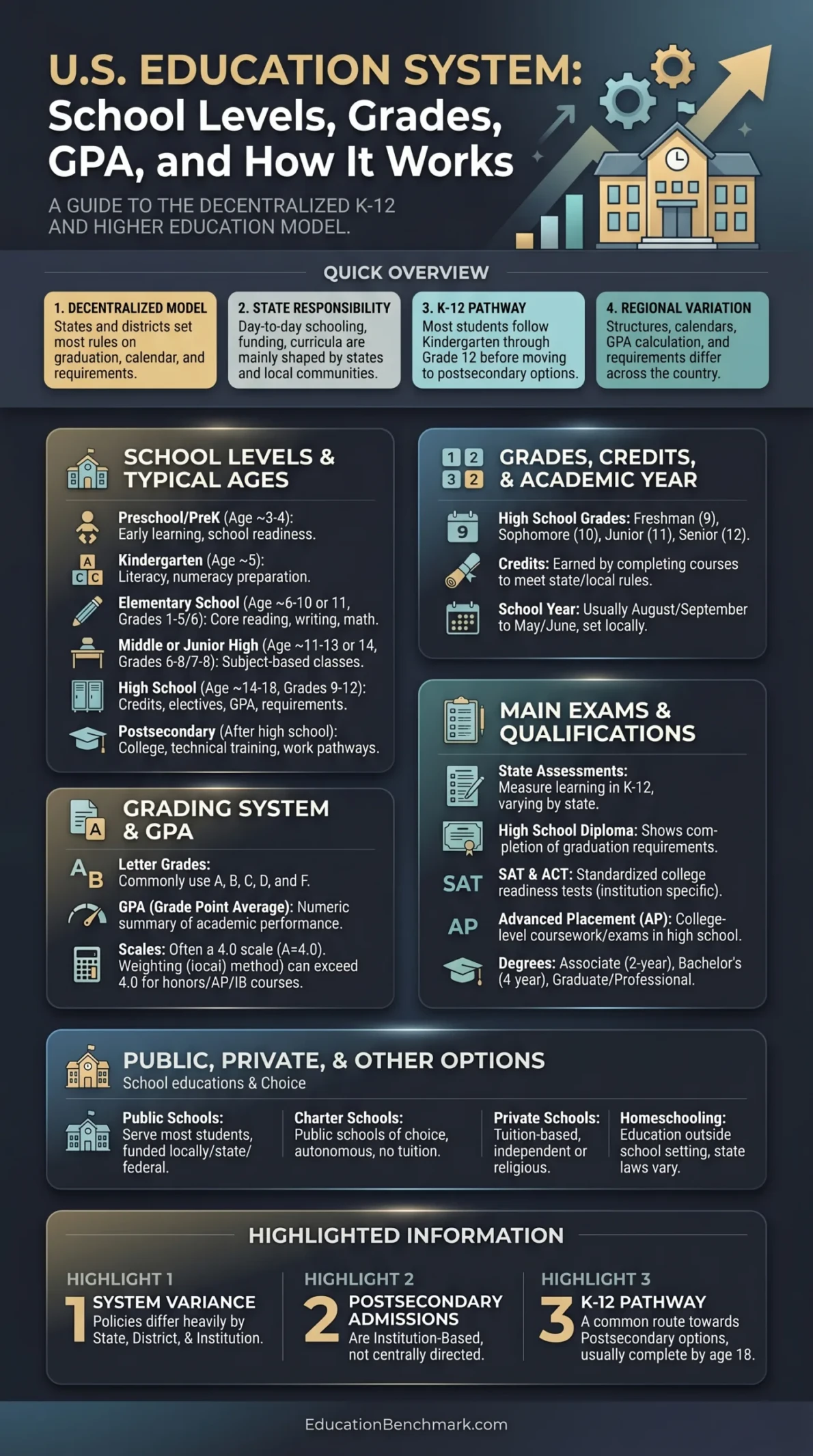
The United States does not operate one uniform national school system. K–12 education is organized mainly by states and local communities, while the federal government supports selected programs, enforces federal civil rights laws, collects education data, and administers federal aid. [a] This division of authority explains why grade names are familiar across the country but attendance ages, credits, testing, calendars, and diploma rules can differ.
The national route is still recognizable: kindergarten, elementary school, middle or junior high school, high school, and several postsecondary options. The defining feature is variation inside that route. A state may set graduation minimums, a district may add courses, and a college may recalculate an applicant’s GPA under its own method. A dedicated United States overview from Education by Country also describes the system as a network of state, local, public, private, and postsecondary systems rather than one centrally directed model. [b]
Governance stack
Who Controls School Rules in the United States
Authority moves through several layers. No single layer controls every part of a student’s route.
Federal agencies administer programs, collect national statistics, enforce federal protections, and support students and institutions through funding. They do not create one national K–12 curriculum or one nationwide diploma.
State constitutions, laws, boards, and education departments shape the main public-school rules. States commonly define learning standards, teacher licensing, accountability, and minimum diploma conditions.
Districts assign students to schools, employ staff, organize calendars, choose materials within state rules, operate transport, and may add graduation or course requirements.
Schools build timetables, place students in courses, record credits, and apply district grading policies. Teachers assess work within the rules used by their school system.
A statement can be true in one district and wrong in another. The state education department, district handbook, school course catalog, and college admissions page answer different questions.
Grade route
Grades K–12, Typical Ages, and Attendance Boundaries
Grade spans are common patterns, not national legal definitions. Districts may organize schools differently.
| Stage | Common grade span | Approximate ages | How the stage is used |
|---|---|---|---|
| Prekindergarten | Pre-K | About 3–4 | Early learning before kindergarten; access and funding vary. |
| Kindergarten | K | About 5–6 | Entry year before numbered grades, subject to local birthday cutoffs. |
| Elementary school | K–5 or K–6 | About 5–11 or 12 | Primary-grade instruction, usually before middle school. |
| Middle school or junior high | 6–8, 7–8, or sometimes 7–9 | About 11–14 | Transition to subject-based schedules and wider course choice. |
| High school | 9–12 | About 14–18 | Credit accumulation, diploma completion, and postsecondary planning. |
| Postsecondary education | Not numbered as K–12 grades | Often 18 and older | Certificates, associate degrees, bachelor’s degrees, and graduate study. |
NCES’s Common Core of Data classifies public schools by the grades they serve, using primary, middle, high, and other school-level categories with grade spans that can overlap. This reflects why local school labels and grade configurations do not follow one fixed national sequence. [c]
K–12 means kindergarten through grade 12. It does not mean that every child is legally required to attend from kindergarten through age 18. Compulsory attendance is governed by state law, and the starting age, leaving age, kindergarten rules, exemptions, and free-education limits differ. The NCES state table shows those differences directly rather than treating one age range as national law. [d]
Schools may consider age, prior records, completed coursework, English-language support needs, local placement policy, and available programs. A grade label alone may not show whether earlier credits will transfer.
Diploma logic
How Credits Become a High School Diploma
A passing average and a completed diploma plan are related, but they are not the same record.
High schools normally record completed courses as credits. A full-year course may count as one credit in some systems, while semester courses may carry half-credit values. The exact unit, however, is local. Students usually need a total number of credits plus required subject credits in areas such as English, mathematics, science, and social studies.
The student selects required and elective courses under a school-approved plan.
Credits are awarded according to the district’s grading, attendance, seat-time, or competency rules.
The transcript must show enough credits in each required subject area, not only enough credits overall.
Assessments, projects, service, financial-aid forms, career plans, or local courses may apply in some jurisdictions.
The school confirms that state and district conditions have been met before awarding the diploma.
State policies differ in credit totals, diploma pathways, endorsements, assessment conditions, and permitted substitutions. Districts may add requirements above the state minimum. Education Commission of the States maintains a state-by-state comparison drawn from statutes, regulations, and agency guidance. [e]
Promotion Is Not Identical to Graduation
Promotion means moving to the next grade. Graduation means completing the full secondary program. A student may advance with missing credits that must later be recovered, or may be classified by credits rather than age. High schools can use summer school, online courses, credit recovery, repeated courses, or competency options, but availability and recognition vary.
Transcript reading
GPA: One Number, Several Calculation Methods
GPA summarizes grades. It does not create a national grading scale or replace course and credit requirements.
GPA means grade point average. On a basic unweighted 4.0 scale, an A may equal 4 points, a B 3, a C 2, a D 1, and an F 0. The points are averaged across courses. Schools may use plus and minus grades, credit weighting, different numeric conversions, or another scale. Honors, Advanced Placement, International Baccalaureate, and other advanced courses may receive extra weight.
A Simple Unweighted GPA Calculation
| Course | Letter grade | Grade points |
|---|---|---|
| English | A | 4.0 |
| Algebra II | B | 3.0 |
| Biology | A | 4.0 |
| U.S. history | B | 3.0 |
| Spanish | C | 2.0 |
| Average | 16.0 ÷ 5 = 3.2 | |
The calculation above is only a reading aid. A real transcript may weight courses by credit, include plus/minus values, replace repeated grades, or separate term and cumulative GPA. Colleges may also recalculate GPA using selected academic subjects and their own weighting rules. BigFuture explains both the basic calculation and why college recalculation can differ from the high school’s reported figure. [f]
Unweighted GPA
Uses one point scale for courses regardless of difficulty. An A normally carries the same base value in a standard class and an advanced class.
Weighted GPA
Adds extra value for designated advanced courses. A weighted GPA can exceed 4.0, but the scale and eligible courses are school-specific.
GPA and diploma status answer different questions. GPA describes average course performance. Diploma status shows whether required credits and other completion conditions have been satisfied.
Assessment context
SAT, ACT, and AP in the Student Record
These programs serve different purposes and are not one national school-leaving examination.
SAT and ACT policies should be checked on the admissions page for the exact college, program, and application year. AP credit should be checked separately because admissions consideration and post-enrollment credit are different decisions.
Early postsecondary routes
Dual Enrollment and CTE: Two Ways to Build Credits Early
Both can connect high school with later study, but the course provider, credit type, and end goal are not identical.
Students take a college course before high school graduation. Programs may award college credit and may also count the course toward high school requirements. Eligibility, tuition, transport, instructor arrangements, and transferability are set locally. The What Works Clearinghouse describes dual enrollment as college coursework completed while the student remains in high school. [j]
CTE provides career-related academic and technical learning in high schools, technical centers, community colleges, and trade settings. It may lead to employment skills, a certificate, an industry credential, an apprenticeship, or further college study. IES describes CTE as preparation for the labor market or continued occupational education and training. [k]
AP Is Not the Same as Dual Enrollment
An AP course remains a high school course and college credit usually depends on the receiving college’s AP policy and the exam score. Dual enrollment places the student in a college course that produces a college transcript entry. A credit earned through either route may still be reviewed again when the student changes institutions.
CTE Is Not a Dead-End Track
CTE can sit beside college-preparatory subjects rather than replace them. A student may complete mathematics, science, English, and social studies credits while also following a career sequence. Whether the sequence leads to a recognized credential or transferable college credit depends on the program.
Postsecondary transfer
Community College, Transfer, and the Four-Year Route
The two-year-to-four-year route can work well when courses are chosen against a named transfer plan.
The student meets the community college’s admission and placement conditions.
Courses may cover general education, a major pathway, career preparation, or a combination.
The receiving institution decides which credits apply to admission, the major, and the bachelor’s degree.
The student completes remaining general education, major, residency, and graduation requirements.
EducationUSA explains that community colleges and four-year institutions often create transfer agreements and describes the planned “2+2” route: two years at a community college followed by two years at a four-year institution. [l] The label is a planning model, not a promise that every course will transfer or that every major can be finished on that schedule.
Students should identify the intended university and major early, then compare articulation agreements, transfer-equivalency tools, minimum grades, application deadlines, and residency rules. An associate degree can help organize the route, but the receiving institution still controls the final credit evaluation.
School provision
Public, Charter, Magnet, Private, and Homeschool Routes
The legal category of the provider affects funding, admissions, accountability, curriculum rules, and access.
NCES treats assigned public schools, chosen public schools, charter schools, private schools, and homeschooling as distinct parts of the United States school-choice landscape. [m] The available routes and legal details differ by state and district.
“International school” is usually a descriptive label rather than one nationwide legal category. A school using an international curriculum may be private, public, charter, or part of a district program. Families should verify the provider’s legal status, accreditation claims, diploma route, and how credits are recognized.
Rule checking
What Changes by State, District, and Institution
The most accurate source depends on the decision being made.
Check compulsory attendance, learning standards, statewide assessments, teacher rules, diploma minimums, and public-school accountability.
Check attendance boundaries, calendars, transport, local graduation additions, grading policy, course catalogs, transfers, and enrollment documents.
Check course availability, honors or AP access, GPA weighting, credit recovery, counseling procedures, extracurricular eligibility, and student support.
Check admissions tests, GPA review, prerequisite courses, transfer credit, AP recognition, program accreditation, costs, and deadlines.
Education rules, testing arrangements, diploma conditions, and admissions policies can change between school years and application cycles. Decisions about enrollment, graduation, transfer, or admission should therefore be confirmed with the responsible official body or institution.
Education Benchmark is an independent informational guide and is not affiliated with any ministry of education, school authority, exam board, university, government agency, or official ranking organization. It does not provide school placement, admissions, legal, immigration, or visa advice.
Reference record
Sources and Verification
- [a] Federal Role in Education | U.S. Department of Education — Used for the federal, state, and local division of responsibility. (Reliable because it is an official U.S. Department of Education explanation.)
- [b] US Education System (2026): Structure, Quality, and Performance — Used as a supplementary country-level overview of the decentralized United States system. (Reliable as a dedicated education reference that links its claims to government and statistical sources.)
- [c] Common Core of Data (CCD) — Public School Grade-Span and School-Level Definitions — Used for NCES school-level definitions and grade-span variation across primary, middle, high, and other public schools. (Published by NCES as part of the Common Core of Data documentation.)
- [d] Age Range for Compulsory School Attendance by State — Used to show that compulsory attendance ages and kindergarten rules differ by state. (Reliable because the table is published by NCES from state education practice data.)
- [e] 50-State Comparison: High School Graduation Requirements — Used for state variation in credits, diplomas, pathways, assessments, and substitutions. (Reliable because the comparison is compiled from state statutes, regulations, and agency guidance.)
- [f] How to Calculate Your GPA on a 4.0 Scale – BigFuture — Used for the basic GPA calculation and the distinction between weighted, unweighted, and college-recalculated GPAs. (Reliable because BigFuture is operated by College Board.)
- [g] The SAT – SAT Suite | College Board — Used for the current SAT format and official test context. (Reliable because it is the test owner’s official SAT page.)
- [h] The ACT Test for Students | ACT — Used for the current ACT sections and optional components. (Reliable because it is ACT’s official test page.)
- [i] Getting Credit and Placement – AP Students — Used for the distinction between AP scores, college credit, and advanced placement. (Reliable because it is College Board’s official AP student resource.)
- [j] WWC | Dual Enrollment Programs — Used for the definition and college-credit role of dual enrollment. (Reliable because the What Works Clearinghouse is part of the Institute of Education Sciences.)
- [k] Career and Technical Education (CTE) | IES — Used for the role and delivery settings of career and technical education. (Reliable because IES is the research and statistics arm of the U.S. Department of Education.)
- [l] Community College | EducationUSA — Used for community college transfer agreements and the planned 2+2 route. (Reliable because EducationUSA is a U.S. Department of State network.)
- [m] School Choice in the United States: 2019 — Used for assigned public, chosen public, charter, private, and homeschool categories. (Reliable because it is an NCES national report.)