Canada School Route Passport
Thirteen jurisdictions shape one broadly familiar route, with different grade groupings, graduation credentials, language options, and postsecondary bridges.
Provincial Control
Selected stamp: Provincial Control. Choose another stamp to update the route card.
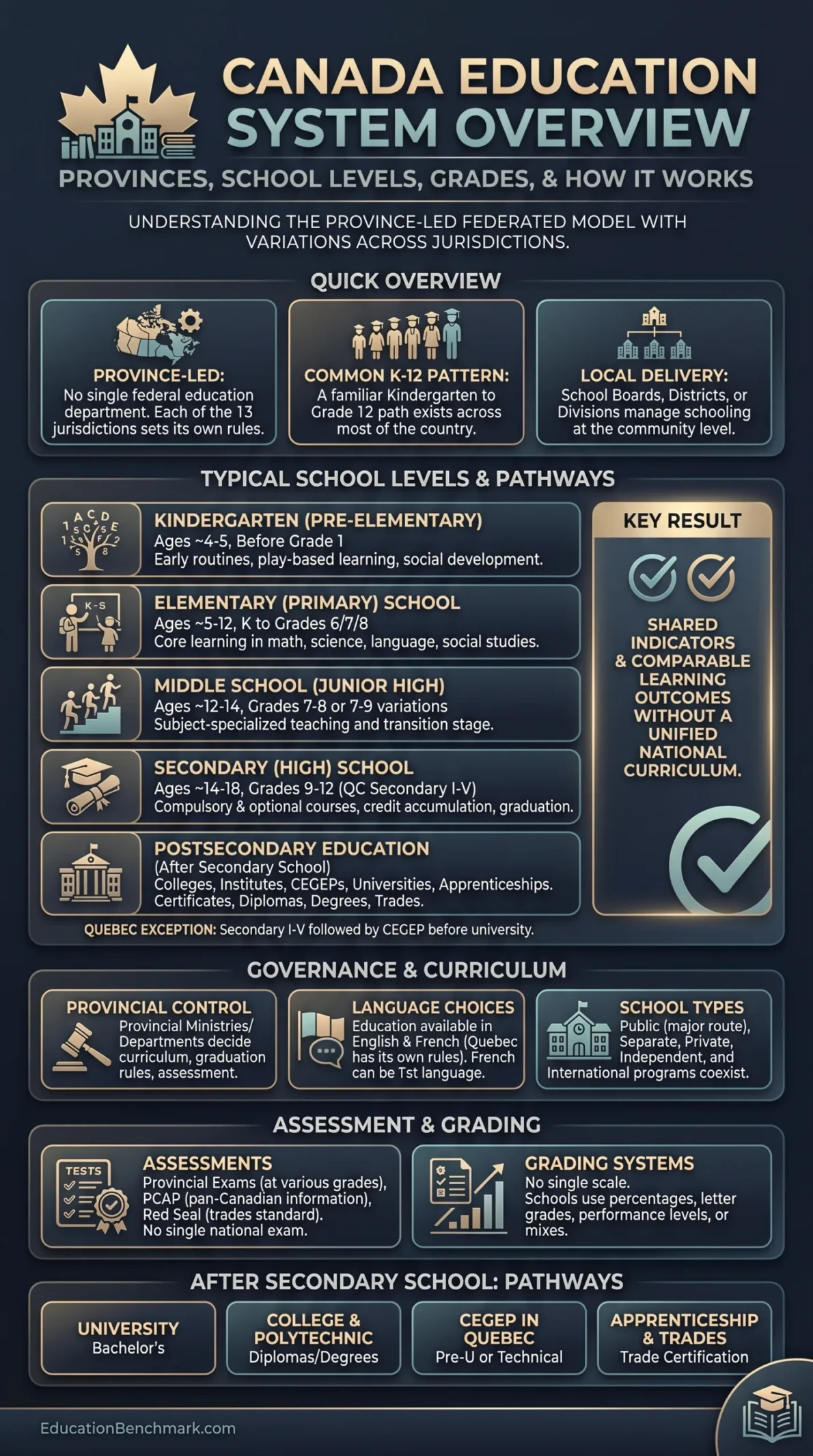
Canada does not operate one national school system. Its ten provinces and three territories control education within their jurisdictions, so curriculum, compulsory attendance, grade organization, assessment, graduation credentials, and postsecondary policy can differ. The broad route remains recognizable: kindergarten or another early-years program, elementary school, secondary school, and then college, university, apprenticeship, vocational training, or employment. The details become clearer only when the province or territory is named.
Jurisdiction first
Why Canada Has 13 Education Systems
Canada has no federal department of education and no single national curriculum. Provincial and territorial ministries or departments organize, deliver, and assess elementary and secondary education within their own laws and policies.[a]
The jurisdiction defines curriculum, compulsory attendance, assessment, funding rules, graduation credentials, and many teacher-regulation arrangements.
Local bodies commonly manage enrolment, staffing, facilities, transportation, and implementation of jurisdiction-level policy.
Schools organize timetables, course selection, assessment records, guidance, and local programs within the rules above them.
This division of responsibility explains why terms such as school board, school district, school division, and district education council may describe similar local functions in different parts of the country. A Canadian high school diploma is tied to a jurisdiction rather than issued under one federal standard.
An independent Canada country profile from Education by Country also describes the system as province- and territory-led, with national comparison built through shared measures rather than one central school authority.[b] Official rules still need confirmation from the responsible jurisdiction.
Grade route
Grades and Ages Across the K–12 Route
Compulsory attendance usually begins around age six and often continues to age 16, although some jurisdictions start earlier or continue to age 18 or secondary graduation. Elementary school commonly covers six to eight years, and secondary school covers the remaining years.[c]
| Stage | Common Grade Placement | Typical Age Range | What May Differ |
|---|---|---|---|
| Kindergarten and early years | Before Grade 1 | Often ages 4–5 | Availability, full-day or part-day delivery, entry cutoff, and whether attendance is compulsory. |
| Elementary school | Usually Grade 1 through Grade 6, 7, or 8 | About ages 6–11, 12, or 13 | The final elementary grade and whether a separate middle or junior high school is used. |
| Middle or junior high | Often Grades 6–8, 7–8, or 7–9 | About ages 11–14 | Some systems do not use this separate stage; combined-grade schools are common in smaller communities. |
| Secondary or high school | Usually ends at Grade 12 | About ages 14–17 or 18 | Starting grade, credit model, provincial assessments, diploma name, and compulsory attendance limit. |
| Québec secondary school | Secondary I through Secondary V | About ages 12–16 or 17 | Students normally complete five secondary years before CÉGEP rather than continuing to Grade 12. |
Age ranges are descriptive, not admission guarantees. Birth-date cutoffs, kindergarten entry, grade placement after migration, special education programming, and accelerated or delayed progression are handled under local rules. Families moving between jurisdictions should use the receiving school’s placement process rather than assuming that the same grade label carries identical course content.
Mobility between systems
What Changes When Students Cross Provincial Borders
Canada’s Student Transfer Guide records jurisdiction-specific course numbering, credit requirements, grading practices, transcripts, graduation credentials, and curriculum organization. It also warns that a credit earned in one jurisdiction may not have a direct equivalent in another.[d]
A receiving school may compare course descriptions, prerequisites, instructional time, and transcript codes before granting an equivalent credit.
The new school may grant direct credit, place the student in a related course, or identify missing content needed for local graduation.
Required subjects, assessments, community components, and minimum local credits can affect the remaining route to graduation.
Transfers are therefore based on records and course content, not only on age. Students usually need an official transcript or school record, and the receiving authority decides placement. “Canadian Grade 11” describes a broad level rather than one identical national program.
Diploma rules
OSSD, Dogwood, and Provincial Graduation Credentials
Secondary diplomas serve a similar school-leaving purpose, but their requirements are not interchangeable.
Other provinces and territories issue their own diplomas, certificates, or transcripts under local rules. The credential name matters, but the course record matters too. Postsecondary institutions often examine subject prerequisites and grades rather than treating every diploma holder as equally prepared for every program.
Québec sequence
Québec’s Secondary V–CÉGEP–University Route
CÉGEP is a distinct college stage between secondary school and university. Public CÉGEPs offer two-year pre-university programs and three-year technical programs leading to a Diploma of College Studies; universities may use the R score when reviewing applications, especially for limited-enrolment programs.[h]
Students complete Québec’s five-year secondary route and meet the requirements for the Secondary School Diploma.
The program prepares students for university study and includes general education with field-related courses.
The program prepares students for employment and may also support later university entry when prerequisites are met.
Universities assess prior study, prerequisites, academic results, and any selection rules set by the institution or program.
Québec also has vocational routes leading to credentials such as the Diploma of Vocational Studies. These routes can begin before or after full secondary completion depending on the program’s admission conditions. The province’s structure should not be translated mechanically into a Grade 12 model; Secondary V, CÉGEP, and university form a connected sequence with their own credentials.
Language and provision
English, French, Immersion, and School Choice
Depending on the jurisdiction and eligibility rules, families may encounter public schools, private schools, home education, English-language schools, French-language schools, and French immersion. Local bodies may be called boards, districts, divisions, or district education councils.[i]
Language of Instruction
English-language and French-language education are not simply language classes. They can be separate school systems or authorities with their own schools, governance arrangements, and eligibility conditions. French immersion usually teaches part or much of the curriculum in French within a second-language program.
School Provider
Public schools form the main route and generally follow the provincial or territorial curriculum. Private or independent schools operate under jurisdiction-specific recognition, inspection, funding, and curriculum rules. Home education is regulated locally rather than through one Canadian policy.
Federal involvement in official-languages education mainly supports cooperation and funding for minority-language education and second-language instruction; provinces and territories remain responsible for delivery.[j] This distinction matters when comparing a French-language school, a French immersion program, and a school that merely offers French as a subject.
After secondary school
College, Polytechnic, University, and Red Seal Routes
- College and institute programs: These may lead to certificates, diplomas, advanced diplomas, applied degrees, or other credentials. Program length and naming vary by province and institution.
- Polytechnic education: Polytechnics often combine applied degrees, diplomas, industry-linked programs, laboratories, and work-integrated learning. The institutional label is not used identically across Canada.
- University study: Universities offer bachelor’s, master’s, doctoral, and other programs. Admission is normally managed by the institution and may be more selective for certain fields.
- Apprenticeship: Apprentices usually combine paid workplace learning with technical training under provincial or territorial rules.
- College-to-university transfer: Some students begin in a college diploma or associate-degree route and later transfer credit toward a bachelor’s program.
Provinces and territories administer apprenticeship training and trade certification. In designated trades, eligible candidates may write the interprovincial Red Seal examination; passing adds a Red Seal endorsement to the provincial or territorial trade certificate.[k]
Canada’s postsecondary sector includes universities, colleges, community colleges, polytechnics, institutes, university colleges, and other recognized providers. Public universities are generally autonomous in admissions and program decisions, while provincial and territorial authorities oversee areas such as funding, accountability, degree authorization, and quality processes.[l]
Entry and mobility
Admissions, Transfer Credit, and Credential Recognition
There is no single Canadian university entrance examination. A university, college, or institute normally sets its own admission standards within the rules that apply to that institution and jurisdiction. Common requirements include a recognized secondary credential, selected senior-level subjects, minimum course marks, language evidence where required, and additional selection material for some programs.
A diploma can establish eligibility without securing a place. Competitive programs may rank applicants, require higher marks than the published minimum, assess portfolios or auditions, or use supplementary forms. Québec applicants may be assessed through CÉGEP records and the R score, while applicants from other provinces are usually reviewed through Grade 12 or equivalent courses.
Transfer credit is also institution dependent. Canadian arrangements include course-by-course equivalency, block transfer, college-to-university pathways, bridging programs, cross-registration, and province-wide transfer systems. Even under a formal agreement, the receiving institution may review the student’s courses and grades before awarding credit.[m]
An academic credential may be accepted for admission but assessed differently for employment, professional licensing, immigration, or transfer credit. The organization making the decision controls the recognition process.
Comparison lens
Reading Canada in International Comparison
Canada is best described as a decentralized, jurisdiction-led education model. It differs from countries that use one national ministry to set a common curriculum, school-leaving examination, and university placement route. Canadian comparability comes instead from similar grade-based structures, shared statistical definitions, intergovernmental cooperation, transfer arrangements, and participation in national or international assessments.
Country-level comparisons are useful for orientation, but provincial rules, diploma conditions, and admissions decisions should always be checked against the responsible authority.
This model creates flexibility, but it makes broad statements less reliable. “Canada requires this course” is usually too wide. “Ontario requires this for the OSSD cohort entering Grade 9 in a named year” is the more accurate form.
Current rules
Where Official Details May Vary
School-entry cutoffs, compulsory attendance, curriculum revisions, diploma requirements, assessment schedules, language eligibility, transfer-credit decisions, and postsecondary prerequisites can change by year, jurisdiction, institution, program, or student cohort. A provincial ministry page may describe the law, while a school board or institution publishes the operational deadlines and local process.
Education Benchmark is an independent informational guide and is not affiliated with any ministry of education, school authority, exam board, university, government agency, or official ranking organization. The material is explanatory rather than legal, immigration, placement, or admissions advice.
Before making a school move, selecting senior-secondary courses, applying to a postsecondary program, or relying on a credential for professional purposes, confirm the current rule with the relevant ministry, school board, school, college, university, apprenticeship authority, or credential-recognition body.
Reference record
Sources and Verification
- [a] Elementary-Secondary Education in Canada — Used for the absence of a federal education department and the authority of the 13 provincial and territorial systems. (Reliable because CMEC represents the ministers responsible for education across Canada.)
- [b] Canada Education System (2026): Structure, Quality, and Performance — Used for an independent comparison-oriented description of Canada’s jurisdiction-led model. (Relevant because it is a dedicated country-education reference that cites official datasets; legal and admission rules were verified through the official sources in this reference list.)
- [c] Education in Canada: An Overview — Used for compulsory-attendance ranges and the usual length of elementary and secondary schooling. (Reliable because it is published by the intergovernmental council of provincial and territorial education ministers.)
- [d] Updated Student Transfer Guide — Used for interprovincial course equivalency, transcript, credit, grading, and graduation differences. (Reliable because CMEC compiles the guide with jurisdiction-specific education information.)
- [e] Diploma and Certificate Requirements and Related Procedures — Used for the Ontario Secondary School Diploma credit structure applying to students entering Grade 9 in 2024–25 or later. (Reliable because it is an official Ontario education policy page.)
- [f] Graduation Requirements — Used for the Dogwood Diploma credit total and provincial literacy and numeracy assessments. (Reliable because it is the official British Columbia graduation policy.)
- [g] Québec Education System — Used for Québec’s six-year elementary stage, five-year secondary stage, SSD, vocational credentials, and higher-education sequence. (Reliable because it is an official Gouvernement du Québec education page.)
- [h] Studying at CEGEP — Used for pre-university and technical DCS programs and the role of the R score in university applications. (Reliable because it is an official Québec government page for the CÉGEP sector.)
- [i] Education in Canada: Elementary and Secondary School — Used for school types, language options, school-board terminology, and the broad kindergarten-to-Grade-12 route. (Reliable because it is a Government of Canada public-information page that directs readers to jurisdiction authorities.)
- [j] Official Languages in Education — Used for the federal-provincial role in minority-language education and second-language instruction. (Reliable because CMEC coordinates official-languages education programs with participating governments.)
- [k] Red Seal Program — Used for provincial and territorial apprenticeship authority, the interprovincial examination, and the Red Seal endorsement. (Reliable because it is the official Red Seal Program site supported by Canadian apprenticeship authorities.)
- [l] Postsecondary Education Systems in Canada — Used for institution types, provincial responsibility, university autonomy, and institution-set admission standards. (Reliable because CICIC is Canada’s national information centre for academic credentials and education systems.)
- [m] Transfer in Canada — Used for course equivalency, block transfer, articulation agreements, bridging programs, and institution-led credit decisions. (Reliable because CICIC documents Canadian transfer and credential practices for learners and assessors.)