Thailand School Route Passport
Follow the Thai route from Prathom through the M3 decision point, O-NET checkpoints, vocational certificates, and TCAS university admission.
Prathom
Selected stamp: Prathom. Choose another stamp to update the route card.
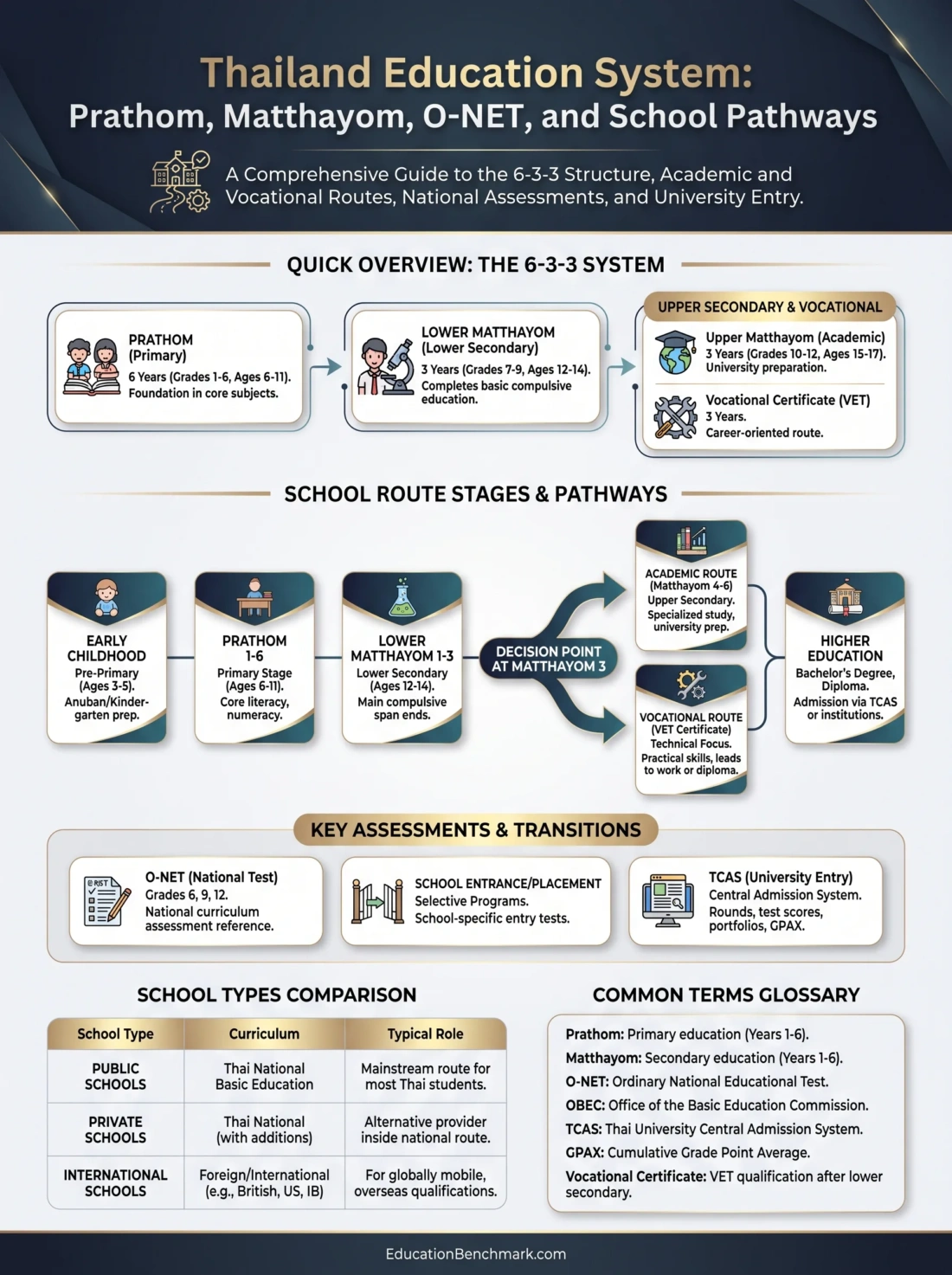
Thailand’s mainstream school route is easiest to understand as a 6–3–3 structure: six years of Prathom primary education, three years of lower Matthayom, and three years of upper Matthayom for students who remain on the general route. The important legal distinction is that basic education spans 12 years while the compulsory sequence covers nine years, making completion of M3 a major boundary in the student’s pathway. [a]
That structure alone does not explain the system. O-NET appears at P6, M3, and M6, but it is a national educational assessment rather than the current university-admission system. Students also encounter earlier RT and NT assessments, a curriculum transition within Prathom, an established vocational alternative after lower secondary, and a separate TCAS process for higher-education admissions.
From Prathom to Matthayom: Thailand’s 6–3–3 Route
Pre-primary education, commonly referred to through the term Anuban, comes before P1. The school route discussed here begins with Prathom Suksa, continues through Matthayom Suksa Ton, and then divides at the upper-secondary level.
| Stage | Thai-system term | Grades | Typical age range | Route significance |
|---|---|---|---|---|
| Primary | Prathom Suksa | P1–P6 | About 6–11 | Six-year primary cycle; P6 is an O-NET assessment point. |
| Lower secondary | Matthayom Suksa Ton | M1–M3 | About 12–14 | Completes the standard nine-year compulsory sequence. |
| General upper secondary | Matthayom Suksa Plai | M4–M6 | About 15–17 | Non-compulsory general route leading toward higher education, work, or other study. |
| Vocational upper secondary | Vocational Certificate | Entered after M3 | Usually mid-to-late teens | Parallel vocational route focused on occupational and technical fields. |
The ages in the table are orientation ranges rather than automatic placement rules. A standardized international legal-data comparison codes Thailand with an official entrance age of 6, nine compulsory years, and a theoretical compulsory-school exit age of 15. That type of coding is useful for country comparison, but actual placement can depend on completed schooling, records, school policy, and the student’s individual situation. [b]
The distinction between basic education and compulsory education is especially important. M4–M6 remains part of the ordinary 12-year basic-education route, but it lies beyond the nine-year compulsory sequence. Describing Thailand simply as having “12 years of compulsory school” therefore obscures the point at which students can move into different pathways.
M3 Is the Main Fork: Matthayom 4–6 or the Vocational Route
M3 is more than the ninth grade in an international comparison table. It is the point where the standard compulsory route ends and the next stage becomes a meaningful educational choice.
M3 decision point
Two Main Routes After Lower Matthayom
The routes are parallel options rather than a simple hierarchy of “academic” and “less academic” schooling.
Students continue general upper-secondary study and prepare for university admission, employment, or other further study.
The compulsory sequence has been completed, and the next institution or programme may apply its own admission conditions.
Students enter career-oriented programmes in vocational colleges or other authorized vocational institutions.
What M4–M6 Actually Represents
Students who continue in general education enter Matthayom Suksa Plai. Schools may organize study plans around combinations such as mathematics and science, languages, arts, technology, or other concentrations. These should not be treated as separate national diplomas simply because a school labels them as different “tracks.” The precise subject package and the way students are admitted to it can be school-specific.
This matters later because university programmes do not all require the same preparation. A student aiming for engineering, medicine, languages, architecture, education, or another field may need a different combination of school subjects and admission tests. The pathway therefore becomes progressively more programme-specific after M3.
Why the Vocational Choice Is Not a Dead End
The vocational branch is a genuine upper-secondary route, not merely an exit from education. A learner can move from a Vocational Certificate toward higher vocational study, employment, or—when the required qualification and admission conditions are satisfied—degree-level education. The exact progression route depends on the field and institution.
O-NET at P6, M3, and M6
O-NET stands for the Ordinary National Educational Test. The National Institute of Educational Testing Service (NIETS) identifies P6, M3, and M6 as the target levels and describes O-NET as an assessment of knowledge, concepts, and analytical thinking linked to the Basic Education Core Curriculum B.E. 2551 (2008). Its stated purposes include improving teaching and learning and evaluating learning quality at national level. [c]
| Level | Thai | English | Mathematics | Science | Social Studies, Religion and Culture |
|---|---|---|---|---|---|
| P6 | Assessed | Assessed | Assessed | Assessed | Not in the current P6 set |
| M3 | Assessed | Assessed | Assessed | Assessed | Not in the current M3 set |
| M6 | Assessed | Assessed | Assessed | Assessed | Assessed |
O-NET Is Not a Single School-Leaving Gate
The presence of O-NET at important transition grades can make it look like a universal “pass this test to advance” examination. That is an oversimplification. NIETS describes O-NET primarily as a national educational assessment. School progression, admission to a particular upper-secondary programme, school records, and later university selection involve separate rules.
What readers often confuse
O-NET Score, School Record, and University Selection Are Different Things
Used to measure learning outcomes at selected school stages and provide system-level educational information.
Course results and the student’s school record document performance within the programme actually studied.
Higher-education admission uses separate rounds and programme-specific criteria rather than functioning as another O-NET stage.
RT, NT, O-NET, and TCAS Are Different Assessment Layers
Thailand’s assessment landscape begins before O-NET. OBEC’s current assessment system includes the Reading Test (RT) at P1 and the National Test (NT) at P3. For the 2025 academic year assessment cycle administered in 2026, RT focused on oral reading and reading comprehension, while NT examined foundational Thai-language and mathematics abilities and was intended to help inform subsequent student development. [d]
Assessment sequence
Where Each Assessment Sits in the Thai Student Route
These assessments do not form one continuous pass-or-fail examination ladder.
Reading assessment focused on foundational reading performance.
Foundational Thai-language and mathematics assessment before the later primary years.
National assessment at three major points in the basic-education route.
University selection framework using programme-specific admission criteria.
The practical distinction is straightforward: RT and NT diagnose earlier learning, O-NET evaluates learning at national school checkpoints, and TCAS organizes higher-education selection. Treating all four as versions of the same national entrance examination produces a misleading picture of the Thai system.
A Curriculum Transition Is Happening Inside Prathom
Descriptions of Thailand that say every school simply follows one unchanged 2008 curriculum now miss an important transition. OBEC developed the Primary Education Curriculum B.E. 2568 (2025) for P1–P3 and reported pilot or rollout use in 4,383 ready and willing schools. In March 2026, OBEC also described the P4–P6 B.E. 2568 curriculum as a competency-based extension intended for ready and willing schools during academic year B.E. 2569 (2026). [e]
What Changes in the Newer Primary Approach
The newer framework places stronger emphasis on competencies: applying knowledge, skills, and learner attributes in learning, work, and everyday life. That makes the reform more than a renaming of subjects. It changes the emphasis of curriculum design and assessment toward what students can do with what they learn.
Curriculum transition
Why Two Curriculum References Can Appear at the Same Time
The newer framework is being introduced through schools that are ready and willing to implement it rather than through one instant national switch.
Existing national frameworks remain relevant during the transition, and current O-NET documentation still references the B.E. 2551 core curriculum.
The result is a transition period in which a student’s curriculum context can depend on grade, school, and implementation status. It is therefore safer to describe the B.E. 2568 reform as a staged rollout, not as a reform that has already replaced the older framework in every Thai school.
PWC to PWS: Thailand’s Vocational Credential Ladder
Thailand’s vocational pathway has nationally recognized certificate levels. The Vocational Certificate, often rendered in English transliteration as Por Wor Chor (PWC), is the principal upper-secondary vocational credential entered after lower secondary. The Office of the Vocational Education Commission maintains current curriculum datasets for this qualification across occupational fields and specializations. [f]
The next major credential is the Higher Vocational Certificate, commonly rendered as Por Wor Sor (PWS). VEC separately maintains the higher-vocational curriculum framework and field structure for this level. [g]
A vocational qualification should not be described as a one-way route that permanently closes university access. At the same time, progression should not be presented as automatic. Institutions can set qualification, subject, credit, portfolio, examination, or other entry conditions, so eligibility must be checked for the specific programme.
TCAS70 After M6: University Entry Is a Separate System
The current central admissions cycle is TCAS70, the Thai University Central Admission System for academic year B.E. 2570. Its national framework uses four rounds: Portfolio, Quota, Admission, and Direct Admission. The current TCAS site also publishes the examination schedule for TGAT/TPAT and A-Level and provides qualification-equivalence procedures for applicants educated abroad or using GED credentials. [h]
- Round 1 — Portfolio: selection commonly centers on portfolio-based or institution-defined criteria, although programmes can add other requirements.
- Round 2 — Quota: universities offer places under defined quota schemes, with eligibility and scoring rules set for each programme or project.
- Round 3 — Admission: applicants compete through the central admission round using the published criteria for their selected programmes.
- Round 4 — Direct Admission: institutions fill available places through their own announced direct-admission procedures within the TCAS framework.
TGAT, TPAT, and A-Level Are Not One Universal Exam Package
TCAS70 publishes separate blueprints for TGAT, multiple TPAT aptitude tests, and subject-based A-Level examinations. The available tests include TGAT components, professional or field-related TPAT assessments, mathematics, sciences, social studies, Thai, English, and additional languages within the A-Level family. [i]
A candidate should not assume that every university programme requires all of them. One course may emphasize a portfolio and interview; another may specify TGAT components, a particular TPAT, several A-Level subjects, GPAX, or a combination. The definitive requirement is the criterion published for the exact university, programme, and TCAS round.
Foreign and International Qualifications Need Separate Attention
TCAS70’s current guidance distinguishes applicants who completed education abroad or use GED-equivalent credentials. Depending on the case, applicants may need an Equivalence Certificate, a GPAX Equivalence Certificate, or provisional equivalence documentation. This is one reason an international-school grade label should not simply be converted to a Thai grade number by age alone.
Who Controls Which Decision: OBEC, NIETS, VEC, and TCAS
Thailand has national education frameworks, but several organizations appear at different points in the student route. Knowing which body controls which part prevents curriculum rules, testing rules, vocational qualifications, and university admissions from being mixed together.
Where School-Level Variation Still Matters
National structures do not make every student’s experience identical. School admission criteria, available M4–M6 study plans, vocational fields, private-school provision, international curricula, transfer placement, and university programme requirements can all vary. International schools may also use grade names and academic calendars that do not map neatly onto Prathom and Matthayom labels.
For a transferring student, a simple age-to-grade conversion should therefore be treated as orientation only. Completed grade, transcript, curriculum studied, language of instruction, qualification status, and the receiving school’s own placement rules can matter more than the student’s age by itself.
O-NET administration, curriculum rollout, school admissions, vocational programme structures, and TCAS criteria can change by academic year or institution. Important placement or application decisions should be checked against the relevant school, university, examination body, or official education authority.
Education Benchmark is an independent informational guide and is not affiliated with any ministry of education, school authority, exam board, university, government agency, or official ranking organization.
Sources and Verification
- [a] Education in Thailand 2025: For the Future of Education and Skills — Used for the current official overview of Thailand’s formal education structure, the basic-versus-compulsory education distinction, and the broader system framework. (Reliable because it is an official Office of the Education Council publication.)
- [b] Compulsory Education Worldwide (2026): Years, Ages, and Enforcement by Country — Used only for standardized cross-country coding of Thailand’s compulsory-school entrance age, duration, and theoretical exit age. (Useful as a comparative dataset because it presents law-coded indicators consistently across countries.)
- [c] O-NET — Used for O-NET’s purpose, target grades, curriculum reference, and current subject coverage at P6, M3, and M6. (Reliable because NIETS is Thailand’s national educational testing organization.)
- [d] OBEC RT and NT Assessment Schedule for Academic Year 2568 — Used for the P1 Reading Test and P3 National Test purposes, assessment areas, and current assessment-cycle context. (Reliable because it is an official Office of the Basic Education Commission source.)
- [e] OBEC Update on the B.E. 2568 Primary Curriculum Rollout — Used for the 4,383-school P1–P3 rollout, the P4–P6 expansion plan, competency-based emphasis, and coexistence of curriculum frameworks during the transition. (Reliable because it is an official OBEC curriculum implementation update.)
- [f] VEC Data Catalog: Vocational Certificate Curriculum — Used to verify the current national curriculum dataset for the Vocational Certificate and its occupational fields. (Reliable because the dataset is published through the Office of the Vocational Education Commission’s official data catalog.)
- [g] VEC Data Catalog: Higher Vocational Certificate Curriculum — Used to verify the separate Higher Vocational Certificate curriculum framework and programme structure. (Reliable because it is an official VEC vocational curriculum dataset.)
- [h] TCAS70 — Thai University Central Admission System — Used for the current TCAS70 admission cycle, four admission rounds, examination calendar, and foreign or GED qualification-equivalence procedures. (Reliable because it is the official TCAS admissions platform operated by the Council of University Presidents of Thailand.)
- [i] TCAS70 Exam Blueprint and Sample Questions — Used to verify the current TGAT, TPAT, and A-Level examination families and subject offerings. (Reliable because it is the official TCAS examination blueprint resource.)