Latvia School Route Passport
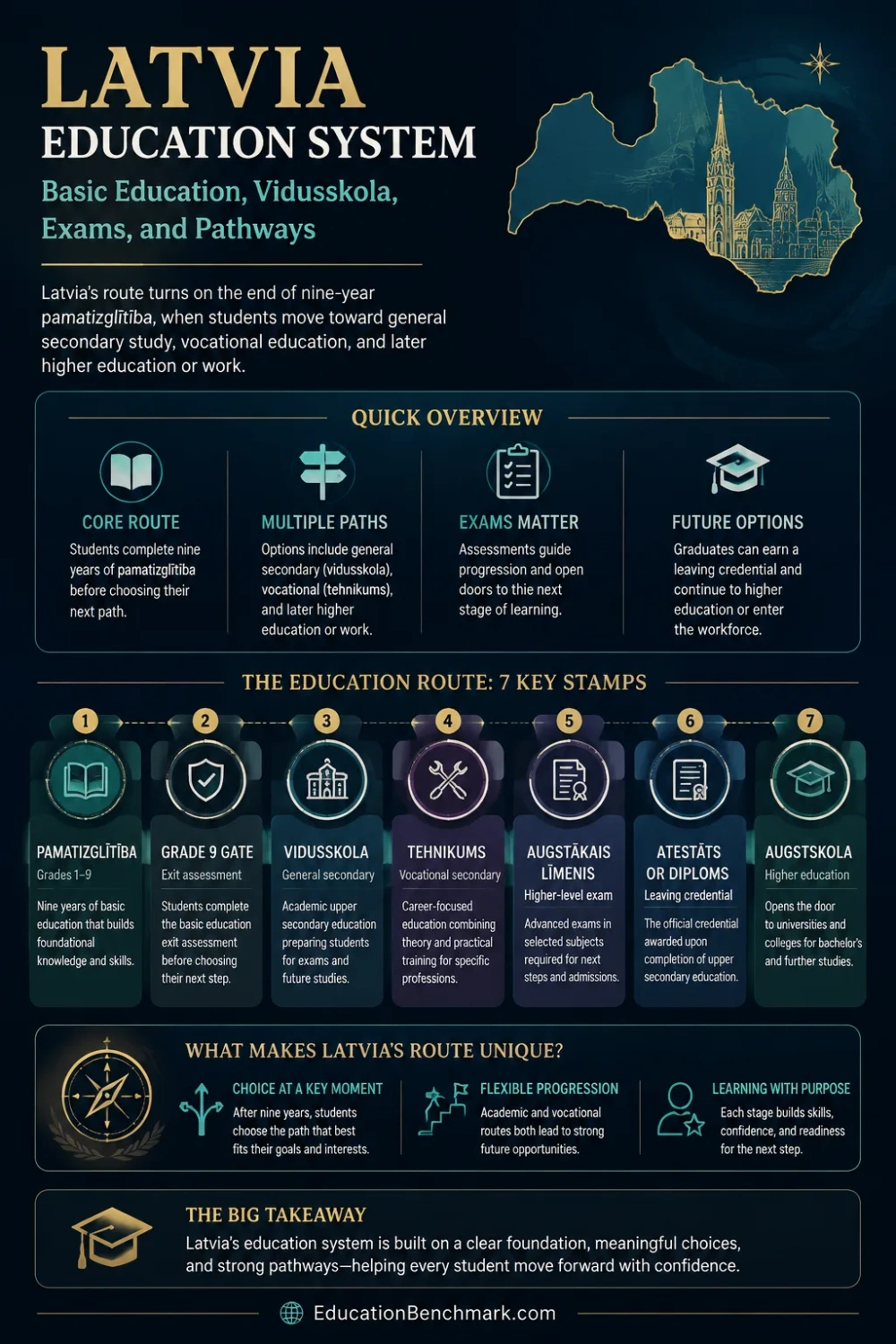
Latvia’s route turns on the end of nine-year pamatizglītība, when students move toward general secondary study, vocational education, and later higher education or work.
Pamatizglītība
Selected stamp: Pamatizglītība. Choose another stamp to update the route card.
Latvia organises compulsory basic schooling as pamatizglītība, a single nine-year stage covering Grades 1–9 rather than treating primary and lower secondary education as two completely separate school routes. Preparation for basic education is compulsory for five- and six-year-olds, while nine-year basic education begins from age seven and is generally completed around age 16, although it may continue until age 18. After Grade 9, students can move into general secondary education or a vocational route. [a]
Why Pamatizglītība Runs as a Nine-Year Stage
The term pamatizglītība is one of the most useful concepts for understanding Latvian schooling. International classifications divide these years between primary and lower secondary education, but Latvia places Grades 1–9 inside one basic education stage. The first six grades form the earlier part of that route; Grades 7–9 lead toward the secondary-school decision.
School route
From Compulsory Preschool Preparation to Secondary Education
Ages indicate the normal route. Individual progression can differ, and upper-secondary programme length depends on the route chosen after Grade 9.
| Stage | Usual point in the route | What it means |
|---|---|---|
| Mandatory preschool preparation | Ages 5–6 | Preparation before entry into compulsory basic education. |
| Pamatizglītība | Grades 1–9, beginning from age 7 | Nine-year compulsory basic education combining primary and lower-secondary phases. |
| Vispārējā vidējā izglītība | After Grade 9 | General secondary study, commonly associated with vidusskola and the route toward an atestāts. |
| Profesionālā vidējā izglītība | After Grade 9 | Vocational secondary study combining general education with preparation for a profession. |
The school name does not always equal the education stage. A sākumskola may provide the first six grades, while a pamatskola can provide the full basic programme. A vidusskola may contain both basic and general secondary education. State gymnasiums (valsts ģimnāzijas) focus strongly on secondary education but may also provide parts of basic education.
Latvian school terms
What the Main School Names Mean
Why Compulsory-Education Ages Can Look Different in International Tables
Cross-country datasets sometimes compress compulsory participation into one age span. One 2026 comparison codes Latvia with an entry age of 5 and a theoretical exit age of 17. [b] Latvia’s own education descriptions are more useful for following the actual school stages: compulsory preparation covers ages five and six, while nine-year pamatizglītība begins from age seven. These two descriptions measure the route in different ways rather than defining the school stages identically.
Grade 9: The First Major Route Decision
Grade 9 is more than the end of a school level. It is the point where the common basic-education route begins to branch. A student who completes the required subjects and assessments can use the basic education credential to continue into secondary education.
Grade 9 decision
Where Pamatizglītība Can Lead Next
General and vocational secondary education are parallel routes rather than steps that every student completes in the same order.
School results and the required state assessments determine completion of the basic education stage.
Students continue general secondary education, choose course depth, take state examinations, and work toward an atestāts.
Students combine secondary studies with vocational preparation and work toward a professional qualification and relevant credential.
Secondary schools may set admission conditions within national rules, so completing Grade 9 does not mean every upper-secondary programme has identical entry requirements. The distinction becomes especially relevant for state gymnasiums, specialised programmes, and schools with more applicants than places.
Vidusskola: Course Depth Shapes the Academic Route
General secondary education is not best understood as a rigid choice between one fixed science stream and one fixed humanities stream. Latvia’s current curriculum structure gives schools and students a combination of basic courses, advanced courses, and specialised courses. General secondary programmes are offered in vidusskolas, state gymnasiums, and some distance or extramural secondary schools. [c]
Basic courses develop content at the general or optimal level. Advanced courses take selected subjects further, while specialised courses allow schools to add content connected with particular interests or programme directions. This makes the student’s course package more informative than a simple label such as “science student” or “humanities student.”
General, Optimal, and Highest-Level Study
The three depth levels have different roles. General-level study provides the relevant secondary content at a broader level. Optimal-level study develops the subject more fully and can prepare the student for deeper study. The highest level is associated with advanced courses and is designed for subjects a student studies in greater depth.
A student considering engineering, for instance, may need stronger preparation in mathematics and physics than a student planning a programme centred on languages or social sciences. The exact course package depends on what the school offers, while later admission conditions depend on the higher education programme. For that reason, course choice and university planning can become connected before the final year of vidusskola.
Assessment inside general secondary education uses a 10-point scale, while centralised examination results are reported as percentages. A school mark and an examination percentage therefore represent different forms of assessment and should not be read as the same measure.
What the 2025/26 State Exams Require
The 2025/26 school year is particularly useful for understanding why Latvia’s exam system needs a year-specific explanation. At Grade 9, Latvian language and mathematics are centralised examinations, while the foreign-language requirement is a monitoring assessment in English, German, or French. At general secondary level, the graduation pattern includes Latvian, mathematics, a foreign language, a natural-sciences field requirement, and at least one highest-level centralised examination. The VIAA guidance sets a 15% minimum for Grade 9 centralised examinations in 2025/26 and a 20% minimum for upper-secondary centralised exam certification. [d]
2025/26 assessment route
Grade 9 and General Secondary Requirements Side by Side
The table describes the 2025/26 rules. Transition provisions can apply in the natural-sciences area at general secondary level.
| Stage | Assessment | 2025/26 status | Threshold or role |
|---|---|---|---|
| Grade 9 | Latvian language | Centralised examination | 15% minimum examination threshold |
| Grade 9 | Mathematics | Centralised examination | 15% minimum examination threshold |
| Grade 9 | English, German, or French | Monitoring assessment | No minimum pass threshold for the monitoring result |
| General secondary | Latvian language | Centralised examination | At least optimal level under the current graduation route |
| General secondary | Foreign language | Centralised examination | English, German, or French at least at optimal B2 level |
| General secondary | Mathematics | Centralised examination | At least optimal level under the current graduation route |
| General secondary | Natural sciences, physics, chemistry, or biology | State examination route with transition provisions | General natural sciences or an eligible science subject at the required level |
| General secondary | Advanced-course subject | Highest-level centralised examination | At least one required; 20% minimum examination threshold |
Table analysis
- The Grade 9 foreign-language assessment is not treated like the Latvian and mathematics centralised exams in 2025/26.
- A monitoring result in the Grade 9 foreign language does not carry the 15% graduation threshold.
- The upper-secondary natural-sciences requirement includes transition arrangements for students who completed eligible monitoring assessments in earlier school years.
- A highest-level examination can overlap with another required subject, so the route should not automatically be read as five completely separate exam subjects.
The difference between a centralised examination and a monitoring assessment matters. Monitoring can provide system-level information about learning without automatically carrying the same graduation consequence as an examination with a minimum certification threshold.
The 2026/27 Grade 9 Science Exam and Proposed Rule Changes
Students entering Grade 9 under the next school-year rules face another change. Latvia’s current basic-education regulation includes a state assessment in the natural-sciences learning area at the end of Grade 9 and states that this requirement applies from 1 September 2026. The same regulation records the 15% threshold as a transition rule for 2025/26. [e]
The Science Exam and the Pass-Threshold Proposal Are Different Changes
The natural-sciences assessment has already been scheduled in the applicable regulation for the 2026/27 route. A separate set of amendments announced on 4 August 2026 proposes that Grade 9 centralised exam percentages would no longer determine whether a student receives the basic education certificate. The same proposal would make the highest-level centralised examination optional for general secondary graduation and allow it to be chosen when needed for higher education or another study goal. The announced changes were intended for application from 1 September 2026, but they were presented as planned amendments at the time of the announcement. [f]
This distinction prevents two different ideas from being merged. One concerns which subject is assessed at the end of Grade 9. The other concerns what result is required for the basic education credential. Students, families, and schools dealing with the 2026/27 transition should check the final regulation applying to their school year rather than carrying the 2025/26 threshold forward automatically.
From Tehnikums to Higher Education
Vocational education is a full secondary pathway after pamatizglītība, not simply a short job-training option beside the school system. After completing basic education, a student can enter a vocational secondary programme that typically lasts four years and combines secondary education with preparation for a profession. The Ministry states that graduates of this route can enter employment or continue to higher education. [g]
What Tehnikums Means in Practice
A tehnikums is a technical vocational secondary institution. Another relevant term is profesionālā vidusskola, or vocational secondary school. Programmes are organised around a professional field and combine theoretical subjects with practical preparation. Depending on the programme, practical learning can take place in school workshops, laboratories, and workplace settings.
After Grade 9
Vidusskola and Vocational Secondary Routes Compared
The routes have different emphases, but they do not create a simple “university versus work” divide. A qualifying vocational secondary diploma can preserve access to tertiary study. The practical difference is that vocational students complete profession-related learning alongside the general education needed for the secondary qualification.
Apliecība, Atestāts, and Diploms: Credentials That Mark the Route
Latvian education terminology becomes clearer when the main leaving documents are placed in sequence. The apliecība par vispārējo pamatizglītību confirms completion of general basic education. The general secondary route leads to an atestāts par vispārējo vidējo izglītību. A completed vocational secondary route can lead to a diploms par profesionālo vidējo izglītību.
Credential ladder
Which Document Opens the Next Stage?
Confirms completion of general basic education and supports progression into eligible secondary programmes.
Confirms general secondary education when the applicable curriculum and state examination conditions are met.
Confirms the relevant vocational secondary education route and can provide access to eligible tertiary study.
Higher education admission in Latvia is not handled through one central national placement procedure for every programme. Higher education institutions set their own admission criteria. An atestāts or qualifying vocational secondary diploms provides the secondary-level basis for higher education, while competition commonly uses centralised examination results. Institutions may also specify prior subjects, qualifications, aptitude conditions, or other requirements. [h]
This is why a highest-level subject can matter even when it is not universally required for every programme. An applicant preparing for a subject-intensive degree may benefit from a different advanced-course and exam combination than an applicant entering a programme with broader entry criteria. The final admission rules belong to the institution and programme concerned.
Vienota Skola and the Language of Instruction
Another Latvia-specific change concerns the language used in preschool and basic education. Under the Vienota skola transition, education in the state language was phased in across basic-school grades over three school years: Grades 1, 4, and 7 from September 2023; Grades 2, 5, and 8 from September 2024; and Grades 3, 6, and 9 from September 2025. Minority-language and cultural-history learning can continue through interest-education programmes. [i]
For the present school route, this means the phased Grade 1–9 transition has reached all basic-school grades. It is best understood as part of the organisation of pamatizglītība rather than as a separate school track.
Where School and Admission Rules Can Vary
Latvia has national education standards and state examinations, but this does not make every student route identical. A vidusskola or state gymnasium can differ in the advanced and specialised courses it offers. Vocational institutions differ by occupational field and qualification. Secondary schools may have their own admission procedures within national rules, and higher education institutions set programme-specific entry criteria.
Exam rules are also sensitive to the school year. The difference between the 2025/26 Grade 9 arrangement and the changes planned for 2026/27 shows why percentages, required subjects, and graduation conditions should be checked against the rules applying to the student’s own cohort.
Verification Before an Education Decision
Education Benchmark is an independent informational guide and is not affiliated with any ministry of education, school authority, exam board, university, government agency, or official ranking organization. School admission conditions, examination rules, curriculum requirements, qualifications, and university entry criteria can change. Decisions affecting a specific student should be checked with the relevant school, higher education institution, VIAA, or Latvia’s Ministry of Education and Science.
The structure itself is relatively easy to follow once the Latvian terms are separated from English school labels: pamatizglītība provides the common nine-year base; Grade 9 is the branching point; vidusskola develops the general academic route through different course depths; and tehnikums or another vocational secondary institution combines secondary study with professional preparation. State examinations and the resulting credentials then connect those routes to further education, employment, or institution-led higher education admission.
Sources and Verification
- [a] Education system in Latvia | Izglītības un zinātnes ministrija — Used for the nine-year basic education structure, compulsory starting point, school types, assessment model, secondary pathways, and education credentials. (Reliable because it is Latvia’s official Ministry of Education and Science.)
- [b] Compulsory Education Worldwide (2026): Years, Ages, and Enforcement by Country — Used only to show how Latvia is coded in a cross-country compulsory-education table and why that coding should be distinguished from Latvia’s stage-by-stage school description. (Useful as a comparative education reference compiled for international system comparison.)
- [c] General Education | Izglītības un zinātnes ministrija — Used for general secondary institution types and the distinction between basic, advanced, and specialised courses. (Reliable because it is an official ministry education page.)
- [d] Biežāk uzdotie jautājumi par valsts pārbaudes darbiem | Valsts izglītības attīstības aģentūra — Used for the 2025/26 Grade 9 assessments, foreign-language monitoring, 15% basic-exam threshold, general secondary examination subjects, transition arrangements, and 20% upper-secondary threshold. (Reliable because VIAA is Latvia’s official state education development agency responsible for current examination information.)
- [e] Noteikumi par valsts pamatizglītības standartu un pamatizglītības programmu paraugiem — Used to verify the basic education standard, the 2025/26 transition threshold, and the natural-sciences state assessment applying from September 2026. (Reliable because Likumi.lv publishes Latvia’s official legislation.)
- [f] Plāno pilnveidot skolēnu vērtēšanas kārtību un centralizēto eksāmenu regulējumu | Valsts izglītības attīstības aģentūra — Used for the August 2026 proposals concerning Grade 9 exam consequences, removal of the minimum certificate threshold, and optional highest-level secondary examinations. (Reliable because it is a current announcement from Latvia’s official state education development agency.)
- [g] Vocational Education | Izglītības un zinātnes ministrija — Used for vocational secondary programme duration and progression from basic education to employment or higher education. (Reliable because it is Latvia’s official ministry page for vocational education.)
- [h] Education System | Valsts izglītības attīstības aģentūra — Used for secondary credentials, higher education eligibility, non-centralised admissions, centralised examination results, and institution-specific entry requirements. (Reliable because it is an official VIAA description of Latvia’s education system.)
- [i] Pāreja uz Vienotu skolu | Izglītības un zinātnes ministrija — Used for the 2023–2025 state-language transition across preschool and Grades 1–9 and the continued minority-language and cultural-history option through interest education. (Reliable because it is the Ministry’s official Vienota skola information page.)