Finland’s Route From Perusopetus to Higher Education
A route map centred on the common nine-year school, the choice after Grade 9, and Finland’s academic and vocational branches.
Common Basic School
Selected stamp: Common Basic School. Choose another stamp to update the route card.
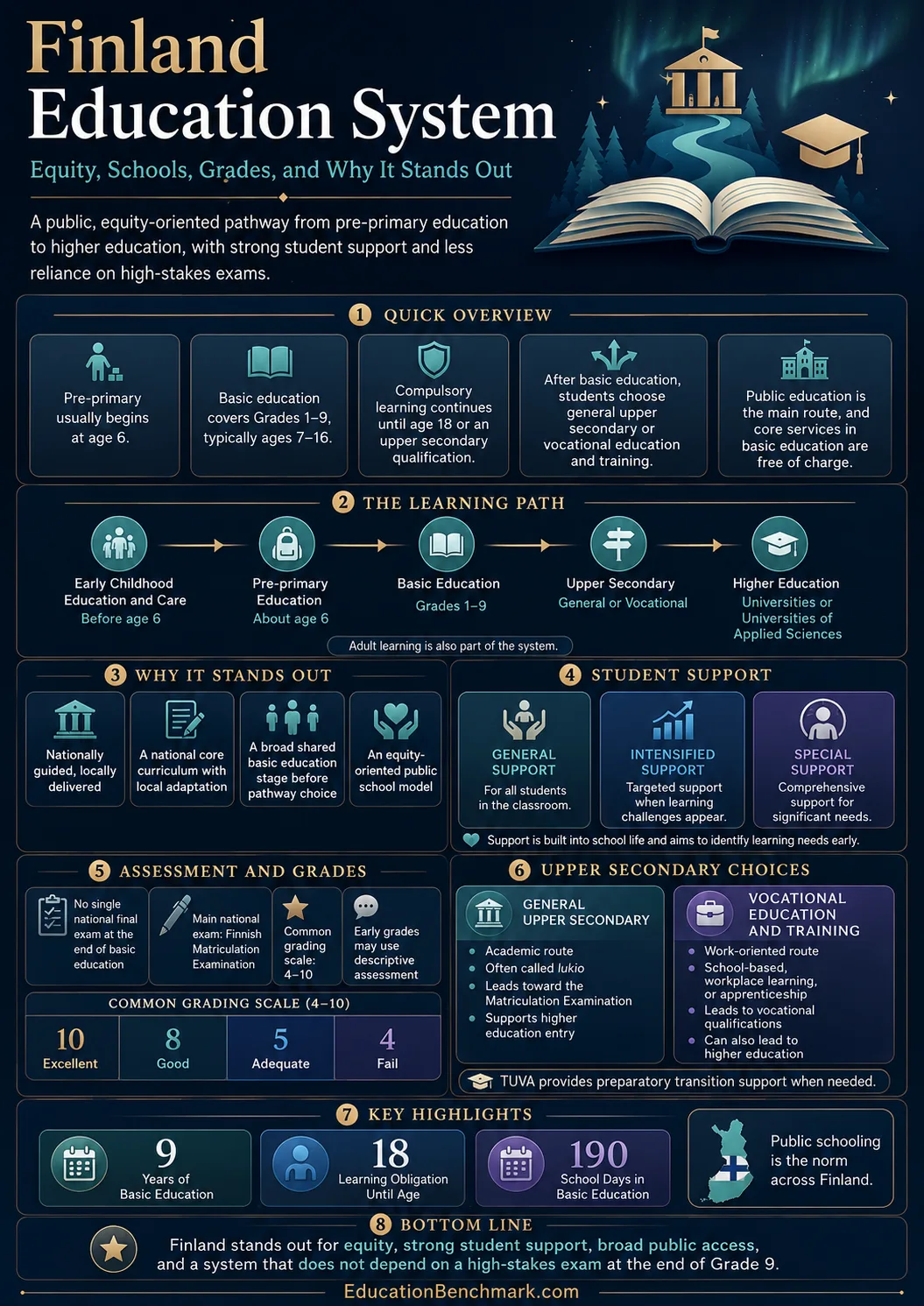
Finland’s education system is often discussed through its international reputation, yet its structure is easier to understand through a simpler idea: most children remain in the same common school route through Grade 9, and the main academic–vocational choice comes later. Compulsory education covers ages 6–18, beginning with pre-primary education and continuing through basic and upper secondary education. After the nine-year basic stage, students normally move into either general upper secondary education or vocational education and training.[a]
This delayed split shapes much of what visitors notice about Finnish schooling. There is no nationwide high-stakes test at the end of every basic-school year, schools work from national curriculum goals but prepare local curricula, and municipalities carry much of the responsibility for providing education. A recent country overview from Education by Country also describes the system as a publicly organised route combining national direction with local delivery.[b]
System logic
One Common School Before the Upper-Secondary Split
The defining route is not early selection between different secondary school types. It is a shared basic-education stage followed by a choice after Grade 9.
Most pupils follow the same basic-education route from about age 7 to 16, whether their school houses all nine grades or only part of them.
Students apply to general upper secondary, vocational, or preparatory options. School results and programme rules matter more than a single national leaving test.
General upper secondary studies lead toward the national matriculation examination and later higher-education applications.
Vocational students build occupation-specific competence while retaining eligibility to apply to higher education.
The common basic-school route does not mean that every pupil has an identical timetable or classroom experience. Municipalities and schools can organise provision differently, language options vary, and local curricula may emphasise different themes. The common element is the legal and curricular base: basic education forms one nine-year stage without a formal early split into academically ranked school tracks.
School route
School Levels, Typical Ages, and Compulsory Participation
Ages are typical rather than absolute. Starting points and completion dates can differ because of individual decisions, preparatory education, or flexible study time.
| Stage | Typical age | Typical duration | Main outcome |
|---|---|---|---|
| Early childhood education and care | Before age 6 | Varies | Care, education, and early learning goals |
| Pre-primary education | 6 | 1 year | Preparation for basic education |
| Primary and lower secondary education | 7–16 | 9 years | Basic-education completion certificate |
| General upper secondary education | About 16–19 | Usually about 3 years | General upper secondary syllabus and matriculation examination route |
| Vocational education and training | Usually 16+ | Individual | Competence-based vocational qualification |
| Higher education | Usually 18+ | Programme-based | University or university of applied sciences degree |
Pre-primary education at age six is part of compulsory education. Basic education normally starts in the year a child turns seven and covers Grades 1–9. Municipalities arrange education for residents in the compulsory age range, and pupils are normally allocated a place in a nearby school. Basic education is free, including learning materials, a daily meal, welfare services, and qualifying school transport.[c]
The school building itself may contain Grades 1–6, Grades 7–9, or the full Grades 1–9. That organisational difference should not be confused with a tracked system. A pupil may move to a different building for the final three grades, but the legal stage remains basic education.
Governance stack
How National Goals Become Local Finnish Curricula
Finland combines national steering with local decisions. Consistency comes from shared goals; variation comes from how providers and schools put them into practice.
National authorities define the legal duties, subject goals, broad content, and minimum lesson distribution that education providers must follow.
The provider translates national requirements into a local curriculum, allocates resources, and decides how schools are organised.
Schools plan daily practice, while teachers select methods, materials, tasks, and assessment evidence within the agreed curriculum.
The national core curriculum sets objectives for subjects and describes values, learning, school culture, and broad competences. It still retains recognisable school subjects—such as mother tongue and literature, mathematics, sciences, social studies, arts, crafts, physical education, and languages—while also asking schools to teach skills that cross subject boundaries. These include multiliteracy, digital competence, participation, interaction, and learning-to-learn skills.[d]
This division of responsibility is one reason Finland cannot be reduced to a single classroom method. Two schools can follow the same national goals while using different textbooks, projects, timetables, or local themes. Local freedom is real, but it operates inside national law and curriculum requirements rather than outside them.
Assessment
Grades 4–10 and What They Mean
Basic-school assessment combines regular teacher feedback with annual reporting. Younger pupils may receive descriptive assessment before numerical grades become standard.
| Grade | Official description | Pass status |
|---|---|---|
| 10 | Excellent | Pass |
| 9 | Very good | Pass |
| 8 | Good | Pass |
| 7 | Satisfactory | Pass |
| 6 | Moderate | Pass |
| 5 | Adequate | Pass |
| 4 | Fail | Fail |
National final-assessment criteria were introduced across subjects in 2021 to improve the comparability and equity of final grades. Teachers still make the assessment, but they work with shared descriptions of competence rather than creating a separate local standard for the basic-education certificate.[e]
Finnish basic education does not use a national test to rank every pupil at the end of Grade 9. Teachers assess learning through classroom work, assignments, tests, participation, and other evidence. Reports are issued at least annually; assessment in early grades can be descriptive, while numerical assessment must be used by Grade 4 at the latest. The same official overview records the 4–10 scale and the learning-support rules that took effect on 1 August 2025.[f]
Equity in daily schooling
Support, Meals, and the Nearby-School Principle
Equity is built through ordinary school arrangements, not only through national test results or policy statements.
Support may be organised for groups or individual pupils, and the legal rules on support for learning and school attendance were revised from 1 August 2025.
School welfare can involve teachers, special-education staff, health professionals, psychologists, and social workers, depending on local provision and need.
Pupils and students are entitled to a free meal during the school day from pre-primary education through upper secondary education.
Municipalities allocate a local school place, while families may seek another school subject to available places and local rules.
Finland’s support rules should not be frozen into the older three-tier description still found in many summaries. Revised provisions that took effect in August 2025 place attention on teaching arrangements that support learning conditions, group-based support, student-specific measures, and other educational services. The exact implementation is local, but the right to support is national.
School meals are another structural feature. Finnish law guarantees a free meal during school days from pre-primary education through upper secondary education, and the curriculum treats the meal as part of wellbeing, social learning, and the school day rather than as an optional service.[g]
These arrangements do not erase differences between municipalities, schools, families, or student groups. They do, however, reduce the number of basic services that depend on a family purchasing them separately. That is a more accurate explanation of Finnish equity than the claim that every school or outcome is identical.
Choice after Grade 9
The Lukio–Ammatillinen Split Is a Branch, Not a Dead End
Both upper-secondary routes can lead to higher education, though the content, assessment, and day-to-day study experience differ.
Students complete 150 credits, study broad academic subjects, and usually prepare for the matriculation examination.
The matriculation examination produces subject results that may be used in university and AMK admissions.
Students demonstrate occupational competence through qualification units, practical learning, and assessment tied to workplace skills.
Students from either branch may apply to higher education, although programme selection methods and preparation needs differ.
General upper secondary education usually lasts about three years and consists of 150 credits. It is not organised as a fixed three-grade package in the same way as basic education; students complete modules and can take more or less time depending on their study plan. The route provides broad general education and usually ends with the matriculation examination.[h]
Vocational education is competence-based. Students can acquire and demonstrate skills in educational institutions and workplaces, and prior competence can affect an individual study plan. A vocational qualification provides eligibility for higher-education studies, so choosing vocational education at 16 does not permanently close university or AMK routes.[i]
Transfer and combination are possible, but they are not frictionless or identical for every learner. A student moving between routes may need additional studies, a new application, or programme-specific preparation. Some learners combine general and vocational studies. The practical route depends on local provision and the student’s goals.
National examination sequence
Ylioppilastutkinto: Five Tests Across Spring or Autumn Sessions
The matriculation examination is national, digital, and tied mainly to the general upper secondary route.
- Complete the general upper secondary syllabus. Students usually prepare for the examination while finishing their lukio studies.
- Take mother tongue and literature. This is required as part of the examination.
- Select at least four additional tests. Choices come from mathematics, the second national language, foreign languages, and humanities and natural sciences.
- Include an advanced-level test. At least one test must be taken at advanced level under the examination rules.
- Finish within one to three consecutive examination periods. The examination is held twice yearly, in spring and autumn.
The minimum is five tests, not four. The examination can be spread across one to three consecutive examination periods, and candidates may later supplement or retake tests under the Board’s rules. The exam certificate matters in higher-education admissions, but it is not a universal automatic ticket: institutions and programmes may use certificate selection, entrance examinations, aptitude tasks, portfolios, or combined methods.[j]
Vocational students can also meet conditions for taking the examination, but the normal preparation route is lukio. For families comparing systems, this distinction matters: Finland has no national leaving test at the end of basic education, yet it does have a national examination at the end of the general upper secondary route.
Higher education
Yliopisto and Ammattikorkeakoulu Serve Different Purposes
Both sectors award recognised higher-education degrees, but their missions, programme design, and progression routes are not the same.
Finland has 13 universities and 22 universities of applied sciences. Universities concentrate on research-based teaching and award doctorates, while AMK institutions focus on professional higher education and applied research and development. Bachelor’s degrees usually take three years at universities and roughly three and a half to four and a half years at an AMK, depending on the programme.[k]
Applications are handled through Studyinfo for many programmes, using joint or separate application routes. Eligibility, deadlines, language requirements, certificate selection, entrance examinations, and other selection rules belong to the individual programme. Applicants should therefore read the current programme description rather than assume that one national formula applies to every Finnish institution.[l]
International context
Why Finland Stands Out—and Why the Older Reputation Needs Updating
Finland stands out less because of one teaching trick than because several parts of the system reinforce one another: a common basic-school route, limited early tracking, teacher-led assessment, national curriculum goals with local implementation, free school meals, pupil welfare, and higher-education eligibility from both general and vocational upper secondary routes.
PISA 2025 still places Finnish 15-year-olds above the OECD average in mathematics, reading, and science. The trend, however, is weaker than Finland’s older international reputation suggests. Average results were lower than in 2022 in mathematics and reading and about the same in science. Across all three subjects, Finland’s 2025 performance was lower than in any assessment before 2022, extending the long decline in mean scores recorded from 2006 to 2025. Compared with 2015, the share of students performing below Level 2 also rose by 17 percentage points in mathematics, 15 points in reading, and eight points in science.[m]
PISA measures the performance and experiences of sampled 15-year-olds. Science was the main assessment domain in PISA 2025, while mathematics and reading were minor domains. PISA does not rank every Finnish school, explain every cause, or replace national information about curriculum, support, qualifications, and admissions.
The fairest description is therefore neither myth nor dismissal. Finland still combines above-average outcomes with a school structure designed around broad access and later selection. It also has real performance declines and equity pressures that require attention.
Before making a decision
What Families and International Students Should Verify
School placement, language provision, local curricula, support arrangements, admission cut-offs, vocational programmes, and higher-education selection methods can differ by municipality, provider, school, year, and programme. The current school or institution should confirm any detail that affects an application or study plan.
Finnish and Swedish are the main languages of instruction in the national system, while English-language and other language options depend on locality and institution. International schools and English-taught programmes may use separate admissions rules, fees, calendars, or qualification requirements.
Education Benchmark is an independent informational guide and is not affiliated with any ministry of education, school authority, exam board, university, government agency, or official ranking organization. It does not provide school placement, admissions, legal, visa, or qualification-recognition advice. For a current decision, check the responsible municipality, school, Studyinfo listing, higher-education institution, Matriculation Examination Board, Finnish National Agency for Education, or other competent authority.
Sources and Verification
- [a] Finnish Education System — Used for the national stage structure, compulsory education ages, upper-secondary branches, and higher-education sectors. (Reliable because it is published by the Finnish National Agency for Education.)
- [b] Finland Education System (2026): Structure, Quality, and Performance — Used as an independent country-level overview of Finland’s nationally guided and locally delivered school structure. (Useful because it is a topic-specific education-system reference page.)
- [c] Primary and Lower Secondary Education — Used for Grades 1–9, typical ages, municipal responsibility, nearby-school placement, free materials, meals, welfare, and transport. (Reliable because it is an official Finnish education source.)
- [d] National Core Curriculum for Primary and Lower Secondary Education — Used for subject goals, school culture, pupil participation, broad competences, and curriculum content. (Reliable because the Finnish National Agency for Education prepares the national core curriculum.)
- [e] Criteria for Final Assessment in Primary and Lower Secondary Education — Used for the purpose and introduction date of national final-assessment criteria. (Reliable because it is the official agency page for basic-education assessment criteria.)
- [f] Bacic Information About Primary and Lower Secondary Education — Used for the learning-support changes effective from 1 August 2025 and the current distinction between group-based and student-specific measures. (Reliable because it is maintained by the Finnish National Agency for Education.)
- [g] School Meals in Finland — Used for the legal entitlement to a free school-day meal through upper secondary education. (Reliable because it explains Finnish legislation and curriculum duties on the official education agency site.)
- [h] General Upper Secondary Education — Used for the usual duration, 150-credit syllabus, general-study purpose, and matriculation route. (Reliable because it is the official national education agency overview.)
- [i] Vocational Education and Training — Used for competence-based qualifications, application routes, and higher-education eligibility. (Reliable because it is published by the national authority responsible for qualification requirements.)
- [j] Structure of the Examination — Used for the five-test minimum, required subject groups, advanced-level rule, and examination periods. (Reliable because it is the official Finnish Matriculation Examination Board.)
- [k] Universities — Used for the number of institutions, sector roles, and typical degree lengths. (Reliable because Study in Finland is produced by the Finnish National Agency for Education.)
- [l] Bachelor’s and Master’s Admissions — Used for Studyinfo applications, joint and separate routes, and programme-specific admissions. (Reliable because it is Finland’s official higher-education information service.)
- [m] PISA 2025 Results (Volume I): Finland — Used for Finland’s 2025 performance relative to the OECD average, changes since 2022, longer-term score trends, and changes in the share of low-performing students. (Reliable because OECD publishes the PISA assessment and country notes.)