Estonia School Route Passport
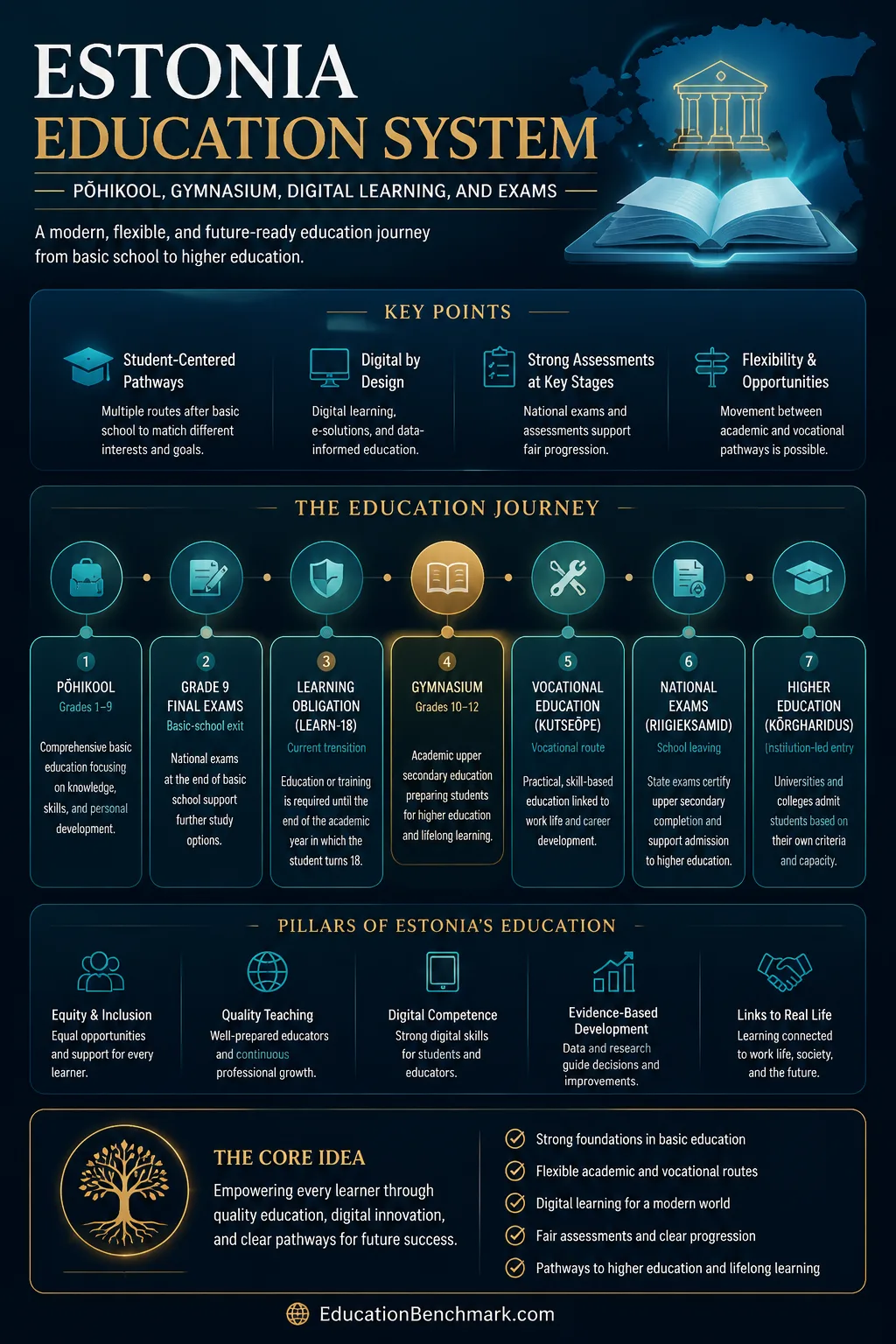
Follow the Põhikool route, the Grade 9 decision, general and vocational upper-secondary paths, and the exams that shape progression.
Põhikool
Selected stamp: Põhikool. Choose another stamp to update the route card.
Estonia’s mainstream school route is built around Põhikool, followed by a choice between general upper-secondary education and vocational study. Exams mark the end of basic school and appear again in gümnaasium, while national curricula, school-level decisions, digital services, and current education reforms shape how students move through the system.
Põhikool: One Basic-School Route Across Grades 1–9
Põhikool is the central term for understanding Estonian schooling. Children normally start school in the year they turn seven if they have reached that age by 1 October. Basic education is divided into Stage I, Grades 1–3 (about ages 7–10); Stage II, Grades 4–6 (about 10–13); and Stage III, Grades 7–9 (about 13–16). It may be provided in a primary school covering Grades 1–6, a basic school covering Grades 1–9, or an upper-secondary school that also teaches basic-school classes. The school year generally begins on 1 September and usually ends in June, with schools organising study in semesters or trimesters.[a]
| Põhikool stage | Grades | Typical ages | Place in the route |
|---|---|---|---|
| Stage I | 1–3 | About 7–10 | Opening stage of basic education |
| Stage II | 4–6 | About 10–13 | Middle stage of the nine-grade route |
| Stage III | 7–9 | About 13–16 | Final stage leading to basic-school completion |
What readers often confuse: Põhikool should not be translated mentally as only “primary school.” It covers the full nine-grade basic-education route, including years that many other systems describe as lower secondary.
The Grade 9 Fork: Final Exams, Gümnaasium, or Kutseõpe
Grade 9 is the first major school-completion point. Students completing basic school take final examinations in Estonian or Estonian as a second language, mathematics, and one elective subject. The final examinations are held in the spring under common arrangements across schools.[b]
The examination results are not the whole graduation requirement. Under rules in force from spring 2026, the standard route requires positive annual grades, completion of the creative assignment, and at least 50% of the maximum score in each of the three final examinations. Mandatory repeat examinations were removed, while the teachers’ council can approve graduation in specified cases where one or two examination results are below the threshold. Once Põhikool is completed, the main routes are general upper-secondary education or vocational education.[c][n]
Final examinations and the other Põhikool graduation requirements complete the basic-school stage.
Students continue into a three-year general upper-secondary programme and work toward a general secondary qualification.
Students enter vocational education leading toward vocational secondary education, an occupational qualification, or further progression.
This is a genuine branch in the student route. Gümnaasium and vocational education are not simply two names for the same programme, and neither should be described as an automatic next grade after Põhikool.
Learning Obligation to 18 Changes the Post-Põhikool Decision
A major current change affects what happens after Grade 9. From the 2025/2026 academic year, Estonia replaced the previous school-attendance obligation with an obligation to learn and extended the relevant age from 17 to 18. A student who completed basic school in spring 2026 or later and is still under 18 must continue in general secondary or vocational education until reaching 18 or completing secondary or vocational education. Transitional rules exclude students who completed basic school before 1 September 2025 or had already turned 17 before that date. The reform also provides preparatory study for students under the learning obligation who need an intermediate route before general or vocational secondary education. The Ministry links the change to post-basic dropout: it reports that nearly 800 basic-school graduates per year had not continued their education, with a similar number leaving during the first year of post-basic study.[d]
The old age-17 shorthand is no longer enough. Descriptions that simply say Estonian compulsory schooling ends at 17 can misstate the position for current cohorts. The student’s age and basic-school completion date now matter.
The reform makes the Grade 9 fork more important to understand. The immediate question is no longer only whether a student prefers an academic or vocational route; for affected under-18 students, continued learning itself is required.
Gümnaasium Graduation: 96 Courses, Riigieksamid, and Long-Form Work
Gümnaasium is the general upper-secondary route following basic school and normally has a three-year study period. The programme includes compulsory and elective courses, with a minimum study load of 96 courses for full-time upper-secondary education. Graduation requires satisfactory completion of the curriculum, state examinations in Estonian or Estonian as a second language, mathematics and a foreign language, an upper-secondary school examination, and a student research paper or practical work. Completion of basic education is the prerequisite for admission, while the school owner or authorised head of school establishes and publishes the school’s admission procedure. Academic performance is normally recorded on a five-point scale; schools may use another system internally, but marks must be converted to the recognised five-point format when a student leaves or transfers.[e]
| Feature | Põhikool | Gümnaasium |
|---|---|---|
| Main span | Grades 1–9 | Normally Grades 10–12 |
| Exit examinations | Estonian or Estonian as a second language, mathematics, elective subject | State examinations in language, mathematics, and foreign language |
| Other completion work | Creative assignment and satisfactory curriculum completion | School examination plus research paper or practical work |
| Main next routes | Gümnaasium or vocational education | Higher education, vocational study, or employment |
The structure explains why riigieksamid, or state examinations, should not be presented as Estonia’s equivalent of a single all-purpose national entrance test. They form part of upper-secondary graduation, while school-level work and later institution-specific admission conditions remain separate parts of the route.
National Curriculum and School-Level Decisions
Estonia combines national study requirements with room for schools to organise their own programmes. The national curriculum for upper-secondary schools sets the national study standard, learning outcomes, subject requirements, assessment principles, and graduation conditions. Schools then prepare their own curricula on that basis and can develop school-specific study directions and elective choices within those rules.[f]
This division matters when comparing two Estonian schools. The national level provides a common educational base, but the day-to-day programme does not have to look identical. Course combinations, elective emphasis, internal organisation, and admission arrangements can differ without creating a separate national school system.
- National level: national curricula, statutory graduation conditions, and common examination rules establish shared requirements.
- School level: the school curriculum translates those requirements into the local programme, including elective priorities and study organisation.
- Local delivery: municipalities and other school owners remain relevant to school provision, while national rules continue to govern the qualification route.
That mix also helps explain why an Estonian school can have a recognisable local profile without its students leaving the national general-education route.
Kutseõpe as the Parallel Post-Basic Route
Kutseõpe, vocational education, is not a side note to the gümnaasium route. Vocational programmes are organised through national and school curricula according to the type of training. Graduation requires completion of the curriculum goals and is normally assessed through a vocational examination; where the occupation does not provide such an examination, a school graduation examination is used. Estonia also provides workplace-based study as a distinct form of vocational education, where practical assignments in a company or institution account for at least two-thirds of the curriculum.[g]
The vocational route can therefore lead to different outcomes depending on the programme: vocational secondary education, an occupational qualification, employment, or later study. Entry requirements also vary with the type and level of vocational curriculum rather than following one universal rule for every programme.
This makes the post-Põhikool choice better understood as a branch between two forms of continued learning. Gümnaasium is centred on general secondary education; kutseõpe is organised around occupational and applied learning, with routes that can still connect to further education.
Digital Schooling: E-Koolikott, EIS, and AI Leap
Estonia’s digital education model is better understood as a set of services woven into teaching, assessment, administration, and access to learning materials rather than as a programme that simply gives students devices. E-koolikott is a state-provided portal for digital learning materials covering basic, general, and vocational education. The Education and Youth Board also provides Moodle to general and vocational schools, while EIS supports electronic national and school-based examinations and assessment and is connected to Estonia’s education information systems.[h]
A state-provided portal used to find digital learning resources for basic, general, and vocational education.
An electronic environment supporting tests and examinations alongside Estonia’s wider education information systems.
The Education and Youth Board makes the learning environment available to general and vocational schools.
AI Leap Moves From Upper Secondary Into a Wider School Route
Estonia’s AI Leap programme adds a newer layer to this digital environment. Its first-year review, published on 7 August 2026, reports that the ITI learning application had been made available to Grades 10–11 during the pilot year. About 12,500 students activated an account, while monthly use during spring ranged from about 4,000 to 5,700 students. For the 2026/27 school year, the programme plans to extend support to teachers in Grades 5–9 as well as vocational students and teachers. The programme’s own review also draws a clear limit around those early figures: first-year usage data does not yet provide a basis for claiming improved learning outcomes, with longer-term research involving more than 9,000 students still underway.[i]
That distinction is useful when discussing Estonia’s reputation for digital education. Digital availability, usage, teacher training, and measured learning effects are different questions. AI Leap is now part of the education system’s current development, but early participation data should not be treated as proof that AI itself raises achievement.
Estonian-Medium Education Is Expanding Grade by Grade
The language of instruction is another part of the present school system that is changing by cohort. Estonia began its transition to Estonian-language education in kindergartens and Grades 1 and 4 in 2024, with a stated aim of completing the process by 2030. The same entry grades joined the transition in September 2025 while the earlier cohorts moved into Grades 2 and 5. The Ministry’s progression for 2026 places Estonian-language education across Grades 1–6, as new first- and fourth-graders enter and earlier cohorts advance. Schools may move more grades earlier when they have the capacity to do so.[j]
- 2024: the transition starts in Grades 1 and 4, alongside kindergarten.
- 2025: new Grades 1 and 4 enter while the first cohorts advance to Grades 2 and 5.
- 2026: the cohort pattern extends Estonian-medium education across Grades 1–6.
- Following years: the transitioned cohorts continue upward, with completion of the wider process targeted for 2030.
Why the year matters: language-of-instruction descriptions written before the transition began can give an outdated picture of current grades. The applicable cohort and school year need to be checked when the language of teaching affects a school decision.
The reform also shows why Estonia’s national curriculum and local school organisation need to be read together. The national direction is clear, but schools may progress faster than the minimum transition schedule when resources allow.
Higher-Education Entry After Secondary School
For bachelor-level study, applicants need completed secondary education or an equivalent qualification that gives access to higher education. Admission then depends on the institution and programme. Universities may require additional examinations, interviews, essays, portfolios, language evidence, or other programme-specific conditions.[k]
This means the Estonian route should not be drawn as “Grade 12 → one national university exam → university.” Riigieksamid belong to the upper-secondary graduation structure, while higher-education institutions retain programme-level admission requirements. The exact use of examination results therefore depends on the institution and course.
An independent 2026 country profile from Education by Country provides a secondary cross-check of the same broad sequence: basic education through Grade 9, followed by general or vocational upper-secondary study and later higher-education routes. It is useful for orientation, but statutory ages, examinations, and reform rules should be verified against the relevant Estonian authorities.[l]
Education Benchmark is an independent informational guide and is not affiliated with any ministry of education, school authority, exam board, university, government agency, or official ranking organization. Admission procedures, examination arrangements, language-transition rules, curricula, and learning-obligation requirements can change, so decisions that affect an individual student should be checked with the relevant school, university, examination authority, or education ministry source.
PISA 2022 as Context, Not a School-Leaving Score
International assessment data add useful context without replacing an explanation of the school route. OECD data for PISA 2022 report average Estonian scores of 510 in mathematics, 511 in reading, and 526 in science. PISA assesses 15-year-old students and is separate from the Grade 9 final examinations and gümnaasium state examinations described earlier.[m]
The distinction matters. PISA results describe performance in an international sample; they do not award an Estonian school qualification, decide gümnaasium graduation, or determine every university admission. They also do not establish that one feature—digital services, school autonomy, examinations, or any single reform—caused the observed scores.
Estonia’s current education model is therefore best understood through the connections between its parts: a nine-grade Põhikool route, a consequential Grade 9 transition, continued learning for affected students until 18, separate general and vocational upper-secondary paths, national and school-level graduation requirements, and a digital environment that is now extending into AI-supported learning. The ongoing language transition adds another year-sensitive layer to that route.
Sources and Verification
- [a] The principles and organisation of kindergartens and schools in Estonia — Used for Põhikool stages, typical ages, school-start timing, school forms, and the school-year pattern. (Reliable because it is published by the Estonian Education and Youth Board.)
- [b] State examinations — Used for the common Grade 9 final examinations and their subjects. (Reliable because it is the Estonian Education and Youth Board’s examination information.)
- [c] Estonian education system — Used for the creative-assignment requirement and the broad progression after basic school. (Reliable for system description because Education Estonia is connected to Estonia’s public education sector.)
- [d] Reform of the obligation to learn — Used for the move to an obligation to learn until 18, the 2025/26 start, transitional cohort rules, preparatory study, and ministry dropout figures. (Reliable because it is the Estonian Ministry of Education and Research’s dedicated reform page.)
- [e] Pre-school, basic and secondary education — Used for gümnaasium duration, the 96-course load, graduation requirements, admissions, marking, and school-leaving rules. (Reliable because it is an official Ministry of Education and Research system page.)
- [f] National curriculum for upper secondary schools — Used for the relationship between national upper-secondary requirements and school curricula. (Reliable because Riigi Teataja is Estonia’s official legal publication database.)
- [g] Vocational education — Used for vocational curricula, graduation examinations, entry variation, and workplace-based study. (Reliable because it is an official Estonian Ministry of Education and Research page.)
- [h] What are the digital solutions used in Estonian education? — Used for E-koolikott, Moodle provision, and the EIS electronic assessment environment. (Reliable for these services because the page documents Estonia’s education-sector digital systems.)
- [i] Read the AI Leap First-Year Report — Used for the August 2026 AI Leap implementation update, ITI usage, planned 2026/27 expansion, and the stated limit on claims about learning outcomes. (Reliable for programme status because it is AI Leap’s own official site; it is not used as independent evidence of learning gains.)
- [j] Transition to Estonian-language education — Used for the Grade 1 and Grade 4 starting cohorts, the 2025 and 2026 progression, faster school-level transitions, and the 2030 target. (Reliable because it is the Ministry of Education and Research’s dedicated transition page.)
- [k] General requirements — Used for secondary-education eligibility and institution- or programme-specific higher-education admission requirements. (Reliable because Study in Estonia is Estonia’s national higher-education information service.)
- [l] Estonia Education System (2026): Structure, Quality, and Performance — Used only as a secondary cross-check of the broad student route, not as authority for statutory rules. (Useful because it is a dedicated independent country-education reference.)
- [m] Education GPS – Estonia – Student performance (PISA 2022) — Used for Estonia’s PISA 2022 mathematics, reading, and science scores and the assessment context. (Reliable because it is an official OECD education data profile.)
- [n] Põhiharidus — Used for the basic-school graduation rules in force from spring 2026, including the 50% examination threshold, removal of mandatory repeat examinations, and teachers’ council provisions. (Reliable because it is the Estonian Ministry of Education and Research’s current basic-education guidance.)