Sweden’s Route From Grundskola to Higher Education
A Swedish route through compulsory school, Year 9 eligibility, Gy25 programmes, adult study, and higher education.
Compulsory School
Selected stamp: Compulsory School. Choose another stamp to update the route card.
Sweden’s education system combines national rules with local delivery. The usual route passes through grundskola, a later choice among upper-secondary programmes, and several routes into adult or higher education. Grades matter, but not as one isolated national leaving test. They accumulate across subjects and become especially important when students apply to gymnasieskola.
The system is often described as relatively uniform because curricula, grading principles, and programme categories are set nationally. Daily provision is less uniform. Municipalities, independent organisers, school profiles, local admissions arrangements, and the availability of programmes can change a student’s practical experience.
School route
From Preschool Class to Gymnasieskola
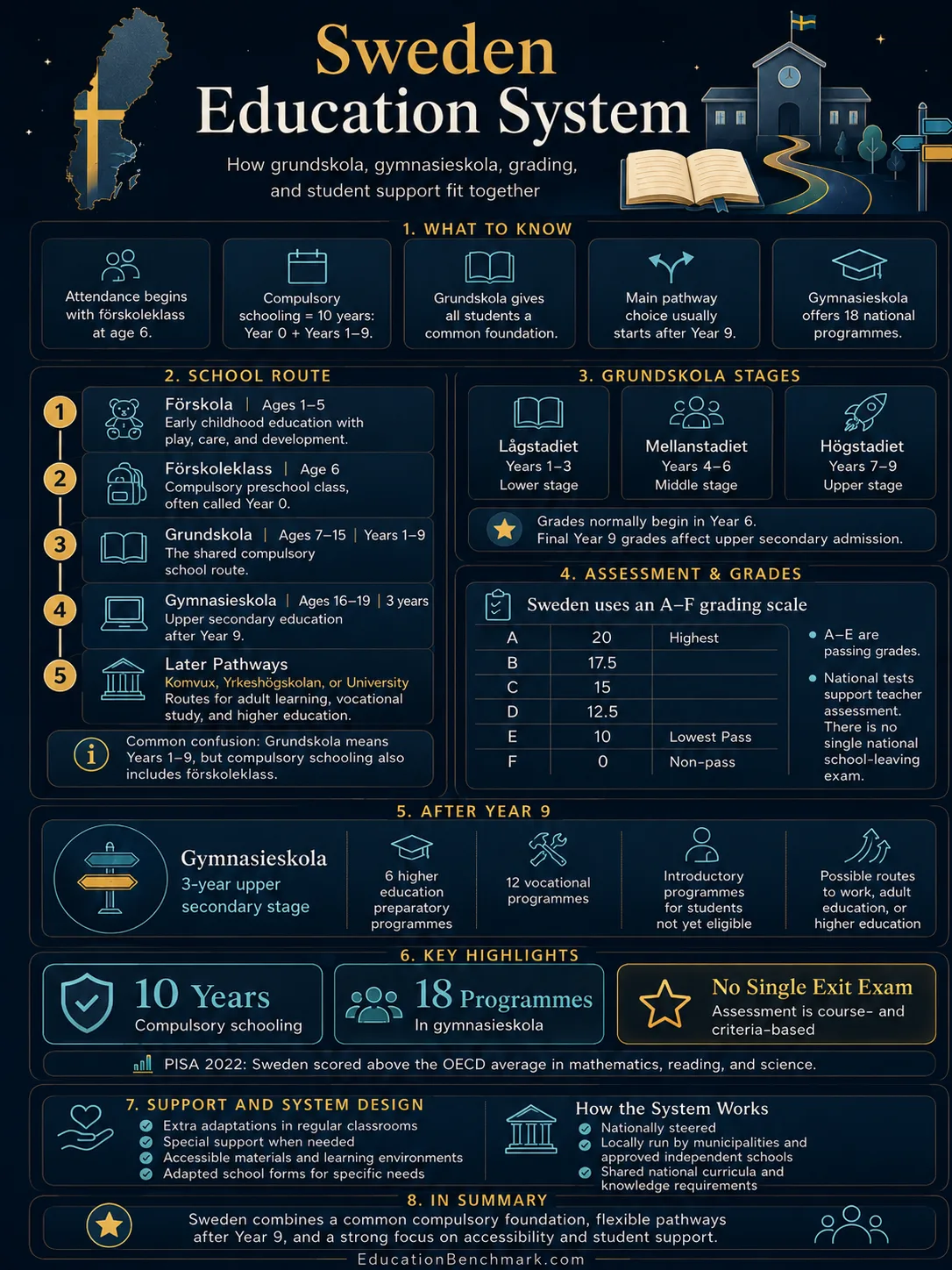
The Government of Sweden lists preschool class at age 6, compulsory school at ages 7–16, and upper-secondary school at ages 16–19 as the normal age pattern. Individual timing can differ. [a] A separate Sweden profile identifies preschool class as the compulsory opening stage before grundskola. [b]
| Stage | Swedish Term | Typical Point in the Route | Main Role |
|---|---|---|---|
| Preschool | Förskola | Before compulsory school | Early education and care before the school route begins. |
| Preschool class | Förskoleklass | Age 6 | A compulsory transition year between preschool and grundskola. |
| Compulsory school | Grundskola | Years 1–9, usually ages 7–16 | The common nine-year school route under the national Lgr22 curriculum. |
| Upper-secondary school | Gymnasieskola | Usually ages 16–19 | Voluntary programmes leading toward employment, further study, or both. |
| Municipal adult education | Komvux | Adult or later return route | Completing subjects, changing direction, improving eligibility, or taking vocational study. |
| Higher education | Högskola or universitet | After an eligible upper-secondary record | First-, second-, and third-cycle courses, programmes, and qualifications. |
Table analysis
- Förskoleklass is part of the compulsory route, not simply an optional preschool year.
- Gymnasieskola follows compulsory school but is organised through programme choice rather than one common upper-secondary syllabus.
- Komvux provides a later route back into subjects, qualifications, vocational preparation, or higher-education eligibility.
Governance stack
Who Sets the Rules: State, Municipality, and School Organiser
Swedish schooling is nationally steered, locally organised, and delivered by more than one type of accountable body.
The Swedish National Agency for Education is the central administrative authority for the public school system and adult education. It prepares regulations, recommendations, national tests, official statistics, and national follow-up work. [c]
Municipalities organise public provision, allocate resources, arrange school placement, and act as the accountable authority for municipal schools.
Independent compulsory schools have a non-municipal organiser and require authorisation from the Swedish Schools Inspectorate. Their teaching must remain on par with municipal provision. [d]
This division explains why two schools can follow the same national curriculum while differing in profile, organisation, admissions procedures, language emphasis, or local support arrangements. National steering sets the common educational expectations. The organiser is responsible for turning those expectations into staffing, timetables, teaching conditions, and support.
Year 9 decision map
From Year 9 Grades to a Gymnasieskola Programme
Sweden’s main lower-to-upper-secondary gate is based on passing subject grades and programme eligibility, followed by competition for available places where demand is higher.
A national vocational programme requires passing grades in Swedish or Swedish as a second language, English, mathematics, and at least five other compulsory-school subjects.
A higher-education-preparatory programme requires passing grades in Swedish or Swedish as a second language, English, mathematics, and at least nine other subjects. Some programmes require named science or social-science subjects. [e]
For education begun after June 30, 2025, the Gy25 structure contains 18 national programmes: six higher-education-preparatory programmes and twelve vocational programmes. [f]
Students who do not qualify for a national programme may enter programme-oriented option, vocational introduction, individual alternative, or language introduction. [g]
Eligibility Is Not the Same as Admission
Meeting the minimum subject requirements makes a student eligible to be considered for a programme. It does not always guarantee the preferred school or programme. Where applications exceed places, the student’s grade value can affect selection, and local cooperation areas can shape which applicants receive first consideration.
The introductory route is also broader than a single remedial year. Each student receives an individual study plan. Depending on the programme, study may include missing compulsory-school subjects, Swedish language learning, vocational content, workplace experience, or preparation for a national programme.
Assessment sequence
How A–F Grades and Gy25 Subject Grades Fit Together
The same letter scale can appear at different school stages, but the timing and way grades accumulate are not identical.
Grades in Sweden serve several functions at once. They report attainment against criteria, show whether a subject has been passed, help determine eligibility, and contribute to selection when places are limited. The purpose depends on the stage. A term grade in grundskola should not be confused with a gymnasieexamen, while an upper-secondary grade record should not be confused with an admission decision from a university.
Support inside the school route
Lgr22, Elevhälsa, and the Route From Adaptation to Special Support
Student support is part of ordinary school responsibility, not a separate track that begins only after a pupil has failed.
The national curriculum for compulsory school, preschool class, and school-age educare is commonly called Lgr22. It joins subject teaching with wider duties concerning learning conditions, guidance, cooperation with homes, and access to support. The curriculum states that teaching and pupil health services should help pupils receive guidance, stimulation, extra adaptations, or special support when needed. [k]
A teacher may adjust instruction, explanations, planning support, materials, task structure, or other classroom conditions so a pupil can participate and progress.
The school may need a closer assessment of the pupil’s needs and a more formal support decision. The exact process depends on the current legal rules and the individual situation.
What Elevhälsa Means
Elevhälsa is usually translated as pupil or student health services. In the education context, the term points to school-based support around a pupil’s learning, development, well-being, and access to education. It should not be reduced to a clinic that operates separately from teaching. Cooperation among teachers, the headteacher, support staff, the pupil, and the home can be part of how barriers are identified and addressed.
Adaptations and special support are intended to improve access to learning. They do not automatically replace the passing-grade rules used for national upper-secondary eligibility. A student may receive support and still need an introductory or adult-education route to complete required subjects.
Local access rules
School Choice, Proximity, and Independent-School Placement
The right to state a preference does not create an unconditional right to every chosen school.
A municipality must offer a compulsory-school place to a child who lives there. Guardians may state preferred schools, but municipal placement must also respect other pupils’ right to a school near home. This is often described through the proximity principle. Application dates and local placement rules differ among municipalities. [l]
Independent schools can use permitted selection rules when they have more applicants than places. These may include application date, sibling priority, proximity, or a rule connected to the school’s organisation. The practical result is a school-choice model with boundaries: families may express preferences, while municipalities and school organisers still apply capacity and admission rules.
Why Municipality Matters Even Under National Rules
The municipality can influence the local map of schools, transport conditions, application calendar, available upper-secondary programmes, adult-education courses, and cooperation agreements with nearby areas. Families moving within Sweden should therefore verify both the national rule and the local implementation.
Post-secondary progression
From Gymnasieexamen to Komvux and Higher Education
A Swedish upper-secondary record can lead directly to further study, but the route depends on the examination, completed subjects, and programme-specific requirements.
An examination from a higher-education-preparatory programme can meet the general entry requirement for first-cycle study.
A vocational examination can meet the general requirement when the stated passing levels in English and Swedish or Swedish as a second language are included.
Applicants missing required Swedish or English study may complete it later through municipal adult education or a folk high school. [m]
Swedish higher education includes a 120-credit higher education diploma, a 180-credit bachelor’s degree, later master’s routes, and doctoral study. [n]
General entry eligibility is only the first filter. A course or programme may require particular upper-secondary subjects, levels, or other prerequisites. Applicants who meet the requirements may then compete for places through the applicable selection groups.
Komvux is therefore not merely a route for repeating school. It can be used to finish missing subjects, gain a new vocational direction, or create eligibility for a later application. The available courses and admission priorities are set within municipal adult-education provision, so local details should be checked before planning a study sequence.
Reading the system accurately
What Makes the Swedish Route Distinct—and What Can Change
Sweden is more nationally steered than systems in which each state or province sets a separate curriculum, yet it is not administered as one uniform national school chain. Municipal and independent organisers shape delivery within national rules. The lower-to-upper-secondary transition is also more grade- and pathway-based than systems built around one universal school-leaving examination.
The strongest continuity lies in the route itself: compulsory schooling, subject grades, programme eligibility, national upper-secondary programme categories, and later study options. Variation appears in school placement, programme supply, local profiles, support organisation, workplace links, and admission competition.
Gy25 means that students from different starting years can be governed by different grading arrangements during the transition. Municipal application dates, school placement, course availability, programme prerequisites, and university admissions rules can also change. Important decisions should be checked with the relevant municipality, school, organiser, Skolverket, University Admissions, or higher education institution.
Education Benchmark is an independent informational guide and is not affiliated with any ministry of education, school authority, exam board, university, government agency, or official ranking organization.
Reference record
Sources and Verification
- [a] 19. Childcare and Education — Used for the ordinary age pattern from preschool class through upper-secondary school. (Reliable because it is an official Government of Sweden page.)
- [b] Sweden Education System Overview — Used as an independent secondary orientation source for Sweden’s education route. (Reliable as a specialised country-education reference that identifies institutional data sources, though official rules should still be checked directly.)
- [c] This Is the Swedish National Agency for Education — Used for Skolverket’s national role, including regulations, national tests, statistics, and evaluation. (Reliable because it is the agency’s official English-language page.)
- [d] Municipal or Independent Compulsory School? — Used for the distinction among municipal, state, and independent compulsory schools and the authorisation of independent organisers. (Reliable because it is published by Skolverket’s official Education Guide.)
- [e] Eligibility and Admission to Upper-Secondary School — Used for the passing-subject requirements for vocational and higher-education-preparatory national programmes. (Reliable because it is current official guidance from Skolverket with references to Swedish education law.)
- [f] Gymnasieprogrammen (Gy25) — Used for the current count of national preparatory and vocational programmes under Gy25. (Reliable because it is Skolverket’s official programme page.)
- [g] Introductory Programme — Used for the four introductory programmes, their individual study plans, and possible progression routes. (Reliable because it is an official Skolverket Education Guide page.)
- [h] Year 6 Term Grade Statistics, 2024/25 — Used to verify Year 6 term grading and the A–F reporting categories in current official statistics. (Reliable because it is a dated release from Sweden’s official education statistics authority.)
- [i] Grades and Merit Points — Used for the A–F scale, passing grades, and the use of a dash when assessment evidence is missing. (Reliable because it is current official guidance from Skolverket.)
- [j] Gy25 Subject Grades at Upper-Secondary Level — Used for the July 1, 2025 start date, subject-grade model, and transition from earlier course grades. (Reliable because it is Skolverket’s official reform page.)
- [k] Curriculum for Compulsory School, Preschool Class and School-Age Educare – Lgr22 — Used for curriculum duties concerning teaching, pupil health services, extra adaptations, and special support. (Reliable because it is the official English curriculum publication from Skolverket.)
- [l] Application and Admission to Compulsory School — Used for municipal placement duties, guardian preferences, the proximity principle, and locally varying application periods. (Reliable because it is official guidance from Skolverket’s Education Guide.)
- [m] Sweden, Bachelor’s Admission — Used for general entry through preparatory or vocational examinations and later completion through Komvux or folkhögskola. (Reliable because Universityadmissions.se is Sweden’s official English-language admissions service.)
- [n] The Swedish Higher Education System — Used for degree cycles and the credit scope of major Swedish higher education qualifications. (Reliable because it is published by the Swedish Council for Higher Education.)