
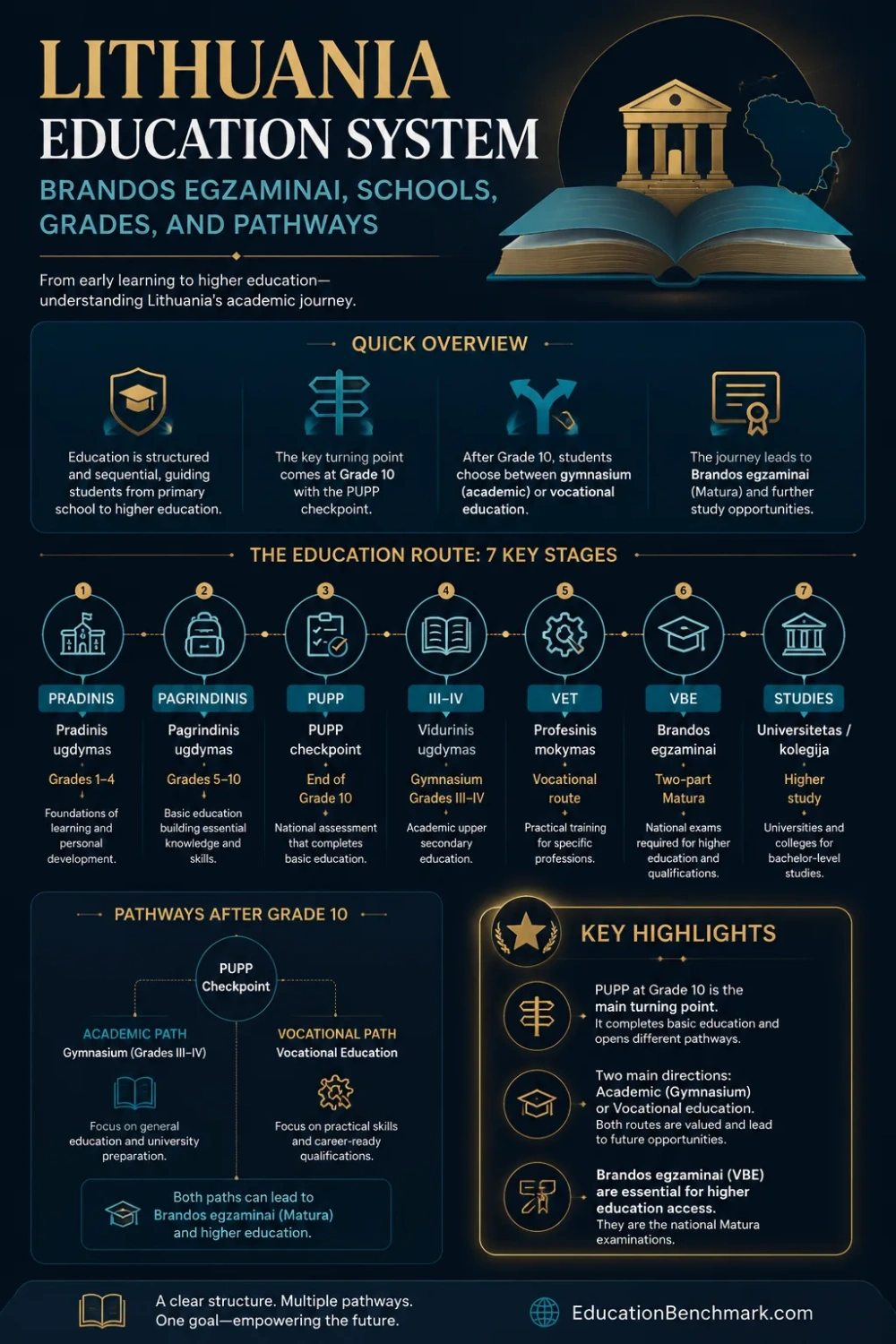
Lithuania: From Pagrindinis Ugdymas to Brandos Atestatas
The route turns at Grade 10: PUPP closes basic education, then gymnasium or vocational study leads toward Matura exams and further study.
Pradinis ugdymas
Selected stamp: Pradinis ugdymas. Choose another stamp to update the route card.
Lithuania’s general education route is built around a 4 + 6 + 2 structure: four years of pradinis ugdymas (primary), six years of pagrindinis ugdymas (basic or lower secondary), and two years of vidurinis ugdymas (upper secondary). The school names can be misleading to outsiders because a gimnazija may cover both the final part of basic education and the upper-secondary stage. State and private providers operate within the system, and the commonly encountered school types include pradinė mokykla, progimnazija, pagrindinė mokykla, and gimnazija. Primary pupils are not normally given numerical marks; from basic education onward, a 1–10 scale is used, with 4 as the lowest passing school mark. [a]
The Lithuanian School Ladder: Grades, Ages, and Compulsory Stages
Compulsory pre-primary education sits immediately before Grade 1. The Ministry’s English overview describes the pre-primary year as compulsory from age 6 to 7, while primary education normally begins at age 7. [b] The important distinction is that the twelve-year general education count begins with Grade 1, not with the pre-primary year.
| Stage | Lithuanian term | Grades / typical age | Compulsory status | What comes next |
|---|---|---|---|---|
| Pre-primary | priešmokyklinis ugdymas | One year before Grade 1; commonly around 6–7 | Compulsory | Entry to primary education |
| Primary | pradinis ugdymas | Grades 1–4; usually about 7–11 | Compulsory | Pagrindinis ugdymas |
| Basic / lower secondary | pagrindinis ugdymas | Grades 5–10; roughly 10/11–16/17 | Compulsory; schooling is required until age 16 | Upper secondary or vocational study |
| Upper secondary | vidurinis ugdymas | Grades 11–12 / Gymnasium III–IV; roughly 17–19 | Not compulsory | Brandos atestatas, VET, work, or higher education if admission conditions are met |
Compulsory attendance and a student’s actual school building are not the same thing. A pupil can move between provider types while remaining in the same national education stage. This is why a Lithuanian school name should not be translated as if it automatically represented a separate qualification level.
Why Gymnasium I–IV Does Not Mean Grades 1–4
The most useful translation rule is numerical: Gymnasium I is national Grade 9, Gymnasium II is Grade 10, Gymnasium III is Grade 11, and Gymnasium IV is Grade 12. The first two gymnasium years still belong to pagrindinis ugdymas. The Ministry describes the six-year basic programme as Grades 5–8 followed by Grades 9–10, with the latter corresponding to Gymnasium I–II. It also places PUPP at the end of this basic-education route and allows students to continue either to upper-secondary education or vocational training. [c]
Grade decoder
National Grade and Gymnasium Numbering
The change in numbering does not reset the student’s national grade level.
Upper secondary education is a separate two-year stage in Gymnasium III–IV. It is not compulsory. Students work through individual education plans, and vocational modules can be included even within an upper-secondary programme; the programme may be delivered in a gymnasium or a vocational school. [d]
PUPP at Grade 10: A Checkpoint, Not the Matura
PUPP stands for Pagrindinio ugdymo pasiekimų patikrinimas, the basic-education achievement check. It belongs to the end of Grade 10 / Gymnasium II, not to the final school-leaving stage. This distinction matters because PUPP is sometimes confused with the brandos egzaminai taken during upper secondary education.
Current transition rule
What a Low PUPP Result Means
The check records achievement levels and identifies where additional learning support may be needed.
Students below the satisfactory level can receive additional support and may still continue to an upper-secondary programme.
This point became especially important in July 2026. Lithuania had been due to introduce a minimum PUPP threshold for acquiring basic education and a three-exam requirement for acquiring secondary education from September 2026. Parliament rejected those not-yet-effective provisions. The existing model therefore remains: basic education is acquired by completing the programme and undergoing the achievement check, while secondary education continues to require completion of the programme and two state Matura examinations. [e]
Who Sets School Rules in Lithuania
Lithuania has national frameworks rather than a federal or province-based school system. The Ministry of Education, Science and Sport approves formal curriculum content and achievement levels, sets rules for state and municipal schools, coordinates accreditation of upper-secondary programmes, and approves procedures for Matura examinations. Municipalities and schools handle important parts of delivery, but the main qualification and curriculum framework is national. [f]
That national structure still leaves room for school-level variation. Subject combinations, optional modules, teaching approaches, admissions to individual schools, and provision in national-minority or international programmes can differ. For a family comparing schools, the important question is therefore not only “Is this a gimnazija?” but also which recognised programme, language of instruction, and upper-secondary options that particular school provides.
After Grade 10: Gimnazija or Profesinis Mokymas
Grade 10 is the clearest branching point in the Lithuanian route. A student who has completed basic education can continue into vidurinis ugdymas, usually Gymnasium III–IV, or enter profesinis mokymas (vocational education and training). These are not completely sealed tracks: vocational schools can provide qualification training while also delivering basic or secondary general education.
Grade 10 decision
Two Main Continuation Routes After Pagrindinis Ugdymas
Gymnasium III–IV focuses on the two-year upper-secondary programme, individual subject choices, and preparation for Brandos egzaminai.
Programmes combine occupational preparation with practical training and may also include the general education needed for a recognised secondary qualification.
Students who also complete secondary education can retain access to college or university study subject to the applicable admission rules.
The Ministry describes vocational schools as providers that can lead to a vocational qualification and can also provide basic or secondary education. Programme duration and entry level vary, so “vocational school” does not automatically mean leaving general education without a Brandos atestatas. [g]
Brandos Egzaminai: Two Parts Across the Final Two Years
Lithuania’s state Matura exams are valstybiniai brandos egzaminai (VBE). The system now splits a state Matura examination into two parts taken over the penultimate and final school years. For the school-leaving certificate, Lithuanian language and literature is compulsory and the student also needs a second chosen state examination. Mathematics is not generally required simply to graduate, although it becomes important for higher-education admission. [h]
Matura sequence
How a VBE Result Is Built
Most subjects allocate 40% of the final result to Part I; Lithuanian language and literature uses a different weighting.
Most subjects allocate 60% to Part II, while Lithuanian language and literature assigns 70% to its second part.
The two parts produce a maximum of 100 raw points, which are then converted under the current state-exam scoring rules.
Under current National Education Agency scoring guidance, the VBE passing threshold is 25 raw points out of 100. The agency’s exam guidance explains that scores from 25 through 95 are converted by adding five points, so the minimum successful result recorded after conversion is 30. For most VBE subjects, Part I contributes 40% and Part II 60%; Lithuanian language and literature is the exception, with a 30% / 70% split. [i]
Do not mix the two grading systems. A school mark of 4 on Lithuania’s 1–10 classroom scale is a passing school grade; a VBE is scored and converted on a 100-point examination scale. They describe different forms of assessment.
The Brandos atestatas itself is now a digital credential. General-education certificates and Maturity Certificates have been issued digitally since May 2023, and the Brandos atestatas has been bilingual in Lithuanian and English since May 2024. The credential can be checked through the official certificate register using its digital verification data. [j]
Brandos Atestatas Is Not the Same as University Eligibility
This is the most important distinction in the final stage of the Lithuanian system. Graduation and higher-education eligibility use related but different thresholds. A graduate can satisfy the school-leaving requirement with the required two VBE, yet still lack the examination set or competitive result needed for a particular higher-education application.
Qualification versus admission
Two VBE for the Certificate, Usually Three for Higher Education
Complete the upper-secondary programme and meet the current requirement of two state Matura exams, including Lithuanian language and literature.
Recent Lithuanian graduates normally need Lithuanian, mathematics, and one chosen VBE, subject to exceptions and programme-specific admission rules.
For applicants who obtained Lithuanian secondary education in 2026, LAMA BPO states that first-cycle and integrated-study applicants normally need at least three VBE: Lithuanian language and literature, mathematics, and one examination chosen by the applicant. Mathematics is not required for applicants to arts study fields, and separate exceptions apply to some short-cycle graduates. The rounded arithmetic mean of the required exams must be at least 50 for university studies and 41 for kolegija studies for 2025-and-later graduates. Institutions also set a minimum competitive score in their own admission rules. [k]
A and B Courses Are Not Letter Grades
From 2025, Lithuanian language and literature and mathematics VBE can be taken at A (advanced) or B (general) course level. For the minimum admission requirement, LAMA BPO treats A- and B-course results as having equal status. The distinction appears when the competitive score is calculated: the recalculated B-course result is valued at 70% of the corresponding A-course state-exam result. [l] This makes the A/B choice relevant to competitiveness even though B is not a “bad grade” or a failed version of A.
Admission should therefore be read as a sequence rather than a single exam gate: first acquire the Brandos atestatas, then satisfy the minimum VBE set for the applicant’s graduation year, then meet the institution’s competitive-score and programme requirements. Applicants educated under older rules are assessed against the minimum indicators that applied to their year of school completion, which is one reason current admission pages should not be applied retrospectively to every graduate.
What to Verify Before Using the Route for a Real Decision
School structure is relatively stable, but examination thresholds, retake arrangements, course-level treatment, admission formulas, and programme-specific entry conditions can change. The July 2026 decision to retain the two-VBE school-leaving requirement is a good example of why a rule announced for a future school year should not be treated as final until the legislation is settled.
Families should also distinguish a national education stage from the policies of an individual provider. A progimnazija, gimnazija, vocational school, private school, national-minority programme, or foreign/international programme may differ in admissions, subjects, language, and local organisation even when a recognised Lithuanian qualification is involved. For consequential choices, the current Ministry, National Education Agency, LAMA BPO, school, vocational provider, or higher-education institution should be checked directly.
Education Benchmark is an independent informational guide and is not affiliated with any ministry of education, school authority, exam board, university, government agency, or official ranking organization.
Sources and Verification
- [a] General Education – SKVC (Centre for Quality Assessment in Higher Education) — Used for the 4 + 6 + 2 structure, school types, typical ages, grading, and the relationship between national grades and gymnasium stages. (Reliable because SKVC is Lithuania’s official Centre for Quality Assessment in Higher Education and publishes the national education-system overview.)
- [b] Pre-primary education – Švietimo, mokslo ir sporto ministerija — Used for the compulsory pre-primary stage immediately before primary school. (Reliable because it is an official Lithuanian Ministry of Education, Science and Sport source.)
- [c] Pagrindinis ugdymas – Švietimo, mokslo ir sporto ministerija — Used for the Grades 5–10 basic-education structure, Gymnasium I–II equivalence, PUPP subjects, and routes after basic education. (Reliable because it is the Ministry’s dedicated basic-education page.)
- [d] Vidurinis ugdymas – Švietimo, mokslo ir sporto ministerija — Used for the two-year Gymnasium III–IV upper-secondary stage, individual study plans, and vocational modules within secondary education. (Reliable because it is the Ministry’s dedicated upper-secondary education page.)
- [e] Seimas patvirtino: reikalavimai pagrindiniam ir viduriniam išsilavinimui įgyti nesikeis — Used for the July 2026 decision retaining the existing PUPP completion logic and two-VBE secondary-education requirement. (Reliable because it is an official Ministry notice reporting enacted education-law changes.)
- [f] Sector Activities – Švietimo, mokslo ir sporto ministerija — Used for the Ministry’s responsibilities over curricula, school requirements, accreditation, vocational planning, and Matura procedures. (Reliable because it is the Ministry’s official description of its statutory education responsibilities.)
- [g] Vocational education and training – Švietimo, mokslo ir sporto ministerija — Used for vocational programme structure, qualification routes, and the possibility of combining VET with basic or secondary education. (Reliable because it is the Ministry’s official VET overview.)
- [h] Matura examinations – Švietimo, mokslo ir sporto ministerija — Used for the two-part Matura structure across two school years and the state-exam combination required for the school-leaving certificate. (Reliable because it is the Ministry’s official Matura examinations page.)
- [i] Valstybiniai brandos egzaminai — Used for VBE scoring, Part I / Part II weighting, the 25-point passing threshold, and score conversion. (Reliable because the National Education Agency administers national examinations and publishes candidate guidance.)
- [j] Skaitmeniniai pažymėjimai ir brandos atestatai — Used for the digital and bilingual status of the Brandos atestatas and its official verification process. (Reliable because it is the Ministry’s dedicated page for Lithuanian education certificates and Maturity Certificates.)
- [k] Priėmimo galimybės – LAMA BPO — Used for 2026 first-cycle admission requirements, the three-VBE rule, university and kolegija average thresholds, and institution-set competitive scores. (Reliable because LAMA BPO administers Lithuania’s common higher-education admissions system.)
- [l] A and B course VBE guidance – LAMA BPO — Used for the distinction between A and B course treatment in minimum requirements and competitive-score calculation. (Reliable because it is LAMA BPO’s official admission FAQ for the current course-level system.)