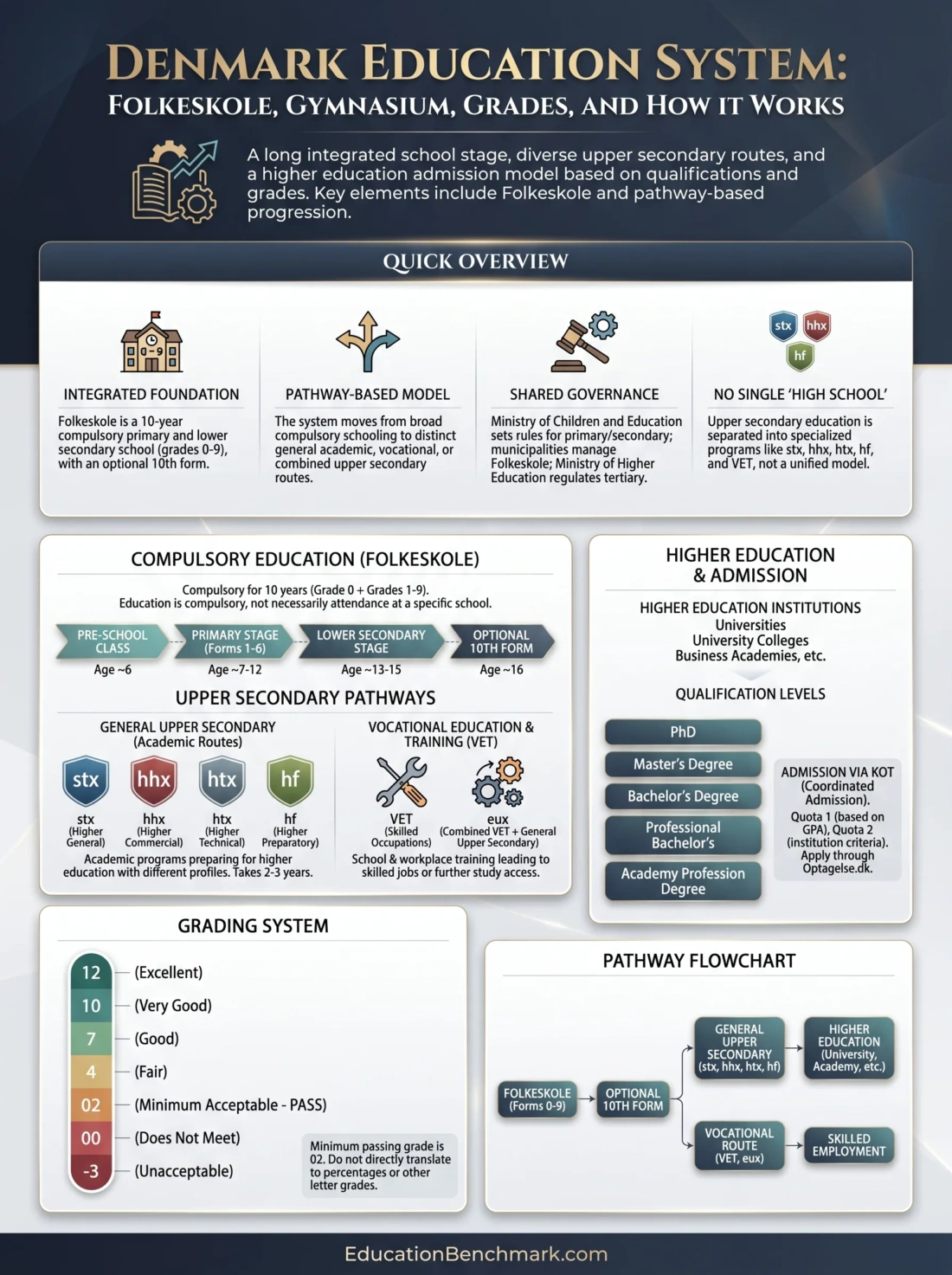
Denmark’s Folkeskole-to-Study Route
A route through integrated compulsory schooling, four gymnasial programmes, vocational training, Danish grades, and coordinated higher-education admission.
Folkeskole
Selected stamp: Folkeskole. Choose another stamp to update the route card.
Denmark’s education system keeps most children in a common school structure for considerably longer than systems that divide pupils into separate academic and vocational schools during early secondary education. Compulsory education covers ten years, beginning with grade 0 and continuing through grade 9, while the municipal Folkeskole normally combines primary and lower secondary education within one institutional route. Schooling itself is not the only legal way to meet the requirement: approved private schooling and home education can also fulfil compulsory education standards.[a]
The major branching point comes near the end of Folkeskole. Students may continue into one of four general upper-secondary programmes, enter vocational education and training, take an optional tenth year, or use a preparatory route before deciding. Denmark therefore does not have one single “high school diploma.” It has several qualifications with different subject profiles, study rights, and links to employment.
Governance stack
Who Controls Danish Schools?
National legislation creates a common framework, but municipalities and self-governing institutions shape much of the local delivery.
The Ministry of Children and Education sets the broad framework for Folkeskole, general upper-secondary education, vocational programmes, curriculum objectives, and national assessment requirements.
Municipal councils organise public compulsory schools, determine local service levels, allocate resources, and set additional priorities within national law.
Schools and teachers translate national objectives into teaching practice. Gymnasial and vocational institutions commonly operate as state-supported, self-governing institutions.
Higher-education authorities regulate degree frameworks and coordinated admission, while institutions set programme content and many specific entry requirements.
The academic year generally runs from August or September to June. Although national rules support continuity across Denmark, municipality-level decisions can affect school organisation, class structures, optional provision, support services, and the practical experience of attending a particular Folkeskole.[b]
Common school route
Folkeskole From Grade 0 to Grade 9
The age ranges below are typical rather than absolute. School-start postponement, early entry, repetition, migration, and individual circumstances can shift them.
| Stage | Danish term or grades | Typical age | Position in the route |
|---|---|---|---|
| Early childhood provision | Dagtilbud | Before school entry | Childcare and preschool provision before compulsory school; it is not grade 0. |
| Preschool class | Børnehaveklasse, grade 0 | About 6 | The first compulsory school year and the bridge into subject-based schooling. |
| Primary years | Folkeskole grades 1–6 | About 7–12 | A common curriculum develops literacy, mathematics, languages, sciences, practical subjects, and social learning. |
| Lower secondary years | Folkeskole grades 7–9 | About 13–15 or 16 | Subject choices, educational guidance, grades, and school-leaving examinations become more important. |
| Optional transition year | 10. klasse | About 16 | An additional year used to strengthen preparation, reconsider choices, or meet route requirements. |
| General upper secondary | STX, HHX, HTX, or HF | Usually 16–19 | Separate programmes prepare students for different areas of higher education. |
| Vocational upper secondary | EUD or EUX | Usually from 16 | School teaching and workplace training lead toward skilled employment and possible further study. |
The term Folkeskole can refer both to Denmark’s municipal public-school system as a whole and to an individual municipal school. It should not be translated simply as “primary school,” because it includes preschool class, primary education, and lower secondary education.
There is also no general structural break equivalent to moving from a separate elementary school into a nationally standardised middle school. A pupil may change building or school locally, but the formal public route remains part of the integrated Folkeskole framework.
School-leaving transition
What the Folkeskole Final Examination Actually Does
Denmark uses school-leaving examinations, but not a single national placement contest that assigns every pupil to an upper-secondary institution.
Schools document academic progress and discuss the pupil’s intended education route during the later Folkeskole years.
Compulsory examinations are completed before pupils leave the ordinary ninth-form route, with national rules governing examination standards.
Completion, examination participation, grades, subject preparation, and other statutory conditions may affect entry to a chosen programme.
Applicants who have not taken required examinations or do not follow the ordinary route may face an individual assessment or admission test.
Written examinations operate under common national arrangements, while subjects are assessed separately. The results create an academic record and can matter for eligibility, but they are not added together to produce a nationwide rank that automatically places every student into a particular secondary school.[c]
This distinction matters. A student does not simply “pass the ninth-grade exam” and receive unrestricted access to every later programme. The selected upper-secondary route may have its own entry rules, required examinations, grade conditions, or subject expectations.
Gymnasial choice board
Choosing Between STX, HHX, HTX, and HF
“Gymnasium” is often used loosely in English, but Denmark has four distinct national general upper-secondary programmes.
Almen studentereksamen Three years Broad general and academic education across humanities, social sciences, languages, and natural sciences. Universities, university colleges, business academies, and other higher-education institutions, subject to requirements.
Højere handelseksamen Three years Business economics, international economics, marketing, languages, and other general subjects. Business, economics, language, communication, and other higher-education fields where requirements are met.
Højere teknisk eksamen Three years Technology, natural sciences, mathematics, technical subjects, and project-based applications. Engineering, technology, science, design, and other academic or professional programmes.
Højere forberedelseseksamen Two years General education with a stronger connection to professional fields and shorter-cycle or professional higher education. Business academies and university colleges; university entry may require an extended subject package or supplementation.
STX, HHX, and HTX normally admit students after nine years of basic schooling and completion of the required Folkeskole final examination. HF normally follows ten years of basic schooling and has its own examination requirements. All four programmes prepare students for further education, but their subject structures are not interchangeable.[d]
A programme name alone does not determine university eligibility. Danish upper-secondary subjects are taught at defined levels, commonly identified as A, B, or C. A student may hold a valid upper-secondary qualification yet still lack the mathematics, science, language, or other subject level required by a particular degree.
In everyday use, gymnasium may refer broadly to general upper-secondary education or more narrowly to an STX institution. HHX and HTX are equally recognised gymnasial programmes, but they have different profiles. HF is shorter and has a distinct progression pattern.
Viewed as a whole, the Danish route is better understood as a branching qualification system than as a ladder built around one decisive national entrance examination. The common Folkeskole foundation leads into several academic, vocational, and preparatory options that retain different possibilities for later progression.[e]
Skilled and preparatory routes
EUD, EUX, Apprenticeships, and FGU
Vocational education is not simply a lower academic tier. It is a regulated qualification route built around occupational learning and workplace training.
Students develop general, technical, and occupation-related knowledge before or alongside progression into the main vocational stage.
Many programmes alternate vocational-college periods with practical training in an approved enterprise.
Completion leads to a recognised skilled qualification, often documented by a journeyman’s certificate or field-specific credential.
EUX combines vocational training with general upper-secondary subjects, supporting both skilled employment and substantial higher-education access.
Admission to vocational education normally requires completion of compulsory education and sufficient results in Danish and mathematics, or an appropriate training agreement with an enterprise. Exact structures differ because the occupational fields, required school periods, workplace components, and final examinations are designed for different trades.[f]
When FGU Sits Between School and a Youth Programme
Forberedende grunduddannelse, usually shortened to FGU, is intended for young people under 25 who are not yet ready to move directly into upper-secondary education, vocational training, or stable employment. It is not a standard compulsory-school year and should not be confused with 10th form.
FGU may last up to two years and combines general, practical, and production-oriented learning. Its purpose is progression: students work toward the academic, personal, and practical readiness needed for vocational education, general upper secondary education, or employment.[g]
Assessment decoder
Reading the Danish 7-Point Grading Scale
The scale is numerical, but it is not a continuous zero-to-twelve scale. Several familiar numbers do not exist as official grades.
| Grade | Status | Performance description | Approximate ECTS reference |
|---|---|---|---|
| 12 | Pass | Excellent command of the relevant material, with no or only minor weaknesses. | A |
| 10 | Pass | Very good command of most aspects of the material, with minor weaknesses. | B |
| 7 | Pass | Good command of the material, although some weaknesses remain. | C |
| 4 | Pass | Fair command of part of the material, with significant weaknesses. | D |
| 02 | Minimum pass | Performance that meets the minimum requirements for acceptance. | E |
| 00 | Fail | Performance that does not meet the minimum requirements. | Fx |
| −3 | Fail | Performance considered unacceptable in relation to the stated objectives. | F |
The scale has been used across state-regulated education since 2007. The ordinary passing grades are 02, 4, 7, 10, and 12; 00 and −3 are failing results. Pass/fail assessment may also be used, and some vocational qualifications include verbal distinctions on the final certificate.[h]
A grade of 7 is therefore not equivalent to 70 percent, and 02 is not a typographical version of the number 2. The leading zero distinguishes the passing grade 02 from the failing grade 00.
Grade averages matter particularly when demand for a higher-education programme exceeds the available places. However, a strong overall average does not override every subject requirement. A degree may still require, for example, mathematics at a specified upper-secondary level and a minimum result in that subject.
Coordinated admission
From Gymnasium to Quota 1, Quota 2, and KOT
Applications are submitted through a coordinated national system, but the higher-education institutions assess whether applicants meet their programme requirements.
The applicant must hold an acceptable upper-secondary or other approved qualification and satisfy relevant subject and language requirements.
Where admission is restricted, available quota 1 places are offered in descending order of qualifying grade averages.
Institutions may consider tests, interviews, relevant activity, written applications, or other published criteria instead of relying only on the average.
Applicants rank several programmes, and the coordinated system returns the highest preference for which a place can be offered.
Undergraduate applications are normally submitted through Optagelse.dk. Applicants may rank up to eight programmes, while the Coordinated Admission system, known as KOT, prevents multiple simultaneous offers by allocating the highest possible preference.
Quota 1 uses the grade-point average from the qualifying upper-secondary examination. Quota 2 uses criteria published by the individual institution and may include qualifications beyond that average. Some programmes also use admission tests, interviews, portfolios, or other forms of selection. Application deadlines differ according to the applicant’s qualification, quota, and route, so current dates must be checked rather than assumed from a previous admission year.[i]
A student with an STX diploma applies to four programmes in priority order. The student meets the subject requirements for three. If the grade average is sufficient for the second and fourth choices but not the first, KOT can offer the second choice. The student does not also receive the fourth-choice offer.
Qualification ladder
AP, Professional Bachelor, and University Degrees
Danish higher education includes both research-based university programmes and professionally oriented programmes with structured workplace learning.
| Qualification | Typical scope | Main character | Possible progression |
|---|---|---|---|
| Academy Profession degree | Usually 90–150 ECTS; many are 120 ECTS | Short-cycle, professionally oriented study with a required work-placement component. | Employment or, in relevant fields, a professional bachelor top-up programme. |
| Professional Bachelor’s degree | Usually 180–240 ECTS | Applied higher education combining theory with substantial professional practice. | Employment in a regulated or defined profession and possible relevant postgraduate study. |
| University Bachelor’s degree | 180 ECTS | Research-based first-cycle academic education. | A relevant university master’s programme or graduate employment. |
| University Master’s degree | Usually 120 ECTS | Advanced research-based study building on a relevant bachelor’s degree. | Specialist employment, research activity, or PhD admission where requirements are met. |
| PhD | Normally three years after the qualifying master’s level | Supervised independent research and a publicly defended thesis. | Research, academic work, and highly specialised professional roles. |
An Academy Profession qualification is not merely an incomplete bachelor’s degree. It is a recognised short-cycle professional qualification with its own labour-market purpose. In some fields, graduates can continue through a defined top-up route to a Professional Bachelor’s degree.
Professional Bachelor’s programmes commonly prepare students for fields such as teaching, nursing, social education, engineering, business, and public services. University bachelor’s and master’s degrees are more directly research-based. The qualification type therefore communicates both level and educational orientation.[j]
Provision outside the standard route
Frie Grundskoler, Efterskoler, and International Options
Folkeskole is the mainstream public route, but it is not the only recognised way to complete basic education.
Families should distinguish between legal recognition and practical equivalence. A school may satisfy Danish compulsory-education requirements while following a curriculum that does not lead directly to the same examinations, subject levels, or upper-secondary options as a municipal Folkeskole.
This is particularly important for internationally mobile students. Before enrolling, families should check whether the intended curriculum leads to the Folkeskole examinations, the International Baccalaureate, another foreign qualification, or an institution-specific record—and how that outcome will be assessed by the student’s next school or higher-education provider.
Rules in transition
The Current System and the Planned EPX Reform
The Folkeskole, tenth-form, HF, and upper-secondary descriptions above reflect the system operating in 2026, not the full structure planned for the next decade.
Students currently encounter the established Folkeskole, optional tenth-form, STX, HHX, HTX, HF, EUD, EUX, and FGU routes described in this guide.
Political agreements envisage a new professionally and practically oriented gymnasial programme and a changed institutional landscape from 2030.
The present tenth-form model is planned to be partly integrated into EPX, although some school settings are expected to retain tenth-school-year-style provision.
Families planning education for 2030 or later should verify final legislation, commencement dates, transition arrangements, and local programme availability.
The planned reform should not be described as though EPX already replaced HF or tenth form in 2026. The official reform material places the structural changes in the future and distinguishes the current school route from the intended post-2030 landscape.[k]
Admission thresholds, subject packages, examination combinations, apprenticeship availability, municipal school organisation, international-school recognition, and higher-education requirements can change by year or institution. Important decisions should be checked with the relevant school, municipality, programme provider, admissions authority, or ministry source.
Education Benchmark is an independent informational guide and is not affiliated with any ministry of education, school authority, exam board, university, government agency, or official ranking organization. The explanations here are intended to clarify the structure of the Danish system, not to replace official admissions, placement, qualification-recognition, or legal guidance.
Reference record
Sources and Verification
Official sources are prioritised for rules, qualifications, examinations, grading, governance, and admissions. The independent country source is used as a secondary structural cross-check.
- [a] About the Folkeskole — Used for the Folkeskole structure, compulsory education, optional tenth form, and recognised alternatives to municipal schooling. (Reliable because it is an official Danish Ministry of Children and Education source.)
- [b] General organisation and administration — Used for governance, municipal responsibility, institutional organisation, funding roles, and the academic-year framework. (Reliable because it is published by the Danish Agency for Higher Education and Science.)
- [c] Examinations and Other Forms of Assessment — Used for Folkeskole school-leaving examinations, compulsory assessment, subject-based results, and national examination arrangements. (Reliable because it is an official Danish Ministry of Children and Education source.)
- [d] About the four Upper Secondary Education Programmes — Used for STX, HHX, HTX, and HF duration, purpose, admission stage, and progression to higher education. (Reliable because it is an official Danish Ministry of Children and Education programme overview.)
- [e] Denmark Education System (2026): Structure, Quality, and Performance — Used as an independent structural cross-check for Denmark’s integrated compulsory route and branching post-Folkeskole pathways. (Useful because it is a country-focused education reference, although official sources remain authoritative for rules.)
- [f] Vocational education and training in Denmark — Used for EUD, EUX, admission requirements, workplace training, adult vocational routes, and vocational qualifications. (Reliable because it is an official Danish Ministry of Children and Education source.)
- [g] Preparatory Basic Education and Training (FGU) — Used for FGU’s target group, maximum duration, preparatory purpose, and intended progression into education or employment. (Reliable because it is an official Danish Ministry of Children and Education source.)
- [h] Grading system — Used for the seven official grades, their performance descriptions, passing threshold, ECTS references, and pass/fail alternatives. (Reliable because it is published by the Danish Agency for Higher Education and Science.)
- [i] The admission system in Denmark — Used for Quota 1, Quota 2, Optagelse.dk, KOT coordination, ranked programme choices, and application deadlines. (Reliable because it is the Danish Agency for Higher Education and Science’s official admissions guidance.)
- [j] Degrees and qualifications — Used for Academy Profession, Professional Bachelor’s, university bachelor’s, master’s, and PhD structures and ECTS ranges. (Reliable because it is the official Danish Agency for Higher Education and Science qualifications reference.)
- [k] Skoleåret efter 9. klasse — Used to distinguish the education system operating in 2026 from planned changes to tenth form and the future EPX landscape. (Reliable because it is an official Danish Ministry of Children and Education reform page.)