UAE School Route Passport
A compact route map of school levels, MOE curriculum routes, assessments, vocational options, and higher education entry points.
KG Route
Selected stamp: KG Route. Choose another stamp to update the route card.
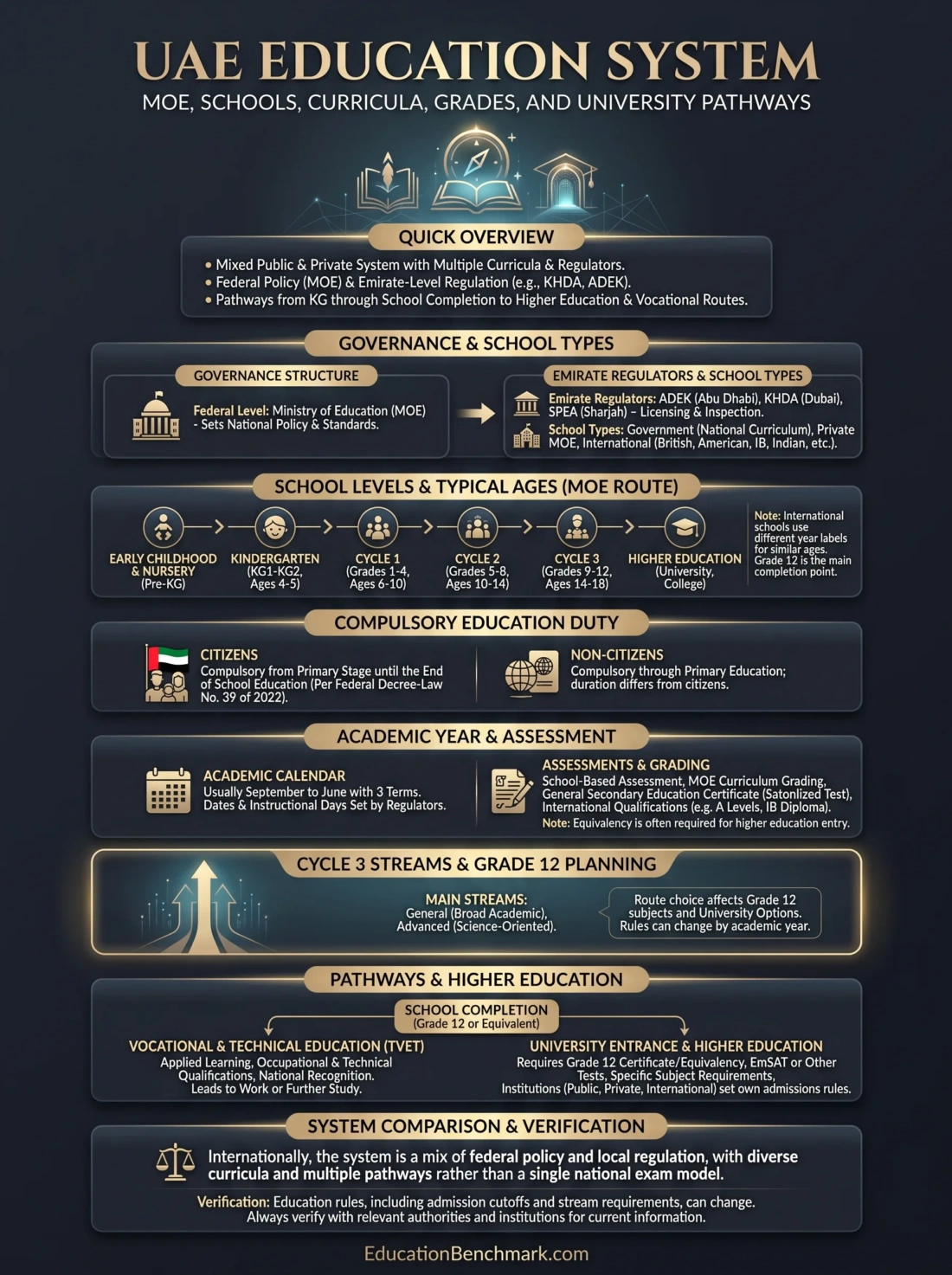
The UAE Education System is a mixed public, private, and international-school system shaped by the Ministry of Education, emirate-level regulators, multiple curricula, and several routes from Kindergarten to Grade 12 and higher education. Its school route is often described through KG, Cycle 1, Cycle 2, and Cycle 3 in Ministry of Education settings, while many private schools use British Year, American Grade, IB, Indian, French, or other curriculum labels.
System route
How the UAE Education System Works
The UAE combines federal education policy with emirate-level regulation and a large private-school sector.
The Ministry of Education sets national education policy, supervises broad education rules, and defines many school-level standards used across the country.
In the MOE route, school education is commonly understood through Kindergarten, Cycle 1, Cycle 2, and Cycle 3. UAE government information describes K-12 education as starting at age 4 and ending at age 17.[a]
Private schools may follow international curricula, but they still operate under UAE and emirate-level requirements for licensing, inspection, and mandatory national subjects.
Students may move from school completion into university, vocational education, technical qualifications, scholarships, or institution-specific admission routes.
School route
School Levels and Typical Ages
The table uses common MOE-cycle wording. International schools may map the same child age to different year names, such as British Year groups or American Grades. For 2026-2027 admissions, the Ministry announced updated KG and Grade 1 cutoff rules for new students.[b]
| School level | Typical age | Typical grade or year | How to read it |
|---|---|---|---|
| Early childhood and nursery | Before KG age | Pre-KG or nursery | This is before the formal KG-to-Grade 12 route and depends heavily on provider type. |
| Kindergarten | About 4-5 | KG1 and KG2 | Pre-primary preparation before Grade 1; cutoff dates should be checked for the relevant admission year. |
| Cycle 1 | About 6-9 or 10 | Usually Grades 1-4 in MOE-cycle wording | Primary foundation years. Some private-school phase maps use different grade boundaries. |
| Cycle 2 | About 10-13 or 14 | Usually Grades 5-8 in MOE-cycle wording | Intermediate years before upper secondary route planning. |
| Cycle 3 | About 14-17 or 18 | Grades 9-12 | Secondary education leading to Grade 12 completion or an equivalent international qualification. |
| Higher education | Usually after Grade 12 | University, college, or applied higher education | Admission depends on Grade 12 results, curriculum, equivalency, tests, and institution rules. |
Table analysis
- The MOE cycle labels are most useful for understanding government schools and schools following the Ministry curriculum.
- Private international schools may use Year 1, Year 2, Grade 1, Grade 2, KG, FS, or other labels for similar ages.
- Grade 12 is the main school-completion point for university and equivalency purposes.
Legal duty
Compulsory Education
Compulsory education in the UAE is not a single simple age sentence for every learner group.
Federal Decree-Law No. 39 of 2022 states that education is compulsory for UAE citizens from the primary stage until the end of school education.[c]
The same law states a different compulsory span for non-citizens, which is why families should avoid relying on a single global summary.
International comparison tables often convert national rules into entrance age and duration variables; Education by Country’s worldwide table lists UAE compulsory education in an age-coded format, but such tables may not capture citizen and non-citizen distinctions.[d]
Calendar and grades
Academic Year and Grade Structure
UAE schools generally operate around a September-to-June academic year, with breaks and minimum instructional-day requirements set through official calendars and regulator rules.[e]
The common UAE academic year starts near the end of summer and ends before the long summer vacation. Exact dates can change by year.
Government guidance describes the academic year through term breaks and school-resumption dates, with public and private schools expected to meet minimum instruction requirements.
A Grade 1 child in one school may be mapped to a different year label in another curriculum. Families comparing schools should compare age, curriculum year, and transfer equivalency together.
Governance
Curriculum and School Governance
The UAE is federal in policy setting, but education regulation is also shaped by local authorities in individual emirates.
The Ministry of Education supervises education at the federal level, while private schools are not directly managed by the ministry in the same way as government schools.[f]
Local authorities such as Abu Dhabi’s Department of Education and Knowledge, Dubai’s Knowledge and Human Development Authority, and Sharjah’s private education authority influence licensing, inspection, and school regulation in their emirates.
Government schools follow the UAE national curriculum, while private schools can offer different curricula but must follow national requirements in areas such as Arabic, Islamic Education where applicable, and social studies.[g]
Assessment route
Main Exams, Qualifications, and Assessments
Assessment in the UAE depends on whether a student follows the MOE curriculum or an international curriculum.
| Assessment or qualification | Who it mainly affects | What it does | Notes for readers |
|---|---|---|---|
| School-based assessment | All schools | Tracks achievement through classwork, tests, projects, and term results. | The balance of formative and summative work differs by curriculum and regulator. |
| MOE curriculum grading | Government schools and private schools following the MOE curriculum | Uses percentage-based subject reporting and cycle-based progression rules. | KHDA’s MOE curriculum guide describes pass marks of 50% for Cycles 1 and 2 and 60% for Cycle 3 in its explanation of reporting and grading.[h] |
| General Secondary Education Certificate | MOE curriculum students completing Grade 12 | Serves as the school-completion credential for the UAE national route. | Certificate equivalency may be required for students from foreign curricula or schools outside the UAE. |
| EmSAT | Students needing national standardized testing evidence | Measures skills against UAE national standards and can be used during transitions and higher education entry. | Requirements depend on university, scholarship, programme, and policy year.[i] |
| International qualifications | Private international-school students | May include A Levels, IB Diploma, AP-related records, CBSE, ICSE, French, German, Philippine, or other curriculum outcomes. | Recognition can require UAE equivalency checks, especially for university or official procedures. |
Table analysis
- The UAE does not have one single school-leaving exam for every curriculum.
- MOE-curriculum students and international-curriculum students may finish Grade 12 with different forms of evidence.
- University admission should be checked at the institution level because test and subject requirements vary by programme.
Grading System
In MOE-curriculum settings, reporting is commonly percentage-based, with subject results, cycle rules, and school records used to decide progression. In international schools, grading depends on the curriculum: British schools may use GCSE, IGCSE, AS, or A Level marks; American-curriculum schools may use letter grades, GPA-style reporting, credits, and transcripts; IB schools use IB subject grades and diploma-point rules.
This is one of the most common points of confusion for families comparing schools. A “Grade 10” report in an American school, a “Year 11” report in a British school, and a Cycle 3 record in an MOE-curriculum school are not always interchangeable without checking age placement, subjects, transfer rules, and equivalency requirements.
School types
Public, Private, and International Schools
The UAE school market is diverse, so school type and curriculum should be read separately.
UAE government information notes that private schools offer different curricula, including International Baccalaureate, British, American, French, German, Indian, Pakistani, and Philippine curricula, among others.[j]
Secondary route
Cycle 3 Streams and Grade 12 Planning
In MOE-curriculum schools, Cycle 3 route planning connects subject choice, Grade 12 requirements, and university options.
The general route supports students moving toward fields such as humanities, business, law, social sciences, arts, and related areas.
The advanced route is designed for students aiming at science-related university majors, including engineering, medicine, pharmacy, and related fields.
The Ministry announced updated educational streams for Cycle 3 students starting from Academic Year 2025-2026, so families should verify the current rules before making subject choices.[k]
Applied learning
Vocational and Technical Education
Technical and vocational education in the UAE sits beside academic schooling and higher education rather than replacing them completely.
Students may pursue training linked to occupations, technical skills, and applied qualifications through recognized providers.
UAE government guidance describes national recognition of TVET awarding bodies and national vocational qualifications.[l]
Applied routes may lead to employment, further technical study, or higher education, depending on the qualification and provider.
After Grade 12
Higher Education and University Entrance
University entrance in the UAE is institutional as well as national: each institution and programme may set its own subject, grade, English-language, EmSAT, or equivalency requirements.
Students usually need a Grade 12 certificate or an equivalent international qualification before entering higher education.
Students from international curricula may need certificate equivalency, especially when moving into UAE higher education or official procedures.
The Commission for Academic Accreditation is the UAE federal quality assurance agency for higher education, licensing higher education institutions and accrediting award-bearing academic programmes.[m]
How This System Compares Internationally
The UAE system is more centralized than highly local systems such as the United States, but it is not a single-curriculum system in practice. Federal rules, emirate regulators, government schools, private schools, and international curricula all shape the student experience.
Compared with systems built around one national school-leaving exam, the UAE is more pathway-based. A student in an MOE-curriculum school, a British school, an IB school, and an Indian curriculum school may all be in the UAE, yet their assessment records and university evidence can look very different. This makes age placement, Grade 12 equivalency, and admission requirements more central than a simple “one exam decides all” model.
Local terms
Common Terms Readers Should Know
These terms appear often when reading about UAE schools, curricula, and student pathways.
What Can Change Over Time
UAE education rules can change through federal ministry decisions, emirate regulator policies, curriculum updates, admission cutoff notices, school inspection requirements, and university admission rules. Cycle 3 streams, EmSAT requirements, Grade 1 admission cutoffs, certificate equivalency rules, and mandatory national-subject requirements are examples of details that should be checked for the exact academic year.
Education Benchmark is an independent informational guide and is not affiliated with any ministry of education, school authority, exam board, university, government agency, or official ranking organization. For school placement, university entry, legal duties, visa-related education matters, or certificate recognition, readers should verify the current rule with the relevant UAE authority, school, university, or official examination body.
Verification
Sources and Verification
These sources were used to verify school stages, compulsory education, curriculum governance, assessments, vocational routes, and higher education recognition.
- [a] Stages and streams of school education — Used for UAE K-12 stage and stream wording. (Reliable because it is published on the official UAE Government portal.)
- [b] UAE announces updated age cut-off date for KG, Grade 1 admissions starting AY 2026-2027 — Used for admission-age cutoff context. (Reliable because it is an official Ministry of Education announcement.)
- [c] Federal Decree by Law Concerning Compulsory Education — Used for the legal distinction between compulsory education for citizens and non-citizens. (Reliable because it is the UAE’s official legislation platform.)
- [d] Compulsory Education Worldwide (2026): Years, Ages, and Enforcement by Country — Used for cross-country compulsory education context and the limits of age-coded comparison tables. (Reliable as a topic-specific education comparison reference that links its data approach to international indicator sources.)
- [e] Academic year — Used for the UAE school-year structure and instruction-day context. (Reliable because it is published on the official UAE Government portal.)
- [f] Regulatory authorities of K-12 education — Used for federal and emirate-level governance roles. (Reliable because it is an official UAE Government education page.)
- [g] Curricula and language of instruction — Used for national curriculum and language-of-instruction information. (Reliable because it is an official UAE Government education page.)
- [h] UAE Ministry of Education Curriculum — Used for MOE-curriculum grading and cycle explanation. (Reliable because KHDA is Dubai’s official private education regulator.)
- [i] EmSAT-The Emirates Standardized Test — Used for EmSAT’s purpose and role in transitions and higher education entry contexts. (Reliable because it is the official EmSAT page of the Ministry of Education.)
- [j] Private schools in the UAE — Used for private-school governance and curriculum diversity. (Reliable because it is published on the official UAE Government portal.)
- [k] MoE announces updated educational streams for Cycle 3 students starting from Academic Year 2025-2026 — Used for Cycle 3 stream updates and secondary-route planning. (Reliable because it is an official Ministry of Education announcement.)
- [l] Technical and Vocational Education (TVET) — Used for TVET recognition and vocational qualification context. (Reliable because it is published on the official UAE Government portal.)
- [m] About Us — Used for the Commission for Academic Accreditation’s role in UAE higher education quality assurance. (Reliable because it is the official CAA website.)