China School Route Passport
Follow the nine-year compulsory base, the locally managed Zhongkao transition, and the academic or vocational routes leading toward tertiary study.
Senior High Transition
Selected stamp: Senior High Transition. Choose another stamp to update the route card.
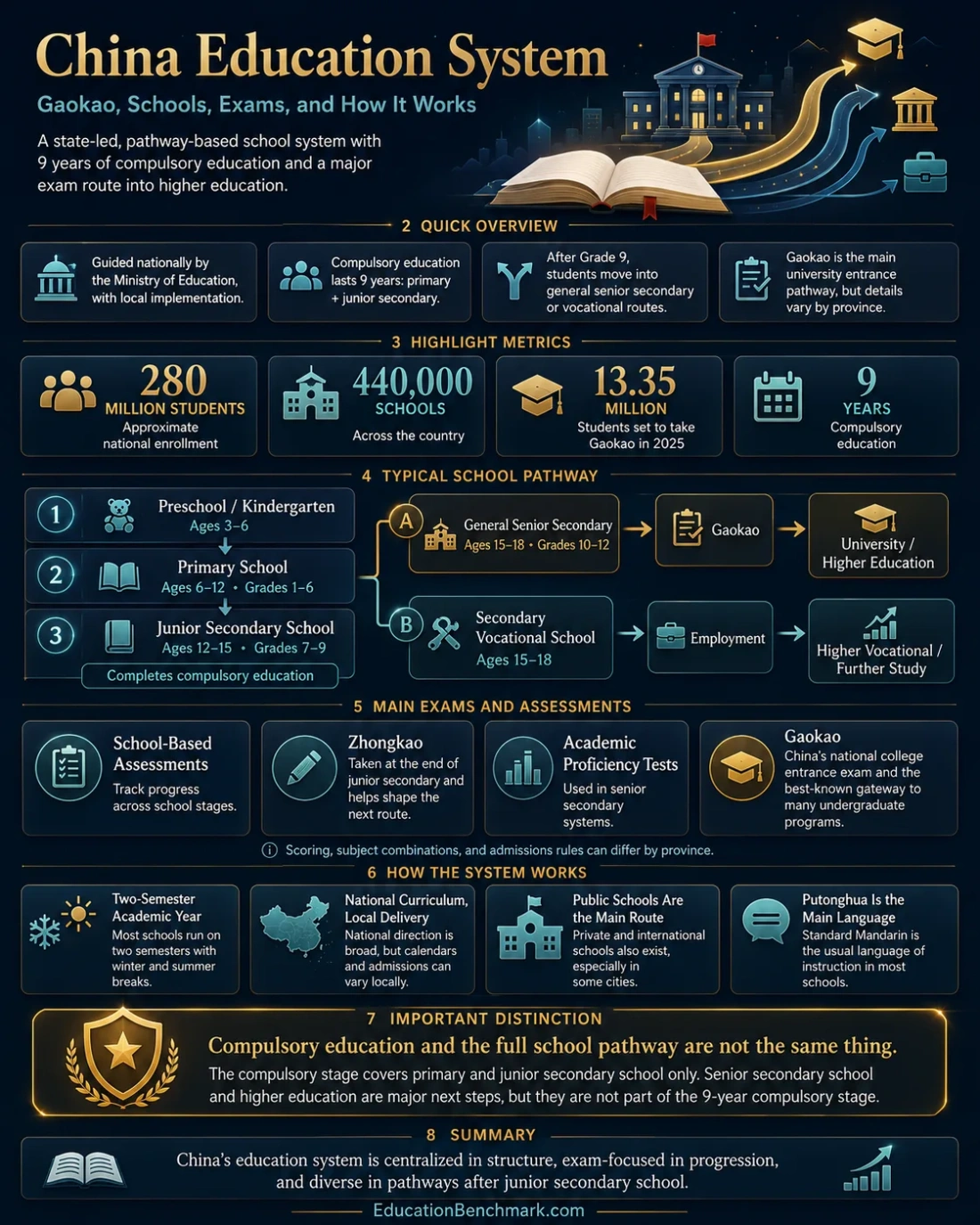
China’s education system has a common national legal base, yet students do not experience every transition through one identical national process. Primary school and junior secondary school form nine years of compulsory education, while senior secondary placement, examination details, and tertiary admission are administered through provincial and local arrangements. The result is a system that is centrally directed but locally operated at several decisive points.[a]
Common foundation
Nine Years Form the Shared School Base
The compulsory route normally joins primary school and junior secondary school before students encounter upper-secondary selection.
The ordinary pattern is six years of primary education followed by three years of junior secondary education.
Local rules determine enrollment dates, documentation, catchment arrangements, and any permitted delay in entry.
Students may continue in general senior high school, secondary vocational education, or another locally recognized option.
Preschool sits before this compulsory base, and senior secondary education sits after it. That distinction matters because a twelve-year school sequence is common, but only the primary and junior secondary portion is the nationwide compulsory entitlement. China’s route also includes academic, vocational, and continuing forms of education rather than one school-to-university line.[b]
Grade 9 decision point
The Zhongkao Transition Is Local, Not One National Paper
Zhongkao is a common name for the senior high school entrance examination or related junior secondary academic proficiency process.
Grade 9 students complete local academic proficiency and graduation requirements.
Scores, preferences, school plans, quotas, and local policy are combined during placement.
The curriculum is oriented toward upper-secondary graduation and tertiary admission.
Programs combine general education with occupational or technical preparation.
The name is familiar across China, but the operational details belong to local education systems. A city or province may decide which subjects count, how physical education or practical components are treated, how school preferences are submitted, and how different student groups enter the admission process. Shanghai’s published rules, for instance, refer directly to the senior high school entrance examination as zhongkao and show that placement procedures depend on district policy, results, and preferences.[c]
Zhongkao does not create one permanent national cutoff. Admission thresholds depend on locality, year, school capacity, route, and applicant category.
Tertiary selection
Gaokao: National Coordination, Provincial Admission Logic
Gaokao is the best-known university entrance route, but a score alone does not explain the final placement.
- Subject plan: students follow the examination model used in their provincial-level region and meet subject requirements connected to intended majors.
- Examination: Chinese, mathematics, and a foreign language remain central, while elective structures and score treatment vary under different reform models.
- Provincial position: applicants are considered within a province-level admission system, where score distribution and rank affect realistic choices.
- Preferences: candidates submit combinations of institutions and majors under locally published application rules.
- Placement: universities admit through quotas, subject conditions, preference order, and other authorized criteria.
Reformed Gaokao models give students more subject choice than the older fixed arts-versus-science split, though the exact model is not uniform across every region. Some places use a “3+3” structure; many use “3+1+2.” The practical reading is simple: families must check the provincial examination authority’s subject rules well before the final year because a chosen subject combination can affect eligibility for particular university majors.
Gaokao is also not the only authorized admission channel. Separate routes may apply to higher vocational institutions, selected talent programs, arts or sports applicants, recommended students, and institution-specific procedures allowed by national and provincial policy. Ministry of Education guidance for 2025 continued the revised examination system and called for closer attention to academic competency, reasoning, and broader student development.[d]
Stage map
Primary, Junior Secondary, and Senior Secondary Ages
Ages are typical rather than universal because enrollment dates, five-year primary arrangements, transfers, and local policy can shift the pattern.
| Stage | Typical age | Usual duration | Compulsory status | Main next step |
|---|---|---|---|---|
| Preschool or kindergarten | About 3–5/6 | Often 3 years | Not part of nine-year compulsory education | Primary school entry |
| Primary school, xiaoxue | About 6–12 | Usually 6 years | Yes | Junior secondary school |
| Junior secondary, chuzhong | About 12–15 | Usually 3 years | Yes | Zhongkao-related transition |
| General senior high, putong gaozhong | About 15–18 | Usually 3 years | No | Gaokao or another tertiary route |
| Secondary vocational education, zhongzhi | Often 15–18 | Commonly 3 years | No | Employment or further vocational and degree study |
Official descriptions commonly present a twelve-year primary-and-secondary sequence, divided into primary, junior secondary, and senior secondary stages. They also note that a minority of schools use five-year primary or four-year junior secondary patterns. The school year is normally divided into two semesters, with local education authorities publishing exact calendars.[e]
Responsibility map
Who Sets Rules and Who Runs Schools
National direction and local delivery operate together rather than as separate systems.
Set broad policy, laws, curriculum standards, degree rules, examination direction, and national education priorities.
Translate national rules into examination plans, admissions procedures, funding arrangements, teacher policy, and regional implementation.
Manage school enrollment, catchment arrangements, staffing, facilities, local assessment, and day-to-day administration.
Deliver courses, assess students, apply admissions rules, and operate within the authority granted to their institution type.
The Ministry of Education describes its role as national guidance and coordination across compulsory, vocational, higher, and other fields of education. Local authorities carry much of the operational work, which is why exam timetables, enrollment documents, school catchments, subject combinations, and admission procedures must be checked at the provincial or municipal level.[f]
Learning and assessment
National Curriculum Standards Meet Local Assessment
China uses national curriculum plans and subject standards to define the broad content and aims of compulsory education. The 2022 revision covered 16 subjects and adjusted how areas such as science, labor education, and information technology appear across the compulsory years. Schools and local authorities then organize teaching, textbooks, timetables, classroom assessment, and permitted local content within that national direction.[g]
Student progress is not represented by one nationwide grading label. Schools may use numerical marks, achievement levels, comments, semester examinations, practical assessments, and locally required records. In junior secondary education, the academic proficiency examination can serve both graduation and senior-high admission purposes. Its subjects and score use vary.
Senior High Academic Proficiency
General senior high schools combine required courses, selective courses, and academic proficiency examinations. Under Gaokao reform, elective subjects connect school study with later examination choices. Graduation and university admission remain different decisions: a student may satisfy school completion rules but still need the required exam profile, score, and provincial application result for a particular tertiary program.
National high-school reform guidance links new curricula and textbooks with student course choice, Gaokao subject selection, and broader evaluation in college admissions. That makes senior high school more than a three-year preparation course for one test, even though the test remains highly influential.[h]
Upper-secondary branches
Putong Gaozhong and Zhongzhi Lead to Different Routes
The academic and vocational branches have different teaching priorities, but both can connect to further study.
General senior high school emphasizes academic subjects, course choice, school proficiency assessments, and Gaokao preparation.
Students apply through Gaokao or another approved channel, subject to local eligibility and institution requirements.
Secondary vocational schools combine general learning with programs related to technical, service, industrial, or occupational fields.
Progression can continue through higher vocational colleges, applied programs, and authorized degree routes.
The vocational branch includes several school and institution types rather than one uniform program. Course names, workplace learning, certificates, and progression arrangements depend on the field and locality. The Ministry of Education’s vocational program catalogue covers secondary vocational schools, higher vocational colleges, and bachelor-degree-awarding vocational institutions, showing that vocational study is organized across more than one education level.[i]
Tertiary progression
From Gaozhi and Zhuanke to Benke and Graduate Study
China’s tertiary sector contains academic and applied institutions, short-cycle programs, bachelor study, and postgraduate degrees.
Programs focus on applied and occupational fields and may support employment or later progression.
Bachelor-level study is offered by authorized universities and other higher education institutions.
Some short-cycle graduates compete for transfer or upgrading routes into bachelor-level study under provincial rules.
Graduate entry depends on degree background, examinations, institutional selection, and program requirements.
Higher education is subject to unified national guidance, while provincial governments and institutions hold defined administrative responsibilities. The legal structure recognizes different levels and forms of tertiary education, so “university admission” should not be used as a synonym for every post-secondary route.[j]
A candidate’s usable choices can depend on provincial rank, selected Gaokao subjects, university quotas, major prerequisites, preference order, health standards for certain fields, and that year’s published admission plan.
School provision
Public, Private, and International-Curriculum Options
School labels do not remove local admissions rules, licensing requirements, or student eligibility conditions.
Private education is legally permitted, and current regulation allows non-state organizations and individuals to operate private schools under the applicable approval and supervision system.[k] International provision is more locally specific. Shanghai’s official guidance distinguishes international schools for expatriate children, international divisions of local schools, and ordinary public or private schools.[l]
Verification
Where Official Details May Vary
Several parts of the Chinese education route can change by province, municipality, district, institution, student category, and admission year. These include school-entry dates, catchment documents, Zhongkao subjects, physical education scoring, Gaokao subject models, converted scores, preference submission, university quotas, vocational progression, and rules for children moving between education systems.
- Use the provincial education examination authority for current Zhongkao and Gaokao rules.
- Use the local education bureau for compulsory-school enrollment, transfer, and residence requirements.
- Use the target university or college for major prerequisites, admission plans, and qualification details.
- Use the school and its supervising authority to confirm licensing, curriculum, student status, and recognized leaving documents.
Education Benchmark is an independent informational guide and is not affiliated with any ministry of education, school authority, exam board, university, government agency, or official ranking organization. Important study and admission decisions should be checked against the responsible official body because published rules can be revised.
Reference record
Sources and Verification
- [a] Compulsory Education Law of the People’s Republic of China — Used for the legal nine-year compulsory education base and government responsibility. (Reliable because it is an official Ministry of Education legal text.)
- [b] China Education System (2026): Structure, Quality, and Performance — Used to cross-check the overall route from compulsory schooling through academic and vocational tertiary study. (Reliable as a current country education profile that cites official and international data sources.)
- [c] How to Enroll Your Children in a Senior High School in Changning — Used for the local meaning of Zhongkao and the relationship between results, preferences, and district placement. (Reliable because it is an official Shanghai government education page based on district education bureau rules.)
- [d] MOE Introduces Measures to Strengthen 2025 College Enrollment — Used for the current direction of Gaokao reform and college enrollment policy. (Reliable because it is an official Ministry of Education release.)
- [e] Primary and Secondary Education in China — Used for stage duration, typical progression, semester structure, and local variation in primary and secondary schooling. (Reliable because it is published by a Beijing district government portal and sourced from the Beijing government.)
- [f] What We Do — Used for the Ministry of Education’s national responsibilities across compulsory, vocational, and higher education. (Reliable because it is the ministry’s official description of its functions.)
- [g] MOE Releases Compulsory Education Curriculum Program and Standards — Used for the 2022 compulsory curriculum revision and its coverage of national subjects. (Reliable because it is an official Ministry of Education curriculum release.)
- [h] State Council Issues Guidelines for Reform of High School Education — Used for senior-high curriculum, course choice, academic proficiency, and the connection with Gaokao reform. (Reliable because it is an official State Council policy release.)
- [i] MOE Publishes Catalogue of Vocational School Programs — Used for the multi-level organization of secondary, higher, and bachelor-level vocational programs. (Reliable because it is an official Ministry of Education program catalogue announcement.)
- [j] Higher Education Law of the People’s Republic of China — Used for national and provincial responsibilities and the recognized forms of higher education. (Reliable because it is an official Ministry of Education legal text.)
- [k] Private Education to Be Promoted — Used for the legal position and regulation of privately operated schools. (Reliable because it reports a State Council regulation on private education.)
- [l] How to Enroll Children in a Shanghai School — Used to distinguish local public or private schools, international divisions, and schools for expatriate children. (Reliable because it is an official Shanghai government education service page.)