Brazil School Route Passport
Follow the route from compulsory preschool through ensino médio, technical study, ENEM, and Brazil’s main higher-education access channels.
Pré-Escola
Selected stamp: Pré-Escola. Choose another stamp to update the route card.
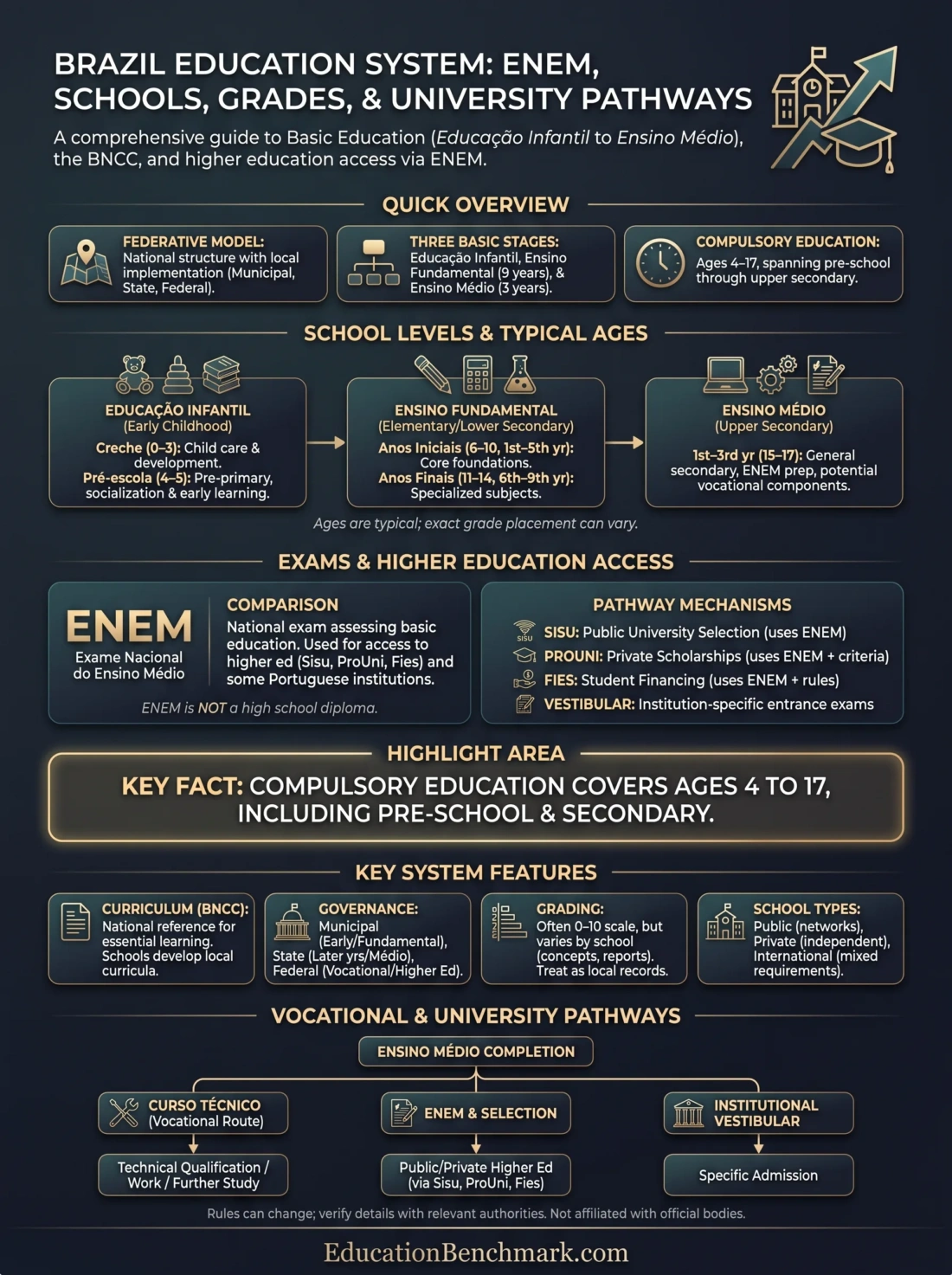
Brazil’s education system combines national law and curriculum references with delivery by states, municipalities, the Federal District, and individual institutions. The normal route moves from educação infantil to nine years of ensino fundamental and then ensino médio. ENEM sits near the end of that route, but it is not a national high-school diploma and does not place every candidate through one universal admission list.
Governance stack
Who Sets School Rules in Brazil
Brazil uses a collaborative system: federal law establishes the legal structure, while subnational systems organize much of the day-to-day provision.
The federal level sets national education law, coordinates policy, maintains national examinations, and supports national curriculum references.
State systems operate many public schools, especially at upper-secondary level, and publish curricula, calendars, assessment rules, and pathway offers.
Municipal systems commonly carry much of the responsibility for educação infantil and ensino fundamental, though local arrangements differ.
The Lei de Diretrizes e Bases da Educação Nacional, usually called the LDB, defines the main stages of education, allocates responsibilities among education systems, and sets broad rules for school organization and assessment. It also leaves room for systems and schools to set local procedures, which is why calendars, report-card scales, promotion rules, and available programmes are not identical across Brazil. [a]
School sequence
From Pré-Escola to Ensino Médio
Compulsory enrolment begins in pré-escola for children who meet the official age cutoff, while creche remains an earlier, non-compulsory part of educação infantil. [b]
| Brazilian stage | Typical age or years | Compulsory status | What the stage does |
|---|---|---|---|
| Creche | About ages 0–3 | Not compulsory | Early childhood care and education before compulsory preschool. |
| Pré-escola | About ages 4–5 | Compulsory | The compulsory preschool phase of educação infantil. |
| Ensino fundamental — anos iniciais | Years 1–5; often about ages 6–10 | Compulsory | Introduces formal literacy, numeracy, and the wider basic curriculum. |
| Ensino fundamental — anos finais | Years 6–9; often about ages 11–14 | Compulsory | Completes the nine-year fundamental stage and prepares students for upper secondary. |
| Ensino médio | Three years; often about ages 15–17 | Within the compulsory age span | Completes basic education and connects to ENEM, technical study, work, or higher education. |
Brazil’s legal compulsory-education span covers ages four through seventeen. International datasets often express this as a fourteen-year statutory duration and a theoretical exit age of eighteen because the exit measure adds duration to the entry age; national law is more naturally read as education being compulsory for people aged 4–17. [c]
Birth-date cutoffs, interrupted schooling, repetition, acceleration, youth and adult education, migration, and local enrolment decisions can place a student outside the typical age shown.
Upper-secondary transition
What Changed in Ensino Médio From 2025
Brazil began implementing the upper-secondary model established by Law No. 14,945/2024 from the 2025 school year, with state systems applying the transition to their own curricula and cohorts.
Regular ensino médio has at least 2,400 hours of general basic formation within a minimum 3,000-hour programme.
At least 600 hours are assigned to pathway study, subject to what the education system and school can offer.
Technical pathways may use a different balance between general formation and occupational preparation.
The reform does not make every school offer the same menu. State networks decide how to distribute subjects, pathways, timetables, and technical opportunities within national rules. Students entering different cohorts can therefore encounter transition arrangements rather than one fully uniform model across the country. [d]
Curriculum and records
BNCC, Local Curricula, and School Assessment
The Base Nacional Comum Curricular (BNCC) is the national reference for the learning expected across basic education. It does not function as a single daily syllabus sent unchanged to every classroom. States, municipalities, the Federal District, school networks, and schools translate the national reference into curricula, teaching plans, materials, and local learning sequences. [e]
This shared-reference model explains two features that can seem contradictory. Brazilian students study nationally defined areas and competencies, yet their timetable, elective options, grading scale, recovery process, and report-card format may differ by network or school. A transfer between states or between public and private schools may require the receiving school to map completed subjects and records rather than simply copy a national transcript format.
In English, grade may mean a school year or a mark. Brazilian school years are usually described as ano or série, while marks may appear as numbers, concepts, percentages, or other scales set by the responsible system.
National examination
ENEM Is an Admission Tool, Not the School Route Itself
The Exame Nacional do Ensino Médio evaluates learning at the end of basic education and has been used as a higher-education access mechanism since 2009.
ENEM is open to people who have completed or are completing ensino médio for higher-education access. Students who have not yet completed the stage may sit as treineiros, meaning their results are used for self-assessment rather than regular admission in that cycle. The examination is administered over two days and includes 180 objective questions plus an argumentative essay. [f]
The objective scores use Teoria de Resposta ao Item (TRI), or item response theory. A candidate’s result is therefore not a simple count of correct answers: the model also considers the statistical characteristics of the items and the response pattern. The essay is scored separately. Universities and programmes may then apply their own weights, minimums, and eligibility rules to these score components. [g]
Admissions decision map
From ENEM to Sisu, Prouni, and Fies
The same ENEM result can enter different systems, but the outcome, institution type, and financial effect are not the same.
Sisu brings together undergraduate places offered by public institutions that join the relevant selection process. [h]
Prouni offers full or partial scholarships for eligible students in participating non-free higher-education institutions. [i]
Fies finances eligible study in participating private higher-education courses with positive quality evaluation. [j]
These are separate application processes. A course offered through Sisu is a public-institution place; a Prouni award is a scholarship; and Fies is financing rather than a scholarship. Each cycle publishes its own calendar, eligible ENEM editions, documentation rules, score conditions, and social or quota criteria.
Sisu also does not replace every university admission process. Only institutions and places included in the relevant offer appear there. Public and private institutions may run their own vestibular, use ENEM scores directly, combine both methods, or set course-specific stages. Applicants must read the institution’s notice even when ENEM supplies the score.
Academic–technical routes
Integrated, Concomitant, and Subsequent Technical Study
Educação Profissional e Tecnológica (EPT) is not one single school type. At upper-secondary level, a technical course can be connected to ensino médio in three common ways. The names describe when the technical qualification is taken in relation to the general upper-secondary programme. [k]
- Integrada: the student follows one coordinated programme that combines ensino médio and technical education, usually under one integrated curriculum.
- Concomitante: the student takes ensino médio and a technical course at the same time, sometimes through separate enrolments or institutions.
- Subsequente: the student begins the technical course after completing ensino médio.
Federal Institutes, state technical networks, public training centres, and private providers may offer EPT. Admission can involve school records, a local selection process, available places, or other institutional criteria. Completing a technical qualification can support direct entry to work, but it does not close the university route; a graduate may still take ENEM or another higher-education selection process.
Tertiary progression
Bacharelado, Licenciatura, and Tecnólogo Routes
Brazilian undergraduate education includes three main degree forms. A bacharelado provides broad professional or disciplinary preparation; a licenciatura prepares graduates for teaching in basic education; and a curso superior de tecnologia leads to the higher-education qualification commonly called tecnólogo. All are undergraduate routes, although their purpose and usual duration differ. [l]
Higher-education institutions include public federal, state, and municipal providers as well as private institutions. Admission rules are course-specific. Competitive programmes may use weighted ENEM areas, separate examinations, quota categories, document checks, or later calls from waiting lists. A general description of the system cannot replace the current notice issued by the institution or programme.
Records and mobility
Reading Brazilian School Records and Transfers
Families moving between Brazilian systems should expect the receiving school to examine the student’s histórico escolar, completed year or series, subjects, attendance, and promotion status. A report card alone may not contain every item required for transfer. Schools can also ask for identification, proof of residence, previous enrolment documents, and translated or authenticated records for study completed abroad.
There is no single nationwide mark format that makes every transcript immediately equivalent. Because education systems and schools set local assessment procedures, a receiving institution may need to interpret the scale, workload, completed subjects, and promotion decision shown on the record.
Enrolment cutoffs, school assignment, uniforms, daily schedules, language support, grading, recovery study, elective availability, and technical-course admission can differ by state, municipality, network, and institution.
Reference trail
Sources and Verification
Education Benchmark is an independent informational guide and is not affiliated with any ministry of education, school authority, exam board, university, government agency, or official ranking organization. Education laws, ENEM notices, Sisu participation, scholarship and financing conditions, curricula, and institutional admissions can change. Decisions should be checked against the current official notice from the responsible school, education system, institution, Inep, or Ministry of Education.
- [a] Law No. 9,394/1996 — National Education Guidelines and Bases Law — Used for the legal stages, collaborative governance, school organization, and broad assessment rules. (Reliable because it is the official federal legislation text.)
- [b] Compulsory preschool enrolment age — Used for the age-four enrolment rule and the compulsory status of pré-escola. (Reliable because it is an official Ministry of Education information page.)
- [c] Compulsory Education Worldwide (2026): Years, Ages, and Enforcement by Country — Used to explain the internationally coded duration and theoretical exit-age convention for Brazil. (Reliable for this purpose because the page states its variables, data treatment, and cross-country coding method.)
- [d] Política Nacional de Ensino Médio — Used for the post-2024 upper-secondary workload and pathway structure. (Reliable because it is the Ministry of Education’s policy page for ensino médio.)
- [e] Base Nacional Comum Curricular (BNCC) — Used for the national curriculum reference and its relationship to education systems. (Reliable because it is an official Ministry of Education and National Education Council page.)
- [f] Enem — Inep — Used for ENEM’s purpose, participants, two-day format, four objective areas, 180 questions, essay, and links to higher education. (Reliable because Inep administers ENEM.)
- [g] Metodologia usada para correção define notas máxima e mínima — Used for the TRI method applied to ENEM objective scores. (Reliable because it is an official Inep explanation of ENEM scoring.)
- [h] Sistema de Seleção Unificada — Used for Sisu’s role in offering places from participating public higher-education institutions. (Reliable because it is the official Ministry of Education Sisu page.)
- [i] Programa Universidade para Todos (Prouni) — Used for the distinction between full and partial scholarships in participating non-free institutions. (Reliable because it is the official Ministry of Education programme page.)
- [j] Fies — Used for the programme’s student-financing role in eligible private higher-education courses. (Reliable because it is the official Ministry of Education programme page.)
- [k] Referência Metodológica — Educação Profissional e Tecnológica — Used for the integrated, concomitant, and subsequent technical-education categories. (Reliable because it is an official Ministry of Education methodology page.)
- [l] Bacharelado, licenciatura, and technology degrees — Used for the main undergraduate degree categories and their purposes. (Reliable because it is an official Ministry of Education higher-education information page.)