Mexico School Route Passport
Follow the SEP-regulated route from educación básica through Mexico’s upper-secondary branches and institution-led entry into higher education.
Educación Básica
Selected stamp: Educación Básica. Choose another stamp to update the route card.
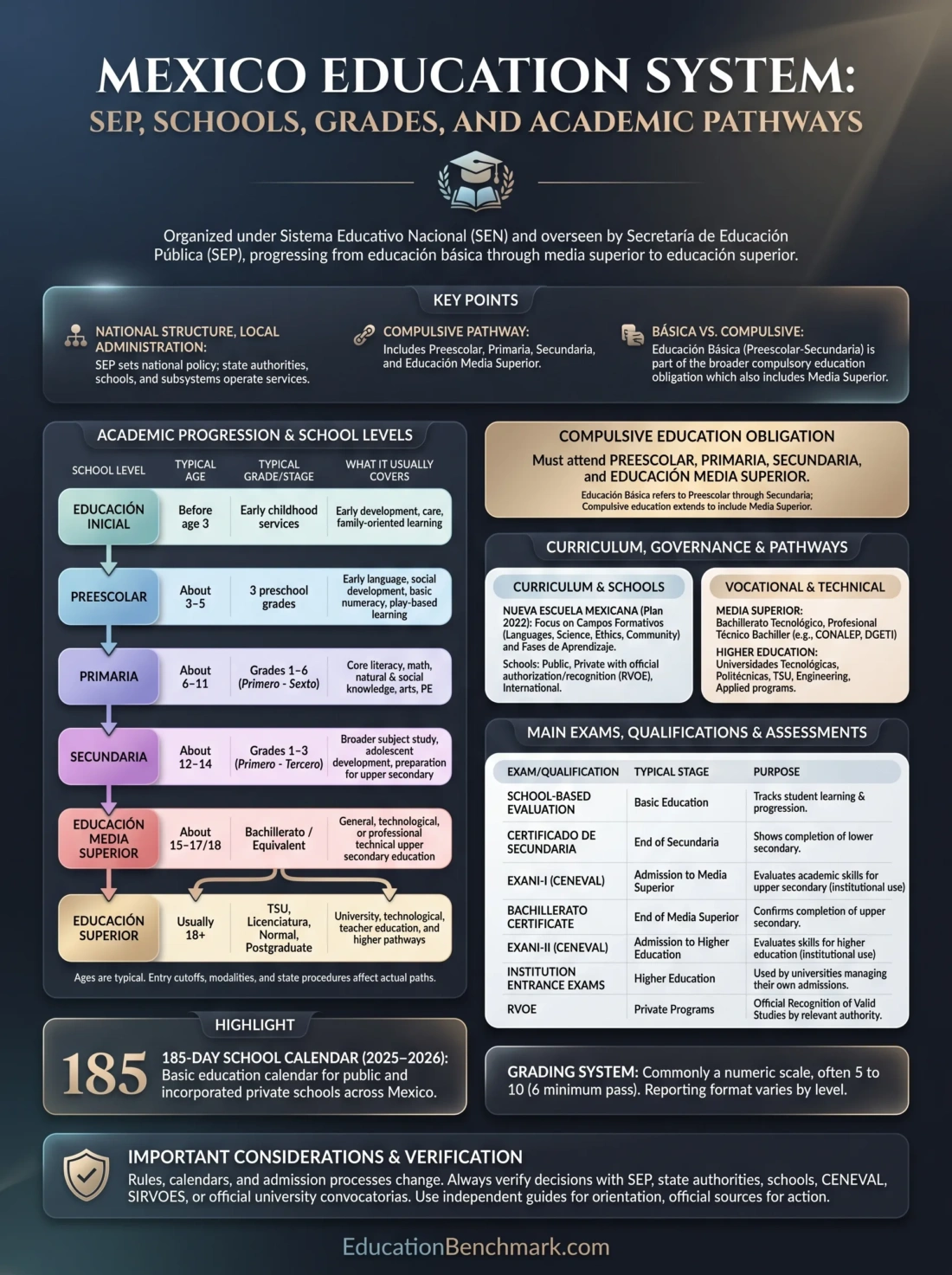
Mexico’s education system follows a nationally defined sequence, but it is delivered through a large network of federal, state, autonomous, community, and private institutions. The Secretaría de Educación Pública (SEP) identifies three broad types: educación básica, educación media superior, and educación superior. Basic education contains preescolar, primaria, and secundaria; upper-secondary education includes bachillerato and equivalent professional routes; higher education begins after bachillerato or an equivalent qualification.[a]
The usual student path is easy to recognize: three years of preschool, six years of primary school, three years of lower secondary school, and commonly three years of upper-secondary study. The difficult part is the branching. After secundaria, students encounter many subsystems, school operators, technical specialties, and admission procedures. At university level, institutions set their own entry rules rather than following one national examination for every programme.
Governance stack
SEP, States, and the Shared National School Route
National rules create a common structure, while state authorities and individual institutions shape much of the day-to-day experience.
The federal authority determines basic education plans and programmes, issues national rules, and coordinates the Sistema Educativo Nacional.
State education authorities manage schools, staff, enrolment processes, calendars within national rules, and local implementation across 32 federal entities.
Upper-secondary subsystems and autonomous universities can set provider-specific programmes, admissions, internal assessment, and academic procedures.
The Ley General de Educación distributes responsibilities across the federation, the states, Mexico City, and municipalities, while preserving federal authority over the national basic education curriculum. It also defines preescolar, primaria, secundaria, and educación media superior as compulsory levels. Educación inicial is recognized as a right of early childhood, while higher education carries a state obligation that is implemented under separate legal provisions and available capacity.[b]
This arrangement means that Mexico is neither fully centralized nor a collection of unrelated state systems. A student in Oaxaca, Nuevo León, or Mexico City encounters the same national level names and basic curricular direction, yet school availability, language support, admission procedures, technical programmes, and local administration can differ.
School sequence
From Preescolar to Secundaria: The 3–6–3 Route
Ages are typical for students progressing on time. Entry cut-off dates and individual placement can alter the age shown in a classroom.
| Level | Grades or years | Typical ages | Main transition |
|---|---|---|---|
| Preescolar | 1st to 3rd year | About 3–5 | Entry to primaria |
| Primaria | Grades 1–6 | About 6–11 | Primary certificate and entry to secundaria |
| Secundaria | Grades 1–3 | About 12–14 | Certificado de secundaria and upper-secondary application |
| Educación media superior | Usually 3 years | About 15–17 | Bachillerato or equivalent certificate |
The law defines compulsory education through levels rather than a single simple school-leaving age. For international comparison, Education by Country’s 2026 table codes Mexico with an official entrance age of 3 and a 14-year compulsory span, producing a theoretical exit age of 17. That coding is useful for comparison, but Mexican enrolment and completion decisions should still be checked against the current law, state rules, and the student’s actual grade placement.[c]
What “Secundaria” Means in Mexico
Secundaria is the final three-year level of educación básica. It is closer to lower secondary or junior high school than to the entire secondary stage. The next level, educación media superior, is commonly called preparatoria, prepa, or bachillerato.
Nueva Escuela Mexicana
How Fases 2–6 Reshape Basic Education
Mexico’s 2022 plan keeps familiar grades, but groups learning across phases that span preescolar, primaria, and secundaria.
The Plan de Estudio para la Educación Preescolar, Primaria y Secundaria 2022 is national and compulsory for these levels. It organizes content through four campos formativos: Lenguajes; Saberes y Pensamiento Científico; Ética, Naturaleza y Sociedades; and De lo Humano y lo Comunitario. It also uses cross-cutting ejes articuladores such as inclusion, critical thinking, interculturality, gender equality, healthy living, reading and writing cultures, and arts experiences.[d]
The national plan does not require every school to teach every lesson in an identical local form. Teachers and school teams develop a programa analítico that contextualizes national content for the community, territory, language, and student group. This local codiseño is one reason classroom projects can look different even when schools follow the same SEP plan.
Assessment records
Grades, Promotion, and School Certificates
Basic education uses national assessment and certification rules, while upper-secondary and higher education institutions apply their own detailed regulations.
| Stage | How results appear | Promotion or completion point |
|---|---|---|
| Preescolar | Qualitative observations and suggestions rather than numeric marks | Accreditation is based on having completed the corresponding grade |
| Primaria grades 1–2 | Whole-number marks from 6 to 10 with formative observations | Grade 1 is completion-based; grade 2 requires a minimum final average of 6 |
| Primaria grades 3–6 | Whole-number marks from 5 to 10; 6 to 10 are passing | A minimum final average of 6 applies, together with grade-specific accreditation rules |
| Secundaria | Disciplines are marked from 5 to 10; 6 to 10 are passing | Regularization is possible for limited non-accredited disciplines; completion leads to certification |
Under Acuerdo 10/09/23, assessment is intended to support teaching decisions as well as formal reporting. Preschool remains non-numeric. Primary grades 1–2 use whole-number results from 6 to 10, while grades 3–6 use 5 to 10, with 6 as the passing threshold. Secondary disciplines also use 5 to 10, with 6 to 10 passing. Students with a limited number of non-accredited disciplines may use regularization procedures, while those with five or more at the end of the cycle can be required to repeat the grade.[e]
Certificates mark the end of primary and secondary levels, but a certificate is not the same as a competitive admission result. A student may complete secundaria and still need to follow a local allocation, provider application, or entrance procedure for a preferred upper-secondary school. Upper-secondary grading rules also vary among subsystems, so a 0–10 or 5–10 institutional scale should not automatically be assumed from the basic education rule.
Decision after secundaria
Bachillerato General, Tecnológico, and CONALEP Routes
The main decision is not simply “academic or vocational.” Several upper-secondary options combine general education, technical preparation, and later access to higher education.
Emphasizes broad upper-secondary study and preparation for admission to a university, technological institute, teacher education institution, or other tertiary provider.
Combines upper-secondary academic learning with a technological specialty, allowing progression toward work or higher education after completion.
Links the shared bachillerato curriculum to occupational training, with CONALEP as the best-known national provider of this qualification.
Mexico’s upper-secondary system has long contained many subsystems. A 2025 federal agreement established the Sistema Nacional de Bachillerato de la Nueva Escuela Mexicana (SINBANEM) to organize shared national principles and recognition. Within that current structure, Bachillerato General and Bachillerato Tecnológico remain central options, delivered through school-based, mixed, and other authorized modalities.[f]
CONALEP’s Profesional Técnico-Bachiller programmes illustrate the mixed character of vocational education in Mexico. Students do not simply leave academic study behind. They complete upper-secondary learning while training in a named technical field. The national 2026–2027 offer includes careers across administration, health, industrial production, information technology, transport, tourism, energy, and newer technical areas, but the list available at a particular campus is narrower.[g]
Transfer Is Possible, but Not Automatic
A bachillerato certificate or equivalent can support higher education entry, yet institutions may require a particular subject background, admission score, prerequisite, or document format. Transfers between upper-secondary subsystems depend on recognized studies, available places, and the receiving school’s rules.
Admission logic
Why Mexico Has No Single National University Entrance Exam
Higher education admission belongs mainly to institutions and their individual programmes, not to one compulsory national placement test.
Large autonomous universities and other providers can publish separate calls, examination formats, cut scores, and programme quotas.
EXANI-II is an admission support instrument contracted by participating institutions; applicants cannot treat it as a universal national application.
An institution may also consider the bachillerato record, prerequisite subjects, interviews, portfolios, language evidence, or additional assessments.
Ceneval describes EXANI-II as an instrument for applicants seeking entry to higher education at institutions that have contracted its services. The institution—not the individual applicant—organizes registration and communicates dates, locations, cost, and delivery mode. This makes EXANI-II widely recognizable without making it compulsory for every Mexican university applicant.[h]
Higher education includes Técnico Superior Universitario (TSU) or professional associate routes, licenciatura degrees, teacher education, specializations, master’s degrees, and doctorates. Public autonomous universities, state universities, federal institutions, technological and polytechnic universities, teacher-training schools, and private institutions all operate within the wider national system. The Ley General de Educación Superior sets shared principles, but institutional autonomy and programme-level rules remain important.[i]
Provision across communities
General, Technical, Telesecundaria, Indigenous, and Private Schools
The level name may be national, but the form of schooling can reflect population density, language, provider, and local access.
SEP’s basic education offer includes general, Indigenous, community, and distance-supported services designed for different populations and locations. The presence of a national curriculum does not erase Mexico’s linguistic and territorial diversity, so the school format available in a rural community may differ from the standard urban model.[j]
For private higher education, official validity must be checked at programme level. An RVOE applies to a particular plan of study, not automatically to every programme advertised by the same institution. A school can therefore hold valid recognition for one degree and not for another. Federal and state RVOE records have equal validity within the national system when properly granted.[k]
Calendar, Language, and Regional Variation
The basic education year normally begins in late August or early September and ends in July, with official dates published for each cycle. The SEP calendar for 2026–2027 sets 185 instructional days for public schools and private schools incorporated into the Sistema Educativo Nacional.[l] Upper-secondary institutions, universities, and schools using non-standard calendars may publish different schedules.
Spanish is the main language of instruction across the system, but Mexico is multilingual. Indigenous education, bilingual programmes, intercultural universities, border-region provision, and private international schools can use additional languages. The label “bilingual” does not guarantee the same balance of languages, staffing, or curriculum in every school.
Regional variation appears most strongly in access and implementation: available upper-secondary subsystems, technical specialties, travel distance, Indigenous-language services, public university capacity, and admission procedures. National documents define the route; the student’s real options are determined by the institutions operating nearby and the rules published for that cycle.
Terminology decoder
Mexican Education Terms That Change the Route
Verification Before Enrolment or Application
Rules that deserve direct checking include age cut-offs, state registration dates, school catchment, admission examinations, document legalization, transfer equivalence, upper-secondary allocation, programme validity, fees, and university selection criteria. These details can change by cycle and may differ between two institutions using the same broad qualification name.
Education Benchmark is an independent informational guide and is not affiliated with any ministry of education, school authority, exam board, university, government agency, or official ranking organization. For a decision affecting enrolment, certification, transfer, or admission, the current notice from SEP, the relevant state authority, and the receiving school or university should take priority.
Sources and Verification
- [a] Conoce el Sistema Educativo Nacional — Used for the three main education types and their component levels. (Reliable because it is an official SEP system overview.)
- [b] Ley General de Educación — Used for compulsory levels, governance duties, and federal-state responsibilities. (Reliable because it is the current federal education law published by Mexico’s Chamber of Deputies.)
- [c] Compulsory Education Worldwide (2026): Years, Ages, and Enforcement by Country — Used for the internationally coded entrance age, duration, and theoretical exit age comparison. (Useful as a specialist cross-country education reference that identifies its international data basis.)
- [d] Plan de Estudio para la Educación Preescolar, Primaria y Secundaria 2022 — Used for Fases 2–6, campos formativos, ejes articuladores, and local codiseño. (Reliable because it is the official national basic education plan.)
- [e] Acuerdo número 10/09/23 — Used for basic education evaluation, grading, accreditation, promotion, regularization, and certification. (Reliable because it is an official SEP agreement reproduced by DGAIR.)
- [f] Acuerdo número 22/08/25 por el que se establece y regula el Sistema Nacional de Bachillerato de la Nueva Escuela Mexicana — Used for the current national organization of bachillerato and its principal options. (Reliable because it is an official federal upper-secondary agreement.)
- [g] Catálogo de la Oferta Educativa Nacional 2026–2027 — Used for current CONALEP Profesional Técnico-Bachiller fields and campus-level variation. (Reliable because it is CONALEP’s official national programme catalogue.)
- [h] Nivel Superior EXANI II — Used to explain the purpose of EXANI-II and the role of participating institutions. (Reliable because Ceneval administers the examination.)
- [i] Ley General de Educación Superior — Used for higher education levels, institutions, autonomy, and national legal principles. (Reliable because it is Mexico’s federal higher education law.)
- [j] Oferta Educativa para Educación Básica — Used for basic education modalities serving different communities and learner groups. (Reliable because it is an official SEP service overview.)
- [k] Reconocimientos de validez oficial de estudios del tipo superior: Preguntas frecuentes — Used for programme-specific RVOE rules and federal-state recognition. (Reliable because it is SEP’s official higher education validity system.)
- [l] Calendario Escolar 2026–2027 — Used for the 185-day basic education calendar and its national scope. (Reliable because it is SEP’s official current school calendar.)