
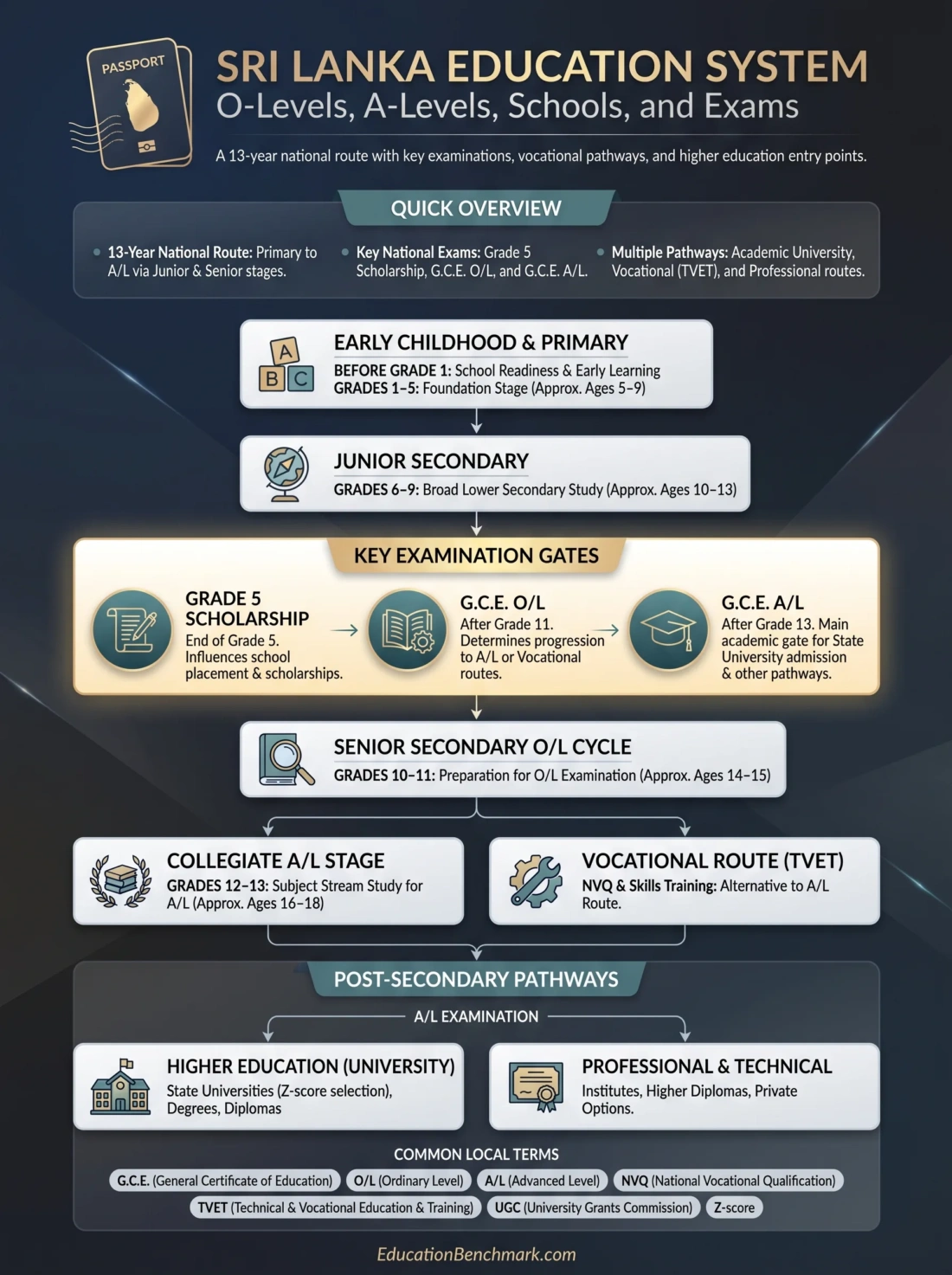
Sri Lanka School Route Passport
A compact route map of school levels, Grade 5 Scholarship, G.C.E. O/L, G.C.E. A/L, vocational options, and higher education entry points.
Early Childhood
Selected stamp: Early Childhood. Choose another stamp to update the route card.
The Sri Lanka education system is built around a 13-year general education route, with primary school, junior secondary school, the G.C.E. Ordinary Level, the G.C.E. Advanced Level, and separate vocational and higher education pathways. For many readers, the hardest part is not the list of grades; it is understanding how Grade 5 Scholarship, O-Levels, A-Levels, school types, and university admission connect in practice.
System structure
How the Sri Lanka Education System Works
Sri Lanka combines a national school route with national examinations and several post-secondary options.
The mainstream route moves from primary education to junior secondary, then to senior secondary O/L study and the collegiate A/L stage.
Grade 5 Scholarship, G.C.E. O/L, and G.C.E. A/L are the main national school examinations readers usually need to understand.
Curriculum, examinations, and university admission are nationally shaped, while school type, language medium, and available streams differ by school.
After O/L and A/L, students may continue toward university, technical education, vocational training, diplomas, or employment-linked routes.
UNESCO’s Sri Lanka education profile maps the national system from early childhood and pre-primary education through primary, lower secondary, upper secondary, post-secondary non-tertiary, and tertiary education. It also shows the broad age progression from primary entry at about age 5 through the end of secondary schooling. [a]
School route
School Levels and Typical Ages
Age ranges are typical for on-time progression. Individual students may be slightly older or younger because of entry timing, transfers, exam repetition, or school decisions.
| School level | Typical age | Typical grade or stage | What it means |
|---|---|---|---|
| Early childhood and pre-primary | About 3–4, with the year before Grade 1 especially relevant | Before Grade 1 | School readiness, early learning, and preparation before formal primary education. |
| Primary education | About 5–9 | Grades 1–5 | Foundation stage ending with the Grade 5 Scholarship Examination option. |
| Junior secondary education | About 10–13 | Grades 6–9 | Broad lower secondary study before the O/L preparation cycle. |
| Senior secondary O/L cycle | About 14–15 | Grades 10–11 | Preparation for the G.C.E. Ordinary Level examination. |
| Collegiate or A/L stage | About 16–17 or 18 | Grades 12–13 | Subject stream study leading to the G.C.E. Advanced Level examination. |
| Post-secondary and tertiary education | Usually after secondary school | Diploma, degree, professional, or technical route | University, higher diploma, technical, vocational, and professional study options. |
Table analysis
- The O/L and A/L stages are not separate school systems; they sit inside the secondary route.
- Grade 5 Scholarship is a transition-related exam, not a school-leaving certificate.
- A/L study usually follows O/L results and subject stream selection.
Attendance requirement
Compulsory Education
Compulsory education is best read as a legal attendance span, while school progression is usually described by grades and examinations.
Internationally coded data lists Sri Lanka with an official compulsory entrance age of 5.
The cross-country compulsory education table lists Sri Lanka with 11 years of compulsory schooling.
The same dataset gives a theoretical exit age of 16, calculated from entry age plus duration.
For international comparison, Education by Country’s compulsory education table lists Sri Lanka as entrance age 5, compulsory duration 11 years, and theoretical exit age 16. [c] In practice, families should still check current Ministry and school notices because compulsory education rules, term calendars, and admission procedures may be updated.
Calendar and grades
Academic Year and Grade Structure
The school year is organized through Ministry-issued calendars and term notices, while grade progression follows the Grade 1 to Grade 13 route.
The Ministry’s 2026 school calendar notice shows why readers should avoid assuming a fixed school calendar from older summaries. Term schedules and notices are issued for the relevant year, and schools follow the current official calendar rather than a permanent public-facing date pattern. [h]
Curriculum and delivery
Curriculum and School Governance
Sri Lanka’s school system has national curriculum and examination features, with delivery differences across school categories.
The National Institute of Education is responsible for developing curricula for general education, including primary, secondary, and post-secondary general education.
National school examinations and related certificate services are administered through the Sri Lankan examination authority.
Government schools, assisted private schools, private schools, international schools, and pirivena institutions may differ in control, curriculum route, and language medium.
The National Institute of Education describes itself as the body delegated with curriculum development for national general education, including primary, secondary, and post-secondary general education. [d] That makes NIE a central reference point for understanding curriculum changes, teaching materials, and national education planning.
Exams and qualifications
Main Exams, Qualifications, and Assessments
Sri Lanka’s education route is often explained through its examination points. These exams should not be treated as identical to school levels; they are assessment gates within the route.
| Exam or qualification | Usual point | Main role | What it can affect |
|---|---|---|---|
| Grade 5 Scholarship Examination | End of Grade 5 | Scholarship and school placement-related examination. | Access to selected schools and scholarship support, depending on current rules. |
| G.C.E. Ordinary Level | After Grade 11 | National subject examination at the end of the O/L cycle. | Progression to A/L study, subject stream opportunities, vocational entry, and later course requirements. |
| G.C.E. Advanced Level | After Grade 13 | National advanced subject examination. | State university admission, course eligibility, Z-score-based selection, and other post-secondary routes. |
| NVQ and TVET qualifications | After O/L, after A/L, or as adult training | Skills-based vocational certification and training route. | Employment, technical progression, diploma routes, and skills recognition. |
Table analysis
- O/L is usually the turning point before A/L or vocational decisions.
- A/L is the main academic gate for state university admission.
- TVET routes should be read as parallel options, not only as fallback routes.
The Department of Examinations provides services for Grade 5 Scholarship, G.C.E. O/L, and G.C.E. A/L examinations, including results, certificate-related processes, and rescrutiny services. [e] Exam calendars, subject timetables, and certificate processes should always be checked for the current year.
Marks and grades
Grading System
Sri Lanka uses examination grades in O/L and A/L contexts, while schools and universities may also use their own internal assessment methods.
A is the strongest grade in the national exam scale. S indicates a simple pass. W indicates weak performance or failure in that subject context.
Some later courses or subject routes may require a Credit Pass in a specific O/L subject, such as English, Mathematics, or Science.
State university admission also depends on course rules, approved subjects, attempts, the Common General Paper requirement, Z-score selection, and application procedures.
For the 2025/2026 university admission cycle, the University Grants Commission notice states that eligible candidates should have at least S grades in all three approved A/L subjects in one sitting within the allowed attempts, and a minimum mark of 30% for the Common General Paper. [f] Course-level requirements can be more specific, so the current UGC handbook and university notices matter.
School types
Public, Private, and International Schools
School type can affect governance, curriculum route, language medium, fees, and the exams a student prepares for.
The Ministry’s school census summary classifies government schools by functional type, including 1AB schools with A/L Science streams, 1C schools with A/L streams other than Science, Type 2 schools with classes only up to Grade 11, and Type 3 primary schools. [b] This matters because a student’s school may not offer every grade or A/L stream.
Student pathway
Vocational and Technical Education
Vocational education is part of Sri Lanka’s wider education system and should be read as a skills route with its own institutions and recognition processes.
Students who meet progression requirements may choose A/L streams and continue toward university or other post-secondary study.
Students may enter technical or vocational training through registered providers and NVQ-linked programmes.
Vocational qualifications can support employment, further training, or movement into diploma-level study depending on the qualification and provider.
The Tertiary and Vocational Education Commission describes itself as the apex body for Sri Lanka’s technical and vocational education and training sector, with responsibilities in policy, planning, quality assurance, coordination, and development. [g]
University route
Higher Education and University Entrance
A/L results are central, but university admission is not simply a matter of passing A/L subjects.
State university admission is normally tied to approved A/L subject results and UGC procedures.
University selection depends on course demand, subject stream, Z-score rules, district or national selection where applicable, and the current admission handbook.
Students may also choose technical institutes, higher diplomas, private higher education, professional qualifications, or study abroad routes.
The University Grants Commission is the reference point for Sri Lankan state university admissions. Its admission notices and handbooks should be checked for the relevant academic year because attempts, subject combinations, Common General Paper rules, and online application procedures can change by cycle.
Benchmark view
How This System Compares Internationally
Sri Lanka is best compared by structure, exam timing, and pathway design rather than by broad judgments.
Local terms
Common Terms Readers Should Know
Sri Lankan education terms are often abbreviated. Knowing the local terms makes official notices much easier to read.
Rules and updates
What Can Change Over Time
Sri Lanka’s school route is stable in broad outline, but the details that families rely on can change.
O/L and A/L timetables, application windows, rescrutiny periods, and certificate processes should be checked through current Department of Examinations notices.
Curriculum reforms can be introduced by grade level and phased over time, so older summaries may not match the newest classroom model.
UGC requirements, school admission rules, A/L stream availability, and institutional eligibility rules should be verified before decisions are made.
Recent Ministry communications show that education reforms may be introduced by grade and phased stage by stage. [i] Education Benchmark is an independent informational guide and is not affiliated with any ministry of education, school authority, exam board, university, government agency, or official ranking organization. For school placement, exam registration, university admission, visas, or legal decisions, readers should verify details with the relevant official institution.
Sources and Verification
- [a] SDG 4 – Country Profiles: Sri Lanka — Used for the ISCED view of Sri Lanka’s education structure, broad level mapping, and typical age progression. (Reliable because it is published by the UNESCO Institute for Statistics.)
- [b] Annual School Census of Sri Lanka Summary Report 2025 — Used for government school category definitions such as 1AB, 1C, Type 2, and Type 3. (Reliable because it is a Ministry of Education school census publication.)
- [c] Compulsory Education Worldwide (2026): Years, Ages, and Enforcement by Country — Used for the comparative compulsory education entry age, duration, and theoretical exit age entry for Sri Lanka. (Reliable as an education-system reference table that cites cross-country indicator sources.)
- [d] NIE About Us — Used for the role of the National Institute of Education in curriculum development for general education. (Reliable because it is the official National Institute of Education website.)
- [e] Services – Department of Examinations — Used for the Department of Examinations services connected with Grade 5 Scholarship, G.C.E. O/L, and G.C.E. A/L examinations. (Reliable because it is the official Department of Examinations service page.)
- [f] University Admission – Academic Year 2025/2026 — Used for UGC admission requirements, including A/L subject passes, Common General Paper minimum mark, and online application information. (Reliable because it is an official University Grants Commission admission notice.)
- [g] TVEC | Tertiary and Vocational Education Commission Sri Lanka — Used for the role of TVEC in Sri Lanka’s technical and vocational education and training sector. (Reliable because it is the official Tertiary and Vocational Education Commission website.)
- [h] School Calendar – 2026 — Used to explain why school calendar details should be checked through the current Ministry notice. (Reliable because it is an official Ministry of Education calendar page.)
- [i] In the year 2026, reform is implemented in grades 1 and 6 and priority will be given to it. — Used for the note that curriculum and system reforms may be introduced by grade and phased over time. (Reliable because it is an official Ministry of Education news release.)