
Bangladesh School Route Passport
A compact route map of school levels, SSC and HSC exams, technical routes, and higher education entry points.
Pre-Primary
Selected stamp: Pre-Primary. Choose another stamp to update the route card.
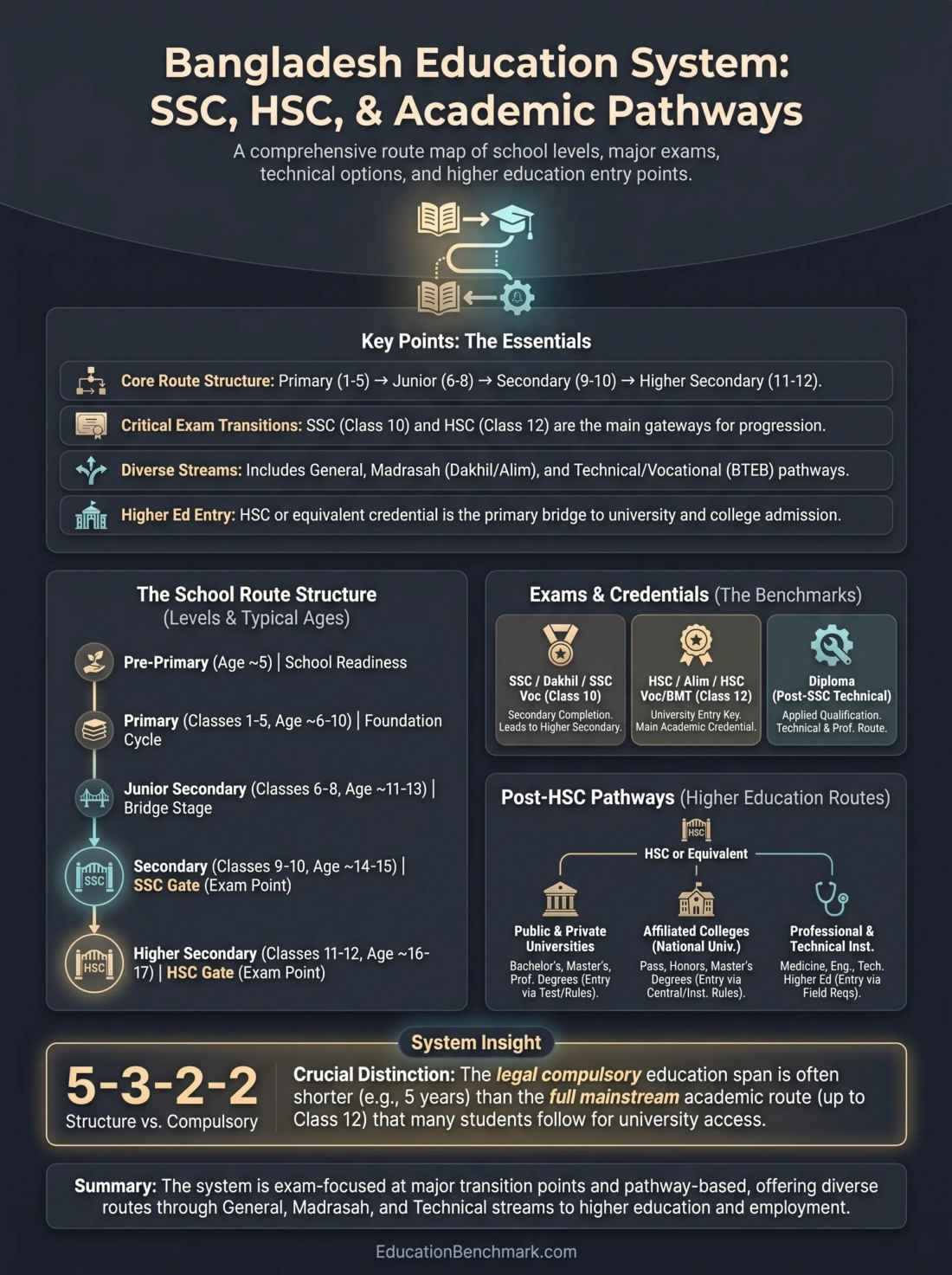
The Bangladesh education system is usually understood through a school route of primary education, junior secondary education, SSC-level secondary education, HSC-level higher secondary education, and higher education. For many readers, the most important points are the Class 10 Secondary School Certificate, the Class 12 Higher Secondary Certificate, the role of education boards, and the difference between general, madrasah, and technical pathways.
Bangladesh uses a national school structure with separate administrative responsibilities across education levels. The Ministry of Primary and Mass Education is connected with primary education, while secondary, higher secondary, technical, madrasah, and higher education involve the Ministry of Education and related bodies. The Directorate of Secondary and Higher Education describes the system as three broad stages: primary, secondary, and higher education, with primary covering Grade I-V and secondary and higher education covering Grade VI and above.[a]
System Structure
How the Bangladesh Education System Works
The school route is national in shape, but students may follow general, madrasah, English-medium, or technical tracks depending on school type and board affiliation.
The familiar academic route runs from primary school through SSC at Class 10 and HSC at Class 12.
Intermediate and secondary education boards, the madrasah board, and the technical board manage major public examination routes.
Students may study in general schools and colleges, Alia madrasahs, technical schools and colleges, or English-medium schools using foreign curricula.
After HSC or equivalent study, students may enter public universities, private universities, National University affiliated colleges, professional colleges, or technical higher education.
School Route
School Levels and Typical Ages
Ages are typical pathway estimates. Actual entry age, repetition, school readiness, transfer rules, and school type can change the route for individual students.
| School level | Typical age | Typical class or year | How it fits the pathway |
|---|---|---|---|
| Pre-primary | About 5 | Before Class 1 | School readiness stage before formal primary education. |
| Primary education | About 6-10 | Classes 1-5 | Foundation cycle for literacy, numeracy, basic science, social learning, and later secondary study. |
| Junior secondary | About 11-13 | Classes 6-8 | Bridge between primary school and the more exam-focused secondary stage. |
| Secondary education | About 14-15 | Classes 9-10 | Leads to the SSC, Dakhil, or vocational equivalent route. |
| Higher secondary education | About 16-17 | Classes 11-12 | Leads to HSC, Alim, HSC vocational, HSC business management and technology, or equivalent credentials. |
| Technical diploma route | Often after SSC or equivalent | Diploma or certificate programme | Applied route through BTEB-affiliated institutions, including diploma-level technical programmes. |
| Higher education | Usually 18+ | Bachelor’s and above | University, affiliated college, professional, open, or technical higher education route. |
Table analysis
- The school route is easiest to read as a 5-3-2-2 structure: five primary years, three junior secondary years, two SSC-level years, and two HSC-level years.
- SSC and HSC are not just exams; they are transition points that shape college, university, and technical choices.
- Technical and madrasah routes sit beside the general route rather than outside the education system.
Compulsory Education in Bangladesh
International law-coded datasets usually list Bangladesh with an official compulsory education entrance age of 6 and a compulsory duration of 5 years, which aligns with the primary cycle rather than the full Class 1-12 route. The Education by Country compulsory education table, based on cross-country law-coded indicators, lists Bangladesh as entrance age 6, compulsory duration 5 years, and theoretical exit age 11.[b]
This distinction matters. Many students continue far beyond the legally compulsory minimum, and the normal academic pathway extends through SSC and HSC. A reader comparing Bangladesh internationally should separate the legal compulsory span from the full mainstream school route.
Calendar and Classes
Academic Year and Grade Structure
Bangladesh school planning is commonly organized by education year, class level, textbook list, and public examination cycle.
Bangladesh usually uses “Class” rather than “Grade” in everyday school language, though international readers may see Grade I-V or Grade 1-5 in translated official descriptions.
NCTB publishes textbook lists by education year, including primary, secondary, and higher secondary materials where applicable.[c]
SSC, HSC, Dakhil, Alim, and vocational exam calendars depend on board instructions and can shift by year.
Curriculum and School Governance
Curriculum and textbook planning in Bangladesh is closely associated with the National Curriculum and Textbook Board, usually shortened to NCTB. Public and government-recognized Bangla-medium schools generally follow the national curriculum route, while English-medium schools often use foreign curricula such as Cambridge or Pearson Edexcel, depending on school registration and examination choices.
School governance is not handled by one office alone. Primary education, secondary schools, higher secondary colleges, technical institutions, madrasahs, and universities connect to different directorates, boards, or commissions. This is why Bangladesh can feel centralized in curriculum and public examinations, yet varied in school type and institutional route.
Exams and Credentials
Main Exams, Qualifications, and Assessments
Bangladesh uses public examinations and equivalent credentials across general, madrasah, and technical pathways.
| Exam or qualification | Usual stage | Main pathway | Typical role |
|---|---|---|---|
| SSC | End of Class 10 | General secondary | Certification for secondary completion and entry to higher secondary study. |
| Dakhil | End of Class 10 equivalent | Madrasah education | Madrasah-route equivalent commonly treated alongside SSC for progression. |
| SSC Vocational | Secondary technical level | Technical and vocational | Applied secondary credential connected to the technical education board route. |
| HSC | End of Class 12 | General higher secondary | Main academic credential for university and college admission. |
| Alim | Class 12 equivalent | Madrasah education | Madrasah-route higher secondary credential used for further study. |
| HSC Vocational or HSC BMT | Higher secondary technical level | Technical and vocational | Applied higher secondary route for technical, business management, or technology-oriented study. |
| Diploma in Engineering and related diplomas | Post-SSC or equivalent technical route | Technical education | Longer applied programme that may lead to employment or further technical higher education. |
Table analysis
- SSC and HSC are the best-known credentials in the general school pathway.
- Dakhil and Alim show how the madrasah route connects to the wider certificate structure.
- Technical routes are not limited to short training; they include secondary, higher secondary, and diploma-level options.
The official online result publication system lists result categories for JSC/JDC, SSC/Dakhil, HSC/Alim, and equivalent examinations.[d] The presence of an older examination category on the result portal does not by itself mean that the examination is part of the current cycle. Families should verify the current board notice for the relevant year rather than relying on an older exam schedule or archived result category.
Grading System
Bangladesh public examination results are commonly reported with letter grades and GPA. At SSC and HSC level, GPA 5.00 is widely understood as the highest common result summary, while failing a subject can affect progression. For university-level study, grading and credit rules can vary by institution, although many universities use letter grades and grade points on transcripts.
Assessment Language
How to Read Grades Without Overreading Them
Results are often discussed through GPA and letter grades, especially for selection into colleges and higher education.
Credit systems, CGPA calculations, and course grading rules may differ between public universities, private universities, and affiliated colleges.
Foreign universities and credential evaluators may interpret Bangladeshi marks, grades, and certificates through their own conversion rules.
Public, Private, Madrasah, and International Schools
Bangladesh has several school types. Public and government-supported schools form the main national route. Private Bangla-medium schools may also follow the national curriculum. Alia madrasahs combine general subjects with religious studies and lead to credentials such as Dakhil and Alim. English-medium schools often prepare students for international examinations rather than SSC and HSC.
School Type Comparison
School Types Compared
Vocational and Technical Education
Technical and vocational education in Bangladesh is mainly associated with the Bangladesh Technical Education Board, usually shortened to BTEB. BTEB lists activities such as prescribing courses, developing learning materials, granting or withdrawing institutional affiliation, setting admission and transfer conditions, regulating examinations, publishing results, and granting diplomas or certificates.[e]
The technical route includes SSC-level vocational education, HSC-level vocational or business management and technology programmes, short courses, and diploma programmes. BTEB’s syllabus and course structure page lists diploma programmes in engineering, agriculture, fisheries, livestock, forestry, textile engineering, health technology and services, as well as HSC vocational and HSC BMT materials.[f]
Student Pathway
Main Routes After SSC or Equivalent
Students enter Classes 11-12 in a college or higher secondary section, often choosing science, humanities, or business studies.
SSC or equivalent results can affect access to preferred institutions and groups.
Students may choose BTEB-linked programmes that focus on applied subjects, technical skills, and occupational preparation.
HSC, Alim, diploma, or equivalent credentials can support later applications, subject to institutional rules.
Higher Education and University Entrance
Higher education in Bangladesh includes public universities, private universities, specialized universities, National University affiliated colleges, Bangladesh Open University, professional colleges, and technical higher education institutions. The University Grants Commission of Bangladesh is the public body connected with university oversight and lists approved universities through official university information channels.[g]
University entrance is not a single national placement process for every institution and subject. Competitive public universities, medical and engineering routes, private universities, affiliated colleges, and professional programmes may use different combinations of HSC or equivalent results, admission tests, subject requirements, and faculty rules. WES describes HSC as a main route into higher education and notes that admission criteria differ by institution and faculty, with entrance examinations common at competitive institutions.[h]
Higher Education Routes
Common Post-HSC Pathways
| Route | Usual entry basis | Typical credential | What to verify |
|---|---|---|---|
| Public university | HSC or equivalent plus admission test or faculty rules | Bachelor’s, honours, professional, master’s, research degree | Admission circular, subject requirements, test format, and seat rules. |
| Private university | HSC or equivalent plus institutional admission rules | Bachelor’s and master’s degrees | UGC approval, programme recognition, tuition, and credit system. |
| National University affiliated college | HSC or equivalent and centralized or institutional rules for the programme | Pass degree, honours degree, master’s degree | College affiliation, programme availability, and current admission notice. |
| Professional college | HSC or equivalent with field-specific requirements | Medicine, dentistry, engineering, law, pharmacy, or other professional awards | Professional council rules, admission tests, internship, and licensing route. |
| Technical higher education | Diploma, HSC, or equivalent depending on programme | Diploma, bachelor’s, or applied professional qualification | BTEB or university recognition, transfer options, and programme duration. |
How This System Compares Internationally
Compared with many systems that make lower secondary education compulsory, Bangladesh has a shorter law-coded compulsory duration in international datasets, while its actual school pathway still extends through Class 12 for students aiming at university entrance. UNESCO’s 2026 GEM country case study reports large gains in completion over time, including primary completion rising from 34% in 1990 to 90% in 2024 and lower secondary completion rising from 23% to 74% over the same period.[i]
Structurally, Bangladesh is exam-focused at major transition points, especially SSC and HSC. It is also pathway-based: general schools, Alia madrasahs, technical schools and colleges, English-medium schools, and higher education institutions may lead to different credentials. A neutral benchmark view should therefore compare Bangladesh by route design, legal compulsory duration, examination pressure, and access to post-secondary options rather than by a single ranking label.
Common Terms Readers Should Know
Local Terms
Bangladesh Education Terms
What Can Change Over Time
Bangladesh’s education rules can change through curriculum revisions, examination instructions, admission circulars, board decisions, and university policies. The Constitution of Bangladesh states that the state shall adopt effective measures for a uniform, mass-oriented and universal education system and for extending free and compulsory education to children to the stage determined by law.[j] The exact operational rules still need to be checked through current official notices.
Education Benchmark is an independent informational guide and is not affiliated with any ministry of education, school authority, exam board, university, government agency, or official ranking organization. For school placement, university admission, equivalency, visa-related education documentation, or legal interpretation, readers should verify details with the relevant official board, institution, ministry, or credential authority.
Sources and Verification
- [a] Directorate of Secondary and Higher Education: History — Used for the broad structure of Bangladesh education, including the division of primary, secondary, and higher education and the Grade I-V / Grade VI and above distinction. (Reliable because it is an official Bangladesh government education directorate source.)
- [b] Compulsory Education Worldwide (2026): Years, Ages, and Enforcement by Country — Used for Bangladesh’s internationally coded compulsory education entrance age, duration, and theoretical exit age. (Reliable for this article because it compiles country-level compulsory education indicators from auditable international data releases.)
- [c] NCTB 2026 Textbook List — Used for the education-year textbook and curriculum materials context. (Reliable because NCTB is the official National Curriculum and Textbook Board of Bangladesh.)
- [d] Web Based Result Publication System for Education Board — Used for the public examination groupings shown by Bangladesh education board result systems, including SSC, Dakhil, HSC, Alim, and equivalent examinations. (Reliable because it is an official result publication platform for education board examinations.)
- [e] Bangladesh Technical Education Board: Activities — Used for BTEB responsibilities such as course prescription, affiliation, examinations, results, and diplomas or certificates. (Reliable because it is an official Bangladesh Technical Education Board page.)
- [f] BTEB Syllabus, Course Structure, and Regulations — Used for examples of technical and vocational programme areas, including diploma, HSC vocational, and HSC BMT routes. (Reliable because it is an official BTEB curriculum and regulation listing.)
- [g] University Grants Commission of Bangladesh — Used for higher education oversight context and official university recognition channels. (Reliable because it is the official website of Bangladesh’s University Grants Commission.)
- [h] WES: Education in Bangladesh — Used for higher education admission context, HSC progression, and institutional differences in admission criteria. (Reliable because WES is a recognized credential evaluation and international education reference organization.)
- [i] UNESCO GEM Report: Bangladesh — Used for international comparison context and reported changes in primary and lower secondary completion over time. (Reliable because UNESCO’s Global Education Monitoring Report is an established international education data source.)
- [j] The Constitution of the People’s Republic of Bangladesh: Article 17 — Used for the constitutional statement on free and compulsory education and the need to verify the legal stage determined by law. (Reliable because it is the official Bangladesh Laws source.)