India School Route Passport
Follow India’s board choices, NEP stages, Class X and XII certificates, open-school options, skill routes, and entrance tests.
Board Choice
Selected stamp: Board Choice. Choose another stamp to update the route card.
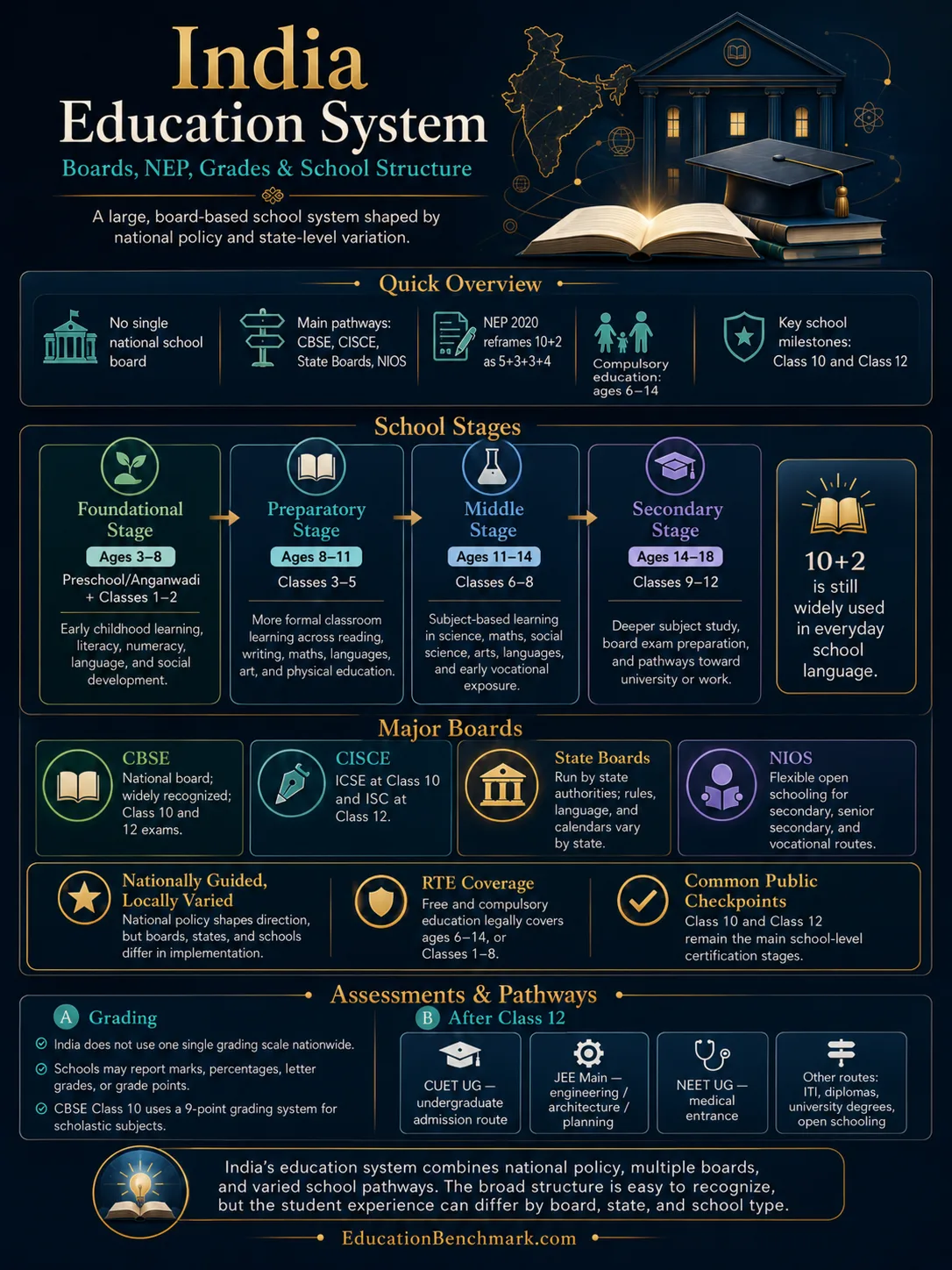
India’s school route is best read through two overlapping maps. The familiar Class I–XII sequence remains the everyday language of schools and certificates, while the National Education Policy 2020 groups learning into Foundational, Preparatory, Middle, and Secondary stages covering ages 3–18. This 5+3+3+4 design changes how the years are organized for curriculum and teaching; it does not make Class numbers disappear. [a]
A second map is administrative. A school may be run by a state government, a local body, a private trust, a central organization, or another provider, while following the syllabus and examination rules of a particular board. Board affiliation and school ownership are related in practice, but they are not the same thing.
Who Sets the Rules: Union, State, Board, and School
Education is shared between the Union and the states. The Right of Children to Free and Compulsory Education Act provides a legal entitlement to elementary education for children aged 6–14, while most schools remain under the control of state governments. [b] This makes India neither a fully centralized school system nor a collection of unrelated state systems.
Governance stack
Four Layers Behind a Student’s School Rules
The rule that matters often depends on which layer controls the issue.
The Ministry of Education sets national policy direction, while central bodies develop curriculum resources, board rules, testing systems, and national programmes within their mandates.
State and Union Territory authorities regulate their school systems, operate or oversee many schools, and set local calendars, recruitment arrangements, language policies, and state-board requirements.
A board defines subject schemes, assessment rules, examination timetables, certificates, and affiliated-school conditions for the students within its system.
The school organizes teaching, timetables, internal assessment, subject availability, fees where applicable, and support services within its legal and affiliation obligations.
What Readers Often Confuse
The RTE age band and the NEP stage design answer different questions. Ages 6–14 describe the central statutory guarantee for free and compulsory elementary education. Ages 3–18 describe the policy’s curricular and pedagogical route, including preschool and senior secondary years.
The 5+3+3+4 Design Beside the Familiar 10+2 Route
The two labels are not rival school systems. 10+2 remains common shorthand for ten years through Class X followed by two senior secondary years. 5+3+3+4 groups preschool and Classes I–XII into age-linked stages so curriculum, teaching, and assessment can be planned around development rather than a single uninterrupted block.
School-stage map
How NEP Stages Correspond to Classes and Ages
The age bands are broad policy ranges. Admission dates, preschool provision, and individual progression can differ.
| NEP stage | Years included | Typical age band | Main route meaning |
|---|---|---|---|
| Foundational | Three preschool years plus Classes I–II | About 3–8 | Early childhood learning joins the first two years of primary school. |
| Preparatory | Classes III–V | About 8–11 | Activity-based learning expands into a broader classroom subject base. |
| Middle | Classes VI–VIII | About 11–14 | Subjects become more distinct, with greater scope for practical and vocational exposure. |
| Secondary | Classes IX–XII | About 14–18 | Two phases cover Class X certification and the Class XI–XII school-leaving route. |
School names do not always mirror these four stage labels. A campus may be described as primary, upper primary, secondary, senior secondary, higher secondary, junior college, or by another state-specific term. The safest way to compare schools is to check the actual classes offered, the affiliated board, and the certificate issued at the end.
Class X and Class XII Are Different Gates
Both years are commonly called “board years,” yet they serve different purposes. Class X generally closes the first secondary phase. Class XII closes senior secondary schooling and is the main school-leaving point used for undergraduate eligibility.
Certificate sequence
From the Class X Decision to the Class XII Qualification
Students complete the board’s secondary subject and assessment scheme. Results may affect admission and subject access for the next route.
Schools offer subject combinations often grouped as Science, Commerce, Humanities, vocational, or mixed programmes, but availability is local.
The board result records subjects and achievement used by universities, colleges, and professional programmes when checking eligibility.
One board’s reform should not be presented as a nationwide rule. For CBSE students, the Class X system from 2026 provides two board examination opportunities: the first examination is mandatory, while the second is limited to eligible improvement and compartment categories under the board’s conditions. [c] State boards, CISCE, NIOS, and other providers follow their own current rules.
CBSE, ICSE/ISC, State Boards, and NIOS Compared
Country-profile libraries are useful for comparing broad national routes, but India requires a board-by-board reading because national and state providers operate side by side. [d] A family comparing schools should identify both the school’s management type and the board named on its affiliation or recognition documents.
Board comparison
What Changes When the Board Changes
These are broad distinctions. Current subject, examination, and admission rules must be checked with the relevant board and school.
“ICSE board” is common informal speech, though ICSE is the Class X examination and CISCE is the Council. ISC refers to the senior secondary examination. Similar shorthand appears across states, where the examination name, board name, and certificate name may not be identical.
Marks, Grades, Promotion, and Subject Choice
India does not use one national grading scale for every school. Percentage marks remain widely used, and boards may also report grades, grade points, qualitative descriptors, or subject-specific practical and internal-assessment scores. A “90%” result and an “A1” grade only make sense when read with the issuing board’s scheme for that examination year.
Promotion before board classes is usually shaped by the school, board, and state rules that apply to the learner. In examination years, written papers may be combined with practicals, projects, oral work, portfolios, or internal assessment. Pass marks, compartment status, improvement attempts, attendance conditions, and rules for replacing a failed subject can differ.
Subject choice becomes more visible after Class X. Science, Commerce, and Humanities are familiar labels, but they are not one nationally fixed set of three boxes. A school may offer Physics, Chemistry, Biology, Mathematics, Economics, Accountancy, Business Studies, History, Political Science, Psychology, Computer Science, arts, languages, or vocational subjects in combinations permitted by its board and timetable. A desired combination may be valid under the board but unavailable at a particular school.
Why Direct Score Comparisons Can Mislead
Boards differ in syllabi, paper design, internal assessment, subject combinations, moderation practices, and reporting. Universities may publish board-neutral percentage thresholds, normalization methods, subject prerequisites, or entrance-test rules rather than assuming every score was produced in the same way.
Routes After Class X: Higher Secondary, ITI, Diploma, or Open Schooling
Classes XI–XII are the most familiar continuation, but they are not the only recognized next step. The route can branch toward academic study, trade training, technical diplomas, or open schooling. Entry requirements and later transfer options need to be checked before treating the branches as interchangeable.
Parallel routes
Four Common Directions After the Secondary Certificate
Students continue toward a senior secondary certificate with board-approved academic, vocational, or mixed subject combinations.
Industrial Training Institutes offer designated trades under national training standards, while states and territories handle much of the administration. [h]
State-regulated diploma programmes can provide applied technical study, with entry level, duration, and later degree-transfer rules varying by programme.
Open schooling can lead to a Class XII-equivalent certificate through a less conventional attendance and examination pattern.
An ITI certificate, a polytechnic diploma, and a Class XII certificate serve different purposes. One may lead directly toward a trade or apprenticeship, another toward technician-level study, and another toward degree eligibility. Later progression can be possible, but it depends on the receiving institution’s recognition and entry rules rather than the route name alone.
From Class XII to CUET, JEE Main, NEET, and Degree Admission
India has no single university entrance test for all subjects and institutions. Admission normally begins with a recognized Class XII or equivalent qualification, required subjects, and any minimum marks specified by the programme. A test score may then become one part of the selection process.
Admission sequence
Match the Course Before Choosing the Entrance Test
The university or programme checks whether the applicant holds an accepted qualification and studied any required subjects.
Central Universities and other participating institutions use CUET-UG, while each university retains its programme eligibility and admission procedures. [i]
Paper 1 supports admission to undergraduate engineering programmes at NITs, IIITs, CFTIs, and other participating institutions, and connects eligible candidates to JEE Advanced. [j]
NEET-UG is the common entrance examination used for undergraduate medical education, followed by the applicable counselling and admission process. [k]
Many programmes sit outside those three routes. States may run entrance tests or centralized counselling; universities may admit by board marks, their own tests, auditions, portfolios, interviews, or mixed criteria. Law, design, agriculture, nursing, teacher education, and other fields can have separate pathways. The correct sequence is always programme first, current eligibility second, test third.
Where State, Language, and School Management Change the Experience
A student’s daily experience can differ even when two schools lead to the same Class XII level. State curricula may give more space to regional history, literature, and language. CBSE or CISCE schools may use different textbooks and examination patterns. English-medium, Hindi-medium, regional-language, bilingual, and multilingual arrangements coexist, and the language used for teaching may differ by subject or class.
- Government schools are operated by public authorities and usually follow the relevant state, territory, or central system.
- Government-aided schools are privately managed but receive public support under rules that differ by jurisdiction.
- Private unaided schools rely mainly on private management and fees while remaining subject to recognition, affiliation, and other applicable requirements.
- Central school systems, including nationally administered school networks, may follow CBSE across several states.
- International-curriculum schools may offer foreign or international qualifications; recognition, equivalence, and Indian university eligibility need separate checking.
The academic year often begins between spring and early summer and ends the following year, but there is no single date for every state and board. Vacation patterns, climate, local festivals, examination schedules, and administrative decisions can shift the calendar.
NEP 2020 Is a Direction, Not One National Timetable
NEP 2020 sets national policy direction for early childhood education, stage-based curriculum, foundational learning, subject flexibility, assessment changes, vocational exposure, multilingual education, and links between school and higher education. Implementation is carried out through governments, boards, regulators, curriculum bodies, institutions, and schools. They do not all change on the same date.
This is why three statements can be true at once: the 5+3+3+4 design is the national policy model; students still speak in terms of Class I to Class XII; and schools continue to use board-specific syllabi and certificates. New textbooks, revised subject schemes, assessment reforms, and changed examination opportunities may reach different classes in different years.
Where Official Details May Vary
A policy announcement does not by itself confirm that a particular school, board, state, or admission cycle has adopted the same operating rule. The applicable circular, examination bulletin, affiliation notice, or university prospectus should carry the decision.
Checking the Rule That Applies to a Student
The most reliable check begins with five identifiers: the state or Union Territory, the school’s management type, the affiliated board, the student’s class and examination year, and the intended next institution or course. These details determine which age rule, syllabus, certificate, entrance test, counselling process, and deadline should be consulted.
- Confirm the board or awarding body named by the school.
- Open the current curriculum, examination, or admission notice for the relevant year.
- Check subject prerequisites before selecting Classes XI–XII combinations.
- Verify whether an entrance test is required for the chosen programme and institution.
- Read the current counselling, recognition, and document rules before making a final decision.
Education Benchmark is an independent informational guide and is not affiliated with any ministry of education, school authority, exam board, university, government agency, or official ranking organization. School rules, board examinations, compulsory-education provisions, curriculum reforms, and admissions procedures can change, so decisions should be checked with the responsible official body.
Sources and Verification
- [a] National Education Policy 2020 — Used for the 5+3+3+4 stage design, age bands, and its relationship with the established 10+2 sequence. (Reliable because it is the official Government of India policy document.)
- [b] Education for Poor — Used for the RTE age range, the concurrent responsibility for education, and state control of most schools. (Reliable because it is an official Government of India parliamentary response.)
- [c] Two Board Examinations in Class X from 2026 – Clarification reg. — Used for the mandatory first CBSE Class X examination and the limited eligibility for the second opportunity. (Reliable because it is an official CBSE examination notification.)
- [d] Countries Library – Education by Country — Used only as a comparative country-guide reference for placing India’s multi-board structure in a wider reading context. (Useful as a dedicated education-system reference library; India-specific rules were verified through official sources.)
- [e] CBSE | Academics Unit : Curriculum/Syllabus — Used for the current CBSE secondary and senior secondary curriculum organization, including academic, vocational, and internal-assessment components. (Reliable because it is the official CBSE academic curriculum page.)
- [f] REGULATIONS — Used for CISCE examination names, subject entry, internal assessment, and examination conditions. (Reliable because it is an official Council regulation document.)
- [g] NIOS FAQs — Used for the recognized Class X and Class XII equivalence, open-learning model, and subject-choice features of NIOS. (Reliable because it is an official NIOS programme page.)
- [h] Craftsmen Training Scheme(CTS) — Used for ITI trade training, national training standards, and the administrative role of states and territories. (Reliable because it is the official Directorate General of Training page.)
- [i] Information Bulletin — Used for the CUET-UG route and the continuing role of participating universities in eligibility and admission. (Reliable because it is the official National Testing Agency CUET portal.)
- [j] Information Bulletin — Used for JEE Main Paper 1, participating engineering institutions, and the link to JEE Advanced eligibility. (Reliable because it is the official National Testing Agency JEE Main portal.)
- [k] Information Bulletin English — Used for the role of NEET-UG in undergraduate medical admission. (Reliable because it is the official National Testing Agency NEET portal.)