
Nepal School Route Passport
A compact route map of ECED, Basic Education, SEE, Plus Two, technical routes, and higher education entry.
ECED / PPE
Selected stamp: ECED / PPE. Choose another stamp to update the route card.
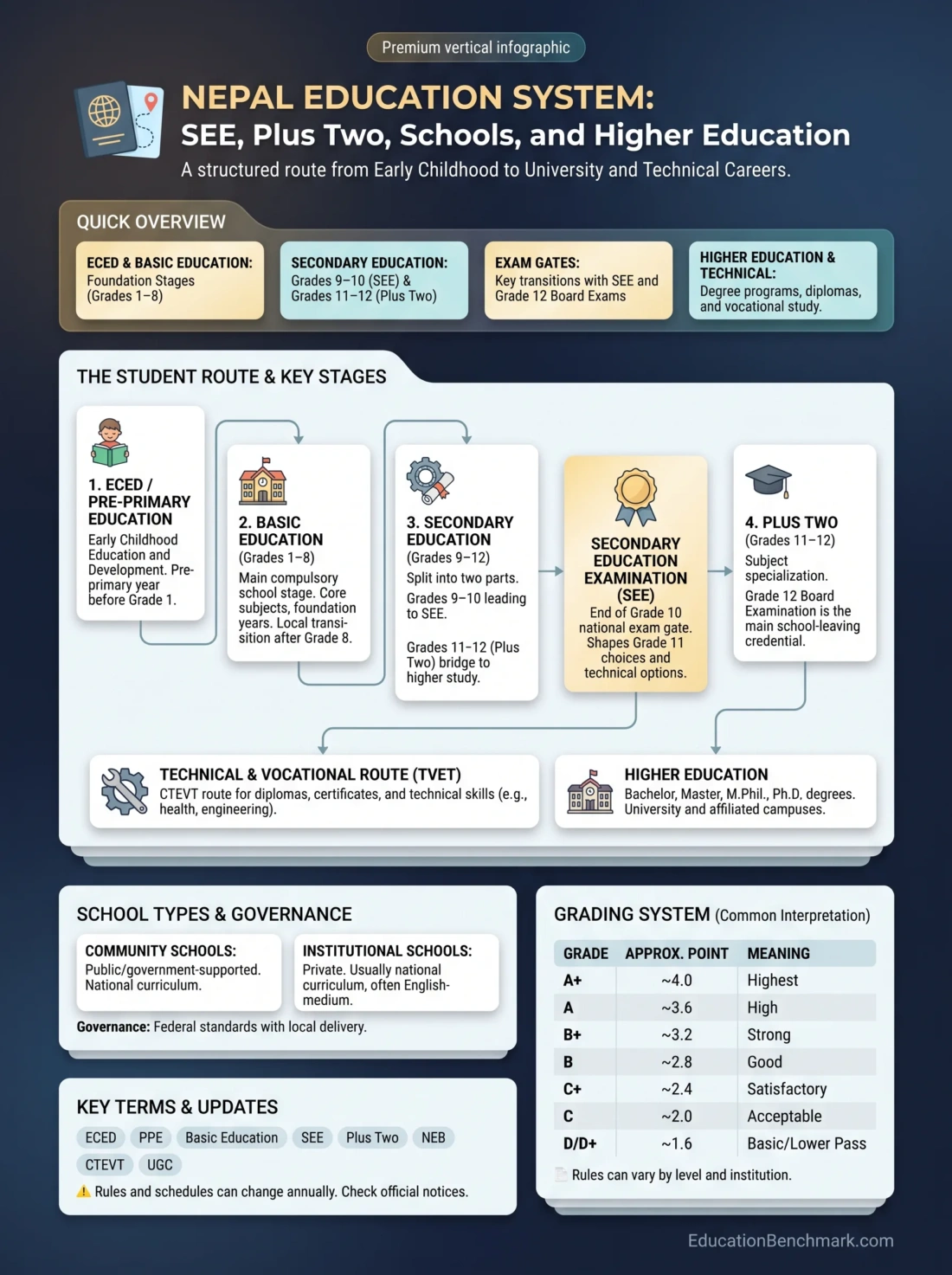
The Nepal education system follows a school-to-higher-education route built around ECED or pre-primary education, Basic Education, secondary school, the Grade 10 SEE, Plus Two in Grades 11–12, technical and vocational options, and university study. For readers comparing school systems internationally, the terms can be confusing because “secondary education” in Nepal now covers Grades 9–12, while “Plus Two” remains a widely used name for the final two school years.
Nepal’s system is also shaped by federal governance. Local governments play a direct role in basic and secondary school delivery, while national bodies remain central for curriculum, examinations, standards, and higher education oversight. The result is a route that is nationally recognizable but locally delivered.
System structure
How the Nepal Education System Works
Nepal’s school route is usually read as ECED/PPE, Basic Education, Secondary Education, SEE, Plus Two, and then higher education or technical training.
The formal school route begins with early childhood or pre-primary provision, then moves through Basic Education in Grades 1–8 and Secondary Education in Grades 9–12.
SEE comes after Grade 10. Grade 12 board assessment is the main school-leaving point for most higher education entry routes.
Publicly supported schools are often called community schools. Private schools are commonly described as institutional schools.
School education responsibilities are shared across levels of government, with local governments handling many basic and secondary education functions while national institutions set policy and standards. [c]
School levels
School Levels and Typical Ages
The age ranges below use the standard route described in Nepal’s School Education Sector Plan. Real enrollment age can vary because some children enter school early or late. [a]
| School level | Typical age | Typical grade or year | How to read it |
|---|---|---|---|
| ECED / PPE | About 4 | Pre-primary year | Early Childhood Education and Development or Pre-Primary Education before Grade 1. |
| Basic Education | About 5–12 | Grades 1–8 | The main required school stage, covering the foundation years before secondary school. |
| Secondary Education, first phase | About 13–14 | Grades 9–10 | The stage leading to the Secondary Education Examination, widely known as SEE. |
| Secondary Education, Plus Two | About 15–16 | Grades 11–12 | Often called Plus Two or +2; usually the school route before bachelor-level study. |
| Technical and vocational route | Usually after SEE or by program rule | Diploma, pre-diploma, certificate, or technical stream | A practical route through CTEVT or technical secondary options, depending on eligibility. |
| Higher Education | Usually after Grade 12 or equivalent | Bachelor level and above | University or campus-based study, with admissions set by institution, faculty, and program. |
Table analysis
- Nepal’s current school structure is best read as Grades 1–8 plus Grades 9–12, not as a simple primary-secondary split.
- SEE is not the final school-leaving point; it sits after Grade 10 and before Plus Two.
- Plus Two is part of secondary education, even though many families discuss it as a separate college-like stage.
Compulsory schooling
Compulsory Education
Nepal’s compulsory education discussion centers on Basic Education. Secondary education is normally described as free in policy language, but families should verify current school, local government, and program-level rules before making decisions.
Basic Education covers Grades 1–8, with ECED/PPE treated as the pre-primary route that prepares children for Grade 1.
Policy sources describe free and compulsory education up to the basic level and free education at the secondary level.
When comparing Nepal with other countries, it helps to separate official compulsory years from the normal school route students follow in practice. [b]
School calendar
Academic Year and Grade Structure
School calendars in Nepal are closely connected to the Nepali Bikram Sambat calendar, while board exam notices may publish dates in Nepali calendar format.
The school route is usually described by grade number. Grade 10 is associated with SEE, while Grades 11 and 12 are widely called Plus Two.
Families using English-language sources may need to convert Bikram Sambat dates when reading exam routines, admission notices, and school calendars.
Holiday schedules, internal exams, admissions windows, and term dates can differ by school, municipality, and board notice.
Curriculum and governance
Curriculum and School Governance
Nepal combines national curriculum work, national exam bodies, local school management, and separate higher education oversight.
The Curriculum Development Centre publishes school curriculum materials and textbooks for different grades and subjects, including secondary-level subjects. [d]
NEB is central to Grade 10 and Grade 12 examination routines, results, notices, forms, and exam-related services.
Local governments influence planning, monitoring, school operation, and delivery of basic and secondary education.
Exams and qualifications
Main Exams, Qualifications, and Assessments
The two exam names readers most often meet are SEE after Grade 10 and Grade 12 board examination after Plus Two.
| Point in the route | Common name | Who it affects | Typical role |
|---|---|---|---|
| End of Grade 8 | Basic-level assessment or local Grade 8 assessment | Students completing Basic Education | Marks the transition into secondary education; local practice can vary. |
| End of Grade 10 | Secondary Education Examination, or SEE | Grade 10 students | A national exam gate before Grade 11, Plus Two colleges, or some technical routes. [e] |
| Grades 11–12 | Plus Two or +2 | Students in the final two school years | Subject choices and Grade 12 results shape university and professional program eligibility. |
| End of Grade 12 | Grade 12 board examination | Students completing Plus Two | A main school-leaving credential for bachelor-level entry and other post-secondary routes. [f] |
| After SEE or Grade 12 | Program-specific entrance tests | Applicants to competitive technical, medical, engineering, or university programs | Admissions may depend on grades, entrance tests, interviews, quotas, or faculty rules. |
Table analysis
- SEE is a mid-secondary exam in the current Grade 1–12 route, not the final point of school education.
- Grade 12 results usually matter more for direct bachelor-level entry.
- Some technical and professional routes use separate entrance or eligibility rules.
Marks and GPA
Grading System
Nepal uses letter grades and grade points in school documents, but grading can differ between Grade 10, Grade 12, and university systems. The table below reflects common school-level interpretation used by credential evaluators. [g]
| Letter grade | Grade point | Percentage range | Meaning in school documents |
|---|---|---|---|
| A+ | Around 4.0 | About 90–100 | Highest school-level grade band. |
| A | Around 3.6 | About 80–90 | High achievement band. |
| B+ | Around 3.2 | About 70–80 | Strong school-level result. |
| B | Around 2.8 | About 60–70 | Good result band. |
| C+ | Around 2.4 | About 50–60 | Satisfactory result band. |
| C | Around 2.0 | About 40–50 | Acceptable result band. |
| D or D+ | Around 1.6 | About 35–40, depending on level | Basic or lower passing band in some school-level contexts. |
| NG | Not graded | Below required threshold | May require improvement or re-examination depending on the current rule. |
Table analysis
- Letter grades alone do not always show admission eligibility; some programs also require subject grades.
- University grading can differ from school grading, so Grade 12 and bachelor transcripts should be read separately.
- Credential evaluation may treat older SLC/HSEB records differently from current SEE and Grade 12 records.
School types
Public, Private, and International Schools
Nepal’s school market uses terms that may differ from other countries. “Community school” often refers to public or government-supported schooling, while “institutional school” commonly refers to private schooling.
Student pathway
Vocational and Technical Education
Nepal’s technical and vocational route is mainly associated with CTEVT and technical programs in schools or affiliated institutions.
Many students move from SEE into Grade 11 and Grade 12, choosing subject combinations that prepare them for higher education.
CTEVT lists diploma, proficiency certificate, and technical programs across fields such as engineering, health, agriculture, hospitality, forestry, and technology. [h]
Entry may depend on SEE completion, Grade 12 completion, subject background, entrance tests, seats, and the current admission notice.
University route
Higher Education and University Entrance
Higher education in Nepal includes universities, constituent campuses, affiliated campuses, and specialized institutes.
Higher education institutions offer bachelor, master, M.Phil., and Ph.D. study across technical and liberal fields such as management, humanities, education, engineering, medicine, law, and arts. [i]
For many bachelor programs, Grade 12 completion is the normal academic base. Competitive programs may require entrance exams or subject prerequisites.
Large universities may operate through central departments, constituent campuses, and affiliated colleges, so the same university name can appear on many campuses.
Comparison view
How This System Compares Internationally
Nepal is best compared through structure, exam timing, governance, and pathway choice rather than through one ranking label.
Compared with systems that divide schooling into primary, lower secondary, and upper secondary, Nepal’s official route is often clearer when read as Basic Education plus Secondary Education.
In some countries, the main national exam comes at the end of upper secondary school. In Nepal, SEE comes after Grade 10, while Grade 12 remains central for higher education entry.
Nepal’s school governance is not purely centralized. Local governments, national curriculum bodies, national exam offices, and higher education institutions each shape part of the student route.
Local terms
Common Terms Readers Should Know
These terms appear often in Nepal school documents, admission notices, and education discussions.
Route reading
Student Pathways After SEE and Plus Two
The route after Grade 10 is where many readers mix up SEE, Plus Two, technical study, and university entry.
| Student point | Common next route | What to verify |
|---|---|---|
| After Grade 8 | Grades 9–10 secondary education | Local assessment rule, school transfer process, language of instruction, and subject availability. |
| After SEE | Plus Two, technical secondary route, CTEVT route, or other eligible program | SEE grades, subject requirements, college admission notices, technical program seats, and deadlines. |
| After Grade 12 | Bachelor degree, professional program, diploma route, or work-linked training | University entrance rules, faculty-specific tests, Grade 12 subject background, scholarship rules, and equivalency requirements. |
| After a technical program | Employment, further diploma study, or higher technical study if eligible | Program recognition, licensing requirements, bridging options, and current CTEVT or institution notices. |
Rules and updates
What Can Change Over Time
Nepal’s education rules, exam routines, curriculum materials, grading thresholds, and admission requirements can change by year.
Students should check the current NEB or SEE office notice before relying on an exam date, retotaling rule, supplementary exam rule, or result process.
Entrance tests, subject requirements, quotas, and documentation can vary by university, faculty, campus, and academic year.
Education Benchmark is an independent informational guide and is not affiliated with any ministry of education, school authority, exam board, university, government agency, or official ranking organization.
Verification
Sources and Verification
The sources below were used to verify school levels, exam bodies, vocational routes, higher education structure, grading context, and comparison notes.
- [a] School Education Sector Plan – 2022/23-2031/32 — Used for Nepal’s ECED, Basic Education, Secondary Education, age-range, and free or compulsory education context. (Reliable because it is a Government of Nepal school education sector plan source.)
- [b] Compulsory Education Worldwide (2026): Years, Ages, and Enforcement by Country — Used for international context on how compulsory schooling differs across countries. (Reliable for comparison because it is a dedicated country education guide and comparison resource.)
- [c] Nepal School Sector Development Program for Results Project Additional Financing and Restructuring — Used for federal and local governance context in Nepal’s basic and secondary education system. (Reliable because it is a World Bank project document with education-sector governance details.)
- [d] Curriculum Development Centre Catalogue — Used for Nepal school curriculum material context, including secondary-level curriculum publications. (Reliable because it is the official Curriculum Development Centre e-library catalogue.)
- [e] See.gov.np — Used for SEE as Nepal’s Grade 10 Secondary Education Examination office context. (Reliable because it is the official SEE office website.)
- [f] National Examinations Board Annual Calendar — Used for NEB board-exam routine and Grade 11–12 examination calendar context. (Reliable because it is the official National Examinations Board calendar page.)
- [g] Grades and study results — Used for school-level grade, percentage, and grade-point interpretation. (Reliable because Nuffic is a recognized credential evaluation and international education information organization.)
- [h] Courses and Programs — Used for Nepal’s CTEVT technical, vocational, diploma, and certificate program examples. (Reliable because it is the official Council for Technical Education and Vocational Training website.)
- [i] University Grant Commission Nepal — Used for university, institute, faculty, and higher education degree-level context. (Reliable because it is the official University Grants Commission Nepal website.)