
Pakistan School Route Passport
Follow the route from primary and middle school to SSC and HSSC, with subject-group, technical, and equivalence branches after Matric.
Primary & Middle
Selected stamp: Primary & Middle. Choose another stamp to update the route card.
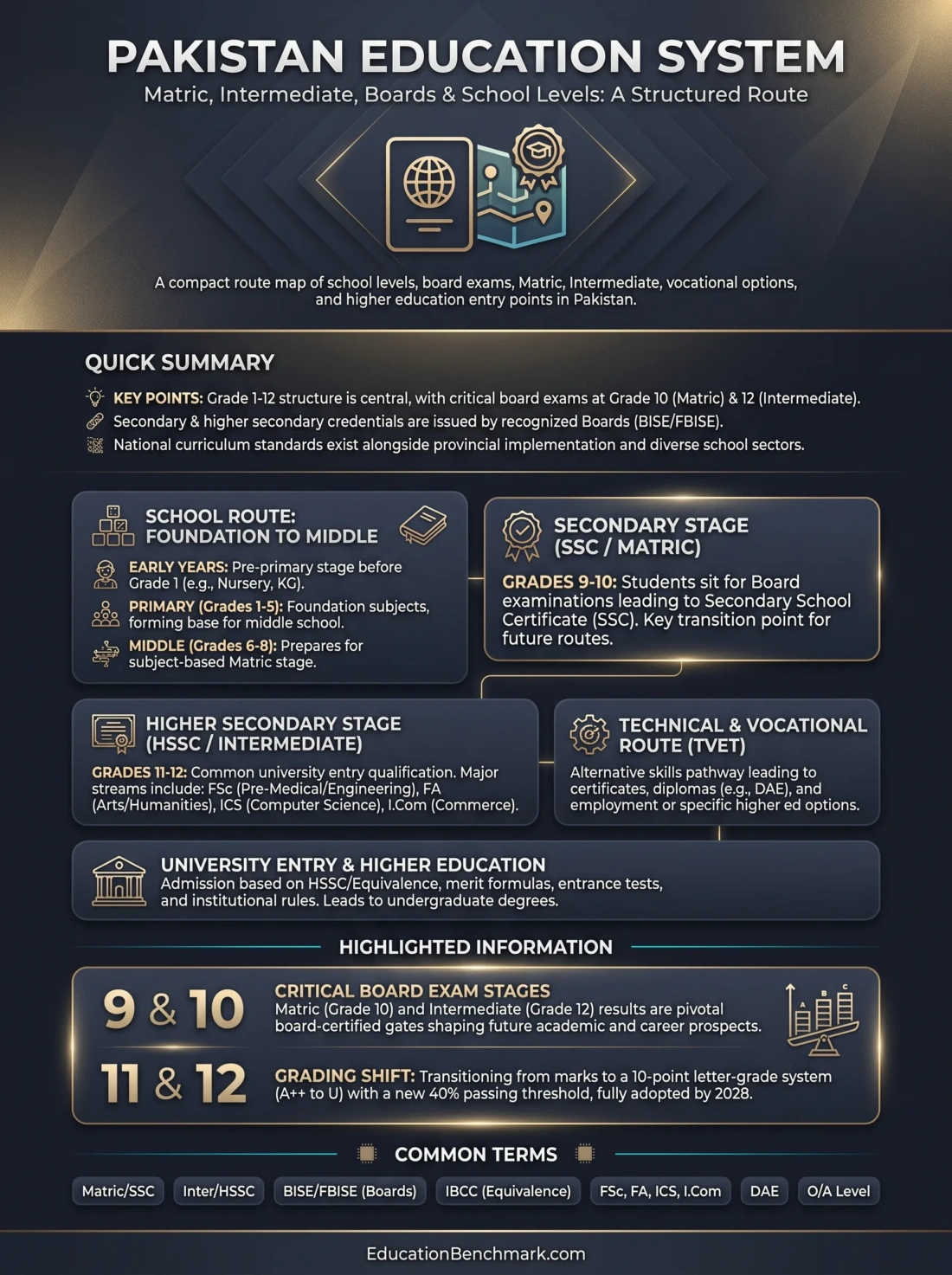
Pakistan’s mainstream school route changes character after Grade 8. Grades 9 and 10 form the Secondary School Certificate stage, commonly called SSC, Matric, or Matriculation, while Grades 11 and 12 form the Higher Secondary School Certificate stage, commonly called HSSC or Intermediate. Before that point, the normal route runs through Grades 1–5 and Grades 6–8.[a]
The distinction between a school, an examination board, and a qualification is central to understanding the Pakistani system. A student may study at one school or college, take examinations through an affiliated board, receive an SSC or HSSC credential from that board, and later use the credential for admission or equivalence purposes. This is why “Matric,” “Intermediate,” and “board” describe different parts of the same route rather than interchangeable ideas.
Pakistan’s Grade 1–12 Route and the 5–16 Education Duty
The school sequence is easier to read as four main academic stages. The first eight grades lead into two consecutive board-oriented qualifications rather than one uninterrupted twelve-grade certificate. The twelve-grade school structure does not mean that all twelve grades form Pakistan’s constitutional compulsory-education period.
School sequence
From Grade 1 to HSSC
The table shows the mainstream general-education route. Technical and international-qualification routes can branch from it.
| Stage | Grades | Common wording | Main transition or result |
|---|---|---|---|
| Primary | 1–5 | Primary school | Progression into the middle stage |
| Middle | 6–8 | Middle school | Entry into secondary study in Grade 9 |
| Secondary | 9–10 | SSC / Matric | Secondary School Certificate or Matriculation Certificate |
| Higher secondary | 11–12 | HSSC / Intermediate | Higher Secondary School Certificate or Intermediate qualification |
Pakistan’s constitutional rule is stated by age rather than as a twelve-grade compulsory sequence. Article 25-A provides that the state shall provide free and compulsory education to children from five to sixteen years of age in the manner determined by law.[b] School entry, progression, interrupted schooling, and local implementation can affect which grade a child occupies at a particular age.
Comparative data note
Comparative Coding Is Not the Constitutional Age Rule
A separate cross-country dataset currently lists Pakistan with a reported compulsory start age of 5 and a 12-year compulsory-duration indicator. The dataset keeps its age and duration fields separate and states that their legal scope or reference year can differ; it does not derive a school-leaving age by adding them together.[c] For Pakistan, the legal reference remains Article 25-A’s 5–16 age range. The comparative duration indicator should therefore not be read as a constitutional rule requiring attendance through age 17.
From Grade 9 to Matric: How SSC-I and SSC-II Fit Together
Matric is a two-year stage, not simply another name for Grade 10. Grade 9 is commonly described as SSC-I or Matric Part I, followed by SSC-II or Matric Part II in Grade 10. Completion of the second part leads to the SSC or Matriculation credential.
This distinction matters when reading result notices, registration schedules, improvement rules, or school records. “SSC-I result” refers to the first part of the secondary cycle; it does not mean that the student already holds the completed SSC qualification. In the same way, sitting Grade 10 examinations and holding a final SSC certificate are related steps but not identical documents.
Matric terminology
Stage, Part, and Credential
Students also begin to encounter subject-group choices more directly at secondary level. Those choices can affect which subjects are carried into higher secondary study, although the exact scheme, electives, practical components, and change-of-subject rules belong to the relevant board rather than to a single nationwide Matric timetable.
Why the Exam Board Matters More After Grade 8
Pakistan does not use one single “Matric Board” for every student. Schools and colleges teach students, while recognized examination boards administer external examinations and issue the relevant secondary or higher-secondary credential. Nuffic’s Pakistan credential guidance describes the separation directly: students are educated at a school but take their examinations from a board.[d]
Regional variation is also part of the system. Pakistan’s National Curriculum Council states that provinces retain autonomy over education governance, policy, and curriculum, while the council coordinates minimum national curriculum standards with the federating units. Provincial legal processes remain necessary for implementation within a province.[e]
Who does what
School, Board, Province, NCC, and IBCC
These bodies interact, but they do not perform the same job.
The Inter Boards Coordination Commission, or IBCC, is therefore not the board that every Pakistani Matric student sits under. Its statutory functions include serving as a forum for member examination boards, supporting country-level coordination in assessment policy, and authenticating equivalence, attestation, and verification matters up to higher-secondary level.[f]
Two students can attend different schools but sit under the same examination board. Two schools using similar course labels can also be affiliated with different boards, which may mean different registration schedules, practical arrangements, result procedures, and administrative rules.
FSc, FA, ICS, and I.Com: The Choice After Matric
Intermediate describes the education level; FSc, FA, ICS, and I.Com describe common programme orientations within that level. They should not be read as four different qualification levels. Students normally enter these routes after SSC or Matric and continue toward higher-secondary completion.
Post-Matric subject choice
What the Common Intermediate Labels Usually Signal
Exact subjects and formal group names must be checked against the student’s board and college.
Usually centers on biology, chemistry, and physics and is used where later programmes require a biology-based science background.
Usually centers on mathematics, physics, and chemistry and supports routes that require a mathematics-based science background.
Commonly combines computer science with mathematics and another approved subject, with combinations varying by institution or scheme.
Usually covers humanities, arts, or social-science combinations rather than the pre-medical or pre-engineering science sequence.
Focuses on commerce-related study such as accounting, economics, business mathematics, statistics, banking, or related subjects.
These labels remain visible in current college admissions. Lahore College for Women University’s Intermediate section, for instance, lists Pre-Medical, Pre-Engineering, computer science, commerce, humanities, and other groupings in its 2026 admissions material.[g] The example illustrates institutional usage; it does not establish one subject scheme for every board in Pakistan.
Board-facing terminology can be different. The Board of Intermediate Education Karachi’s 2026 notices identify HSC Part-I groups such as Science Pre-Medical, Science Pre-Engineering, Science General, Commerce, Humanities, and Medical Technology.[h] A student who casually says “ICS” or “FSc” may therefore see a different formal group description on board documents.
Intermediate Is Not a Completely Open Grade 11–12 Menu
The subjects taken during higher secondary study can later be used by universities to determine eligibility for programmes requiring mathematics, biology, physics, computing, commerce, or another academic background. Passing Intermediate does not make every degree route automatically available.
The 2026 SSC and HSSC Grading Transition
Pakistan entered a new grading phase with the first annual examinations of 2026. The change is especially relevant when comparing current Grade 9 or Grade 11 results with older Matric and Intermediate records, because the transition is being introduced by examination stage rather than by rewriting past certificates.
Assessment transition
What Changed Under the New SSC and HSSC Policy
The rollout is phased, so a student’s examination year and part of the qualification matter.
| Feature | Earlier approach | New policy and transition |
|---|---|---|
| Grade labels | Seven-grade pattern using A-1 through F | Ten grades: A++, A+, A, B++, B+, B, C+, C, D, and U |
| Passing threshold | 33% | 40% |
| First 2026 phase | Not applicable | Begins with Grade 9 SSC and Grade 11 HSSC in the first annual examination of 2026 |
| Result reporting during transition | Marks and the previous grading practice | Absolute scores continue alongside grades in the first phase; GPA is deferred during the wider rollout |
| Wider adoption | Previous grading arrangements | IBCC states that phased national adoption is intended to be completed by 2028 |
IBCC states that public and private Pakistani examination boards are required to implement the new policy from the first annual examination of 2026, while foreign examination boards operating in Pakistan are outside that requirement. Its current FAQ also says universities in 2026–27 may refer to board grades or continue using raw scores during the transition; a later move toward CGPA-based admissions is planned after the scheme is fully adopted.[i]
Older records should therefore be read according to the grading system under which they were issued. A Grade 9 result from the new phase, a Grade 10 result still governed by a transition rule, and an SSC certificate from an earlier cohort should not be assumed to use identical reporting conventions. Improvement and reappearance cases can also retain earlier rules in circumstances identified by the relevant board or IBCC policy.
Matric vs O Level, Intermediate vs A Level
O Level is not simply an English-medium name for Matric, and A Level is not another spelling of Intermediate. They are qualifications from a different examination system. When a Pakistani SSC or HSSC level must be established for an O Level or A Level holder, IBCC equivalence becomes the connecting mechanism.
Qualification equivalence
Domestic Board Route and British Qualification Route
Pakistani secondary-board qualification O Level / IGCSE
Foreign examination qualification Can be considered for SSC equivalence when IBCC subject and examination requirements are met
Pakistani higher-secondary qualification A Level
Foreign examination qualification Can be considered for HSSC equivalence when the required lower-level and group conditions are met
For O Level examinations taken in Pakistan, IBCC currently requires eight subjects for SSC equivalence, including English, Mathematics, Urdu, Islamiyat, Pakistan Studies, and three academic electives, subject to its stated passing requirements. Overseas O Level cases use a different subject-count rule. At A Level, the required subjects depend on the equivalence group: for example, Pre-Medical uses Physics, Chemistry, and Biology, while Pre-Engineering uses Physics, Chemistry, and Mathematics.[j]
This group-based equivalence matters because the question is not always only “Is A Level equal to HSSC?” The recognized type of HSSC group can matter when a later programme requires a particular science or computing background. The current IBCC requirements should be checked before relying on an assumed equivalence for admission.
DAE and Matric-Tech: Technical Routes After Matric
The academic Intermediate route is not the only option after SSC. Pakistan also has secondary vocational and technical programmes examined through technical boards. One established route is the Diploma of Associate Engineer (DAE).
Nuffic describes Pakistani diploma programmes in secondary vocational education as commonly lasting two to three years, with SSC or Matric usually serving as the admission qualification. Exams are commonly administered by a Board of Technical Education, and a DAE may lead to work or, where accepted, further education.[k]
A newer skills-integrated route is Matric-Tech. It should be read carefully: Matric-Tech is not a replacement for the whole national Matric system. The Federal Directorate of Education lists participating institutions and programmes within its own federal-school context, including Industrial Electrician, Data Coding (IoT), Graphic Designing & Media Production, and Plumbing & Solar Water Heating System.[l]
Technical distinction
DAE and Matric-Tech Serve Different Points in the Route
Availability must be checked locally. A programme shown by a federal institution does not imply that every provincial board, BISE, technical board, or secondary school offers the same route.
From HSSC to University: Qualification First, Programme Rules Second
HSSC or Intermediate normally provides the school-level qualification needed to move into higher education, but it is only the first admission gate. Universities can add subject requirements, grade thresholds, merit calculations, admission tests, or other conditions for a particular degree.
Nuffic’s current Pakistan higher-education description notes that bachelor-level programmes generally require HSSC or Intermediate and can impose extra conditions involving subjects or grades. It also notes that institutions may accept other qualifications, including a Diploma of Associate Engineer, for some programmes.[m]
Student-route logic
Why the Grade 11 Subject Choice Can Reach Into University Admission
- SSC or Matric is completed. The student reaches the main higher-secondary decision point.
- An Intermediate group is selected. The route may emphasize biology, mathematics, computing, commerce, humanities, or another approved combination.
- HSSC or Intermediate is completed. The student now holds the upper-secondary qualification used for higher-education entry.
- The intended degree is checked against its current requirements. A programme may demand particular subjects or a particular equivalence group.
- The institution applies its own admission process. Meeting the school-leaving qualification alone does not guarantee admission.
A medicine-oriented student, an engineering-oriented student, and a computing-oriented student may all complete Grade 12, yet arrive there with different subject records. That is why “Intermediate passed” and “eligible for this degree” are separate questions.
Certificates, Verification, and What Must Be Checked Locally
Pakistan’s board system produces several documents and processes that are easy to merge mentally. A result card or marks sheet records examination results, while the SSC or HSSC certificate represents the completed qualification. Verification, attestation, and equivalence are also separate processes.
Document language
Result, Certificate, Verification, Attestation, and Equivalence
IBCC’s current attestation rules state that certificates, diplomas, marks sheets, and result cards issued by recognized BISEs and Boards of Technical Education are eligible for its attestation process, and the document must first be verified by the issuing authority before submission to IBCC.[n]
The same caution applies to examination rules. Registration dates, subject combinations, practical arrangements, improvement or reappearance rules, grading implementation, certificate formats, equivalence requirements, and university admission conditions can change by board, province, year, institution, and programme. Current decisions should be checked against the relevant examination board, school or college, IBCC, university, technical board, or other responsible authority.
Education Benchmark is an independent informational guide and is not affiliated with any ministry of education, school authority, exam board, university, government agency, or official ranking organization.
Sources and Verification
- [a] Primary and secondary education — Used for Pakistan’s Grade 1–12 sequence, SSC/Matric and HSSC/Intermediate structure, and qualification terminology. (Reliable because Nuffic is a national expertise organization for international education and credential comparison.)
- [b] Directorate General of Basic Education Community Schools (BECS) — Used for Article 25-A and the constitutional wording covering free and compulsory education from ages five to sixteen. (Reliable because it is an official Government of Pakistan education source.)
- [c] Compulsory Education Worldwide (2026): Years, Ages, and Enforcement by Country — Used only to explain the separate cross-country compulsory-start and duration indicators and the dataset’s warning against deriving a school-leaving age by combining fields with potentially different legal scopes or reference years. (Useful as an independent comparative dataset; Article 25-A remains the legal reference for Pakistan.)
- [d] Educational institutions and study programmes — Used for the distinction between the teaching institution and the examination board in Pakistani secondary education. (Reliable because Nuffic specializes in international qualification and education-system evaluation.)
- [e] Ministry of Federal Education and Professional Training — Used for provincial autonomy in education governance and curriculum and the coordinating role of the National Curriculum Council. (Reliable because it is an official Pakistan federal education source.)
- [f] Functions – Inter Boards Coordination Commission (IBCC) — Used for IBCC’s roles in inter-board coordination, examination matters, equivalence, attestation, and verification. (Reliable because it is the official IBCC description of its functions.)
- [g] Admission — Used to illustrate current Intermediate programme labels and subject-group usage at Lahore College for Women University. (Reliable for this purpose because it is the university’s official admissions page.)
- [h] Welcome to Board of Intermediate Education Karachi — Used for current HSC group terminology in Karachi. (Reliable because it is the official notification page of the Board of Intermediate Education Karachi.)
- [i] New Grading System of SSC & HSSC – Inter Boards Coordination Commission (IBCC) — Used for the 2026 grading rollout, ten-grade scale, 40% passing threshold, phased implementation, transitional result reporting, and admission implications. (Reliable because it is the official IBCC FAQ for the SSC and HSSC grading policy.)
- [j] British System (O & A levels) – Inter Boards Coordination Commission (IBCC) — Used for current O Level and A Level equivalence requirements and academic-group subject conditions. (Reliable because IBCC is the Pakistani authority responsible for these equivalence rules.)
- [k] Secondary vocational education — Used for post-Matric diploma routes, Board of Technical Education examinations, typical diploma duration, DAE, and progression context. (Reliable because Nuffic provides institutional credential-evaluation information on Pakistani vocational qualifications.)
- [l] Matric Tech Admissions — Used for Federal Directorate of Education Matric-Tech participating institutions and listed skills programmes. (Reliable because it is the official Federal Directorate of Education admissions page.)
- [m] Higher education — Used for the role of HSSC or Intermediate in bachelor-level admission and the possibility of additional subject or grade requirements. (Reliable because Nuffic evaluates international education systems and qualifications.)
- [n] Rules For Attestation – Inter Boards Coordination Commission (IBCC) — Used for document attestation eligibility and the requirement for prior verification by the issuing BISE or BTE. (Reliable because it is the official IBCC attestation-rules page.)
Pakistan’s mainstream school route changes character after Grade 8. Grades 9 and 10 form the Secondary School Certificate stage, commonly called SSC, Matric, or Matriculation, while Grades 11 and 12 form the Higher Secondary School Certificate stage, commonly called HSSC or Intermediate. Before that point, the normal route runs through Grades 1–5 and Grades 6–8. [a]
The distinction between a school, an examination board, and a qualification is central to understanding the Pakistani system. A student may study at one school or college, take examinations through an affiliated board, receive an SSC or HSSC credential from that board, and later use the credential for admission or equivalence purposes. This is why “Matric,” “Intermediate,” and “board” describe different parts of the same route rather than interchangeable ideas.
Pakistan’s Grade 1–12 Route and the 5–16 Education Duty
The school sequence is easier to read as four main academic stages. The first eight grades lead into two consecutive board-oriented qualifications rather than one uninterrupted twelve-grade certificate.
School sequence
From Grade 1 to HSSC
The table shows the mainstream general-education route. Technical and international-qualification routes can branch from it.
| Stage | Grades | Common wording | Main transition or result |
|---|---|---|---|
| Primary | 1–5 | Primary school | Progression into the middle stage |
| Middle | 6–8 | Middle school | Entry into secondary study in Grade 9 |
| Secondary | 9–10 | SSC / Matric | Secondary School Certificate or Matriculation Certificate |
| Higher secondary | 11–12 | HSSC / Intermediate | Higher Secondary School Certificate or Intermediate qualification |
Pakistan’s constitutional wording is broader than the labels in the school-stage table. Article 25-A states that the state shall provide free and compulsory education to children from five to sixteen years of age. [b] Legal compulsory-education ages should not be treated as a promise that every child of a particular age is automatically in one fixed grade; school entry, progression, interrupted schooling, and local implementation can affect the grade occupied at a given age.
Reading compulsory-age data
Legal Wording and Comparative Coding Can Look Different
A cross-country 2026 dataset codes Pakistan with an official entrance age of 5, a compulsory duration of 12 years, and a derived theoretical exit age of 17. That exit-age figure is a comparison device calculated from the dataset; it does not replace Article 25-A’s wording of ages five to sixteen. [c]
From Grade 9 to Matric: How SSC-I and SSC-II Fit Together
Matric is a two-year stage, not simply another name for Grade 10. Grade 9 is commonly described as SSC-I or Matric Part I, followed by SSC-II or Matric Part II in Grade 10. Completion of the second part leads to the SSC or Matriculation credential.
This distinction matters when reading result notices, registration schedules, improvement rules, or school records. “SSC-I result” refers to the first part of the secondary cycle; it does not mean that the student already holds the completed SSC qualification. In the same way, sitting Grade 10 examinations and holding a final SSC certificate are related steps but not identical documents.
Matric terminology
Stage, Part, and Credential
Students also begin to encounter subject-group choices more directly at secondary level. Those choices can affect which subjects are carried into higher secondary study, although the exact scheme, electives, practical components, and change-of-subject rules belong to the relevant board rather than to a single nationwide Matric timetable.
Why the Exam Board Matters More After Grade 8
Pakistan does not use one single “Matric Board” for every student. Schools and colleges teach students, while recognized examination boards administer the external examination and issue the relevant secondary or higher-secondary credential. Nuffic’s Pakistan credential guidance describes this separation directly: students are educated at a school but take their examinations from a board. [d]
Regional variation is also part of the system. Pakistan’s National Curriculum Council states that provinces retain autonomy over education governance, policy, and curriculum, while the council coordinates minimum national curriculum standards with the federating units. Provincial legal processes remain necessary for implementation within a province. [e]
Who does what
School, Board, Province, NCC, and IBCC
These bodies interact, but they do not perform the same job.
Provides instruction, student support, internal administration, and preparation for the applicable course and examinations.
Handles board-facing examination processes and issues SSC or HSSC results and credentials within its jurisdiction or affiliation system.
Shapes education administration and implements applicable curriculum and school rules within its legal remit.
Works with federating units on common minimum curriculum standards while provincial authority over implementation remains relevant.
Coordinates examination-board matters and handles functions including equivalence, attestation, and verification up to higher-secondary level.
The Inter Boards Coordination Commission, or IBCC, is therefore not the board that every Pakistani Matric student sits under. Its statutory functions include serving as a forum for member examination boards, supporting country-level coordination in assessment policy, and authenticating equivalence, attestation, and verification matters up to higher-secondary level. [f]
What readers often confuse
A School Name Is Not an Exam Board Name
Two students can attend different schools but sit under the same examination board. Two schools using similar course labels can also be affiliated with different boards, which may mean different registration schedules, practical arrangements, result procedures, and administrative rules.
FSc, FA, ICS, and I.Com: The Choice After Matric
Intermediate describes the education level; FSc, FA, ICS, and I.Com describe common programme orientations within that level. They should not be read as four different qualification levels. Students normally enter these routes after SSC or Matric and continue toward higher-secondary completion.
Post-Matric subject choice
What the Common Intermediate Labels Usually Signal
Exact subjects and formal group names must be checked against the student’s board and college.
Usually centers on biology, chemistry, and physics and is used where later programmes require a biology-based science background.
Usually centers on mathematics, physics, and chemistry and supports routes that require a mathematics-based science background.
Commonly combines computer science with mathematics and another approved subject, with combinations varying by institution or scheme.
Usually covers humanities, arts, or social-science combinations rather than the pre-medical or pre-engineering science sequence.
Focuses on commerce-related study such as accounting, economics, business mathematics, statistics, banking, or related subjects.
These labels are visible in current college admissions. Lahore College for Women University’s Intermediate section, for instance, uses F.A./F.Sc. and lists Pre-Medical, Pre-Engineering, ICS, I.Com, and Arts among its programme groupings. [g] The example illustrates local usage; it does not establish one subject scheme for every board in Pakistan.
Board-facing terminology can be different. The Board of Intermediate Education Karachi’s 2026 notices identify HSC Part-I groups such as Science Pre-Medical, Science Pre-Engineering, Science General, Commerce, Humanities, and Medical Technology. [h] A student who casually says “ICS” or “FSc” may therefore see a different formal group description on board documents.
Why the group choice matters
Intermediate Is Not a Completely Open Grade 11–12 Menu
The subjects taken during higher secondary study can later be used by universities to determine eligibility for programmes requiring mathematics, biology, physics, computing, commerce, or another academic background. Passing Intermediate does not make every degree route automatically available.
The 2026 SSC and HSSC Grading Transition
Pakistan entered a new grading phase with the first annual examinations of 2026. The change is especially relevant when comparing current Grade 9 or Grade 11 results with older Matric and Intermediate records, because the transition is being introduced by examination stage rather than by rewriting past certificates.
Assessment transition
What Changed Under the New SSC and HSSC Policy
The rollout is phased, so a student’s examination year and part of the qualification matter.
| Feature | Earlier approach | New policy and transition |
|---|---|---|
| Grade labels | Seven-grade pattern using A-1 through F | Ten grades: A++, A+, A, B++, B+, B, C+, C, D, and U |
| Passing threshold | 33% | 40% |
| First 2026 phase | Not applicable | Begins with Grade 9 SSC and Grade 11 HSSC in the first annual examination of 2026 |
| Result reporting during transition | Marks and the previous grading practice | Absolute scores continue alongside grades in the first phase; GPA is deferred during the wider rollout |
| Wider adoption | Previous grading arrangements | IBCC states that the phased national adoption is intended to be completed by 2028 |
IBCC states that public and private Pakistani examination boards are required to implement the new policy from the first annual examination of 2026, while foreign examination boards operating in Pakistan are outside that requirement. Its current FAQ also says universities in 2026–27 may refer to board grades or continue using raw scores during the transition; a later move toward CGPA-based admissions is planned after the scheme is fully adopted. [i]
Older records should therefore be read according to the grading system under which they were issued. A Grade 9 result from the new phase, a Grade 10 result still governed by a transition rule, and an SSC certificate from an earlier cohort should not be assumed to use identical reporting conventions. Improvement and reappearance cases can also retain earlier rules in circumstances identified by the relevant board or IBCC policy.
Matric vs O Level, Intermediate vs A Level
O Level is not simply an English-medium name for Matric, and A Level is not another spelling of Intermediate. They are qualifications from a different examination system. When a Pakistani SSC or HSSC level must be established for an O Level or A Level holder, IBCC equivalence becomes the connecting mechanism.
Qualification equivalence
Domestic Board Route and British Qualification Route
Pakistani secondary-board qualification O Level / IGCSE
Foreign examination qualification Can be considered for SSC equivalence when IBCC subject and examination requirements are met
Pakistani higher-secondary qualification A Level
Foreign examination qualification Can be considered for HSSC equivalence when the required lower-level and group conditions are met
For O Level examinations taken in Pakistan, IBCC currently requires eight subjects for SSC equivalence, including English, Mathematics, Urdu, Islamiyat, Pakistan Studies, and three academic electives, subject to its stated passing requirements. Overseas O Level cases use a different subject-count rule. At A Level, the required subjects depend on the equivalence group: for example, Pre-Medical uses Physics, Chemistry, and Biology, while Pre-Engineering uses Physics, Chemistry, and Mathematics. [j]
This group-based equivalence matters because the question is not always only “Is A Level equal to HSSC?” The recognized type of HSSC group can matter when a later programme requires a particular science or computing background. The current IBCC requirements should be checked before relying on an assumed equivalence for admission.
DAE and Matric-Tech: Technical Routes After Matric
The academic Intermediate route is not the only option after SSC. Pakistan also has secondary vocational and technical programmes examined through technical boards. One established route is the Diploma of Associate Engineer (DAE).
Nuffic describes Pakistani diploma programmes in secondary vocational education as commonly lasting two to three years, with SSC or Matric usually serving as the admission qualification. Exams are commonly administered by a Board of Technical Education, and a DAE may lead to work or, where accepted, further education. [k]
A newer skills-integrated route is Matric-Tech. It should be read carefully: Matric-Tech is not a replacement for the whole national Matric system. The Federal Directorate of Education lists participating institutions and programmes within its own federal-school context, including Industrial Electrician, Data Coding (IoT), Graphic Designing & Media Production, and Plumbing & Solar Water Heating System. [l]
Technical distinction
DAE and Matric-Tech Serve Different Points in the Route
Availability must be checked locally. A programme shown by a federal institution does not imply that every provincial board, BISE, technical board, or secondary school offers the same route.
From HSSC to University: Qualification First, Programme Rules Second
HSSC or Intermediate normally provides the school-level qualification needed to move into higher education, but it is only the first admission gate. Universities can add subject requirements, grade thresholds, merit calculations, admission tests, or other conditions for a particular degree.
Nuffic’s current Pakistan higher-education description notes that professional bachelor’s programmes generally require HSSC or Intermediate and often impose extra conditions involving subjects or grades. It also notes that institutions may accept other qualifications, including a Diploma of Associate Engineer, for some programmes. [m]
Student-route logic
Why the Grade 11 Subject Choice Can Reach Into University Admission
- SSC or Matric is completed. The student reaches the main higher-secondary decision point.
- An Intermediate group is selected. The route may emphasize biology, mathematics, computing, commerce, humanities, or another approved combination.
- HSSC or Intermediate is completed. The student now holds the upper-secondary qualification used for higher-education entry.
- The intended degree is checked against its current requirements. A programme may demand particular subjects or a particular equivalence group.
- The institution applies its own admission process. Meeting the school-leaving qualification alone does not guarantee admission.
A medicine-oriented student, an engineering-oriented student, and a computing-oriented student may all complete Grade 12, yet arrive there with different subject records. That is why “Intermediate passed” and “eligible for this degree” are separate questions.
Certificates, Verification, and What Must Be Checked Locally
Pakistan’s board system produces several documents and processes that are easy to merge mentally. A result card or marks sheet records examination results, while the SSC or HSSC certificate represents the completed qualification. Verification, attestation, and equivalence are also separate processes.
Document language
Result, Certificate, Verification, Attestation, and Equivalence
IBCC’s current attestation rules state that certificates, diplomas, marks sheets, and result cards issued by recognized BISEs and Boards of Technical Education are eligible for its attestation process, and the document must first be verified by the issuing authority before submission to IBCC. [n]
The same caution applies to examination rules. Registration dates, subject combinations, practical arrangements, improvement or reappearance rules, grading implementation, certificate formats, equivalence requirements, and university admission conditions can change by board, province, year, institution, and programme. Current decisions should be checked against the relevant examination board, school or college, IBCC, university, technical board, or other responsible authority.
Education Benchmark is an independent informational guide and is not affiliated with any ministry of education, school authority, exam board, university, government agency, or official ranking organization.
Sources and Verification
- [a] Primary and secondary education | Nuffic — Used for Pakistan’s Grade 1–12 sequence, SSC/Matric and HSSC/Intermediate structure, and qualification terminology. (Reliable because Nuffic is a national expertise organization for international education and credential comparison.)
- [b] Directorate General of Basic Education Community Schools (BECS) — Used for Article 25-A and the constitutional wording covering free and compulsory education from ages five to sixteen. (Reliable because it is an official Government of Pakistan education source.)
- [c] Compulsory Education Worldwide (2026): Years, Ages, and Enforcement by Country — Used as a secondary cross-country reference for Pakistan’s coded entrance age, compulsory duration, and derived theoretical exit age. (Useful because it presents source-based education indicators in a country-comparison format; the constitutional source remains the legal reference.)
- [d] Educational institutions and study programmes | Nuffic — Used for the distinction between the teaching institution and the examination board in Pakistani secondary education. (Reliable because Nuffic specializes in international qualification and education-system evaluation.)
- [e] Ministry of Federal Education and Professional Training — Used for provincial autonomy in education governance and curriculum and the coordinating role of the National Curriculum Council. (Reliable because it is an official Pakistan federal education source.)
- [f] Functions – Inter Boards Coordination Commission (IBCC) — Used for IBCC’s statutory roles in inter-board coordination, examination matters, equivalence, attestation, and verification. (Reliable because it is the official IBCC description of its functions.)
- [g] Admission — Used to illustrate current institutional use of F.A., F.Sc., ICS, I.Com, Pre-Medical, Pre-Engineering, and Arts labels at Intermediate level. (Reliable for this purpose because it is the official admissions page of Lahore College for Women University.)
- [h] Welcome to Board of Intermediate Education Karachi — Used for current 2026 HSC group terminology in Karachi, including Pre-Medical, Pre-Engineering, Science General, Commerce, Humanities, and Medical Technology. (Reliable because it is the official notification page of the Board of Intermediate Education Karachi.)
- [i] New Grading System of SSC & HSSC – Inter Boards Coordination Commission (IBCC) — Used for the 2026 grading rollout, ten-grade scale, 40% passing threshold, phased implementation, transitional result reporting, and admission implications. (Reliable because it is the official IBCC FAQ for the new SSC and HSSC grading policy.)
- [j] British System (O & A levels) – Inter Boards Coordination Commission (IBCC) — Used for current O Level and A Level equivalence requirements and academic-group subject conditions. (Reliable because IBCC is the Pakistani authority responsible for these equivalence rules.)
- [k] Secondary vocational education | Nuffic — Used for post-Matric diploma routes, Board of Technical Education examinations, typical diploma duration, DAE, and progression context. (Reliable because Nuffic provides institutional credential-evaluation information on Pakistani vocational qualifications.)
- [l] Matric Tech Admissions — Used for current Federal Directorate of Education Matric-Tech participating institutions and listed skills programmes. (Reliable because it is the official Federal Directorate of Education admissions page.)
- [m] Higher education | Nuffic — Used for the role of HSSC or Intermediate in bachelor-level admission and the possibility of additional subject or grade requirements. (Reliable because Nuffic evaluates education systems and international qualifications.)
- [n] Rules For Attestation – Inter Boards Coordination Commission (IBCC) — Used for document attestation eligibility and the requirement for prior verification by the issuing BISE or BTE. (Reliable because it is the official IBCC attestation-rules page.)