United Kingdom School Route Passport
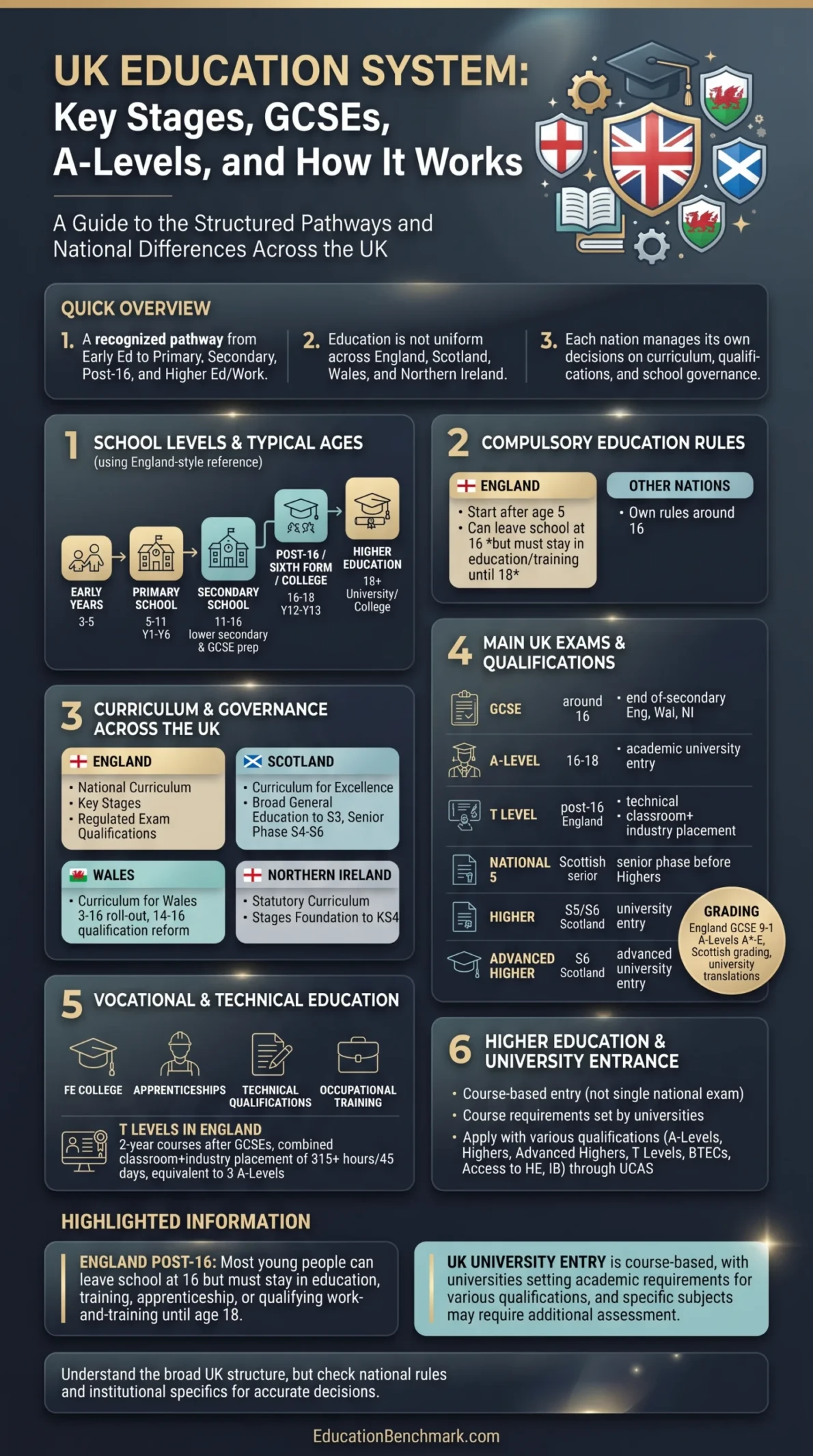
Four national systems share familiar qualification names, but curriculum stages, school years, grading, and post-16 routes do not fully match.
Devolved Systems
Selected stamp: Devolved Systems. Choose another stamp to update the route card.
The phrase UK education system is useful, but it can also mislead. England, Scotland, Wales, and Northern Ireland control many of their own curriculum, qualification, inspection, and post-16 arrangements. England’s national curriculum, for instance, is organised through the Early Years Foundation Stage and Key Stages 1 to 4; it is not a universal map for every UK learner.[a] An independent country profile from Education by Country supports the same practical reading: the United Kingdom is best read as four connected systems rather than one uniform national model.[b]
Devolved education
England, Scotland, Wales, and Northern Ireland Compared
The first question is not simply “Which UK year is the student in?” It is “Which national system sets the route?”
The UK Age Route From Primary Entry to Post-16 Choice
Age is the easiest way to line up the four systems, but even age comparisons need care. Scotland usually begins primary school later than Northern Ireland, while England and Wales use Reception before Year 1. A child of the same age may therefore carry a different year label in another nation.
Age and year map
Typical School Routes Across the Four Nations
These are common routes, not placement guarantees. Birth-date cut-offs, deferred entry, school organisation, and individual progression can change the exact year.
| Nation | Primary route | Secondary route | Usual age-16 point | Common continuation |
|---|---|---|---|---|
| England | Reception and Years 1–6, usually about ages 4–11 | Years 7–11, usually about ages 11–16 | End of Key Stage 4 and GCSE results | Education or training continues to 18 through several permitted routes |
| Scotland | P1–P7, usually about ages 5–12 | S1–S6, usually about ages 12–18 | Senior Phase choices and National Qualifications | S5–S6, college, training, apprenticeship, or work |
| Wales | Reception and Years 1–6, usually about ages 4–11 | Years 7–11, usually about ages 11–16 | GCSE and other 14–16 qualification results | Sixth form, college, training, apprenticeship, or work |
| Northern Ireland | Primary 1–7, usually about ages 4–11 | Years 8–12, usually about ages 11–16 | End of Key Stage 4 and GCSE results | Years 13–14, further education, training, apprenticeship, or work |
School-leaving rules are not identical. England requires young people to remain in education or training until 18 after they reach the school-leaving point. Scotland and Wales use different leaving dates linked to age and the school calendar. Northern Ireland applies its own statutory dates, described in its national curriculum rules. The UK government’s school-leaving page sets out the separate England, Scotland, and Wales positions rather than presenting one date for all three.[f]
Why Key Stages Stop at the Border
Key Stage is a curriculum label, not a general British word for every phase of schooling. In England, Key Stages divide the national curriculum into year blocks. Key Stage 1 covers Years 1 and 2, Key Stage 2 covers Years 3 to 6, Key Stage 3 normally covers Years 7 to 9, and Key Stage 4 covers Years 10 and 11.
Northern Ireland also uses Key Stages, but its year numbering begins with Primary 1 and moves to Year 8 at post-primary transfer. Its Foundation Stage covers the first two primary years. The shared words therefore do not create an identical timetable.
Scotland uses Curriculum for Excellence levels during Broad General Education. Early, First, Second, Third, and Fourth Levels describe expected progression, but learners can move at different rates. The Senior Phase then creates space for National Qualifications, wider awards, college-linked learning, and work-related options.
Wales now organises learning as a 3–16 continuum. Progression steps broadly relate to ages 5, 8, 11, 14, and 16, but they are reference points rather than fixed promotion gates. Schools design their curriculum within national requirements and six areas of learning and experience.
“Year 10,” “S4,” and “Key Stage 4” are not interchangeable labels. They belong to different parts of the four-nation system and should be matched by age, curriculum phase, and qualification purpose.
Qualification point
GCSEs, National 5s, and the Age-16 Qualification Point
The awards taken near age 16 do not share one UK grading scale.
GCSEs are subject qualifications, not a single leaving diploma. A learner may receive a set of separate results in English, mathematics, sciences, humanities, languages, arts, or technical subjects. Schools and colleges then set their own entry conditions for the next programme. A sixth form might ask for a group of grades and a stronger result in the subject to be continued; a vocational course may use a different mix of subject and level requirements.
Scotland works differently. National Qualifications sit within the Senior Phase, and a learner’s timetable can contain awards at more than one level. National 5 is often compared with GCSE study because both commonly appear near age 16, but a simple grade conversion can hide differences in course design, assessment, and the wider programme.
A Levels, Scottish Highers, and Post-16 Study
After GCSEs, many learners in England specialise through A levels at a school sixth form, sixth-form college, or further education college. A levels are subject-based Level 3 qualifications; students often study three, though provider rules and individual programmes vary. England’s official careers service describes them as classroom-based qualifications that are usually assessed by examinations and can lead to university, higher apprenticeships, or employment.[k]
Wales and Northern Ireland also use AS and A level routes, but their qualification specifications, assessment patterns, and grading arrangements are controlled within their own systems. The presence of the same award name should not be taken to mean that every rule matches England.
Scottish learners commonly use Highers for university entry, sometimes followed by Advanced Highers in S6. A student may also mix school qualifications with college courses or other Senior Phase awards. This makes the Scottish route less dependent on one fixed “three-subject” pattern.
Post-16 route board
A Levels, T Levels, V Levels, College Courses, and Apprenticeships
Post-16 education is not a choice between “A levels or nothing.” The available route depends heavily on nation and provider. V Levels, Foundation Certificates, and Occupational Certificates described here are England-only reforms.
Subject-led study can support university entry, higher training, employment, or a later change of route.
T Levels are two-year programmes after GCSEs, broadly equal in size to three A levels, with an industry placement of at least 315 hours.[l]
V Levels are Level 3 vocational qualifications similar in size to one A level. The first tranche is due to be available for teaching from September 2027, and V Levels can be combined with A levels where the programme makes sense.[u]
Apprentices are employees who combine work, training, and study, but programme names and funding rules are not shared across the UK.
Ofqual confirmed the regulatory arrangements for V Levels, Foundation Certificates, and Occupational Certificates on 10 September 2026. These qualifications apply to England, not automatically to Scotland, Wales, or Northern Ireland. V Levels will join A levels and T Levels among England’s post-16 choices. At Level 2, Foundation Certificates are intended mainly to prepare students for further study and typically last one year, while Occupational Certificates are designed around preparation for employment or apprenticeships and typically last two years. The first tranche of these new qualifications is due to be available for teaching from September 2027.[v]
In England, an apprenticeship combines practical training in a paid job with study, and the duration depends on the occupation and level.[m] In Scotland, Modern Apprenticeships are employment-based, while Graduate Apprenticeships can combine a job with degree-level learning.[n]
In Wales, apprenticeships are open from age 16 under Welsh programme rules and combine employment with recognised learning.[o] In Northern Ireland, the Apprenticeships programme also begins from school-leaving age and links paid work with an approved training route.[p]
How UCAS and University Entry Work
The UK does not use one national university entrance examination. UCAS handles applications for many undergraduate courses, while universities and colleges decide whom to admit. A course can name required qualifications, subjects, and grades; use UCAS Tariff points; ask for an admissions test; or include an interview, audition, portfolio, or other condition.[q]
Worked admission route
Why the Qualification Name Is Only the First Check
- Course requirement: A degree page may ask for specific subjects, a grade profile, a tariff total, or an accepted equivalent.
- Applicant route: The applicant could present A levels, Scottish Highers, a T Level, an access course, an international award, or another accepted combination.
- Selection check: The provider decides whether the subjects, level, volume, and results meet that course’s conditions.
- Offer: An offer may be conditional on pending results and can include requirements that a tariff total alone does not show.
This institution-led model explains why two universities can set different conditions for courses with similar titles. It also explains why a learner should not assume that one qualification automatically opens every degree route. Mathematics, sciences, languages, art and design, medicine-related courses, music, and other specialised fields may have named subject or selection requirements.
School Names and Admissions Need a Nation Check
Publicly funded schooling is the normal route, but legal categories and admission arrangements vary by nation. Some schools operate through local authorities, some have greater institutional autonomy, and others use language, faith, selection, or specialist status. A label used in one nation may not carry the same legal meaning elsewhere in the UK.
Independent schools charge fees and operate outside parts of the state-funded structure. International schools may offer the International Baccalaureate or another non-UK curriculum, but registration, inspection, qualification recognition, and university progression still need separate checks. School-type names should therefore be read against the rules of the relevant nation and institution.
Admissions can depend on residence, catchment area, faith criteria, selection, prior attainment, available places, or provider-set rules. A school type does not by itself reveal the admission method. Local authority, school, national admissions, and inspection pages should be checked for the actual institution.
Comparing UK Qualifications Without False Equivalence
Useful comparison begins with purpose, not grade symbols. GCSEs, National 5s, A levels, Highers, T Levels, V Levels in England, vocational awards, and apprenticeships differ in subject breadth, study volume, assessment, and intended progression. Two awards can sit at a similar level while requiring different amounts or types of learning.
- Compare the learner’s age and school phase before comparing year labels.
- Check whether the award is a single subject, a full programme, or an occupational route.
- Separate qualification level from grade, credit volume, and subject content.
- Use the receiving school, college, university, employer, or recognition service as the final judge of equivalence.
Internationally, the UK combines national curriculum models, devolved control, external qualifications, provider-led university admission, and several academic and work-based routes. That mix is neither one centrally identical system nor four unrelated systems. Shared institutions such as UCAS create common processes, while national authorities retain different rules.
Rules Moving in 2026 Across the Four Nations
In England, Ofqual finalised the regulatory arrangements for V Levels, Foundation Certificates, and Occupational Certificates on 10 September 2026. The first tranche is due to be teachable from September 2027. Ofqual’s qualification reform programme also states that planned GCSE changes will reduce total examination time by around 2.5 to 3 hours for an average student taking eight or nine GCSEs, while retaining subject validity and standards. These are England-specific reforms and should not be presented as UK-wide qualification changes.[v]
In Wales, the Curriculum for Wales reaches Year 11 in September 2026, completing its phased move across ages 3–16. The 14–16 guidance links curriculum design with the new national qualification offer, learner reflection, and planning for post-16 routes.[r]
In Scotland, Qualifications Scotland replaced the Scottish Qualifications Authority on 1 February 2026. Course documents may still appear on the sqa.org.uk domain during the digital transition, but the material is now maintained under Qualifications Scotland.[s]
In Northern Ireland, the Department of Education announced revised policy for future CCEA GCSE, AS, and A level qualifications in March 2026. Present qualifications do not disappear immediately; detailed specifications, regulation, and implementation follow separate timetables.[t]
Education Benchmark is an independent informational guide and is not affiliated with any ministry of education, school authority, exam board, university, government agency, or official ranking organization. School-entry dates, qualification specifications, approved courses, admission rules, and application deadlines can change. Decisions should be checked with the relevant national authority, school, college, awarding body, university, or UCAS course page.
Sources and Verification
- [a] The national curriculum: Overview — Used for England’s national curriculum, Early Years Foundation Stage, Key Stages, year groups, and assessment structure. (Reliable because it is official UK government guidance applying to England.)
- [b] United Kingdom Education System (2026): Structure, Quality, and Performance — Used for the independent four-nation orientation and the distinction between shared labels and nation-specific rules. (Useful because it is a dedicated country education profile with linked supporting sources.)
- [c] Curriculum levels — Used for Scotland’s curriculum levels, Broad General Education, Senior Phase, and flexible progression. (Reliable because Education Scotland is the national education improvement agency.)
- [d] Introduction to Curriculum for Wales guidance — Used for the 3–16 learning continuum and progression-step approach in Wales. (Reliable because Hwb carries official Welsh curriculum guidance.)
- [e] Statutory curriculum — Used for Northern Ireland’s statutory stages, school-start timing, primary and post-primary duration, and leaving rules. (Reliable because it is published by Northern Ireland’s Department of Education.)
- [f] School leaving age — Used for the separate school-leaving and participation rules in England, Scotland, and Wales. (Reliable because it is official government guidance and separates the national rules.)
- [g] National Qualifications explained — Used for National 4, National 5, Higher, Advanced Higher, grading, assessment, and progression. (Reliable because the page is maintained by Scotland’s national awarding body.)
- [h] GCSE 9 to 1 grade scale explained — Used for England’s numerical GCSE grading and the reference points against the former letter scale. (Reliable because it is current Ofqual guidance published on GOV.UK.)
- [i] GCSE Reforms Explained — Used for Made-for-Wales GCSE grading and the phased introduction of reformed qualifications. (Reliable because Qualifications Wales is the independent regulator of qualifications in Wales.)
- [j] GCSEs — Used for CCEA GCSE grading in Northern Ireland and the presence of other approved awarding-body scales. (Reliable because nidirect is the official Northern Ireland government information service.)
- [k] A levels — Used for the usual England A-level study pattern, subject choice, level, and progression routes. (Reliable because Skills for Careers is a Department for Education service.)
- [l] Introduction of T Levels — Used for T Level duration, size, industry placement, provider coverage, and progression in England. (Reliable because it is official Department for Education guidance.)
- [m] Become an apprentice: How apprenticeships work — Used for the employment, training, study, and duration features of apprenticeships in England. (Reliable because it is official UK government guidance for England.)
- [n] Modern Apprenticeships — Used for Scotland’s Modern and Graduate Apprenticeship routes. (Reliable because Apprenticeships.scot is the official home of Scottish apprenticeships.)
- [o] Apprenticeships – individuals — Used for Welsh apprenticeship eligibility and the work-to-learning route from age 16. (Reliable because it is published by the Welsh Government.)
- [p] Apprenticeships explained — Used for Northern Ireland’s apprenticeship age and paid work-based training model. (Reliable because nidirect is the official Northern Ireland government information service.)
- [q] University Entry Requirements — Used for provider-set course requirements, qualifications, grades, tariff points, tests, interviews, and other admission conditions. (Reliable because UCAS operates the main application service for UK higher education.)
- [r] 14 to 16 learning guidance — Used for the 2026 completion of Curriculum for Wales across Year 11 and the design of 14–16 learning. (Reliable because it is current official Welsh curriculum guidance.)
- [s] Launching our new digital service — Used for the 1 February 2026 replacement of SQA and the continued use of the sqa.org.uk domain during the transition. (Reliable because it is Qualifications Scotland’s own transition notice.)
- [t] Education Minister unveils reforms to GCSEs and A Levels in Northern Ireland — Used for the March 2026 announcement on future CCEA GCSE, AS, and A level policy. (Reliable because it is an official Northern Ireland Department of Education publication.)
- [u] Ofqual Confirms New V Level Regulations — Used for the final V Level regulatory arrangements published on 10 September 2026, the relationship with A levels and T Levels, qualification size, grading, and assessment design. (Reliable because it is an official Ofqual publication and applies to England.)
- [v] Qualification Reform Hub — Used for the September 2027 first-teaching timetable, typical Foundation Certificate and Occupational Certificate durations, their Level 2 purposes, and the planned reduction in GCSE examination time. (Reliable because it is current Ofqual guidance and explicitly applies to England.)