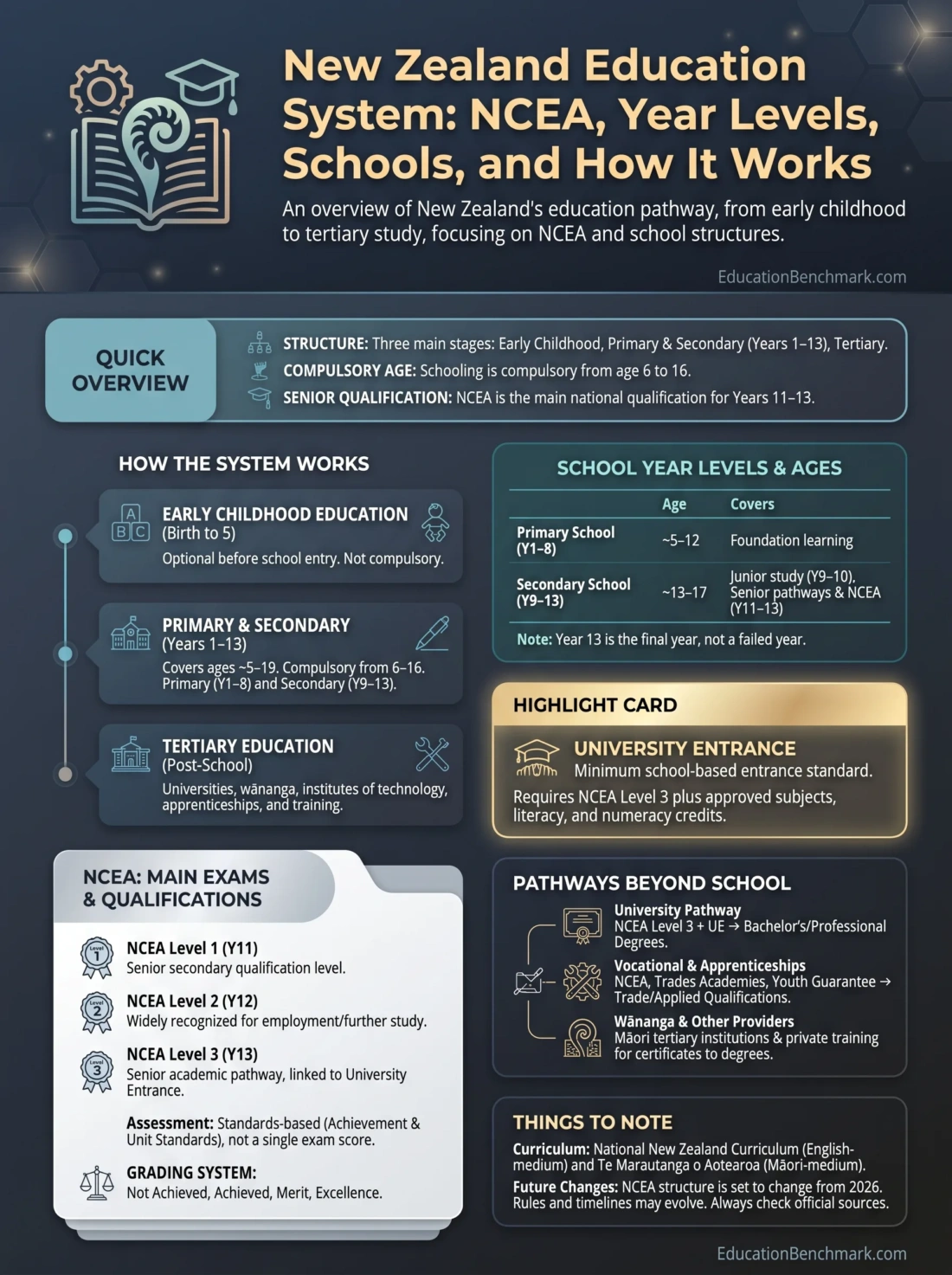
New Zealand School Route: Years, NCEA, and Post-School Choices
The route moves through thirteen school years, then branches through NCEA credits, University Entrance, workplace learning, and tertiary study.
School Start
Selected stamp: School Start. Choose another stamp to update the route card.
New Zealand uses a Year 1–13 school route, with primary education generally covering Years 1–8 and secondary education covering Years 9–13. Children commonly start school at five, enrolment is compulsory from age six until sixteen, and many remain through Year 13 at about age seventeen. State-school education is available without tuition fees for eligible domestic students from ages five to nineteen. [a]
The senior years are shaped by the National Certificate of Educational Achievement, usually shortened to NCEA. It is a credit-based qualification rather than one single leaving examination. That current route now sits beside a confirmed change timetable: NCEA will be phased out for future cohorts and replaced by a Foundational Award, the New Zealand Certificate of Education, and the New Zealand Advanced Certificate of Education.
Year-level route
Where the Year 1–13 Route Changes Shape
Year labels describe progression, but school organisation is not identical everywhere. A student may move through full primary, contributing primary, intermediate, composite, area, or secondary schools.
| Stage | Typical year levels | Approximate ages | What changes at this point |
|---|---|---|---|
| New entrant period | First months of school, sometimes described as Year 0 | About 5 | Children enter school individually or on a cohort-entry date. |
| Primary foundation | Years 1–6 | About 5–10 | Learning remains broad, with strong attention to literacy and mathematics. |
| Upper primary or intermediate | Years 7–8 | About 11–12 | Students may stay in a full primary school or move to an intermediate school. |
| Junior secondary | Years 9–10 | About 13–14 | Students follow a broad programme and begin planning senior subjects. |
| Senior secondary | Years 11–13 | About 15–17 | Courses become more specialised and usually connect with NCEA levels and post-school plans. |
School entry is less rigid than in systems where all children begin on one national date. Many children start on or after their fifth birthday. Schools using cohort entry admit new students in groups on set dates, so the first day may fall after the birthday. [b] The phrase Year 0 appears in newer curriculum and parent materials for the first period at school, while the standard school-level overview still describes the formal route as Year 1 through Year 13.
Senior qualification
How NCEA Credits, Levels, and Grades Fit Together
NCEA records achievement standard by standard. Students can study across more than one level, so a year level and a qualification level are related but not interchangeable.
Students need 60 credits at Level 1 or above, together with the literacy and numeracy requirement.
Common progression: Level 2 study, mixed-level courses, or vocationally linked learning.Students need 60 credits at Level 2 or above, together with the literacy and numeracy requirement.
Common progression: Level 3, vocational training, employment, apprenticeships, or further study.Students need 60 credits at Level 3 or above, together with the literacy and numeracy requirement.
Common progression: University Entrance, other tertiary study, training, or employment.Subjects are divided into standards, each carrying a stated number of credits. Some standards are assessed within the school; others are assessed externally, often through end-of-year examinations or submitted work. Achievement standards commonly report Not Achieved, Achieved, Merit, or Excellence. A student earns the same number of credits for Achieved, Merit, or Excellence, but the grade records the quality of the work. [d]
The literacy and numeracy co-requisite is completed once and then supports the award of any NCEA level. Students need ten literacy or te reo matatini credits and ten numeracy or te pāngarau credits through approved routes. Transition arrangements remain relevant because schools and kura may use specified standards during the change period. [e]
A certificate can be endorsed with Merit or Excellence when enough credits at the required grade are earned at that level or above.
A course endorsement recognises strong results in a particular subject or course rather than across the whole certificate.
For a certificate endorsement, NZQA sets a threshold of 50 credits at Merit or Excellence for a Merit endorsement, or 50 credits at Excellence for an Excellence endorsement. Course endorsements use separate course-based rules. [f]
Qualification change
The NCEA-to-NZCE Transition From 2028 to 2030
NCEA remains the operative senior qualification for current cohorts. The replacement is scheduled by year so students do not have to switch systems midway through their senior schooling.
-
2028
Foundational Award
Benchmarked at Year 11 and focused on literacy and numeracy. It will later be required for NZCE or NZACE, but not for progression into Year 12.
-
2029
New Zealand Certificate of Education
The Year 12 subject-based qualification begins, with students normally enrolled in at least five subjects unless an exception applies.
-
2030
New Zealand Advanced Certificate of Education
The Year 13 qualification begins and aligns with the refreshed senior curriculum and subject-based assessment model.
The confirmed design uses the abbreviations NZCE for the Year 12 certificate and NZACE for the Year 13 certificate. Students will need the Foundational Award and passes in at least three subjects to receive either certificate. Schools will normally enrol Year 12 and Year 13 students in at least five subjects. Subjects will combine coursework with at least one examination, and the planned grade scale runs from A+ to E, with C as the passing grade. Transitional arrangements will allow students close to completing NCEA to finish under NCEA rules for a defined period. [g]
Curriculum routes
English-Medium and Māori-Medium Curriculum Routes
New Zealand has national curriculum direction, but it is expressed through more than one language and schooling route.
English-medium state and state-integrated schools use the national curriculum to plan year-by-year learning and local programmes.
Kura and Māori-medium settings use curriculum direction designed for learning through te reo Māori and within Māori educational contexts.
The strengthened national curriculum is organised into learning phases and year-by-year sequences. Current Ministry material distinguishes the New Zealand Curriculum for English-medium state and state-integrated schools from Te Marautanga o Aotearoa for Māori-medium education. Curriculum implementation is being updated in stages, so schools may be working with newly required content in some learning areas while other parts remain under development or consultation. [h]
This national direction does not make every timetable identical. Schools select local contexts, organise courses, and decide how to combine subjects within official requirements. In Years 11–13, course availability can differ sharply: a large urban secondary school may offer many languages, sciences, arts, technologies, and vocational subjects, while a smaller school may use distance learning or shared provision to widen choice.
Local governance
Who Sets the Rules: Ministry, Boards, Principals, and ERO
The system combines national policy and qualifications with school-level governance and local programme decisions.
Sets education policy direction, curriculum requirements, funding rules, and national operating expectations.
Maintains NCEA rules, standards, results, assessment processes, and quality assurance for national qualifications.
Sets direction, approves policies, oversees finance and curriculum delivery, and employs school staff.
Run the school, organise teaching, support students, and carry out board and national requirements.
Evaluates schools, kura, and early learning services as the government’s external education evaluation agency.
Every state and state-integrated school or kura has a board. The board handles governance rather than routine classroom management: it sets strategic direction, develops policies, oversees curriculum, finance, property, health and safety, and employs staff. The principal manages day-to-day operations. [i] The Education Review Office, known as ERO, provides external evaluation across schools, kura, kōhanga reo, and early learning services. [j]
School provision
State, State-Integrated, Charter, Private, and Kura Options
School type affects governance, curriculum obligations, fees, special character, language of learning, and admissions arrangements.
The Ministry’s school-type guidance distinguishes state, state-integrated, charter, private, and Māori-medium routes. State-integrated schools retain a special character while teaching the national curriculum. Charter schools are publicly funded but have more operating freedom. Private schools are not required to follow the national curriculum in the same way as state schools. [k]
Admission can also depend on location. A school with an enrolment scheme guarantees places for students living within its defined zone, while out-of-zone applicants may face a ballot when applications exceed available places. Not every school has a zone, and specialist or private providers use different admissions rules. [l]
Applied learning
Gateway, Trades Academies, and Mixed School–Work Routes
Vocational learning can sit inside senior secondary education rather than beginning only after school.
Students complete a mainly school-taught selection of academic, creative, technical, and practical subjects.
Senior students undertake structured workplace learning linked to stated knowledge, skills, and assessment.
Schools, tertiary providers, and employers combine learning for trades, technology, and industry pathways.
Students may continue into work-based training, a certificate, a diploma, or employment after leaving school.
Trades Academies are secondary-tertiary partnerships for students in Years 11–13 who want learning connected to trades, technology, or industry. Programmes can contribute toward NCEA or an equivalent qualification while also leading toward nationally recognised tertiary study. [m] Gateway has a different emphasis: it gives senior students access to structured workplace learning with a formal learning arrangement, stated skills, and specified assessment. [n]
These options are not a single nationwide track assigned to every vocationally interested student. Availability depends on the school, region, tertiary partner, employer network, and funded places. Students may combine workplace learning with subjects needed for NCEA Level 2, NCEA Level 3, University Entrance, or another post-school goal.
Higher education gate
From NCEA Level 3 to University Entrance
NCEA Level 3 and University Entrance are connected awards, but they test different conditions.
| Requirement | Current national minimum | Why it is separate |
|---|---|---|
| School qualification | NCEA Level 3 | Confirms the senior certificate level |
| Approved subjects | 14 Level 3 credits in each of three approved subjects | Not every Level 3 credit belongs to a UE-approved subject |
| Literacy | 10 Level 2 or higher credits: five reading and five writing | UE uses its own specified literacy standards |
| Numeracy | 10 Level 1 or higher credits through approved standards | The accepted standards must meet the UE numeracy rule |
NZQA awards University Entrance when all national conditions are met. [o] Individual universities and degree programmes can ask for more. Selective courses may use a rank score, specified subjects, portfolios, auditions, interviews, or higher grades. A student who misses direct entry may still have options through foundation study, certificates, diplomas, discretionary pathways, or later transfer, depending on the institution.
Post-school education is wider than the university route. New Zealand’s tertiary sector includes eight state-funded universities, polytechnics, wānanga, private training establishments, and work-based learning. Qualifications range from foundation and vocational certificates to diplomas, degrees, postgraduate study, and doctorates. [p]
Comparison lens
What Makes the New Zealand Route Distinct
New Zealand combines a national curriculum and national senior qualifications with substantial school-level decision-making. It does not use one nationwide selection examination to divide all students into fixed academic and vocational schools at an early age. The main senior record is built from credits across standards, subjects, and assessment types, with separate national conditions for literacy, numeracy, and University Entrance.
International results add context but do not measure every part of the school route. In PISA 2025, New Zealand averaged 480 in mathematics, 497 in reading, and 509 in science, above the OECD averages of 463, 461, and 482 respectively. The 2025 results were statistically about the same as in 2022 across all three subjects. Science performance has remained broadly stable for more than a decade, while mathematics and reading were below their 2015 and 2018 levels. [q] [r]
Digital learning in PISA 2025: 89% of New Zealand students attended schools whose principals reported that cell phones were not allowed on school premises, up from 18% in PISA 2022. In the same survey, 47% of students reported using AI chatbots to help them learn at least once a week, close to the OECD average of 46%. These figures describe reported school rules and student use; they do not show that either practice caused the achievement results. [r]
The OECD attaches a data-quality caution to New Zealand’s PISA 2025 results because participation and exclusion measures did not fully meet its technical targets. Its analysis indicates that the reported mean scores may be about 10–15 points higher than estimates that also account for non-responding students. The OECD also notes that PISA 2022 was affected in the same direction and to a similar extent, so comparisons between 2022 and 2025 are unlikely to be materially distorted by this issue. [r]
Verification points
Rules That Depend on the School, Cohort, or Provider
- Starting arrangements: individual entry, cohort entry, Year 0 wording, and first-year placement can differ.
- School access: zones, ballots, special-character priorities, and private admissions are provider-specific.
- Senior subjects: schools do not all offer the same NCEA standards, vocational programmes, or advanced courses.
- Qualification cohort: students approaching senior school during 2028–2030 need advice matched to the NCEA replacement timetable.
- Tertiary admission: the national UE award is a minimum, not a guarantee of entry to every programme.
Independent information note: Education Benchmark is an independent informational guide and is not affiliated with any ministry of education, school authority, exam board, university, government agency, or official ranking organization.
Education rules, qualification designs, admissions conditions, and curriculum implementation dates can change. Important decisions should be checked with the relevant school, university, NZQA, Ministry of Education, or other responsible provider.
Reference record
Sources and Verification
- [a] Primary and secondary education — Used for Year 1–13 structure, typical age ranges, compulsory enrolment ages, and state-school access. (Reliable because it is a current New Zealand Ministry of Education page.)
- [b] Cohort or group entry for children starting school — Used for the distinction between birthday entry and scheduled cohort entry. (Reliable because it is official Ministry guidance for school entry.)
- [c] NCEA levels and certificates — Used for current Level 1, Level 2, and Level 3 credit requirements. (Reliable because NZQA administers New Zealand’s national secondary qualifications.)
- [d] About NCEA — Used for standards, credits, assessment types, and NCEA result language. (Reliable because it is NZQA’s official NCEA overview.)
- [e] Literacy and Numeracy — Used for the 20-credit literacy, numeracy, te reo matatini, and pāngarau requirement. (Reliable because it is the official NZQA requirement page.)
- [f] NCEA endorsement — Used for certificate and course endorsement rules. (Reliable because it is NZQA’s current endorsement guidance.)
- [g] Further details confirmed for new senior secondary qualifications replacing NCEA — Used for the Foundational Award, NZCE, NZACE, grading design, subject rules, and 2028–2030 rollout. (Reliable because Tāhūrangi is the Ministry’s official curriculum platform.)
- [h] About the New Zealand Curriculum and your child — Used for curriculum phases, year-by-year learning, and the English-medium and Māori-medium distinction. (Reliable because it is current Ministry curriculum guidance.)
- [i] What is a school board — Used for board responsibilities and the distinction between governance and daily management. (Reliable because it is official Ministry guidance for school boards.)
- [j] About the Education Review Office — Used for ERO’s external evaluation role. (Reliable because ERO is New Zealand’s government education evaluation agency.)
- [k] Types of primary and secondary education — Used for state, state-integrated, charter, private, and Māori-medium school distinctions. (Reliable because it is the Ministry’s official school-type guidance.)
- [l] School zones and enrolment schemes — Used for in-zone guarantees and out-of-zone applications. (Reliable because it is current official enrolment guidance.)
- [m] Trades Academies — Used for secondary-tertiary partnerships and trades-linked senior learning. (Reliable because Youth Guarantee is a Ministry of Education programme.)
- [n] Gateway funding — Used for structured workplace-learning requirements in senior secondary school. (Reliable because it is official Youth Guarantee programme guidance.)
- [o] University Entrance — Used for the national NCEA Level 3, approved-subject, literacy, and numeracy conditions. (Reliable because NZQA sets and awards University Entrance.)
- [p] Tertiary education — Used for provider types and the university sector. (Reliable because it is the Ministry’s official overview of tertiary education.)
- [q] PISA 2025: New Zealand Summary Report — Used for New Zealand’s 2025 mathematics, reading, and science scores and their comparison with the 2022 cycle. (Reliable because it is published by New Zealand’s Ministry of Education through Education Counts.)
- [r] PISA 2025 Results (Volume I): New Zealand — Used for official PISA 2025 trend comparisons, OECD averages, cell-phone policy exposure, AI-chatbot use, and the data-quality note for New Zealand. (Reliable because OECD publishes and maintains the PISA assessment data.)