
Cyprus Secondary Route Passport
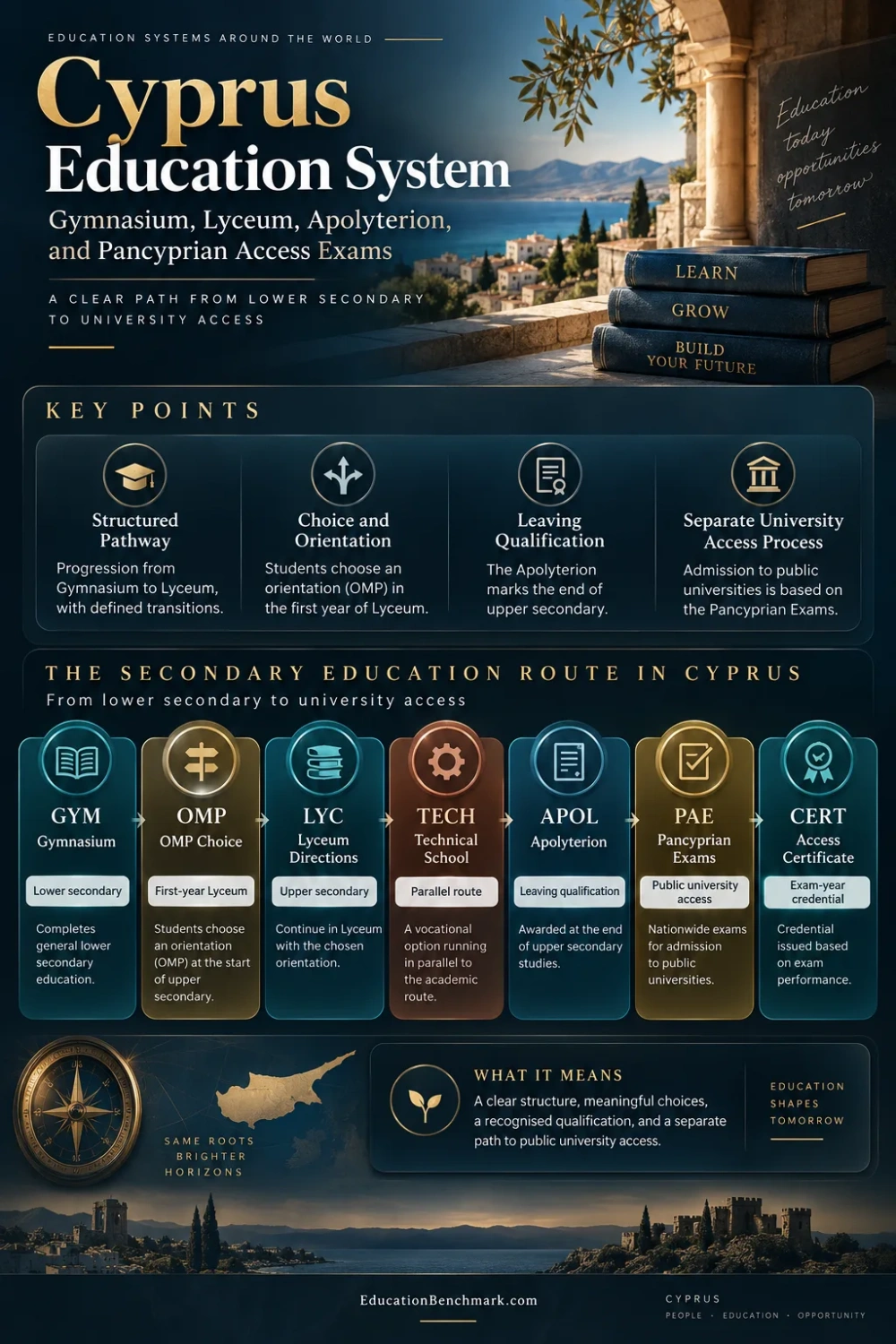
The public secondary route turns on Gymnasium completion, Lyceum orientation choices, an upper-secondary leaving qualification, and a separate public-university access process.
Gymnasium
Selected stamp: Gymnasium. Choose another stamp to update the route card.
Cyprus uses two separate ideas that are easy to confuse: finishing upper secondary school and competing for public-university places. In the public system, Gymnasium forms the lower-secondary stage, while Lyceum and technical education provide upper-secondary routes. References to Cyprus here mean the public education system administered by the Republic of Cyprus Ministry of Education, Sport and Youth. Official secondary education information places Gymnasium and Lyceum in two three-year cycles for students aged roughly 12 to 18, with attendance compulsory up to age 15 or completion of lower secondary school, whichever comes first. [a]
The central distinction is simple: successful completion of Lyceum leads to the Apolyterion, the school-leaving qualification. The Pancyprian Access Examinations serve a different purpose: access and ranking for eligible public higher-education places. Keeping those two processes separate makes the rest of the system much easier to follow.
From Gymnasium to Lyceum: The Core Secondary Route
Gymnasium is the three-year lower-secondary cycle. Students normally enter after primary education and complete Years A, B, and C of Gymnasium before moving into an upper-secondary route. The public Lyceum then runs for another three years, normally from about age 15 to 18, and is not itself compulsory. Students who complete it successfully receive an Apolyterion. [b]
| Stage | Typical age | Length | Role in the route |
|---|---|---|---|
| Gymnasium | About 12–15 | 3 years | Lower secondary; the compulsory stage ends by age 15 or completion of lower secondary, whichever comes first. |
| Lyceum | About 15–18 | 3 years | General upper secondary; successful completion leads to the Apolyterion. |
| Technical School | About 15–18 | 3 years | Parallel technical and vocational upper-secondary route leading to an equivalent school-leaving qualification. |
The table is a route map, not a claim that every student follows the same programme. The main branching point comes after Gymnasium: a student can continue in the general Lyceum route or enter Secondary Technical and Vocational Education. Within Lyceum, subject choice begins to shape the academic route from the first year.
The Lyceum Choice: Four OMP Groups Lead Into Six Directions
First-year Lyceum students choose one of four Orientation Subject Groups, commonly abbreviated as OMP. The four official pairings are Ancient Greek/Classical Studies with History; Mathematics with Physics; Mathematics with Economics; and Economics with English. Public-school rules also set out how students can move into a direction that does not directly follow their original OMP, usually through placement examinations in missing orientation subjects. [c]
| First-year OMP | Orientation subjects | Direct direction options |
|---|---|---|
| 1st OMP | Ancient Greek / Classical Studies and History | Classical and Humanities Studies; Foreign Languages and European Studies; Fine Arts |
| 2nd OMP | Mathematics and Physics | Sciences, Biosciences, Informatics and Technology; Fine Arts |
| 3rd OMP | Mathematics and Economics | Economic Studies; Fine Arts |
| 4th OMP | Economics and English | Commerce and Services; Fine Arts |
Current Ministry transition material lists six directions for second- and third-year Lyceum: Classical and Humanities Studies, Foreign Languages and European Studies, Sciences, Biosciences, Informatics and Technology, Economic Studies, Commerce and Services, and Fine Arts. [d]
Changing Direction Is Possible, but Prerequisites Matter
The OMP choice creates a direct route rather than an irreversible lock. Fine Arts can be entered from all four OMP groups without placement examinations under the published transition rules. For other directions, a student coming from a different OMP may have to pass examinations in orientation subjects that were not previously studied. A student moving from second- to third-year Lyceum can also change direction, but examinations can be required in compulsory or elective subjects missing from the previous direction.
How School Assessment Builds the Apolyterion
Public secondary schools use a 20-point grading scale. The published bands are 19–20 Excellent, 16–18 Very Good, 13–15 Good, 10–12 Almost Good, and 1–9 Fail. A mark of 10 is the normal promotion base. For a subject with a unified final written examination, the annual subject grade is calculated as 35% first term + 35% second term + 30% final written examination. For a subject without that final written examination, the annual mark is based on the two term grades. [e]
School Final Exams and University Access Exams Are Separate
Cyprus currently runs unified final promotion and school-leaving written examinations for public secondary schooling. Those examinations contribute to school-year results. They should not be treated as another name for the Pancyprian Access Examinations, which belong to the public higher-education access process.
The Apolyterion itself records more than a single final number. Public-school regulations provide for school and student details, the Lyceum direction where applicable, the overall school-year grade, common-core subjects, compulsory direction subjects, elective direction subjects, and the corresponding results. The overall school-year grade shown on the leaving record is the arithmetic mean of the listed common-core, compulsory-direction, and elective-direction marks. [f]
Apolyterion and Pancyprian Access Exams Serve Different Purposes
The Apolyterion sits at CyQF/EQF Level 4 for upper-secondary general education, while upper-secondary technical and vocational certificates are also placed at Level 4. This makes the Apolyterion a school qualification in the national level system, not a university entrance score. [g]
Credential contrast
Apolyterion vs Pancyprian Access Examinations
Both can involve marks on a 20-point scale, but they measure different things and are produced by different processes.
The Examination Service states that the Pancyprian Access Examinations are entrance examinations for public universities in Cyprus and Greece. They award an Access Certificate and ranking grade for eligible subject combinations, support allocation to public higher-education places in Cyprus, and transmit ranking information and preferences for the Greek public-university process. The Access Certificate and ranking apply only to the year in which the candidate sits the examinations. [h]
The Technical-School Route Also Ends With an Apolyterion
Secondary Technical and Vocational Education provides a parallel three-year upper-secondary route for students aged about 15 to 18. It has theoretical and practical pathways, combining general education with technological and practical specialisation. The official description states that the leaving certificate is equal and equivalent to the higher-secondary leaving certificate, and that the route can lead either to employment or to further study in higher education. [i]
Technical Gymnasium Is a Different Programme
Technical Gymnasium should not be confused with the upper-secondary Technical School route. For the 2026–27 school year, the Ministry lists Technical Gymnasium provision at four Gymnasia in Nicosia, Limassol, Famagusta, and Paphos, following the programme’s launch in 2025. It introduces technical and applied learning within lower secondary education rather than replacing the later upper-secondary technical route. [j]
Pancyprian Access Exams: From Exam Subjects to Public-University Ranking
The Pancyprian route is subject-based. Candidates choose examination subjects that make them eligible for particular numbered access categories and, through those categories, particular groups of public higher-education programmes. This is why two candidates can sit different subject combinations and qualify for different study options rather than receiving one universal admissions score that opens every programme.
Pancyprian route
How an Exam Combination Becomes an Eligible University Choice
The chosen subjects determine which official access categories the candidate can use.
Only programmes connected to an eligible category can enter that candidate’s public-university choice set.
The score is used to rank candidates within the applicable public higher-education process.
Admission depends on eligibility, ranking, declared preferences, available places, and the rules of the annual cycle.
The official 2026 results page publishes the general access/ranking grade on a 20-point scale to three decimal places and displays each candidate’s valid access-category numbers. This numerical similarity to the school grading scale can be misleading: a Pancyprian ranking grade is not the same record as the Apolyterion school-year average. [k]
2026 examination cycle
Who Entered the Pancyprian Access Process in 2026?
Official application statistics show that the access route includes both current final-year students and earlier graduates.
Candidates seeking access to public higher education in Cyprus and Greece.
Candidates who were in their final school year during the 2026 cycle.
Candidates who had already completed secondary education before the 2026 cycle.
The presence of 341 previous graduates is a useful structural clue: participation is not limited to students receiving an Apolyterion in the same school year. The 2026 application data recorded 5,139 public-higher-education access candidates in total. [l]
Cyprus and Greece Are Connected, but Placement Is Not Identical
For public higher education in Cyprus, Pancyprian results are used within the Cypriot allocation process for eligible places. For Greece, candidate ranking data and declared preferences are transmitted to the Greek education authorities for the allocation of places in Greek public higher education. A candidate therefore should not treat “Cyprus placement” and “Greece placement” as one identical result list.
What Can Change by School Route or Exam Year
Public-school placement can depend on residence. The Ministry’s educational-district information for 2026–27 covers public Gymnasia and Lyceums and states that students are required to enrol in the school assigned to their designated educational district, subject to the applicable transfer rules. [m]
University-access details also change from one examination cycle to another. Subject specifications, exam content, application dates, category eligibility, and programme availability should be checked against the current Pancyprian materials rather than copied from an older year. The official 2026 examination guide, for instance, was issued in separate volumes covering the year’s access examinations and subject specifications. [n]
The public Gymnasium–Lyceum route described here should not be assumed to apply unchanged to every private or international programme. For a school transfer, subject choice, leaving qualification, or university application, the current school, Ministry, examination authority, or receiving institution should be checked directly.
Education Benchmark is an independent informational guide and is not affiliated with any ministry of education, school authority, exam board, university, government agency, or official ranking organization.
Sources and Verification
- [a] Secondary General Education: General Information, Goals, Registrations — Used for the two-cycle public secondary structure, ages, compulsory-attendance boundary, and district-based registration context. (Reliable because it is an official Ministry secondary-education source.)
- [b] Lyceum — Used for the three-year Lyceum cycle, non-compulsory status, first-year orientation choice, and award of the Apolyterion. (Reliable because it is the official Ministry page for public Lyceum education.)
- [c] Secondary Education Enrolment and Transfer Rules — Used for the four OMP subject pairings and the placement-examination rules that apply when students change direction. (Reliable because it publishes the official public secondary-school regulations.)
- [d] Responsible Declaration — Lyceum Orientation Groups and Directions — Used to verify the current OMP-to-direction map and the six named Lyceum directions. (Reliable because it is a Ministry-published transition document.)
- [e] Unified Final Promotion and School-Leaving Written Examinations — Used for the 20-point scale and the 35% + 35% + 30% annual-grade calculation for examined subjects. (Reliable because it is the Ministry’s official final-examinations page.)
- [f] Secondary Education Regulations — Student Attendance and Assessment — Used for the information printed on the Apolyterion and the calculation of the overall school-year grade. (Reliable because it reproduces the official public secondary-school assessment regulations.)
- [g] CyQF Diagram — Used to verify Level 4 placement of general and technical upper-secondary leaving qualifications. (Reliable because it is the official national qualifications-level portal.)
- [h] Examination Service — Pancyprian Access Examinations — Used for the purpose of the access examinations, the Access Certificate, Cyprus and Greece placement roles, and exam-year validity. (Reliable because it is the official government Examination Service.)
- [i] Secondary Technical and Vocational Education: General Information, Goals, Registrations — Used for the three-year technical route, theoretical and practical pathways, certificate equivalence, and progression to work or higher education. (Reliable because it is the official Ministry technical-education source.)
- [j] Technical Gymnasium — Used for the 2026–27 operation and expansion of Technical Gymnasium provision across four listed Gymnasia. (Reliable because it is the Ministry’s official programme page.)
- [k] Pancyprian Access Examinations 2026 — Access and Ranking Grades — Used for the 20-point, three-decimal result format and display of valid access-category numbers. (Reliable because it is the official 2026 Examination Service results system.)
- [l] Statistics for Pancyprian Access Examinations 2026 — Used for the 2026 candidate totals, including final-year students and previous graduates. (Reliable because it is an official Republic of Cyprus government release.)
- [m] Educational Districts — Used for 2026–27 public Gymnasium and Lyceum assignment by place of residence. (Reliable because it is the official Ministry educational-district page.)
- [n] Pancyprian Access Examinations Guide 2026 — Used to verify the annual examination-guide structure and 2026 subject-specification materials. (Reliable because it is the official Pancyprian examinations portal.)