Portugal School Route Passport
Follow the route from the three-cycle Ensino Básico structure to secondary qualifications, entrance examinations, universities, and polytechnics.
Ensino Básico
Selected stamp: Ensino Básico. Choose another stamp to update the route card.
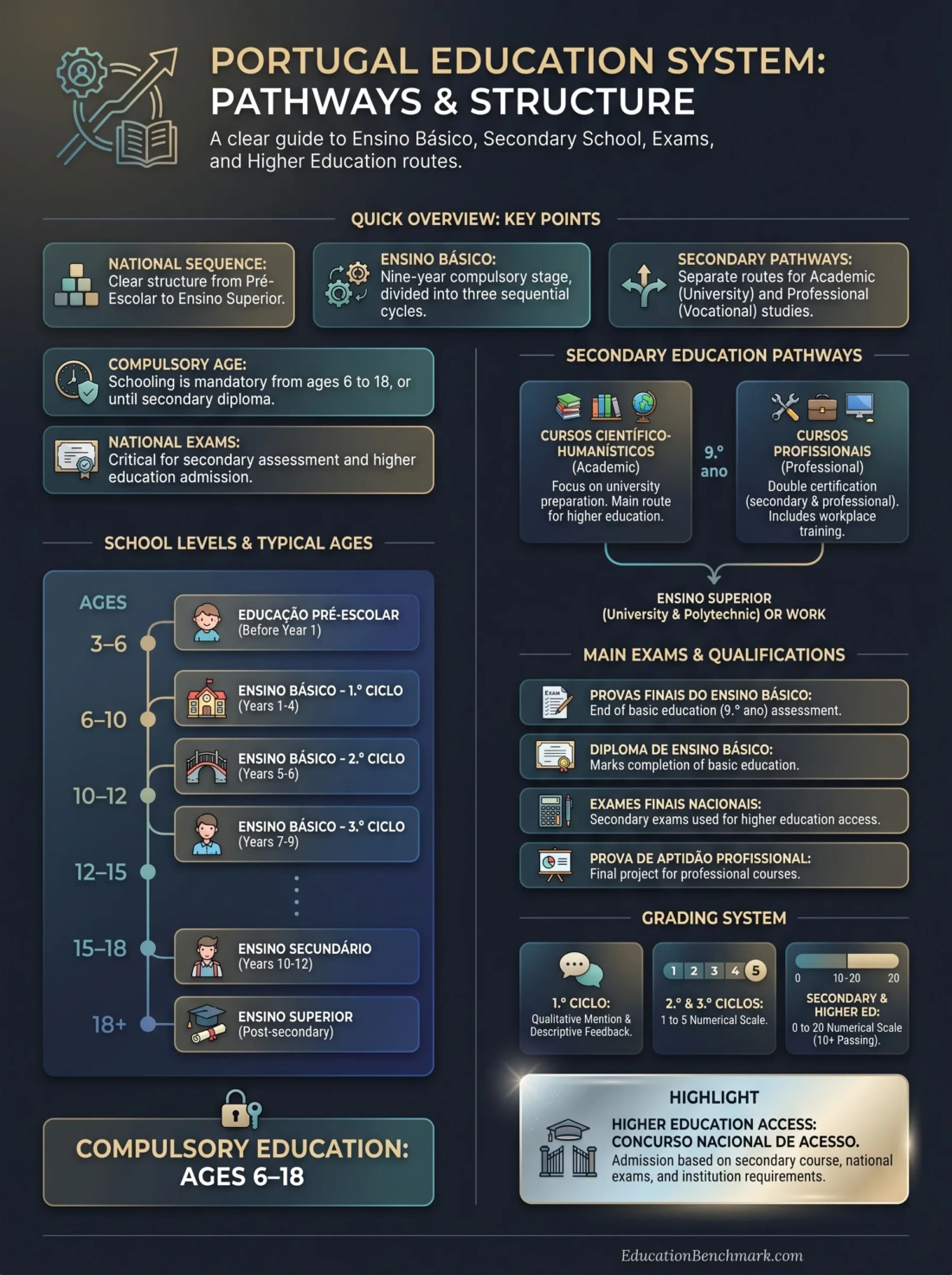
Portugal’s school system is easiest to understand as a continuous twelve-year compulsory route with a major branching point after the 9.º ano. The first nine years form ensino básico, while grades 10–12 form ensino secundário. Students do not all follow the same secondary programme: some choose a scientific-humanistic course aimed mainly at higher education, while others enter professional, artistic, or alternative qualifying routes. School attendance generally begins at age six and remains compulsory until secondary education is completed or the student reaches the applicable age limit of 18. [a]
Nine-year basic route
The Three-Cycle Logic of Ensino Básico
The word “basic” covers a longer route than the English word “primary” normally suggests.
| Education stage | Grades | Typical ages | Main structural feature |
|---|---|---|---|
| Educação pré-escolar | No numbered grade | About 3–5 | Optional pre-school provision before compulsory education |
| 1.º Ciclo do Ensino Básico | 1–4 | About 6–9 | Four-year primary stage, commonly centred on a main classroom teacher |
| 2.º Ciclo do Ensino Básico | 5–6 | About 10–11 | Two-year transition to a broader subject-based timetable |
| 3.º Ciclo do Ensino Básico | 7–9 | About 12–14 | Three-year lower secondary stage ending with basic-education completion |
| Ensino Secundário | 10–12 | About 15–17 or 18 | Three-year upper secondary stage with several academic and qualifying routes |
Typical ages assume entry and progression without delay. Portugal’s three basic-education cycles and their modal ages are described in the European Eurydice system profile. [b]
The first cycle is the closest equivalent to primary school, but ensino básico does not end after grade 4. It continues through the second and third cycles until grade 9. This matters when records are translated or compared internationally: a certificate showing completion of ensino básico represents nine completed school years, not merely elementary education.
What Readers Often Confuse
Portugal’s twelve compulsory years should not be confused with twelve years of ensino básico. The legal route combines nine years of basic education with three years of secondary education. Cross-country compulsory-education datasets also record Portugal as a long compulsory-schooling system beginning around age six. [c]
Assessment also changes as students advance. In the first cycle, reporting is largely qualitative and descriptive. In the second and third cycles, summative results are normally expressed numerically on a 1–5 scale. A level of 3 generally represents satisfactory performance, although progression and retention decisions consider the full set of results and the rules applying to the year or cycle. Retention during non-terminal years of basic education is intended to be exceptional rather than automatic after one weak mark. [d]
The main branching point
What Changes After the 9.º Ano
Students complete the third cycle and then choose a secondary route with a different balance of general study, applied learning, and qualification requirements.
Three-year general programmes organised around one of four fields and designed mainly to prepare students for higher education.
Programmes combining secondary completion with occupational training, workplace experience, and a professional qualification.
Specialised artistic, education-and-training, apprenticeship, recurrent, and other offers serve narrower learner needs and goals.
The transition after grade 9 is a choice of programme rather than a permanent division into rigid school types. A student’s route is shaped by interests, previous achievement, the subjects needed for later study, and the courses available within travelling distance. Large school groupings may provide several options; smaller local networks may offer fewer.
Grade 9 also carries national external assessment. Under the current rules, final examinations include Portuguese—or an applicable Portuguese language version—and mathematics for the students required to take them. These examinations sit alongside school-based assessment and contribute to completion of the third cycle. Earlier in basic education, national monitoring assessments have a different diagnostic purpose and should not be interpreted as secondary-school entrance examinations. [e]
General secondary education
Científico-Humanísticos: Four Routes Toward Higher Study
These programmes share a general component but differ in their specialised subjects and preparation.
| Course | Typical emphasis | Possible later directions | Important planning point |
|---|---|---|---|
| Ciências e Tecnologias | Mathematics, sciences, and technical preparation | Science, engineering, health, technology, and related fields | Specific degree programmes may require mathematics or science entrance subjects |
| Ciências Socioeconómicas | Mathematics, economics, geography, and social analysis | Economics, management, finance, social science, and related fields | Mathematics A is an important component and may be required for later applications |
| Línguas e Humanidades | Languages, literature, history, geography, and humanistic study | Languages, law, humanities, communication, education, and social fields | Students should compare optional subjects with future provas de ingresso |
| Artes Visuais | Drawing, visual communication, geometry, and artistic practice | Art, design, architecture, visual communication, and creative fields | Some later programmes may also impose practical or portfolio-related prerequisites |
Cursos Científico-Humanísticos last three school years, corresponding to grades 10, 11, and 12. They are intended primarily for students planning to continue into university or polytechnic education. Completion provides a secondary-school diploma and a level 3 qualification in Portugal’s national qualifications system. [f]
The four courses are not pre-admission guarantees for particular degrees. A student in Ciências e Tecnologias, for example, still needs the appropriate national examination results for the programmes being targeted. Conversely, an institution looks at the published entrance requirements rather than relying only on the name of the secondary course.
How the Three-Exam Model Fits the Route
Under the current scientific-humanistic completion rules, students complete three final national examinations: Portuguese is compulsory, while the other two are selected from permitted subjects in the specific training component or an allowed combination involving Philosophy. Secondary subjects are graded on a 0–20 scale, with 10 normally representing the minimum passing classification. [g]
Course Choice and Entrance-Subject Choice Are Related but Different
A secondary course determines the student’s timetable and the subjects studied in depth. A prova de ingresso is the subject requirement used for a particular higher-education application. One national examination can sometimes contribute to secondary completion and later be used as an entrance result, but the two functions should not be treated as identical.
Dual-certification route
Cursos Profissionais and Applied Secondary Pathways
Professional education is a full secondary route rather than a short course taken outside the school system.
Students complete common and field-related subjects needed for a recognised secondary qualification.
The programme includes professional preparation and training in a real or closely simulated working context.
A final project is presented and defended before a panel to demonstrate the competence developed during training.
Cursos Profissionais normally last three years and are structured through modules and training components rather than only a conventional subject timetable. They lead to dual certification: completion of secondary education and a professional qualification at national qualification level 4. The route includes training in a workplace context and culminates in the Prova de Aptidão Profissional, commonly shortened to PAP. Graduates may enter employment, continue into post-secondary study, or seek access to higher education. [h]
The professional route is therefore not an educational dead end. The practical issue is that higher-education access may require additional planning. A student must still satisfy the admission route, examinations, local assessments, prerequisites, or subject correspondences applicable to the intended programme.
Other Recognised Secondary Offers
Portugal’s secondary offer also includes specialised artistic courses, programmes with institution-specific study plans, recurrent secondary education, and other vocational or training routes. Specialised artistic provision may cover areas such as music, dance, visual arts, or audiovisual study. Recurrent education provides a more flexible completion route, particularly for learners whose schooling did not follow the standard age sequence. The national offer is wider than the simple academic-versus-professional distinction. [i]
Assessment sequence
How Provas Finais, Exames Nacionais, and Grades Connect
The same word “exam” can refer to assessments with different purposes at different stages.
Teachers assess progress throughout the year. Monitoring assessments support system diagnosis, while grade 9 final tests contribute to third-cycle completion.
Scientific-humanistic students combine school results with required national examinations. Other programmes use their own modules, projects, placements, and completion rules.
Selected examination results can be used to demonstrate the entrance subjects required by a particular degree and institution.
At the end of grade 9, the final examinations cover Portuguese—or the relevant Portuguese language version—and mathematics. These are not a single competitive placement test assigning students to secondary schools. They form part of the assessment and certification system at the end of ensino básico.
In scientific-humanistic secondary education, subject performance is normally recorded on the 0–20 scale. A final classification below 10 means that the subject has not been passed. National examinations are scored initially on a 0–200-point basis and converted to the 0–20 scale where required by the applicable calculation rules.
Professional-course students are evaluated through disciplines, short-duration training units or modules, workplace training, and the PAP. This is why a direct comparison between one CCH average and one professional-course result can be misleading: both certify secondary completion, but the assessment architecture is different.
Application route
From the 12.º Ano to a DGES Application
Admission depends on a specific institution-and-course choice, not on one universal university entrance score.
The applicant needs a Portuguese secondary course or another qualification legally recognised as equivalent.
The applicant identifies the national examinations accepted for the chosen institution-and-course combination.
Each programme may publish minimum entrance marks, a minimum application grade, or health, physical, artistic, and other prerequisites.
Eligible candidates compete for available places through the appropriate national, institutional, special, or international route.
Portuguese higher education is divided into university and polytechnic education. Both sectors can award the licenciado and mestre degrees, while doctorates are awarded within the university sector. A licenciatura commonly carries 180 or 240 ECTS credits, depending on the field and programme structure. Higher education also includes short-cycle Cursos Técnicos Superiores Profissionais, generally known as CTeSP programmes. [j]
For the public higher-education general access competition, the applicant normally needs a completed secondary qualification, the national examinations corresponding to the required provas de ingresso, and any prerequisites imposed for the programme. Institutions set course-specific entrance subjects and minimum classifications under the national rules, and these requirements are published for each application cycle. [k]
A Worked Route Without Inventing One National Formula
A student completing Ciências e Tecnologias might target an engineering licenciatura. The student first checks the DGES entry for the exact institution and course, identifies the accepted entrance-subject combination, confirms the minimum examination and application grades, and checks whether a prerequisite applies. Another engineering programme may accept a different combination or set a different minimum. Eligibility must therefore be checked course by course.
Access From Professional and Dual-Certification Routes
Graduates of professional and other dual-certification programmes can pursue higher education through the ordinary route when they hold the required national examination results. Portugal also provides specific competitions for holders of qualifying professional and specialised artistic routes. These may use locally organised assessments and defined correspondence between the applicant’s training field and the target programme. The available institutions, consortia, fields, vacancies, and assessment arrangements must be checked for the relevant year. [l]
National rules, local delivery
Who Sets the Rules—and Where Schools Still Differ
Portugal is more centrally organised than a federal education system, but school experience is not identical everywhere.
Responsibility for education policy is organised centrally through the national ministry responsible for education, science, and innovation. The central system covers pre-school, basic education, secondary education, vocational qualification policy, and higher education, while specialised agencies administer important parts of the system. Municipalities and schools carry responsibilities in delivery, facilities, local organisation, and support, but they do not operate separate state-style curricula comparable to those found in a federal country. [m]
The Agencies Most Readers Encounter
- DGE — Direção-Geral da Educação: curriculum, educational provision, guidance, and school-level regulatory information.
- IAVE — Instituto de Avaliação Educativa: national external assessment instruments, examination information, calendars, and classification criteria.
- ANQEP — Agência Nacional para a Qualificação e o Ensino Profissional: vocational education, qualifications, professional routes, and the National Qualifications System.
- DGES — Direção-Geral do Ensino Superior: higher-education information, public access competitions, entrance requirements, and application guidance.
Portugal’s curriculum uses national reference documents, including the Aprendizagens Essenciais. These identify essential disciplinary learning and connect teaching and assessment with the broader competence areas described in the Profile of Students Leaving Compulsory Schooling. Schools have room to organise and contextualise part of the curriculum, but this flexibility operates inside national rules rather than replacing it. [n]
Public, Private, and International Provision
Public schools form the main route through compulsory education. Private and cooperative schools may also deliver recognised Portuguese programmes, sometimes under different funding arrangements. International schools may use foreign or international curricula, but families should not assume that grade names, leaving certificates, or university-entry preparation correspond automatically to the Portuguese route.
For a student transferring into or out of Portugal, the important questions are whether the programme leads to a recognised qualification, how prior studies will be granted equivalence, which Portuguese year level is appropriate, and whether the chosen upper-secondary subjects satisfy future entrance requirements.
Benchmark note
Reading Portugal in an International Context
International results describe student performance at one point in time; they do not replace an explanation of the school route.
Portugal remained close to OECD averages in mathematics, reading, and science, but mathematics and reading fell again from 2022.
PISA does not issue one official combined national score covering all three core subjects.
The survey does not explain course availability, national diploma rules, individual school quality, or university eligibility.
In PISA 2025, Portuguese 15-year-olds scored 460 in mathematics, 462 in reading, and 482 in science, compared with OECD averages of 463, 461, and 482 respectively. Mathematics fell by 12 points and reading by 15 points from 2022, while science was about the same as in 2022. The OECD reports that Portugal’s latest results are now close to the levels observed in 2006 across all three subjects, reversing the gains recorded in the intervening years. Science was the main assessment domain in PISA 2025, while mathematics and reading were minor domains. [o]
These results are useful for comparing broad learning outcomes, but they should not be converted into a claim that every Portuguese school performs at the national average. PISA is sample-based, focuses on 15-year-olds, and measures selected competencies rather than the full curriculum. School-level choice requires more specific information about provision, student support, language needs, course continuity, and local outcomes.
Official checks matter
Sources and Verification
Education rules can change between school years, especially examination regulations, calendars, course offers, and higher-education admission conditions.
Education Benchmark is an independent informational guide and is not affiliated with any ministry of education, school authority, exam board, university, government agency, or official ranking organization.
Before making a school placement, examination, qualification, or higher-education decision, verify the current rule with the relevant school, DGE, IAVE, ANQEP, DGES, institution, or other responsible authority. The external-assessment regulation approved in 2026 applies to the 2025/2026, 2026/2027, and 2027/2028 school years, but annual calendars and implementation details are still published separately. [p]
- [a] Having a Child: Children and Young People’s Education — Used for the twelve-year compulsory route, school entry, and the relationship between basic and secondary education. (Reliable because it is an official Portuguese government service guide.)
- [b] Single-Structure Primary and Lower Secondary Education — Used for the three cycles of ensino básico, their grade spans, and modal ages. (Reliable because Eurydice is the European Union’s education-system information network.)
- [c] Compulsory Education Worldwide (2026): Years, Ages, and Enforcement by Country — Used as a secondary cross-country reference for Portugal’s compulsory-schooling duration and entry-age context. (Useful because it presents country-level compulsory-education parameters in a comparative format, while official Portuguese sources remain the primary authority.)
- [d] Avaliação — Used for basic-education assessment formats, numerical reporting in the second and third cycles, and the treatment of retention. (Reliable because DGE is Portugal’s official Directorate-General for Education.)
- [e] Perguntas Frequentes — Ensino Básico — Used to verify the current grade 9 final-examination requirements in Portuguese or the applicable language version and mathematics. (Reliable because DGE is Portugal’s official Directorate-General for Education.)
- [f] Cursos Científico-Humanísticos — Used for the purpose, three-year duration, secondary diploma, and qualification level of scientific-humanistic courses. (Reliable because it is an official DGE programme page.)
- [g] PORTUGAL 2024 — Sistema Educativo Português — Used for the 0–20 secondary grading scale, passing threshold, scientific-humanistic examination structure, and professional-course completion overview. (Reliable because it is an official DGE system infographic.)
- [h] Cursos Profissionais — Used for programme duration, dual certification, level 4 status, workplace learning, and the Prova de Aptidão Profissional. (Reliable because ANQEP is Portugal’s national authority for qualifications and vocational education.)
- [i] Oferta Formativa — Used to identify the wider range of scientific-humanistic, professional, artistic, recurrent, and other secondary offers. (Reliable because it is the official DGE education-and-training offer page.)
- [j] Information on the Portuguese Higher Education System — Used for the university–polytechnic structure and the main higher-education degree cycles. (Reliable because it is published by Portugal’s Directorate-General for Higher Education.)
- [k] Informação Geral — Concurso Nacional de Acesso — Used for general public higher-education eligibility, entrance examinations, prerequisites, and institution-specific minimum classifications. (Reliable because DGES administers and explains Portugal’s public higher-education access rules.)
- [l] Acesso ao Ensino Superior para Diplomados de Vias Profissionalizantes — Used for the specific higher-education application route available to eligible graduates of professionalising pathways. (Reliable because it is an official DGES admissions page.)
- [m] Portugal — Education System Overview — Used for national governance, ministry responsibility, and the main stages of the Portuguese education system. (Reliable because Eurydice profiles are maintained through the European education information network.)
- [n] Aprendizagens Essenciais — Used for the role of Portugal’s essential-learning curriculum documents in teaching, planning, and assessment. (Reliable because it is an official DGE curriculum source.)
- [o] PISA 2025 Results (Volume I): Portugal — Used for Portugal’s 2025 mathematics, reading, and science results, comparison with OECD averages, changes since 2022, and the longer performance trend. (Reliable because it is the official OECD PISA country note.)
- [p] Despacho Normativo n.º 3/2026 — Used to verify the current regulatory period and general rules for external assessments in basic and secondary education. (Reliable because it is the official regulation published through DGE and Portuguese law.)