Norway School Route Passport
Follow the common grunnskole route to the Year 10 transition, then compare study-preparatory, apprenticeship, qualification, and higher-education paths.
Grunnskole
Selected stamp: Grunnskole. Choose another stamp to update the route card.
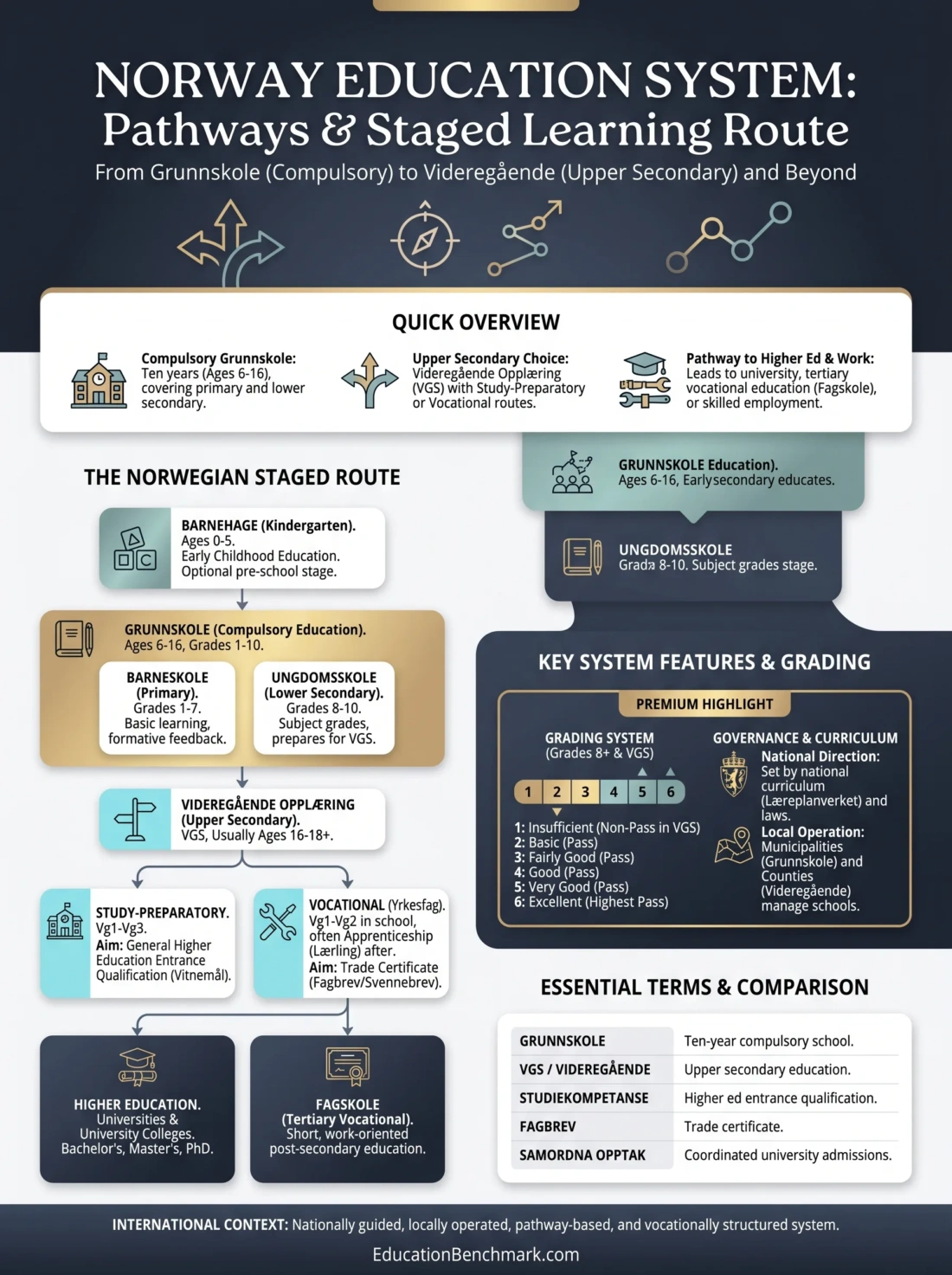
Norway’s education route begins before school with barnehage, a voluntary early-childhood service for children below compulsory school age. Children enter compulsory school in the calendar year they turn six, then continue through a single ten-year grunnskole route before making their first major programme choice.[a]
That ten-year route is both a right and a duty. It joins primary and lower-secondary education under one term, but the everyday labels still matter: barnetrinn covers Years 1–7, while ungdomstrinn covers Years 8–10. Upper secondary, called videregående opplæring, follows after compulsory schooling.[b]
English-language country profiles often flatten these stages into “primary,” “lower secondary,” and “upper secondary.” The Norwegian terms are more useful for understanding where assessment changes and where the route finally divides.[c]
Common school route
Why Grunnskole Stays Together Through Year 10
Norway delays the main academic–vocational branch until pupils have completed the full compulsory route.
Primary-level learning develops subject knowledge, basic skills, social learning, and feedback habits without an early national track decision.
Lower-secondary pupils continue the shared route while grades, final assessment, electives, and education guidance become more visible.
Students apply for an education programme that is study-preparatory, vocational, or designed to connect with a later qualification route.
There is no nationally prescribed separation into different lower-secondary school types comparable to systems that place pupils into academic and vocational schools at an earlier age. Schools can differentiate teaching and support, but pupils remain inside the same broad grunnskole stage.
For the 2026–2027 school year, the subject-and-hour tables for Years 1–10 remain unchanged, but one option at ungdomstrinn has been revised. From 1 August 2026, schools are no longer required to offer depth study in English, Norwegian, Sami, or mathematics to Years 8–10 pupils. Municipalities may still offer those options, and schools may instead offer arbeidslivsfag, a practical working-life subject. From 1 August 2027, schools must offer arbeidslivsfag.[n]
This does not mean every pupil has an identical experience. Municipality size, geography, school organisation, language rights, elective choices, and access to specialist support all shape the route. The common structure is national; delivery is local.
School stages
From Barnetrinn to Ungdomstrinn and Videregående
Ages are typical. A pupil’s exact age depends on birth date, school entry, and any individually approved adjustment.
| Norwegian stage | Years | Typical age | Place in the route |
|---|---|---|---|
| Barnehage | Before Year 1 | Usually 0–5 | Voluntary early-childhood education and care rather than compulsory school. |
| Barnetrinn | 1–7 | About 6–13 | Primary part of grunnskole, with ongoing feedback and no separate national school track. |
| Ungdomstrinn | 8–10 | About 13–16 | Lower-secondary part of grunnskole, ending with final assessment and a vitnemål. |
| Videregående | Vg1–Vg3 or a vocational variant | About 16–19+ | Upper-secondary education leading toward study competence, vocational competence, or another documented outcome. |
| Fagskole or higher education | Programme-dependent | Usually after upper secondary | Tertiary vocational study, university college, university, or another approved postsecondary route. |
The Norwegian use of Vg1, Vg2, and Vg3 is easy to misread as Years 11, 12, and 13. They occupy that place in the overall school sequence, but the labels refer to levels within upper-secondary education, not a continuation of the grunnskole year names.
School calendars are set locally within national rules. Municipalities publish calendars for grunnskole, while counties publish upper-secondary calendars and admission information. Families moving between areas should check the receiving authority rather than assume every holiday date or application detail is identical.
Governance map
Who Sets the Rules: The State, Municipalities, and Counties
National law and curricula create a shared route, while local authorities organise most public provision.
The state sets education law, assessment rules, curriculum requirements, and national duties. Udir supports implementation, curricula, assessment, statistics, and supervision tasks.
Municipalities are mainly responsible for public primary and lower-secondary schools, including local organisation and many pupil services.
Counties are responsible for public upper-secondary education and training, including programme provision and apprenticeship administration.
Most pupils attend public schools. Approved independent schools may operate on stated bases such as a recognised educational direction, life philosophy, international provision, or certain specialised upper-secondary purposes. Approval and public subsidy rules are national.[d]
The national curriculum is called Kunnskapsløftet 2020. It combines a core curriculum with subject curricula and applies across primary, lower-secondary, and upper-secondary education and training. Schools work with subject competence, basic skills, learning strategies, inclusion, and three cross-subject themes: health and life skills, democracy and citizenship, and sustainable development.[e]
Local control therefore concerns organisation more than the creation of an unrelated curriculum. A municipality may arrange schools differently from another municipality, and a county may offer a different mix of upper-secondary programmes, but both operate inside national law and curricular rules.
Assessment record
Grades, Standpunkt, and the Year 10 Vitnemål
Norwegian assessment separates ongoing feedback, teacher-set final grades, and exam grades.
The general school grading scale runs from 1 to 6. Six represents the highest level of demonstrated competence and one the lowest. Trade and journeyman’s tests use a separate result scale: passed with distinction, passed, or failed. Certificates also distinguish standpunkt grades from examination grades and identify the exam form.[f]
By ungdomstrinn, graded assessment becomes part of the formal record. The Year 10 vitnemål is not a single examination score; it gathers final subject assessments and any exam results that apply to the pupil.
Norwegian can generate several certificate entries because oral Norwegian and the written forms Bokmål and Nynorsk can be recorded separately under the applicable curriculum. This is one reason a Norwegian transcript should be read subject by subject rather than reduced immediately to one foreign GPA equivalent.
The first major branch
Choosing Videregående After Year 10
Upper secondary is not compulsory in the same way as grunnskole, but eligible learners have a statutory right to education leading toward a recognised outcome.
Three school-based years normally lead to generell studiekompetanse, the standard general qualification for higher-education admission.
School subjects and occupational training lead toward vocational competence, often through an apprenticeship and a trade or journeyman’s test.
A vocational learner may later add general study competence, enter tertiary vocational study, or use an approved vocational admission path.
Under the current Education Act, the upper-secondary right remains until the learner has obtained university and college admissions certification or vocational qualifications. The route can therefore extend beyond a simple three-year timetable.[g]
Study-preparatory education is broader than studiespesialisering alone. Norway has five study-preparatory programmes: studiespesialisering, sports, music, dance and drama, art, design and architecture, and media and communication. Local availability varies, and studiespesialisering remains the route most readers encounter when looking for a general academic programme.[o]
Admission to a preferred programme or school may depend on the Year 10 record when demand exceeds places. County rules, programme supply, residence, and application procedures should be checked directly. Choosing yrkesfag does not block later study, and choosing a study-preparatory programme does not guarantee admission to every degree.
Work-based learning
The 2+2 Route to Fagbrev or Svennebrev
The best-known Norwegian vocational pattern combines school and paid training in a workplace.
- Vg1: The learner enters a broad vocational education programme and studies common subjects with introductory occupational content.
- Vg2: Training becomes more trade-focused as the learner moves toward a selected occupation or group of occupations.
- Apprenticeship: A training contract connects the apprentice with an approved enterprise or public institution, normally under county oversight.
- Trade or journeyman’s test: The final practical assessment can lead to a fagbrev or svennebrev, depending on the occupation.
The main model uses two school years and two apprenticeship years, but some occupations use a different balance of school and workplace learning. Udir describes ten vocational education programmes leading to more than 180 trade or journeyman’s certificates.[h]
An apprenticeship is not merely work experience added after school. It is part of formal upper-secondary education and training. The training enterprise, county, apprentice, and relevant trade bodies all have roles in the route.
A learner following the main 2+2 route who does not receive an apprenticeship offer has a right to another Vg3-level training offer that builds on the completed Vg2 programme. The exact arrangement depends on the trade and local organisation; special routes and trades with different school-and-work structures can follow other rules.[p]
Higher-education gate
Generell Studiekompetanse and Samordna Opptak
Norway usually admits students through qualifications and ranking rather than one national university entrance examination.
Completing a qualifying study-preparatory programme normally produces generell studiekompetanse (GSK), called Higher Education Entrance Qualification in English.
Medicine, engineering, science, arts, and other programmes may require named upper-secondary subjects, grades, auditions, tests, or other documented abilities.
Samordna opptak, the Norwegian Universities and Colleges Admission Service, manages admission to most first-degree programmes at universities and university colleges. Applicants first meet the general and any special entry requirements; qualified applicants are then ranked under the rules applying to the programme. Some institutions and programmes use local admission procedures.[i]
The national admission rules are scheduled to change in stages. No part of the reform changes admission for the 2026–2027 study year. From admission to 2027–2028, institutions gain wider scope to use ranking admission tests, tied scores are to be resolved by lottery rather than age, and the work-experience condition attached to the six-subject admission route is removed. The larger ranking changes begin with admission to 2028–2029: the first-time certificate quota rises to 65%, its age limit rises to 23, age points and several other supplementary points disappear, and the remaining science and military-service points are reduced.[q]
Vocational graduates have several routes forward. Påbygging til generell studiekompetanse adds the subjects needed for general study competence. Y-veien allows admission to certain adapted higher-education programmes on the basis of a relevant trade certificate or vocational background. Institutions decide whether an approved Y-veien route is offered, so it is not a universal transfer rule.
Applicants educated outside Norway should not assume that a foreign school-leaving certificate automatically equals Norwegian GSK. HK-dir’s GSU list states the education and language requirements used for applicants with foreign qualifications; some countries require completed secondary education, while others require additional higher education before the general education condition is met.[j]
Postsecondary routes
Fagskole, Universities, and Degree Progression
The route after upper secondary can remain occupational, become academic, or combine both over time.
Short tertiary vocational programmes build on upper-secondary education, vocational qualifications, or accepted prior learning and are designed for direct workplace use.
A standard bachelor’s degree is normally three years and 180 ECTS credits, though professional and shorter programmes also exist.
A standard master’s degree is usually two years and 120 ECTS credits after relevant bachelor-level study.
Doctoral study normally follows a relevant master’s degree or equivalent qualification and centres on supervised independent research.
Norwegian higher education uses ECTS credits, with 60 credits representing a standard full-time academic year. The most familiar degree sequence is a three-year bachelor’s degree, a two-year master’s degree, and a three-year PhD, while integrated professional programmes and other exceptions follow different lengths. Fagskole sits outside the university degree ladder and offers a shorter vocational alternative.[k]
Higher-education grades normally use the A–F scale, with E as the lowest passing grade, or a pass/fail result where the course rules specify it. This scale should not be confused with the 1–6 scale used in school education.
Language and access
Language, Sami Education, and School Access
Norway’s national route includes language rights and parallel Sami curriculum provisions that cannot be reduced to one Norwegian-language model.
The national core curriculum applies to the Sami school as well as other primary and secondary education. Udir explains that Sami curricula apply in municipalities within the administrative area for Sami languages and to pupils elsewhere who hold the relevant right to education in a Sami language.[l]
Pupils whose first language is neither Norwegian nor Sami have a right to special language tuition until their Norwegian skills are sufficient for ordinary teaching. Where needed, that right also includes mother-tongue instruction and/or bilingual subject teaching under the applicable rules.[m]
International schools and approved independent schools exist, particularly around larger population centres, but they do not replace the municipal public route as the normal provision. Admissions, fees, curriculum recognition, language of teaching, and transfer arrangements should be checked with the school and the relevant authority.
Verification before decisions
Checking Local Rules Before Moving or Applying
The national structure is stable enough to map, but the decision-level detail often sits with a municipality, county, school, programme, or university.
Check the municipality for catchment, entry, transport, language support, school calendar, and individual adaptation.
Check the county for programme availability, application deadlines, school choices, apprenticeship procedures, and local admission practice.
Check Samordna opptak and the institution for GSK, named subject requirements, ranking rules, language evidence, and local selection.
Check HK-dir, Samordna opptak, and the receiving institution because education and language requirements depend on the country and programme.
Education Benchmark is an independent informational guide and is not affiliated with any ministry of education, school authority, exam board, university, government agency, or official ranking organization. Education law, curricula, admissions rules, programme names, and qualification requirements can change, so high-stakes decisions should be confirmed through the responsible official body.
Sources and Verification
- [a] Early Childhood Education and Care — Used for the usual barnehage age range and the rule that children start compulsory school in the year they turn six. (Reliable because it is an official Norwegian government page.)
- [b] Education Act (Opplæringslova) — Used for the current right and duty to compulsory education from the year a child turns six through completion of Year 10. (Reliable because Lovdata publishes Norway’s current statutory text.)
- [c] Countries Library – Education by Country — Used only for cross-country naming and navigation context, not for Norwegian legal rules. (Reliable as a specialist editorial country index, with official Norwegian sources used for statutory details.)
- [d] Laws and regulations governing schools — Used for municipal and county responsibilities, national school rules, and approved independent-school categories. (Reliable because it is an official Ministry of Education and Research page.)
- [e] Curricula in English — Used for Kunnskapsløftet 2020 and the relationship between the national core and subject curricula. (Reliable because Udir is Norway’s national education directorate.)
- [f] Certificates and grading scales — Used for vitnemål, kompetansebevis, the 1–6 grading scale, exam-form labels, and trade-test results. (Reliable because it is Udir’s official certificate and grading reference.)
- [g] Chapter 5: Right to Upper Secondary Education and Training — Used for the current duration of the right to upper-secondary education until an admissions or vocational qualification is obtained. (Reliable because Lovdata publishes Norway’s official legal text.)
- [h] Norwegian Vocational Education and Training (VET) — Used for the 2+2 apprenticeship model, programme structure, and trade or journeyman’s tests. (Reliable because it is Udir’s official VET overview.)
- [i] Admission to Studies — Used for GSK, programme-specific requirements, Samordna opptak, local admissions, and the vocational Y-route. (Reliable because it is an official Ministry of Education and Research page.)
- [j] Higher Education Entrance Qualification (GSU) — Used for country-specific education and language requirements applied to foreign qualifications. (Reliable because HK-dir is Norway’s official Directorate for Higher Education and Skills.)
- [k] General Information About Education in Norway — Used for fagskole, ECTS, higher-education grading, and the usual bachelor–master–PhD sequence. (Reliable because NOKUT is Norway’s national quality-assurance body for tertiary education.)
- [l] About the Core Curriculum — Used for the scope of the core curriculum and the status of parallel Sami curricula and language rights. (Reliable because it is the official Udir curriculum text.)
- [m] Special Language Tuition for Linguistic Minorities — Used for the current right to special Norwegian tuition and, where needed, mother-tongue instruction and bilingual subject teaching. (Reliable because it is part of Udir’s current 2026 rules for primary and secondary education.)
- [n] Changes for Years 1–10 in 2026–2027 — Used for the August 2026 change to depth-study options in Years 8–10 and the requirement to offer arbeidslivsfag from August 2027. (Reliable because it is Udir’s current 2026–2027 curriculum and subject-allocation circular.)
- [o] Upper Secondary Programme Structure 2026–2027 — Used for the current five study-preparatory and ten vocational education programmes. (Reliable because it is Udir’s active 2026–2027 upper-secondary programme structure.)
- [p] Alternative Training Offer When an Apprenticeship Place Is Not Available — Used for the current right to another Vg3-level training offer for eligible learners in the main 2+2 route who do not receive an apprenticeship place. (Reliable because it is current Udir guidance under the Education Act.)
- [q] New Rules for Admission to Higher Education — Used for the confirmed staged changes beginning with admission to 2027–2028 and the larger ranking changes from 2028–2029. (Reliable because it is an official Ministry of Education and Research announcement of the adopted admission reform.)