South Korea School Route Passport
A route through Korea’s 6–3–3 ladder, high-school branching, school records, Suneung, and the two main university admission rounds.
Chodeung Hakgyo
Selected stamp: Chodeung Hakgyo. Choose another stamp to update the route card.
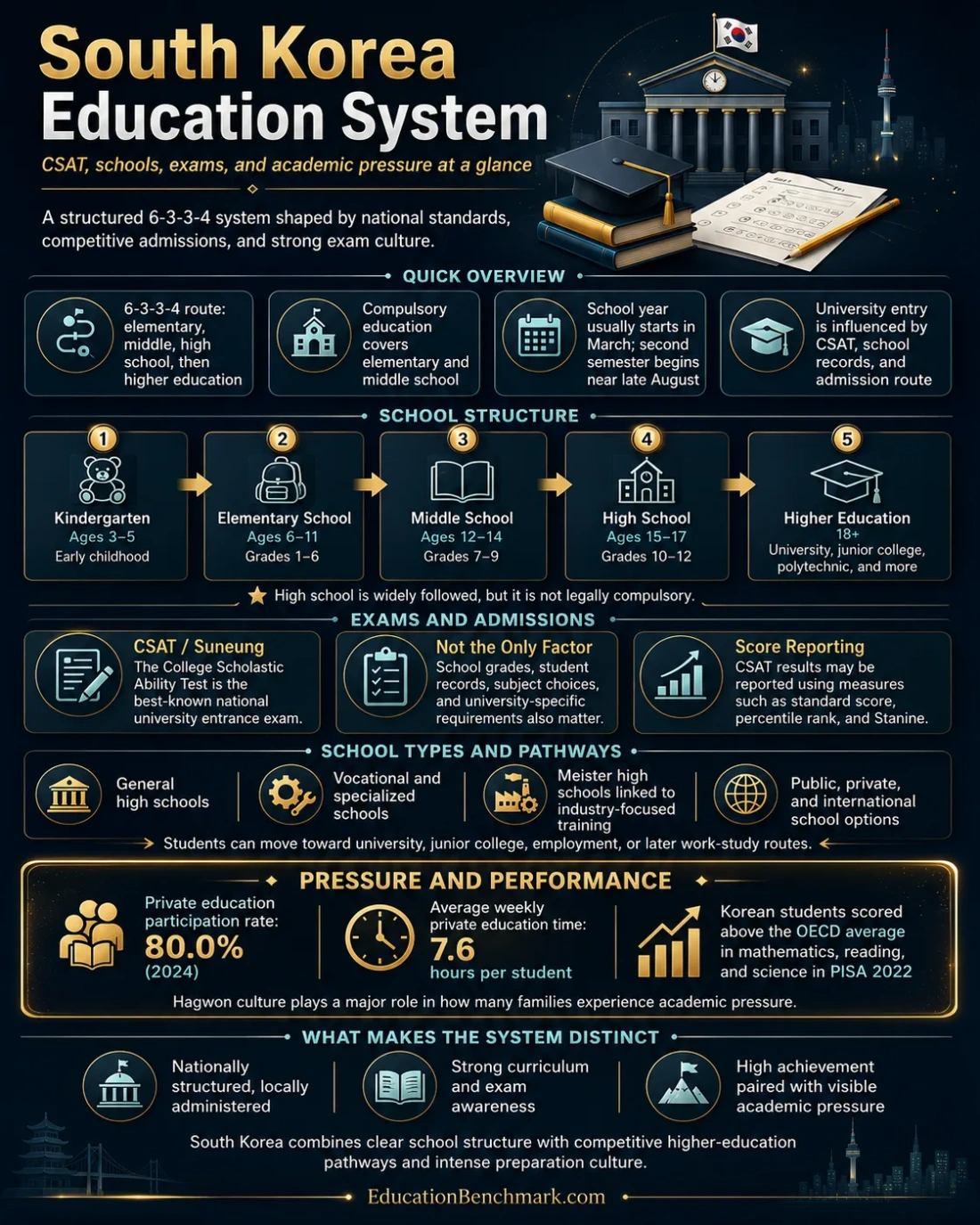
South Korea’s education system is built around a nationally recognizable 6–3–3 ladder: six years of elementary school, three years of middle school, and three years of high school, followed by four-year university study or shorter college routes. Elementary and middle school together form the nine compulsory years, and the academic year begins in March. The structure looks simple on paper. The decisions inside upper secondary school and university admission are much less linear. [a]
School completion, university selection, and private preparation need to be separated. A student can graduate from high school without the CSAT acting as a graduation examination. A university can consider the CSAT, the school life record, interviews, essays, practical assessments, or a combination defined in its annual admission plan. That distinction explains why the words Suneung, Haksaengbu, Susi, and Jeongsi matter as much as the school-level names.
The 6–3–3 School Ladder and the Compulsory Years
Most students move through a single national sequence rather than entering separate academic tracks during the compulsory years. Early childhood education comes before Grade 1, but it is not part of compulsory schooling. High school participation is widespread, although high school itself remains outside the legal compulsory period.
School sequence
Levels, Grades, and Typical Ages
Age bands are typical international-age ranges. Entry timing can differ for individual children, and official rules should be checked for the relevant school year.
| Stage | Grades or duration | Typical age | Compulsory status | Main transition |
|---|---|---|---|---|
| Kindergarten and early childhood provision | Before Grade 1 | Preschool years | Not compulsory | Entry to elementary school |
| Chodeung Hakgyo | Grades 1–6 | About 6–11 or 12 | Compulsory | Progression to middle school |
| Jung Hakgyo | Grades 7–9 | About 12–14 or 15 | Compulsory | Choice or assignment into a high-school route |
| Godeung Hakgyo | Grades 10–12 | About 15–17 or 18 | Not compulsory | Employment, college, polytechnic, or university admission |
| Higher education | Usually 2–6 years, depending on program | Usually 18 or 19+ | Optional | Degree, professional training, transfer, or employment |
The first semester usually runs from March into summer, while the second begins in late August. School calendars still vary in their exact vacation and examination dates, so “March start” is a national orientation point rather than a complete local calendar.
Where Students Branch After Jung Hakgyo
Korea abolished the middle-school entrance examination decades ago, and middle-school assignment generally developed around residence and lottery-based arrangements. The more visible differentiation comes at high-school entry. The Ministry of Education’s overview identifies regular, vocational, autonomous, special-purpose, and gifted-school routes, with course and admission details shaped by the school category and local rules. [b]
Upper-secondary decision
High-School Routes Are Not Interchangeable
The categories describe different emphases, not fixed judgments about quality. Admissions and legal classifications can change.
An Independent System Cross-Check
Education by Country provides a secondary overview of South Korea’s school ladder, centralized curriculum, CSAT, and private tutoring context. It is useful for broad orientation, but official ministry, examination, school, and university material should control any current decision. [c]
From Course Choice to Haksaengbu
South Korea has a national curriculum framework, but a student’s experience is not identical in every classroom. The 2022 Revised National Curriculum emphasizes competencies needed for future society and is being applied in phases across school levels. Within that framework, schools organize subjects, electives, assessment, and student support. [d]
At high-school level, subject selection has a practical admissions consequence. A university may look not only at grades, but also at whether the applicant completed subjects relevant to the intended field. This is one reason the Haksaengbu—usually translated as the school life record—cannot be reduced to a single GPA number.
School record logic
What an Admissions Reader May See
The exact fields available to universities and the way they are evaluated depend on the cohort and published admission rules.
Grades and achievement information provide a multi-semester view rather than one test-day result.
Chosen subjects may help show whether preparation matches the intended university field.
Only fields allowed for the relevant admission cycle should be assumed to influence selection.
For families comparing schools, the useful question is therefore not simply “Which school sends the most students to university?” It is whether the school offers the courses, guidance, support, and learning environment that fit the student’s likely route.
Suneung Is an Admission Gate, Not a Graduation Exam
The College Scholastic Ability Test is widely known by its Korean shorthand, Suneung. It is administered nationally for university admission and can be taken by current high-school seniors as well as graduates. Under the 2027 CSAT format, Korean and mathematics combine common and elective components; English, Korean history, inquiry, and an optional second-foreign-language or Classical Chinese area complete the broader structure. Korean history is compulsory. The Korea Institute for Curriculum and Evaluation also distinguishes standardized-score sections from areas reported through absolute grades. [e]
Pre-2028 test structure
How the Current CSAT Day Is Structured
This describes the format used for the 2027 CSAT. The 2028 reform changes important parts of the subject-choice system.
A common component is combined with one elective under the current format.
A common component is combined with a candidate-selected mathematics elective.
The score report provides a grade rather than a standardized score and percentile.
Every candidate must sit this absolute-grade section for a valid CSAT result.
Eligibility and subject choices depend on the candidate’s route and the current exam plan.
Candidates may select this area when it supports their application strategy.
What the CSAT Does Not Do
The CSAT does not issue a high-school diploma, and it does not create one universal admission cutoff for every university. Institutions convert sections differently, assign different weights by major, and may combine the result with other evidence.
Susi and Jeongsi Split the Admissions Calendar
Korean university admission is often described as “CSAT-based,” but that is incomplete. The two major rounds use different evidence. Susi takes place earlier and generally gives more weight to the school life record and other institution-defined assessments. Jeongsi is the regular round and is more strongly centered on CSAT results. Universities publish their own recruitment plans, so the weighting can differ substantially by institution and major. [f]
Admission contrast
Two Routes, Different Evidence
School records are commonly central. Interviews, essays, practical assessments, document review, and CSAT minimum conditions may also appear.
CSAT results normally carry greater weight, but section conversion, practical tests, and any additional evidence remain university-specific.
How the Difference Changes Student Strategy
A student with consistently strong school performance may build a Susi plan around record-centered routes. Another student whose strongest evidence is a high CSAT profile may depend more heavily on Jeongsi. Neither route is automatically easier. They reward different combinations of preparation, and application restrictions, deadlines, required documents, and score thresholds must be checked for the exact admission year.
Hagwon, Private Education, and Academic Pressure
A hagwon is a private academy, but Korea’s official private-education statistics cover a wider field that can include academies, individual tutoring, group tutoring, online instruction, and other paid learning. In 2025, the government survey reported a 75.7% private-education participation rate among elementary, middle, and high-school students, average weekly participation of 7.1 hours, and total expenditure of 27.5 trillion won. [g]
2025 official survey
The Scale Behind the Hagwon Discussion
The survey covers elementary, middle, and high-school students and measures private education more broadly than hagwon attendance alone.
| Measure | 2025 result | How to read it |
|---|---|---|
| Participation rate | 75.7% | Share of surveyed students participating in private education |
| Weekly participation time | 7.1 hours | Average across the surveyed student population |
| Total expenditure | KRW 27.5 trillion | National household spending measured by the survey |
These figures show why “academic pressure” cannot be measured only by the formal school timetable. For some students, the learning day continues through an academy, tutoring, online courses, supervised self-study, or exam preparation. The intensity is not uniform. It varies by age, household resources, location, school type, intended major, and the selectivity of the universities being considered.
Pressure also comes from more than one test. School grades matter for many Susi routes, subject choices can affect academic fit, and Suneung remains decisive for Jeongsi and some minimum conditions. A student may therefore feel evaluated across several years while still facing a single nationally visible exam day.
Meister High Schools and the Work-First Route
Vocational education begins mainly at high-school level. Specialized vocational schools provide occupational and practical preparation, while Meister high schools are designed around selected industry needs. The official model also includes a “Job First, University Later” principle, allowing employed graduates to return to higher education through designated routes rather than treating employment after high school as a permanent academic endpoint. [h]
- Entry after middle school: students apply to a specialized vocational or Meister program aligned with an occupational field.
- Upper-secondary training: general subjects are combined with technical, practical, and program-specific learning.
- First destination: graduates may enter employment, junior college, a polytechnic route, or another form of postsecondary study.
- Later progression: work experience does not remove the possibility of returning to a degree or applied higher-education program.
This pathway should not be described as a Korean version of every European apprenticeship system. The school-based structure, industry partnerships, workplace exposure, qualifications, and progression arrangements need to be checked program by program.
Beyond the Four-Year University Route
Four-year universities receive much of the public attention, but they are only one part of Korean higher education. The Ministry of Education also identifies junior colleges, universities of education, open and cyber institutions, industrial colleges, intra-company universities, and polytechnic colleges. Admission can use CSAT scores, school records, and other factors, while junior-college graduates may enter employment or transfer to a four-year institution. [i]
Tertiary options
Institution Types in Practical Terms
Program length is not a reliable measure of status or suitability on its own. Professional licensing, transfer rules, employer recognition, curriculum depth, tuition, location, and the student’s intended occupation can matter more than the institution label.
Who Sets the Rules: MOE, Education Offices, and Schools
South Korea combines national direction with local administration. The Ministry of Education handles national policy and school-system responsibilities, while 17 metropolitan and provincial Offices of Education and 176 local Offices of Education form the local administrative structure described in the ministry’s 2023 overview. Education governors are locally elected, and schools operate within this national–local framework. [j]
- National level: the Ministry of Education and related national bodies establish major policy, curriculum, and system frameworks.
- Metropolitan and provincial level: education offices manage local administration, budgets, staffing, and implementation within their authority.
- Local-office level: local education offices support schools, students, and families on operational matters.
- School level: institutions deliver the curriculum, organize courses and assessment, and apply rules within their legal category.
Public and private schools therefore share important national expectations while differing in governance, fees, admissions, and program design. Families comparing institutions should verify the school’s current legal category, curriculum, tuition, admission method, and recognition arrangements rather than relying on the word “private” alone.
The 2028 Reform Changes the Reference Point
The CSAT structure described earlier is the format relevant to the 2027 examination cycle, not a permanent template. For 2028 admissions, the finalized reform moves Korean, mathematics, social studies, and science toward an integrated test structure without the current elective divisions. The affected high-school cohorts also move into a five-level school-record grade framework. Official guidance issued in 2025 links the changes to the revised curriculum and the full introduction of the high-school credit system. [k]
Verify the Cohort, Not Just the Country
A rule that is accurate for a 2027 applicant may be wrong for a 2028 applicant. Check the admission year, high-school entry cohort, university, major, and current examination notice before making decisions.
Education Benchmark is an independent informational guide and is not affiliated with any ministry of education, school authority, exam board, university, government agency, or official ranking organization. It does not provide admission, placement, legal, or visa advice.
School categories, curriculum implementation, grading, CSAT sections, Susi and Jeongsi requirements, foreign-school recognition, and university formulas can all change. Important choices should be confirmed through the relevant Ministry of Education notice, KICE examination material, education office, school, or university admission guide.
Sources and Verification
- [a] Ministry of Education: Education System Overview — Used for the 6–3–3–4 structure, compulsory elementary and middle schooling, and the March-start academic year. (Reliable because it is an official Republic of Korea Ministry of Education source.)
- [b] Ministry of Education: Secondary Education — Used for middle-school assignment context, high-school status, and the main upper-secondary school categories. (Reliable because it is an official ministry description of secondary education.)
- [c] South Korea Education System (2026): Structure, Quality, and Performance — Used as an independent secondary cross-check for the school ladder, admission pressure, and private-education context. (Useful as a country education guide, but not an official authority.)
- [d] 2022 Revised National Curriculum Announced — Used for the national curriculum reform framework and its future-competency orientation. (Reliable because it is an official Ministry of Education curriculum announcement.)
- [e] KICE CSAT Study Materials — Used for the 2027 CSAT subject areas, compulsory Korean history, elective structure, and score-reporting distinctions. (Reliable because KICE is the official curriculum and national assessment institute administering CSAT materials.)
- [f] Education | InvestKOREA — Used for the distinction between Susi and Jeongsi and for institution-specific admission variation. (Reliable because InvestKOREA is a public information service operated through KOTRA.)
- [g] Private Education Expenditures Survey of Students in 2025 — Used for 2025 private-education spending, participation, and weekly-hours figures. (Reliable because it is an official national statistical release.)
- [h] Ministry of Education: Vocational Education — Used for specialized vocational schools, Meister high schools, employment support, and the Job First, University Later route. (Reliable because it is an official Ministry of Education system page.)
- [i] Ministry of Education: Higher Education — Used for institution types, multiple admission factors, junior-college functions, and transfer possibilities. (Reliable because it is an official ministry overview of higher education.)
- [j] Ministry of Education: Education Administration System — Used for the national and local governance structure, including metropolitan, provincial, and local education offices. (Reliable because it is the official ministry description of education administration.)
- [k] How to Prepare for 2028 College Admissions — Used for the integrated 2028 CSAT structure, five-level high-school grading framework, and cohort timing. (Reliable because it is an official Korean Ministry of Education update on the finalized reform.)