
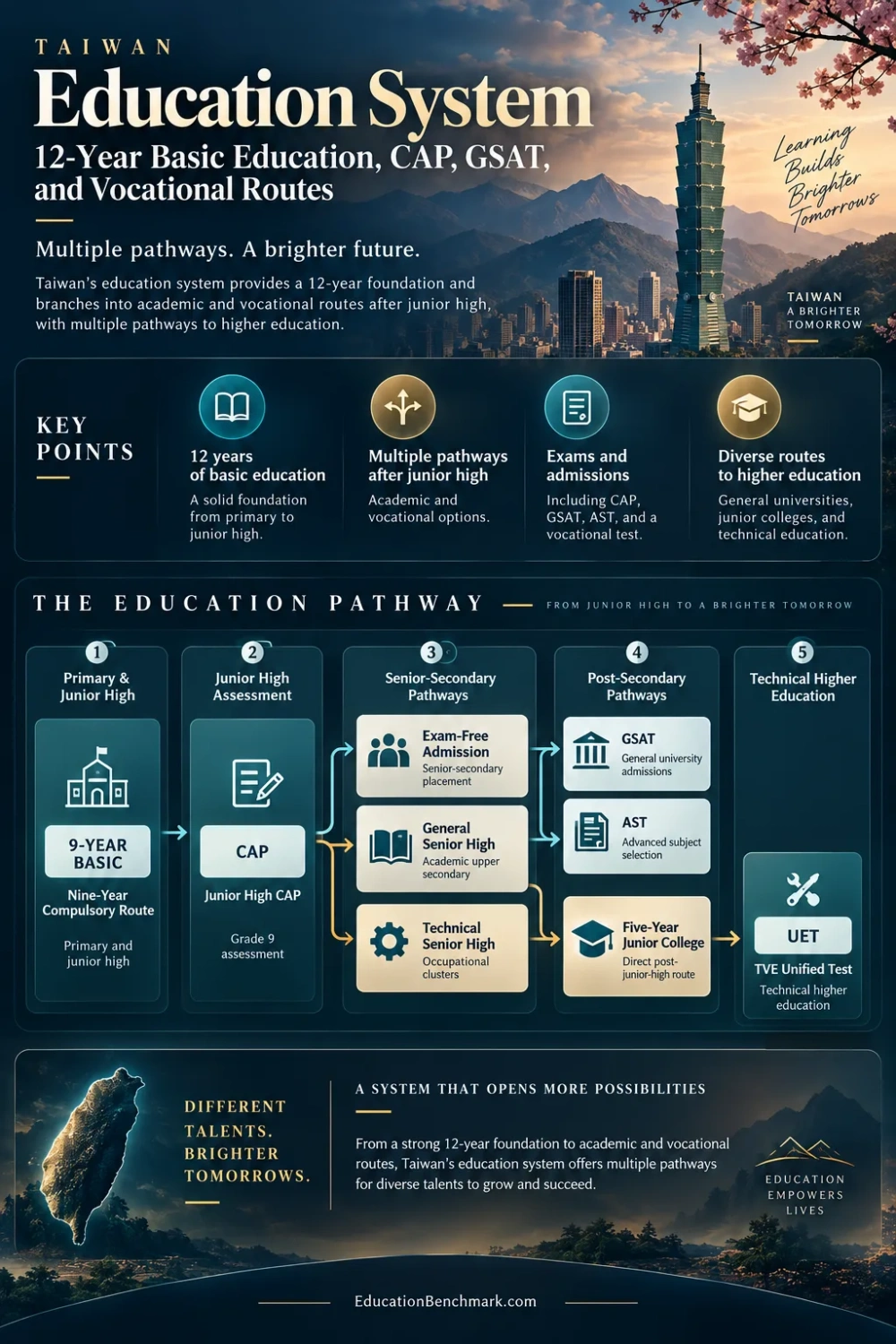
Taiwan’s Route From CAP to GSAT, AST, and Technical Higher Education
The route branches after junior high through exam-free senior-secondary admission, five-year junior colleges, general university admissions, and a separate technical and vocational testing path.
Nine-Year Compulsory Route
Selected stamp: Nine-Year Compulsory Route. Choose another stamp to update the route card.
Taiwan’s education system is easiest to read as two connected branching points. The first comes at the end of junior high, when students move toward general senior high, technical senior high, other senior-secondary programmes, or a five-year junior college. The second comes near the end of upper-secondary study, when general-university admission and technological-vocational admission use different tests and selection routes. CAP, GSAT, AST, and the Unified Entrance Test do not serve the same purpose.
The distinction matters because a simple “one national exam leads to the next school” diagram gives the wrong impression. Taiwan combines national assessment with exam-free admission, area-based senior-secondary placement, institution-specific university requirements, and a well-developed technical education route.
Twelve-Year Basic Education Is Not Twelve Years of Compulsory Schooling
Taiwan’s normal school ladder includes six years of primary school, three years of junior high, and three years of senior secondary education. Preschool is available before primary school, while five-year junior colleges create an alternative route directly after junior high. A bachelor’s programme normally follows secondary education and typically lasts four years. [a]
School route
Stages, Typical Ages, and Main Transition Points
| Stage | Typical age or entry point | Usual length | What follows |
|---|---|---|---|
| Preschool | From age 2 to primary-school entry | Varies | Primary school |
| Primary school | About ages 6–12 | 6 years | Junior high school |
| Junior high school | About ages 12–15 | 3 years | CAP and post-junior-high admission |
| Senior secondary education | Usually from about age 15 | 3 years | Higher education, technical education, or work |
| Five-year junior college | Directly after junior high | 5 years | Employment or further technological study |
| Bachelor’s degree | After secondary-level qualification or eligible equivalent | Usually 4 years | Employment or graduate study |
The phrase 12-Year Basic Education needs a narrower reading than “12 years of compulsory school.” The legally compulsory part remains the first nine years, covering children aged 6–15 through primary and junior high school. The following three-year senior-secondary stage is part of 12-Year Basic Education but is described by the Ministry of Education as universal education with voluntary enrollment. The system also uses tuition waivers, multiple school types, and exam-free admission as major operating principles. National, municipal, county, city, and private providers all participate in the wider senior-secondary structure. [b]
“12-Year Basic Education” describes Taiwan’s wider school route. It does not turn the entire 12-year sequence into legally compulsory attendance. The compulsory portion is the first nine years.
The Grade 9 Gate: CAP, Exam-Free Admission, and 15 Admission Areas
The transition after junior high does not work like a single nationwide high-school entrance cutoff. Taiwan’s mainstream senior-secondary process is built around exam-free admission, with students applying through several admission channels. For the 2026 school-entry cycle, senior high exam-free admission operated across 15 admission areas. Each area’s admission booklet sets out its schools, available places, application procedures, ranking items, point calculations, and schedule. That local ranking layer is why a CAP result cannot be translated into one universal “this score enters this school” table. [c]
Grade 9 decision point
How Junior High Leads Into Different Senior Routes
Exam-free admission removes the need for a separate standard entrance examination at every school, but ranking rules can still use CAP-related information when demand exceeds places.
Measures junior-high learning across the main curriculum areas and provides proficiency results.
Students apply through admission-area or other approved channels rather than one separate school entrance test.
General, technical, integrated, and specialized programmes provide different subject and career emphases.
Students can move directly from junior high into a longer specialist college programme.
CAP (國中教育會考) is taken near the end of junior high. In 2026, the tested areas were Chinese, English, Mathematics, Social Studies, Science, and a Writing Test. English included separate reading and listening components. The assessment was based on the fourth learning stage of the 12-Year Basic Education Curriculum Guidelines. [d]
CAP Results: A, B, C, Plus Marks, and Writing Levels
CAP is not reported as a simple national 0–100 school-entry score. The five main subject areas use three proficiency bands: A for proficient, B for basic, and C for needs improvement. Within the A and B bands, finer marks help distinguish students when admission competition requires more separation. The top quarter of the A group receives A++, the next quarter receives A+; the same pattern produces B++ and B+ within the B group. The Writing Test is reported separately on a one-to-six level scale. [e]
CAP result logic
How the CAP Proficiency Bands Fit Together
The plus marks are therefore positions inside a proficiency band, not extra subjects and not a direct national conversion to a conventional percentage grade. CAP also does not determine university entry. Its role belongs to the transition out of junior high, while GSAT and AST operate much later.
Four Senior Secondary Routes and the 108 Curriculum
Taiwan’s upper-secondary curriculum distinguishes four broad school types: general senior high, vocational senior high, the integrated route known locally as 綜合型高中, and specialized senior high. The 12-Year Basic Education Curriculum Guidelines connect these school types through shared learning principles while allowing technical, specialist, elective, and school-specific elements to differ. The guidelines place core competencies, continuity between learning stages, subject integration, and the application of learning beyond memorized knowledge at the centre of curriculum design. [f]
General Senior High
General senior high provides the clearest route toward Taiwan’s general-university admission system. Students still make subject choices, and university departments do not all require the same GSAT or AST combination. General senior high should therefore be understood as an academic route with later specialization rather than a single fixed exam package.
Technical Senior High
Technical senior high combines general education with occupationally focused study. Fields can include engineering-related groups, business and management, design, agriculture, food, hospitality, foreign languages, maritime subjects, fisheries, arts, and other professional clusters. Students can move into employment, further technical study, or higher education.
Integrated and Specialized Routes
The integrated senior-high route can mix academic and occupational course choices, while specialized schools concentrate on particular talents or fields. These routes matter because Taiwan’s senior-secondary system is not a simple academic-versus-vocational binary.
The Five-Year Junior College Route Starts After Junior High
Five-year junior college is one of Taiwan’s most distinctive post-junior-high options. Instead of entering a three-year senior high school and then applying to tertiary education, an eligible student can enter a five-year specialist programme directly after junior high. The route combines later secondary-level learning with junior-college study and is commonly associated with technical and professional preparation.
The 2026 admissions system included Complete Exam-Free Admission, Priority Exam-Free Admission, and regional Joint Exam-Free Admission routes for five-year colleges. These channels do not treat CAP in exactly the same way: some programmes or routes can include CAP within their ranking logic, while complete exam-free admission is designed around admission without using CAP results. Applicants therefore need the rules of the particular admission channel rather than a single nationwide five-year-college formula. [g]
A five-year junior college is not simply a university entered five years early. It is a separate post-junior-high progression route with its own programme structure and admission channels.
GSAT, AST, and Taiwan’s General-University Admission Routes
Near the end of senior high, the exam sequence changes. For the 2026 admission cycle, the General Scholastic Ability Test (GSAT) covered Chinese, English, Mathematics A, Mathematics B, Social Studies, and Science. The Advanced Subjects Test (AST) offered Mathematics A-style advanced mathematics as Mathematics 甲, Mathematics 乙, History, Geography, Civics and Society, Physics, Chemistry, and Biology. GSAT is aimed at core academic abilities, while AST is used for more advanced subject assessment in Examination and Placement. [h]
How GSAT Scores Work
GSAT subjects use a 0–15 scaled score. Mathematics A and Mathematics B are separate examinations rather than two labels for the same paper; the official score-report specification describes Mathematics A as having a broader testing scope than Mathematics B. A student’s score cannot by itself be read as a guaranteed university placement because departments choose which subjects and admission conditions they use. [i]
Assessment sequence
CAP, GSAT, AST, and the TVE Unified Test Serve Different Gates
| Assessment | Stage | Main role | Typical next route |
|---|---|---|---|
| CAP | End of junior high | Junior-high learning assessment; may enter senior-secondary ranking rules | Senior high or five-year junior college admission |
| GSAT | Late senior high | Core academic assessment used across several general-university admission routes | Stars, Personal Application, or specified placement requirements |
| AST | After or near completion of senior high | Advanced subject assessment | Examination and Placement |
| TVE Unified Entrance Test | Technical and vocational upper-secondary route | Common and professional subject testing linked to TVE admissions | Universities of science and technology and related technical institutions |
Stars, Personal Application, and Examination and Placement
The College Entrance Examination Center describes three major routes for students seeking admission to general universities: Stars Program, Personal Application, and Examination and Placement. Stars combines school-based academic performance with department-specified GSAT requirements and school recommendation. Personal Application uses GSAT for the first part of selection and may then involve department review, submitted materials, further tests, or interviews. Examination and Placement relies on AST results and a ranked preference process, while departments can also set relevant GSAT conditions. [j]
General university admission
The Three Routes Do Not Use One Identical Selection Formula
This is why describing GSAT as “Taiwan’s university entrance exam” is only partly accurate. It is an important admission assessment, but Taiwan’s general-university system uses several routes, and AST has a separate role in Examination and Placement.
From Technical Senior High to Tech University: The Unified Entrance Test
The technical and vocational education route has its own admission system. The Unified Entrance Test used for four-year technological universities and two-year junior-college admissions is organized around vocational groups. In the 2026 test, common subjects included Chinese, English, and Mathematics A, B, or C depending on the occupational group, alongside group-specific professional subjects. The result can feed into more than one TVE admission route rather than producing one automatic institution assignment. [k]
A Confirmed Change From the 2027 Admission Cycle
From Taiwan’s Academic Year 116 admission cycle, beginning in 2027, candidates receive more control over which Unified Entrance Test subjects they sit. Students applying within one vocational group must select at least two subjects, including at least one professional subject. Cross-group candidates must select at least three subjects, with Professional Subject II required for the relevant cross-group route. Universities and departments will correspondingly specify which test subjects they use in selection. [l]
This change makes the technical route less suitable for a fixed five-subject diagram that never changes. A student planning for a technological university needs to match the occupational group, selected test subjects, and the receiving department’s admission requirements for that year.
Three Student Routes Through Taiwan’s Education System
The route becomes clearer when the exams are placed around actual student progression rather than treated as a list of test names.
Student progression
Academic, Technical, and Five-Year College Paths
A student may continue through Stars or Personal Application, or later use AST for Examination and Placement.
A student builds occupational knowledge and can apply through technical and vocational higher-education admission channels.
A student enters specialist college education directly after junior high and may later work or continue technological study.
Transfers and cross-route progression mean these examples are not rigid tracks for life. A technical senior-high graduate can continue into higher education, and admissions are not limited to one test for every student. The route chosen after junior high shapes the most common later examinations, but it does not eliminate every alternative.
Where Taiwan’s Education Rules Need Year-Specific Verification
Several parts of the system remain stable enough to describe as a national structure: the six-year primary stage, three-year junior-high stage, the distinction between nine compulsory years and the wider 12-Year Basic Education system, and the existence of general and technical routes. Admission details are more changeable. CAP ranking rules can depend on the admission area; five-year college rules differ by route; universities set department-level GSAT and AST requirements; and technical higher-education subject rules can change by admission year.
For an application or placement decision, the current admission booklet from the relevant school, admission committee, university department, examination body, or education authority should take precedence over a general explanatory article.
Education Benchmark is an independent informational resource and is not affiliated with any ministry of education, school authority, exam board, university, government agency, or official ranking organization.
Sources and Verification
- [a] Educational System — Used for Taiwan’s school stages, preschool entry range, junior-college structure, and typical degree lengths. (Reliable because it is an official Ministry of Education system page.)
- [b] Implementation Scheme for 12-Year Basic Education — Used for the nine-year compulsory stage, voluntary senior-secondary enrollment, tuition policy, school providers, and exam-free admission principles. (Reliable because it is an official Ministry of Education policy page.)
- [c] 2026 Senior High Exam-Free Admission Places and Admission Areas — Used for the 15 admission areas and the role of area-specific admission booklets and ranking rules. (Reliable because it is published by Taiwan’s National K-12 Education Administration.)
- [d] 2026 CAP Schedule and Test Subjects — Used for current CAP subjects and the curriculum basis of the 2026 examination. (Reliable because it is an official National K-12 Education Administration notice.)
- [e] Junior High School CAP — Used for the 2026 A/B/C proficiency bands, A++/A+ and B++/B+ subdivisions, English components, and writing levels. (Reliable because it is Taipei City’s official 12-Year Basic Education information site applying the national CAP rules.)
- [f] Curriculum Guidelines of 12-Year Basic Education — Used for learning stages, senior-secondary school categories, core competencies, and curriculum organization. (Reliable because it is an official Ministry of Education curriculum document published through the National Academy for Educational Research.)
- [g] 2026 Five-Year Junior College Admission Guides — Used for the current five-year junior-college admission channels and their differing admission arrangements. (Reliable because it is published by Taiwan’s technical and vocational college admissions authority.)
- [h] CEEC 2026 Examination Guide: GSAT and AST — Used for the 2026 GSAT and AST purposes, subject sets, and their roles in university admissions. (Reliable because it is published by Taiwan’s College Entrance Examination Center.)
- [i] GSAT Student Score Report — Used for the 0–15 subject scale and the distinction between Mathematics A and Mathematics B. (Reliable because it is an official College Entrance Examination Center score-report specification.)
- [j] The College Admission Process in Taiwan — Used for the Stars Program, Personal Application, and Examination and Placement routes and their selection stages. (Reliable because it is the official English explanation from the College Entrance Examination Center.)
- [k] 2026 Four-Year and Two-Year Technical College Unified Entrance Test — Used for the current Unified Entrance Test subject structure, including common mathematics versions and vocational-group testing. (Reliable because it is published by Taiwan’s Testing Center for Technological and Vocational Education.)
- [l] 2027 UET Subject-Selection Reform — Used for the Academic Year 116 self-selected Unified Entrance Test subject rules beginning with the 2027 admission cycle. (Reliable because it is an official technical and vocational admissions policy announcement.)